Categories
ideological culture individual achievement nannyism responsibility too much government

Don’t Dress for Excess

Undoubtedly, men have it easy in several ways that women do not. Take something only seemingly trivial: clothing.

When men need to dress to impress, the answer is simple: a suit. There is not really a lot of variety here, and little is required of a man in his choice of suit.

Women, on the other hand, do not have a business and formal occasion uniform to rely upon.

Instead, they have fashion.

Which is a whirl of constant change and a world of enervating expense.

I wouldn’t put up with it. But then, I’m a man. The modern dress suit was developed to meet men’s needs for functionality as well as excellence. And our need to not think hard on a matter of mere garment.

So it is with no small pleasure to read, in the Telegraph, of a professional woman who forswears fashion to wear just one design of clothing. “‘I can tell you the cashier in the store look[ed] pretty confused when I asked if she had 15 extra sets of the whole outfit,’ she jokes, ‘but all in all, choosing the uniform was a pretty pain-free process.’”

And the style choice seemed obvious: “I’ve always felt that black and white is a cool and classy look,” so that’s what she went with.

She made herself culturally equal with men. Took for herself a formerly all-male advantage. And she did not depend upon a man for that advance, he-for-she style.

And did not look to government.

This is the way forward.

This is Common Sense. I’m Paul Jacob.


Printable PDF

fashion, government, suits, illustration


Categories
general freedom nannyism national politics & policies Popular privacy too much government

Inconvenient Cash?

Everywhere I turn these days, I am hearing something about the push to get rid of cash.

Yes, cash. Greenbacks. Federal Reserve Notes.

You might think that getting rid of cash is a no-brainer. Cash makes up only 11 percent of the money supply. Most of the money stock is already those 1s and 0s in bank computers, on debit cards, and the like. So why not go all the way?

It is the “logical next step,” after all!

But not every “next step” is advisable. When walking towards a cliff, that next step might be a doozy. And when you are dealing with government and the banks, jumping off a cliff proves an apt metaphor.

Don’t go lemming on me, man.

You can probably guess the usual arguments for getting rid of cash. Convenience, for one. It sure would be convenient for government and central bankers if they could just seize control of money “magically” in the banks’ computers.

Somehow, I am not persuaded. Neither is economist Pierre Lemieux, who provides us with a helpful survey of anti-cash arguments. And when the experts argue that it would be more convenient for consumers, incredulity is the best response. “To argue against the usefulness of cash is to deny the revealed preferences of many individuals,” Lemieux insists. “The fact that cash has not disappeared even in non-criminal hands means that it is convenient for many individuals.”

He expands the thought with an important truth: “Economic efficiency is defined in terms of what individuals want.”

And the purpose of governments is to follow individuals, not corral them, manipulate them . . . for bureaucratic convenience.

Let’s keep cash.

This is Common Sense. I’m Paul Jacob.


Printable PDF

currency, money, binary, electronic, cash, illustrattion


Originally (cc) photo by FamZoo Staff on Flickr

Categories
initiative, referendum, and recall nannyism political challengers Regulating Protest

Irony in Spain

When I arrived at the Donostia-San Sebastián City Hall, in the beautiful Basque Country of Spain, I wondered what all the ruckus was about. There were hundreds of noisy protesters waving long, colorful banners.

My goodness, how interesting to witness acts of political agitation on the public square in another country, I thought. Then, atop the crowd some 20 feet opposite the protest, I spied Daniel Schily, a key activist, funder and cheerleading motivator of the direct democracy movement in Germany.

After greeting, he drily brought me up to date: “They’re protesting us.”

“No, really,” I asked, “what are they protesting?”

“Really,” he said, seemingly sincere. “They’re protesting the Global Forum.”

I stood there dumbstruck, for a moment, before I noticed one sign written in English: “Global Forum on Modern Direct Democracy,” with a very large, black, bold question mark beside it.

Schily wasn’t kidding.

In almost no time, I met up with friends from Bulgaria, South Korea, Uruguay, Chile — fellow activists, all. We had gathered in this “cultural capital of Europe” precisely because of our belief that all people have a right to not only speak out, but effect change, through ballot initiatives and referendums.

It turned out that the protestors hailed from the Satorralaia neighborhood movement. Their beef? Even after gathering nearly 9,000 signatures on petitions requesting a public referendum on a proposed through-station for the mass-transit metro system project, the city government shrugs.

The same city council that helped organize our forum, ignoring citizens while claiming the city is “The World Capital of Democracy.”

Government. What more proof do we need that it could use more checks and balances from the people themselves?

This is Common Sense. I’m Paul Jacob.


N.B. This is a Common Sense digest version of Paul’s weekend column. For more information, see Saturday’s and Sunday’s posts. Paul was in transit home when this entry was being prepared for the Web; he may offer further reports from his trip in the near future.


Printable PDF

Spain, Paul Jacob, Common Sense, initiative, democracy


Categories
general freedom ideological culture nannyism national politics & policies Popular too much government U.S. Constitution

The Venezuela Chaos

I have friends who call themselves anarchists. Their theory? Government is always merely an open conspiracy of some to live at the expense of others.

Republicanism, on the other hand, proposes that if we limit government, we can hone it down to the level where there is no conspiracy, and everything the government does can plausibly help everybody.

Not just a few insiders.

Socialism is the opposite notion. Socialists seek to grow government so far that it “naturally” serves everybody, not only the few. It’s all about “equality,” you see.

Here’s what we know for sure: socialism, when really tried, is so awful that it makes anarchy-as-chaos sound good.

The latest socialist horror is Venezuela, which is getting worse every day. Now hospitals place newborns in cardboard boxes. There are no other supplies.

But that’s not all. The special program for feeding everybody? It’s now mainly for feeding just those close to the government — precisely as my anarchist friends say all government is:

Six months after the creation of the Local Committees of Supply and Production (Clap) that is designed to “distribute food directly to the people,” the government has decided to change its approach by threatening those using the program.

The Venezuelan government announced that it will suspend delivery of food packages to those who criticize its policies.

Are socialist out to prove anarchists right?

I bet most of my readers still put some hope in limiting government to serve all. Venezuelan socialism demonstrates how badly the opposite idea is, showing us that serving everybody by total government just decays into the folks allied closely with government warring against everybody else . . . who starve in plain sight.

This is Common Sense. I’m Paul Jacob.


Ask the next question.

Questions Answered:

What is the difference between a republic and a socialist state?

What do anarchists think of government?

What happens when government tries to do everything for everybody?

The Next Question:

How do we convince well-meaning socialists that total government cannot work for the benefit of everybody? (Since the examples of the USSR, Communist China, and Venezuela haven’t worked so far.)


Printable PDF

government, bathtub, Venezuela, illustration


Categories
Accountability crime and punishment folly nannyism national politics & policies responsibility too much government

Virtually Useless

Here is something I don’t quite understand about us moderns — we, oh-so-sophisticated citizens of the world; we who say that government is instituted to help us . . . but often we expect almost no real help when it comes to even the basics.

Take this very “virtual” venue: the Internet; “the Web.”

This wasn’t a thing in the first decade of my adult life. I never expected to spend so much time “on” something that did not, then, exist in any meaningful way.

Well, computers opened up brave new worlds for us, but, did you notice? Bad guys were right there from the beginning, making “viruses” and “spyware” and “malware” of all kinds. Destroying billions of dollars of data and equipment, robbing us of the most important thing of all: time.

And what did the United States government do?

Nothing, or next to it.

Belatedly, and haphazardly, it scraped together a digital defense for its own infrastructure, and began to cook up ways to surveil us all.

But did it offer to help? What programs did it provide the public, or the states, to assist us with bad guys trying to steal our savings, credit, and virtual identities?

I haven’t seen anything. And our local governments have stood around useless, too.

Yet I haven’t heard anyone complain.

Our security has been up to us. Long ago, John McAfee invented the first anti-virus software, and an industry grew up from his kernel — and that industry is where we turn to for help.

Government has mostly just stood by — in the sole area of the computer industry that it could plausibly have warrant to “interfere.”

This is Common Sense. I’m Paul Jacob.


Ask the next question.

Questions Answered:

Does government fulfill its main function consistently?

Who do Americans turn to for effective security?

The Next Question:

If government doesn’t even bother doing its main job, why give it more jobs?


Printable PDF

web, crime, virus, government, illustration


Categories
Accountability moral hazard nannyism national politics & policies political challengers too much government U.S. Constitution

Term Limits Trump

Entering his campaign’s homestretch, underdog Donald J. Trump gave an important speech at Gettysburg, Pennsylvania. He emphasized his support for term limits in what he called his “100-day action plan to Make America Great Again.”

“[R]estoring honesty, accountability and change to Washington” is the top item on Trump’s agenda, along with a pledge to begin the drive for “a Constitutional Amendment to impose term limits on all members of Congress” on his very first day in the Oval Office.

Public disgust with the corrupt status quo in Washington — and the hope that he will shake things up — drove Trump’s victory.

Yet, today, the Elections Committee of Michigan’s House of Representatives hears testimony on several bills to weaken or repeal term limits. Have the limits lost public support? Not on your life.

Politicians simply want to stay ensconced in power, reaping the many benefits they’ve bestowed upon themselves. They want to stay in power longer.

Just look to California. Back in 2012, a dishonest ballot explanation tricked voters into thinking they were tightening their term limits law. But what they were actually doing was voting to weaken it.

Now, Golden State legislators can stay in the same seat for a dozen years. And special interests have noticed. They’re “investing” more heavily than ever before.

The Los Angeles Times summarized the result in its headline: “Longer terms for California’s Legislature mean a flood of cash from interest groups . . .”

Here’s for enacting real term limits at every level of government. And if the politicians and special interests don’t like it — good!

This is Common Sense. I’m Paul Jacob.


Printable PDF

Donald Trump, term limits, president, first, illustration


Categories
Accountability general freedom initiative, referendum, and recall local leaders media and media people nannyism national politics & policies

Are We Special?

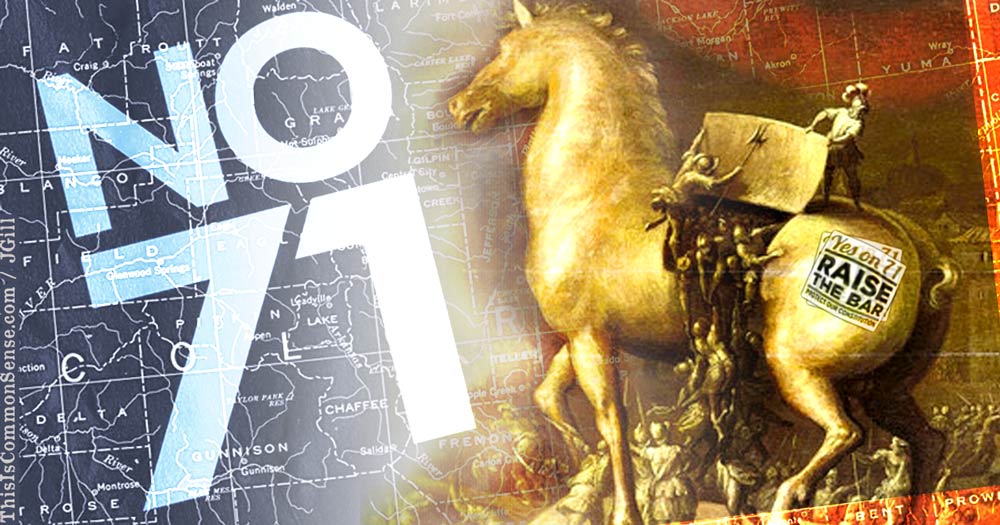
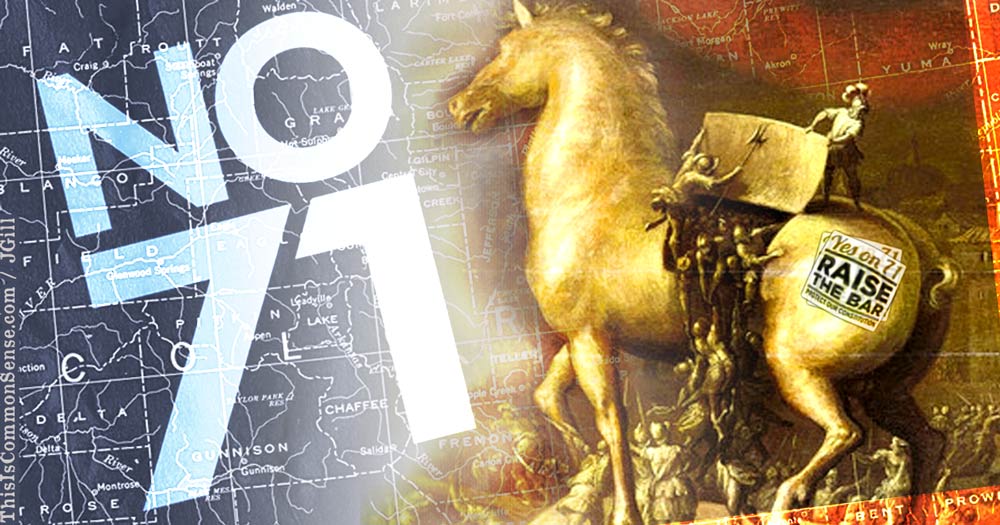
“Cringe-worthy,” said Kyle Clark, co-anchor of 9NEWS in Denver. He was mocking the 10-foot tall, carved, wooden Trojan Horse replica that Amendment 71 opponents are wheeling around the Rocky Mountain State.

Clark admits that Amendment 71 “would make it harder to change Colorado’s constitution,” but doesn’t seem to have any clue just how much harder.*

“Those opponents with their Trojan Horse want to paint 71 as a sneaky power grab by big money interests from out of state,” Clark continued. “Funny, though, when you find out who paid for their horse.”

Wait . . . this is BIG: Who paid for the horse?

“It’s an in-kind contribution from Citizens in Charge Foundation. They’re a group that protects the initiative process around the country. . . . based out of Woodbridge, Virginia,” replied an Amendment 71 opponent.

Hey, that’s my group!

“Amendment 71 might be a Trojan Horse funded by outside interests,” Clark concluded, but it’s “illustrated by the Trojan Horse funded by outside interests.”

Cute . . . but . . . ?

Does Mr. Clark seriously think that (a) an organization dedicated to making the ballot initiative process accessible to all, with no other interest or business before state government, providing a vehicle and a trailer to carry a wooden horse across the state is equivalent to (b) a multi-million-dollar paid media barrage funded largely by oil and gas interests with lucrative interests before state government?

Citizens in Charge Foundation is honored to work with Coloradans to save their initiative rights by defeating 71.

Speaking of interests and who’s paying . . . 9NEWS has received the better part of a million dollars in ad revenue from the interests supporting Amendment 71.

Compared to a peek at a wooden horse from opponents.

Kyle Clark didn’t mention that.

This is Common Sense. I’m Paul Jacob.


P.S. Please help save Colorado by making a contribution right now.


*Coloradans who have actually qualified ballot initiatives say Amendment 71 would kill the process for all but the wealthiest special interests.


Trojan Horse Trails in Colorado


Printable PDF

Trojan Horse, Colorado, Amendment 71, initiative, referendum, Citizens in Charge, Paul Jacob,


Categories
Common Sense free trade & free markets general freedom initiative, referendum, and recall local leaders nannyism national politics & policies political challengers Regulating Protest too much government U.S. Constitution

Don’t Kill Colorado!

America has lots of problems. Colorado isn’t one of them.

Search the Internet and confirm that the Rocky Mountain State is the fourth best state “to make a living”; sixth best for homeowners; third on CNBC’s “Top States for Business”; and even holds a coveted first place in “arts engagement.”

What’s not to like?

I know Colorado, fondly, as the only state with a Taxpayer Bill of Rights (TABOR), a constitutional amendment requiring state legislators who want to hike spending or taxes to first ask citizens for approval. It was passed by voters in 1992, by citizens’ initiative.

Imagine that! Citizens in charge. In real life.

In Colorado.

Unsurprisingly, TABOR has long been No. 1 on Big Government’s hit list; for politicians, lobbyists, university presidents and political insiders, it’s the bane of their existence.

Along with the citizen initiative process, from which it came.

That’s why Colorado’s political establishment spent a million dollars to put Amendment 71 on next Tuesday’s ballot. They aim to kill both TABOR and the citizen initiative.

The amendment allows any partial or total repeal of TABOR — or other current parts of the state constitution — with a simple majority vote of 50-percent-plus-one. But it demands that any new enactment of taxpayer protection (or other reform) leap over a 55 percent supermajority hurdle.

Fair?

It means that a court decision, which “reinterprets” any provision of the Taxpayer Bill of Rights, could only be corrected by citizens with a supermajority vote. And citizens would face an avalanche of big spending from big labor and big business. That’s not a bug, but a feature for the powerful forces behind 71.

Still, Amendment 71’s murderous intent goes deeper. The measure also destroys the ability of regular people and grassroots groups to petition constitutional amendments onto the ballot. Instead of one statewide petition drive, Amendment 71 adds 35 additional onerous petition requirements — in every single senate district in the state.

The next question is obvious: Did the political big-shots behind Amendment 71, who blew a cool million dollars to gather their signatures, manage to meet their own mandate for future initiatives by qualifying in all 35 senate districts? Not even close.

While the lobbyists and politicians behind 71 have spent many additional millions claiming Colorado is the easiest state to amend the constitution, a real expert — Dane Waters, chairman of the Initiative & Referendum Institute — concludes just the opposite. His analysis indicates that Colorado’s process is actually “one of the most difficult in the country.” And should 71 pass, Colorado would have “the most strict distribution requirement anywhere in the world,” he said.

Waters fears that by blocking initiative constitutional amendments “on top of the fact that the legislature [in Colorado] has the authority to overturn any statutory initiative, [Amendment 71] will basically shut down the initiative process in Colorado.”

And that is how voters would be silenced and the investments powerful interests have made in the Centennial State’s legislature would be protected.

So there is no reason to be shocked when a bevy of special interests — most notably oil and gas interests, but also gambling interests and other major lobbies — raise and spend over $20 million dollars carpet-bombing the state’s electorate with TV and radio ads, slick mailings, and robo calls to support Amendment 71. They’re trying to convince voters to restrict their own power and increase the legislature’s leverage, since those special interests feel much more “comfortable” with politicians making all the decisions.

And voters making exactly none.

The politicians and lobbyists behind 71 have pulled out all the stops. Big money dominates the airwaves; all four living former state governors are on board; and their TV spots even feature the beloved Hall of Fame Denver Broncos QB John Elway.

But in the end, the beautiful thing about a ballot initiative is that voters have the final say.

And that’s why grassroots groups from throughout the state and all across the leftright spectrum, from the state’s free-market Independence Institute to progressive Common Cause, from pro-TABOR taxpayer groups to more liberal anti-fracking activists, from Colorado NARAL to Colorado Right to Life — those who care about citizens having a say in government — are standing up to the big money establishment barrage, joining the coalition to Stop71.org.

Weeks ago, to kick off the campaign, Citizens in Charge Foundation provided the Vote No on 71 Committee a 10-foot tall, carved, wooden Trojan Horse. The float has been wheeled across the state on a trailer, dramatizing that Amendment 71 is a Trojan Horse from big money interests, who pretend they’re protecting the constitution when they’re actually seeking to restrict citizen power. Providing this focal point has allowed dozens of Colorado citizens to speak out to fellow voters, garnering tons of media attention in the process.

The Trojan Horse continues to reach voters, but like stone soup, the Vote No on 71 campaign has grown in many diverse ways:

  • The head of Common Cause, Elena Nunez, and the head of the Independence Institute, Jon Caldara, have bridged ideological divide to reach out to editorial boards across the state, resulting in the Denver Post and most other major papers editorializing against 71.
  • The Colorado League of Responsible Voters raised several hundred thousand dollars and is running a TV spot countering the millions spent by proponents.
  • The Greenpeace blimp floats over the state, sending the Vote No on 71 message airborne.
  • The coalition has grown to more than 76 groups, each contacting its membership and urging folks to spread the word against 71.
  • A number of groups are advertising against 71 on Facebook.
  • A volunteer phone bank has been set up making thousands of calls to likely voters.

As this election winds down, we know we’re underdogs against the big-shots and their big money. But we also know we cannot let them kill the initiative without a fight. And we know that if we can reach enough Colorado voters with our message against Amendment 71, we can defeat it.

Help us reach more Colorado voters. The best way you can help is to make a financial gift right now. Today. The hour is very late, some voters have already cast their ballots, more are voting every day up until Nov. 8.

Please don’t let them kill Colorado. Help now:
  • Your $50 giftcovers gas for the Trojan Horse to reach another town
  • Your $100 giftpays to put 1,000 flyers on voters’ doorknobs.
  • Your $500 gift – launches Facebook ads reaching 5,000 voters or more.
  • Your $1,000 giftpays for robo phone calls to 10,000 folks who haven’t voted yet, reminding them to vote NO on Amendment 71.

Please give what you can. And take action now.

Can’t afford to give? How about giving your time?

Join our volunteer phone bank and dedicate a few hours one night this week or over the weekend to call likely Colorado voters between 4 pm and 8 pm Mountain Time. You can sign up here for two or four hour shifts and we’ll walk you through how it works.

You do NOT have to live in Colorado to pick up the phone and educate Rocky Mountain State voters about Amendment 71.
Those pushing Amendment 71 claim they want to protect the state constitution from “too many” amendments. But where’s the problem? They won’t say what amendments they believe don’t belong in the constitution.

No, they aren’t seeking to protect Colorado’s constitution, but rather Colorado’s political establishment.

The good guys, Colorado citizens, have taken aim to shoot down Amendment 71. They’ll save the initiative and good government . . . if you’ll pass the ammunition.

This is Common Sense. Thanks for your serious consideration. I’m Paul Jacob.

 

Printable PDF

TABOR, Amendment 71, Colorado, Raise the Bar, initiative, voter rights, Taxpayer Bill of Rights,


Categories
folly government transparency ideological culture media and media people nannyism national politics & policies

The Problem with Ruth Marcus

Channeling The Sound of Music’s Mother Superior, Washington Post columnist Ruth Marcus asks, “How do you solve a problem like Bill Clinton?”

Marcus means Bill’s problematic possible return to the White House, the scene of his crimes, as First Dude in a new Clinton Administration — specifically his difficulties with “the twin minefields of sex and money.”

Starting with sex, Marcus argues that, “Trump’s misbehavior with women is a far more important topic than Clinton’s” because “Trump is on the ballot; Bill Clinton is not.”

True, except that Mrs. Clinton has promised to place Mr. Clinton “in charge of revitalizing the economy,” which Mrs. Marcus called “crazy.” Maybe, but it wasn’t Trump’s idea to ballyhoo the old two-for-one Clinton couple “advantage.”

“There is no condoning a record that reflects not just serial adultery, but abuse of power,” writes Marcus. Yet, she does precisely that by adding, “Clinton was a successful president who deserved the two terms for which he was elected, but his misbehavior would disqualify him from a third term even if the Constitution allowed it.”

What?! Quite a convenient drawing of the line, eh?

Of course, the problem isn’t merely Bill, as the columnist admits: “[I]t has become clear that they cannot be trusted to appropriately navigate ethical boundaries between their private interests and public responsibilities.”

Complaining about the “incessant schnorring for private jets, luxury vacation lodging, expensive trifles” by the Clintons, Marcus warns that, “It cannot happen in a new Clinton White House, especially with a Republican Party already drooling over the prospect of congressional investigations.”

But, Ruth, how will electing Hillary Clinton the next president cause Bill & Hill to change their ways?

This is Common Sense. I’m Paul Jacob.


Printable PDF

Bill Clinton, First Gentleman


Categories
nannyism national politics & policies political challengers too much government

Precedents for Hillary

That grin. That cackle. Please: No more!

While there is much to be said against Donald Trump, and I’ve said some of it, the sheer unlikability and . . . distastefulness . . . of Hillary Clinton is . . . precedented.

Historically, she reminds me of two past Republican presidential candidates: Richard Milhous Nixon (1913-1994) and James G. Blaine (1830-1893).

Nixon was a power-lusting careerist — just like Mrs. Clinton. Both made runs for office and were brushed aside before ultimate success. Clinton lost the Democratic nod to Obama in 2008; Nixon famously lost the presidential race to John F. Kennedy in 1960, and then went on to lose a governor’s race in California — to the current governor’s father.

But he got in when the Democratic Party was divided over the Vietnam War. If Clinton gets in it will be largely the result of Republican disarray, not her own sparkling personality and charm.

‘Crooked’ Hillary, like ‘Tricky Dick,’ demonstrates extreme social awkwardness as well no small trouble keeping her temper, and being likable. Both are probably best defined as misanthropes. That was Florence King’s judgment of Nixon, and I’d concur regarding Hillary.

But, in terms of corruption, could Hillary be worse than Nixon?

Surely, she’s not as corrupt as James G. Blaine was. Indeed, it was this Maine politician’s outrageous corruption that led to his undoing, and to the election of Democrat Grover Cleveland — despite Cleveland’s sex scandal.

Win or lose, Hillary will have made history, but it won’t be for her gender. Instead, for her striking similarity to past . . . deplorables.

This is Common Sense. I’m Paul Jacob.


Printable PDF
Hillary, Nixon, president, awkward, hated, illustration