Categories
Common Sense general freedom ideological culture moral hazard national politics & policies tax policy too much government

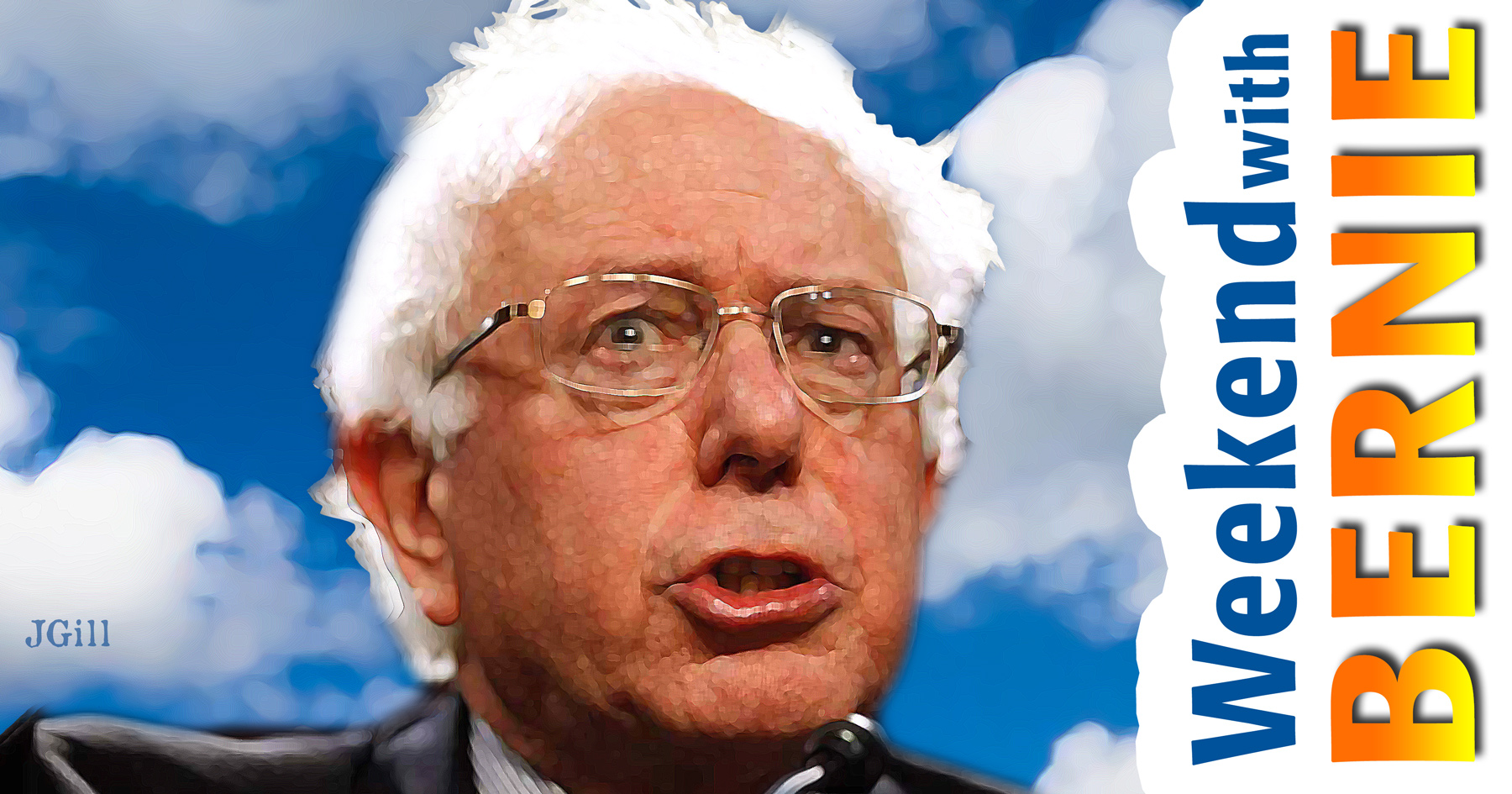
Weekend with Bernie: Hard Looker?

What is a “democratic socialist”?

According to leading presidential candidate and Senator Bernie Sanders, such a socialist “takes a hard look at countries around the world who [sic] have successful records fighting and implementing programs for the middle class and working families.”

I don’t believe him. He shows his cavalier attitude in his next few words: “When you do that you automatically go to countries like Denmark, Finland, Norway, Sweden . . .”

Competent comparative economics doesn’t simply focus on a few policies one happens to admire and then trumpet them for America. Other countries following Bernie-branded socialist policies are in or headed into the proverbial toilet, i.e. PIGS (Portugal, Italy, Greece and Spain).

The common-on-the-left meme runs like this: “No Other Advanced Country,” which Kevin D. Williamson handily demolishes in a recent article:

If we are to go around the world cherry-picking policies from happy countries, we might pass over French paid-leave laws in favor of the Swiss capital-gains tax (generally 0.00 percent) or the Swiss national minimum wage (there isn’t one), or Finland’s very liberal (in the good sense of that word) education system, or Sweden’s free-trade regime and its financial-regulatory system. We’d have to make radical improvements on our federal balance sheet to get our public debt down to Norwegian levels.

American success has never really been about copycatting Europe. We need to look hard at those who pretend otherwise — like nova Bernie, the rising star of the left, who’s now besting Hillary in polls in New Hampshire and Iowa.

And about “democratic socialism” — extreme redistributionism in a putative republic — Bernie needs to look hard at the worldwide experience . . . not hardly look.

This is Common Sense. I’m Paul Jacob.

Printable PDF

Weekend with Bernie Sanders


Categories
individual achievement moral hazard responsibility too much government

Finding a Mission

Iraq War vet Daniel Gade is a lieutenant colonel, professor of public policy, and triathlon competitor with a message for fellow veterans: disability pay may be doing you more harm than good.

Having lost a leg in combat himself, he submits that he is a messenger somewhat harder to dismiss than some others would be.

Professor Gade criticizes how the government puts vets with relatively mild problems in the same category as those with true disabilities, and gives them incentives to stay out of the job market.

An example is the Individual Unemployability program, which treats veterans rated as at least 60 percent disabled as if they are 100 percent disabled as well as 100 percent long-term unemployable. Demonstrating that level of disability and unemployability to the satisfaction of the government means a bump in monthly benefits from $1,200 to $3,100.

“It’s a trap,” Gade insists.

He is working with private donors on a pilot program for vets. His idea is to give grants to develop employment skills rather than to maintain unemployment. Participants must forego any attempt to increase their disability pay by seeking a higher disability rating.

According to one soldier who gave the professor’s pitch a hearing, the government’s system to help vets “is just ‘Give me the money, who cares about anything else.’”

Gade’s proposal, on the other hand, “says go out and work, be productive, feel good about yourself. There is where we do well. If we don’t have a mission, we don’t do well.”

Accept the mission.

This is Common Sense. I’m Paul Jacob.

Categories
moral hazard subsidy

For Some Reason

Yesterday, the House voted to extend the legal ability for the Export-Import Bank to run . . . for another nine months. The people’s legislature passed the “stop-gap” measure, 319-108, with both bipartisan support and bipartisan opposition.

Just last month, President Obama expressed dismay that Republicans would be against it.

“For some reason,” he intoned, “right now the House Republicans have decided that we shouldn’t do this. . . .” He pretended to incredulity and puzzlement. He gave the usual reasoning for the subsidized financial guarantees, and insisted that “every country does this.”

“When,” he asked, “did that become something that Republicans opposed?”

Obama could’ve asked all those members of his own party who opposed it.

But then, he could have asked himself. Back in 2008, he very clearly put the Ex-Im Bank on the theoretical chopping block. Candidate Obama gave the big business bank up as a program that “didn’t work” and one that had become “little more than a fund for corporate welfare.”

So why the change of mind, Mr. Obama?

Has the Ex-Im ceased being a fund for corporate welfare?

No. It’s still there, propping up big businesses doing business abroad — indeed, multinationals abroad, the kind of companies that Obama’s Occupier friends despise so deeply.

What has changed? He’s in power, now. And that power derives from the mighty federal purse, filled by taxing hundreds of millions of Americans, and used to give hundreds of millions and billions in benefits to the few, the insiders.

President Obama and the congressional leadership of both parties are tighter than ever with special interests.

This is Common Sense. I’m Paul Jacob.