Categories
ideological culture initiative, referendum, and recall

Erecting Democracy

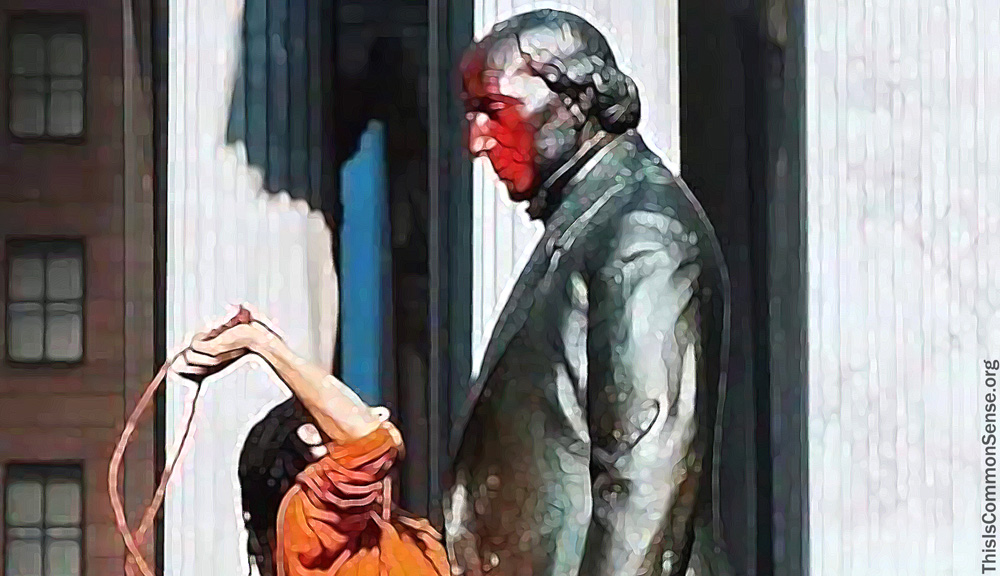
Though I opposed the 2003 U.S. invasion of Iraq, I was not at all offended when an Iraqi mob toppled the statue of Saddam Hussein. 

I liked it. That statue was a symbol of oppression.

In my mind, at least. 

I guess that’s the rub, eh? A symbol of oppression to one person might be an important piece of history to another.

Here in the good ole USA, we now have our own variant of statue roulette going on, of course. And I wonder: Can we not find a better way to decide public policy regarding statue removal than today’s status quo of leaving it up to roaming, violent mobs? Iconoclastic crowds that, we can see, have some trouble coherently identifying the enemy symbols they seek to vandalize.*

“[T]he choice in 2020 is very simple,” offers President Trump. “Do you want to bow before the left-wing mob or do you want to stand up tall and proud as Americans?”

Actually, cancel those calisthenics.

Let’s vote on the issue. 

Either lawmakers or citizens should initiate ballot measures, city by city, state by state, asking voters to choose: keep or remove said statute(s).

The advantages?

  • A more fair and democratic approach, for starters. 
  • Less public policy decision-making by mobs.
  • No one else need be critically injured from faulty statue-removal efforts.

Perhaps most important of all, a real discussion and debate can take place.

Where all sides can be heard. 

Whatever decisions get made regarding any given monument, we would at least better understand each other.

Let’s stop fighting and start voting.

This is Common Sense. I’m Paul Jacob.


* Monuments to famous abolitionists, Matthias Baldwin and John Greenleaf Whittier, as well as a memorial to fallen Union soldiers, who gave their “last full measure of devotion” to end slavery, have been defaced or destroyed. “The irony of vandalizing a monument to those who died to end slavery,” said a Friends of Matthias Baldwin Park member, “is lost on the morons who don’t know their history.” 

PDF for printing

See all recent commentary
(simplified and organized)
See recent popular posts
Categories
initiative, referendum, and recall national politics & policies

Impeachments Are Forever?

The impeachment of President Donald J. Trump, just concluded in the Senate with an acquittal, was — so far as the Senate trial portion of the exercise is concerned — the least partisan presidential impeachment in U.S. history.

That’s because Senator Mitt Romney (R-Utah) was the first senator ever to vote against his own party in such a proceeding.

Before we give the notorious flip-flopper a ticker-tape parade, or query too deeply into his personal animus against Trump, let’s acknowledge that the House impeachment, proper, was heavily partisan, and is only going to get more-so.

What? you ask.

How can a past event get more or less of anything?

Well, House Republicans, expecting a big backlash against Democrats next November, are already plotting to “expunge” the impeachment from the record. 

As if to stick it to Speaker Nancy Pelosi’s bizarre point that her House’s action would be “an impeachment that lasts forever.”

Sorta like Pharaoh Thutmose III chiseling his mother’s name — Hatshepsut — off the monuments of Egypt.

The Republicans’ planned “damnatio memoriae” is a good clue to the moral of this story: the impeachment process is . . . “not good,” to apply a Trumpian mantra.

Now, the process of impeachment has long seemed to me like a great idea — another one from those wise framers of the Constitution.

But with persistent partisanship, this constitutional recourse has not worked out very well. 

Overall. 

Historically.

Whether in 1868, with Democrat Andrew Johnson, or 1999, with Democrat Bill Clinton, or today, with Trump’s failed ouster, the impeachment process has proved (Romney notwithstanding) maddeningly partisan, and looks like it will only get more partisan — with House Democrats already talking about a second impeachment of Trump.

We need some new form of recall.

Citizen-based, perhaps?

This is Common Sense. I’m Paul Jacob.


PDF for printing

Pharaoh Thutmose III, history, myth, memory,

See all recent commentary
(simplified and organized)
See recent popular posts

Categories
initiative, referendum, and recall too much government

The Gig Is Up

Eventually, champions of government intervention, of all forms of thwarting independent judgment and killing dreams, find themselves under assault. From the public. 

And you don’t need an economics degree to grasp why. 

Initially, an intervention prevents other people from pursuing projects, getting jobs, earning a living. Then, finally, government meddling goes a step too far. Maybe lawmakers had “good intentions,” but hey! This is me now! 

Your legislation needs tweaking!

This is where we are in California’s attack on the so-called gig economy. Hatched to “protect” Uber drivers or some such nonsense, Assembly Bill 5 makes it massively harder for companies to classify freelancers as independent contractors. After it was signed into law, many companies—from blogs to transcription services—told California-based freelancers adios

Millions of people lost work and options.

What walks of life are affected? All

“California’s new gig worker law is . . . threatening all performing arts,” complains Brendan Rawson at CalMatters.org. California has “overreached.” Gotta nip-and-tuck that otherwise “worthy” bill! Use only the magic arbitrary intervention in our lives that works!

Not everybody now being hurt was previously okay with pushing other people around, of course. I’ve never been a fan. One of my missions is defending the right of citizen initiative. Well, AB5 makes it much harder and more expensive for petition campaigns to hire people for such gigs as collecting signatures for an initiative in California. 

AB5 attacks earning a living, speaking freely, associating freely, and petitioning one’s government freely. Maybe the law will be rescinded. But there’s more mischief where that came from. 

So let’s protect other people’s freedom . . . and stop the overreach before it reaches us.

This is Common Sense. I’m Paul Jacob.


PDF for printing

California, gig, freelance, law, control, interference, intervention, labor,

Photo by Dairo Cervantes

See all recent commentary
(simplified and organized)
See recent popular posts

Categories
initiative, referendum, and recall tax policy

Extraordinarily Unusual

“It’s a government-on-government fight,” reports Seattle-based KOMO News, as the Pierce County Council voted 4-3 to provide assistance in defending Initiative 976 in court.

The ballot measure, which limits car license fees among other provisions, passed 53 to 47 percent statewide last month, including a whopping 66 percent affirmative vote in Pierce County. And — you guessed it — I-976 was immediately swarmed by life-devouring locusts — er, I mean, sued by “a handful of counties, cities, transportation agencies, and one transit rider.”

In short, many governments seek to undo a vote of the people . . . along with a lone citizen to serve as fig leaf.

Against only one government, Pierce County, now joining the voters.

Late last month, a judge in King County, one of only four counties (out of the state’s 39) to vote against I-976, issued a preliminary injunction blocking implementation of the initiative, while the case is being adjudicated.   

The voter-approved measure does have Attorney General Bob Ferguson lawyering on its behalf. But Mr. Ferguson has been engaged in a multi-year civil lawsuit against Tim Eyman, the sponsor of 976. The two aren’t friends. And the AG is no friend of lower taxes, either. No surprise, then, for Eyman to talk of “sabotage” and Ferguson’s mere pro forma defense: “he truly doesn’t want it to succeed.”

This isn’t a government-on-government fight, but governments-versus-voters. With the wonderful exception of Pierce County, where political representation still lives.

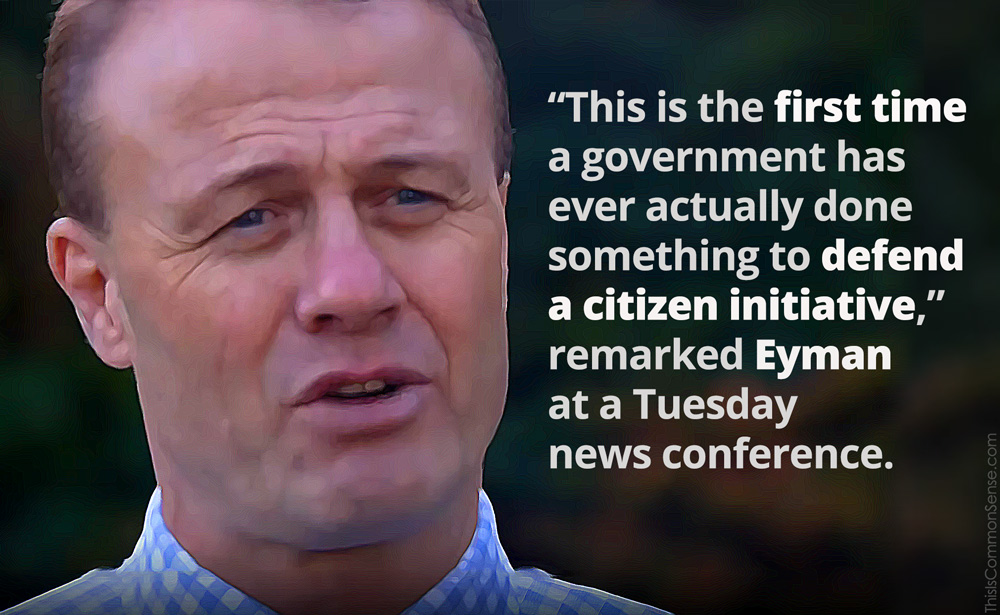
“This is the first time a government has ever actually done something to defend a citizen initiative,” remarked Eyman at a Tuesday news conference. 

“It is really extraordinarily unusual,” he added.

That’s how out-of-control government in our “democracy” is. 

This is Common Sense. I’m Paul Jacob.


PDF for printing

Tim Eyman

See all recent commentary
(simplified and organized)
See recent popular posts


Categories
initiative, referendum, and recall tax policy

My Favorite Control Group

Tim Eyman strikes again. 

In deep blue Washington State, the ballot measure activist celebrated another Election Day victory last week with Initiative 976, limiting vehicle taxes. Not to mention Referendum 88, whereby voters kept a ban on government use of racial preferences, enacted via an initiative Eyman had co-authored two decades ago.

And still, there were a dozen more issues on last Tuesday’s statewide ballot thanks to Mr. Eyman’s 2007 initiative, I-960, which mandates “advisory votes on taxes enacted without voter approval.” (Also thanks to state legislators, I guess, for racking up 12 new tax increases this year without bothering to ask voters!)

Yet, perhaps it matters not at all. Nearly two million votes cast on each of these measures? Three supported by a majority? Nine rejected? Two esteemed Evergreen State newspaper columnists pooh-pooh them as “meaningless.”

“The Legislature has never taken the voters’ advice when they say a tax should be repealed,” writes Spokane Spokesman Review columnist Jim Camden. 

That’s a failing of the Legislature, Jim,* not these advisory measures . . . which you seem to acknowledge when you write that these votes at least “provide a good control group for any experiment on the voters’ knee jerk reaction to higher taxes.”

If legislators cared to know. 

While dumping on the dozen measures as “an empty remnant of an earlier initiative,” The Columbian’s Greg Jayne notices that “their presence on the ballot this year reminded voters, over and over again, of the Legislature’s spendthrift ways.”

Helping create an anti-tax mood that spurred support for I-976.

Not bad for being meaningless.

This is Common Sense. I’m Paul Jacob.


* I use his first name because I know Mr. Camden from decades ago when he was a reporter covering House Speaker Tom Foley, who after suing to overturn the 1992 citizen initiative for term limits became the only Speaker defeated for reelection since the Civil War. 

PDF for printing

Tim Eyman

See all recent commentary
(simplified and organized)
See recent popular posts
Categories
initiative, referendum, and recall tax policy

Blue Colorado Big Spenders

“The Trump years may have cemented Colorado’s blue-state status — time will tell,” writes Alex Burness in the Denver Post, “but voters in the Centennial State continue to hold a hard line on anything that has even a whiff [of] new tax.”

Burness is talking about Proposition CC, a measure placed on Tuesday’s ballot by the state’s Democratic-controlled legislature, which would have allowed state government to keep and spend $37 million annually coming into government coffers over the state’s constitutional spending cap, rather than refunding those dollars to taxpayers as required by the Taxpayer Bill of Rights passed back in the 1990s.

The elite supporters of Proposition CC devoted more than $4 million to promoting the measure, outspending opponents better than two-to-one and arguing that government desperately needed the money for education and transportation. Opponents cried foul over the official ballot summary voters read, which began with the words “Without a tax increase . . .”

 “But the measure lost,” Burness informs, “and it wasn’t close.”

“The measure’s failure amounts to a significant victory for supporters of the Taxpayer’s Bill of Rights,” Colorado Public Radio reports. “That constitutional amendment requires voter approval for all tax increases, sets a revenue limit for every government in the state and requires any surpluses be returned to taxpayers.”

“Who’s in charge?” TABOR author Douglas Bruce asked years ago. “We, the people, who earn the money, or the politicians who want to spend it?”

The answer from supposedly blue-leaning Colorado voters was unequivocal.

This is Common Sense. I’m Paul Jacob.


PDF for printing

Colorado, elections, taxes, Bruce,

Photo credit: Pictures of Money

See all recent commentary
(simplified and organized)
See recent popular posts

Categories
general freedom initiative, referendum, and recall

Today’s Trifecta

Three measures on ballots today are particularly worth watching.

Two issues in Washington State represent the only citizen-initiated measures out of 32 propositions voters will see in eight states: Washington Referendum 88 allows voters to re-decide the issue of racial and gender preferences, so-called “affirmative action,” while Washington Initiative 976 offers voters a chance to cap their vehicle taxes.

More than two decades ago, in 1998, Washingtonians passed Initiative 200 to end racial and gender preferences in state employment and education. This year, the state legislature enacted a virtual repeal of I-200, by allowing the state to employ such a preference provided it was not the “only factor” used. 

Washington’s vibrant Asian-American community, which stands to be discriminated against should affirmative action return, rose up to petition Referendum 88 onto the ballot. A “yes” vote upholds the legislature’s new pro-preference policy; a “no” vote restores the prior voter-enacted policy prohibiting such preferences.  

Initiative 976 is yet another effort from Tim Eyman, the state’s most prolific initiative practitioner. “This measure,” as the official summary states, “would repeal or remove authority to impose certain vehicle taxes and fees; limit state and local license fees to $30 for motor vehicles weighing 10,000 pounds or less, except charges approved by voters . . .”

Like virtually every Eyman initiative, powerful opponents have dramatically outspent supporters — by greater than a 6-to-1 margin — funding ads that have been less than truthful. Additionally, government officials have broken campaign laws in pushing a “no” vote.

Nonetheless, a mid-October poll showed 48 percent of voters support I-976 against 37 percent who oppose it. Could Eyman again thwart the state’s behemoth Blue Establishment?

Lastly, New York City voters will decide a ballot question on whether to use ranked choice voting in future primary and special elections for mayor, city council and other offices. It would mark a major victory for a reform growing in popularity.

This is Common Sense. I’m Paul Jacob.


PDF for printing

vote, election, initiative, referendum, Washington, New York,

See all recent commentary
(simplified and organized)
See recent popular posts


Categories
initiative, referendum, and recall insider corruption

Revolt of the Desk Jockeys

Our Constitution guarantees that each state of the union provide a republican form of government.

Does that mean that all that is prohibited is . . . monarchy?

No. 

One very common form of modern governance is deeply anti-republican, requiring — at the very least — strict regulation to prevent it from usurping our form of government. And what is this dangerous variety? The kind an economist defined centuries ago: “We have an illness in France which bids fair to play havoc with us; this illness is called bureaumania.” He called it “government by desk,” or, “bureaucratie.”

Yes, bureaucracy.

You might think I’m about to launch into another attack upon the Deep State, perhaps in relation to the ongoing coup-by-desk of the Trump Presidency.

But no. Let us turn to the other Washington, the one with the capital named Olympia.

In that hotbed of politics-as-usual, the city government printed out and mailed — on the public dime — a pamphlet entreating voters to vote against I-976, a state-wide initiative that had been advanced onto the ballot by Tim Eyman* and hundreds of thousands of voter signatures.

Even if it had been a broadside for the initiative this would have been very, very bad.

In republics, those who inhabit public desks must not be allowed to hijack election campaigns from those who are, ultimately, in charge: the citizens.

And in Washington State by law: RCW 42.17A.555 broadly and strictly prohibits using public resources for campaigning.

Apparently, public servants in the Evergreen State (as elsewhere) do not see that they themselves can corrupt our form of government.

Which makes this government-printed pamphlet a very serious breach of law indeed. 

This is Common Sense. I’m Paul Jacob.


* You may remember me talking about Eyman before — often. I have called him the most effective limited-government activist in these United States. And it is from Eyman himself that I learned of this story.

PDF for printing

See all recent commentary
(simplified and organized)
See recent popular posts

Categories
initiative, referendum, and recall tax policy

The Legislature That Couldn’t Tax Straight

“If you lost count of how many new and higher taxes state lawmakers passed this year,” begins Jerry Cornfield’s recent column in the Everett Herald, “it was 12.”

Cornfield doesn’t appear too distressed about the tax hikes, however, worrying instead that Evergreen State voters will be “awash in tax advisory measures this fall.”

That’s because for every tax increase the Washington State Legislature enacts without putting it to a vote of the people of Washington, an advisory vote is mandated by Initiative 960, passed by voters back in 2007.

So 12 tax increases = 12 tax advisory votes. 

“We wouldn’t be talking about advisory votes and providing Eyman a platform for politicial [sic] ministering,” Mr. Cornfield complains, “had Democratic lawmakers gotten rid of them by passing Senate Bill 5224.”

Seems odd somehow that a newspaper columnist would be berating politicians for not passing a law to silence voters regarding tax hikes. Democrats could have done so without a single Republican vote. SB-5224 did pass the Senate, but it was blocked in the House by the Democratic Speaker — “democratic,” thankfully, in more ways than one.

Eyman is Tim Eyman, the state’s anti-tax initiative leader. His group, Voters Want More Choices, spearheaded Initiative 960, which from 2008 to 2018 required 19 tax advisory votes. Voters have expressed opposition to 12 of the 19 tax increases passed by the legislature — 63 percent — and support for seven. 

“It’s a tax increase report card,” explains Eyman, “and the Legislature this year gets an F.” 

A grade that was certainly earned.

This is Common Sense. I’m Paul Jacob.


PDF for printing

Tim Eyman, Senate Bill 5224, taxes, vote, democracy,

See all recent commentary
(simplified and organized)
See recent popular posts


Categories
initiative, referendum, and recall subsidy

Subsidizers May Be Checked

“FirstEnergy Solutions might not want to spend its bailout money just yet,” warns a story in Crain’s Cleveland Business. 

At issue? A possible statewide referendum on House Bill 6.

HB6 would, according to the Cleveland Plain Dealer, “gut Ohio’s green-energy mandates and set up customer-funded subsidies to nuclear and coal power plants.” It passed the majority Republican state House “thanks to key support from several House Democrats.”

Passage of HB6 through both houses of the Ohio Legislature and its signature by Governor Mike DeWine would force Ohio ratepayers to fork over roughly $150 million in subsidies to FirstEnergy Solutions for its two nuclear power plants.

Except for one thing — in Ohio, voters possess a powerful political weapon: the referendum. 

Already a diverse coalition of opponents to the bill has formed Ohioans Against Corporate Bailouts, filed a referendum and kicked off a petition drive that has “until October 21, 2019, to collect the 265,774 required signatures.”

“HB6 has created some strange bedfellows,” the Plain Dealer notices, including bringing together “environmental groups, the fossil-fuel industry, renewable energy companies, and some small-government activists” in opposition.

“Many of the forces that fueled the Trump presidency, before 2016 — I’m talking the Tea Party and others — could be supportive in undoing this bill,” explains Paul Beck, former chair of Ohio State University’s political science department. “And so could people on the left. You may find an incredible divergent group of people aligned with each other.”

“Liberals hate that it subsidizes dirty coal plants,” reports Crain’s. “Many conservatives hate that it picks winners and losers by subsidizing one industry over another.”

Thankfully, the fate of the giveaway rests in the hands of Ohioans, not their subsidy-loving representatives.

This is Common Sense. I’m Paul Jacob.


PDF for printing

Ohio, referendum, control, stop, emergency button,

See all recent commentary
(simplified and organized)
See recent popular posts