Categories
Common Sense general freedom individual achievement meme U.S. Constitution

Everything That Could Be Done

Two hundred forty years ago, the situation was dire. In the Virginia Colony, not too far from where I live, representatives to the Second Virginia Convention were debating the problems they were having with their “masters” in Britain — and the more dangerous, violent situation that was developing to the north.

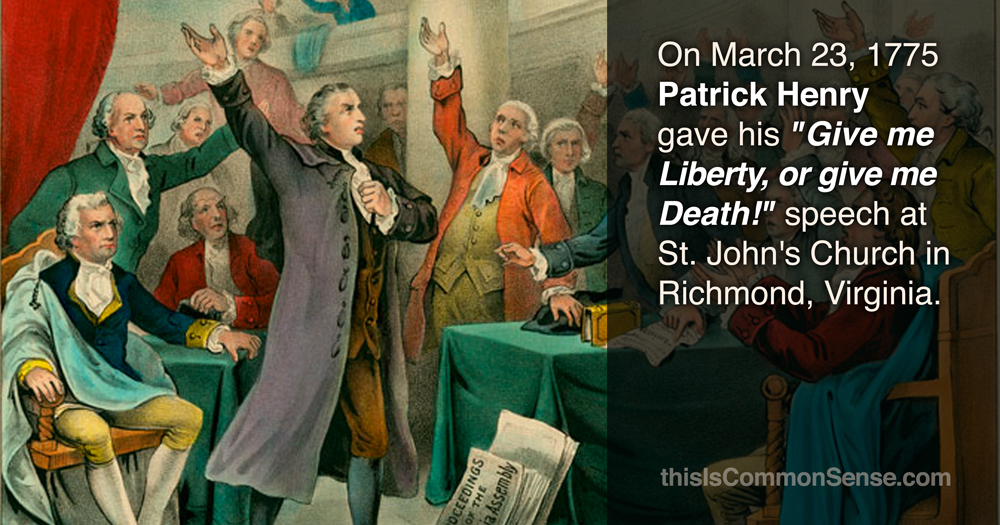
Several days into the convention, Patrick Henry spoke. His speech was rousing. And it changed minds, concluding with the famous words “give me liberty or give me death!” — an ultimatum quite stark indeed.

Mr. Henry was for action, and waiting no longer. Addressing himself to the president of the convention, he said, “Let us not, I beseech you, sir, deceive ourselves longer. Sir, we have done everything that could be done to avert the storm which is now coming on.” And they had done a great deal, engaging in

– petitioning

– remonstration

– supplication

and, Henry went on, had even “prostrated ourselves before the throne.” And they got worse than the cold shoulder for all their efforts. They got the brush-off, the turn of the cold robe. Along with troops of occupation.

Hence the need for serious action.

Then, Americans were wrestling with the world’s most powerful nation: the British Empire. Today we again face the world’s most powerful empire: our own.

A federal regime similarly out of control in terms of spending and debt, arrogance and corruption, intrusiveness and incompetence. As if dictated by a know-it-all king of old, or a cabal of insiders acting as oligarchs.

Then it was a far-off Parliament; today it is our own far out-of-it representatives . . . duly elected.

We are engaged in a sort of class war, insiders vs. outsiders, and it is the insiders who are bringing the country to the brink of collapse.

The biggest difference between 1775 and 2015? We haven’t done all we can. There is much more to do. And possibly even succeed before the doom of another financial collapse, sovereign debt crisis, or . . . worse.

It often seems a Herculean task, but as Mr. Henry implored, “Sir, we are not weak, if we make a proper use of those means which the God of nature hath placed in our power.”

Let’s join together to give ourselves, our loved ones, and generations hence liberty.

This is Common Sense. I’m Paul Jacob.


Printable PDF

Read the entire speech here

Printable PDF of the entire speech here

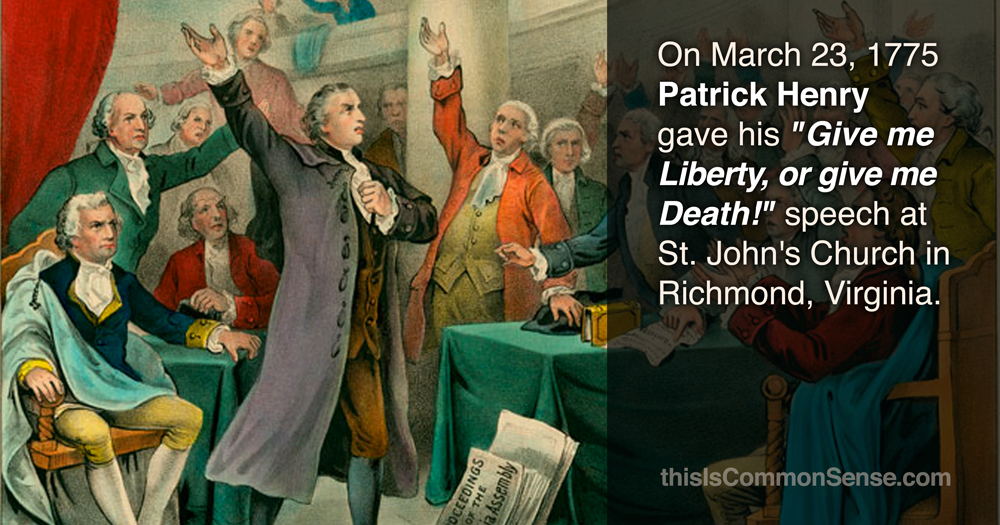
Get a high-resolution screensaver of this day’s image. Click on the thumbnail picture below to open a large version that you can download.
The Meaning of "Liberal"


Categories
Common Sense general freedom individual achievement judiciary U.S. Constitution

Racial Justice Advanced

[mks_dropcap style=”letter” size=”60″ bg_color=”#ffffff” txt_color=”#000000″]I[/mks_dropcap] don’t know if Juan Williams is right about who qualifies as America’s most influential thinker on race. But I hope he is.

In a Friday Wall Street Journal op-ed, Fox News’s liberal-leaning political analyst and author of Thurgood Marshall: American Revolutionary (1998), argues that our country’s most important influencer of thought on race is neither some current and trendy academic writer nor our current president (or his outgoing attorney general). Instead, it is none other than Supreme Court Justice Clarence Thomas.

While more famous figures of African-American descent have dominated the news talk shows and airwaves and popular consciousness, Justice Thomas has gone about “reshaping the law and government policy on race by virtue of the power of his opinions from the bench.” While previous African-American racial activists and thinkers have striven to defend the rights of black people, Justice Thomas, “the second black man on the court, takes a different tack. He stands up for individual rights as a sure blanket of legal protection for everyone, including minorities.”

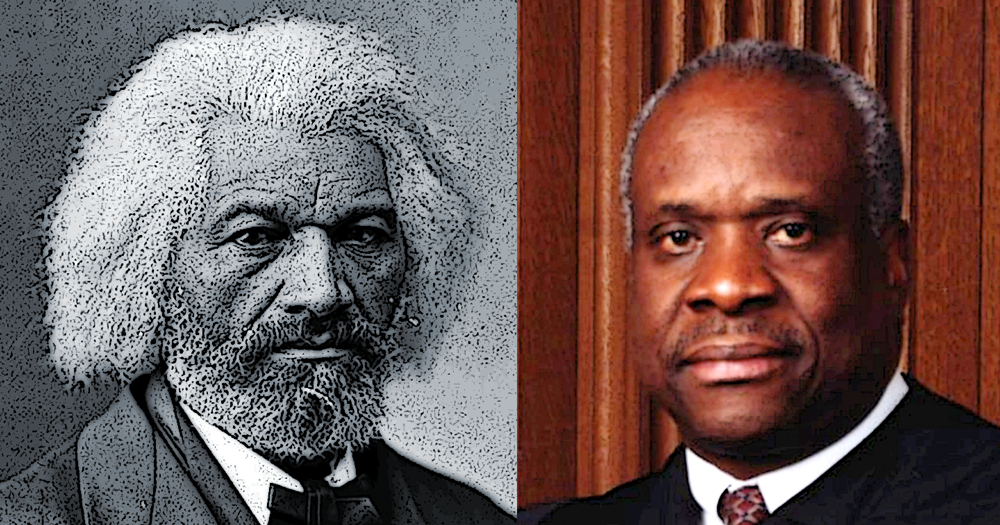
Opposed to “perpetual racial tinkering,” Thomas has marshaled Frederick Douglass’s words to make his case: “What I ask for the Negro is not benevolence, not pity, not sympathy, but simply justice.” And justice, in Clarence Thomas’s judgment, does not entail a constant rescue-worker attitude towards minorities, or other disadvantaged folks. It requires nothing other than equality of rights before the law.

And perhaps some hard work on the part of the disadvantaged.

Hats off, then, to Juan Williams for recognizing the importance of Thomas’s common sense contention that “black people deserve to be treated as independent, competent, self-sufficient citizens.”

This is Common Sense. I’m Paul Jacob.

Categories
individual achievement moral hazard responsibility too much government

Finding a Mission

Iraq War vet Daniel Gade is a lieutenant colonel, professor of public policy, and triathlon competitor with a message for fellow veterans: disability pay may be doing you more harm than good.

Having lost a leg in combat himself, he submits that he is a messenger somewhat harder to dismiss than some others would be.

Professor Gade criticizes how the government puts vets with relatively mild problems in the same category as those with true disabilities, and gives them incentives to stay out of the job market.

An example is the Individual Unemployability program, which treats veterans rated as at least 60 percent disabled as if they are 100 percent disabled as well as 100 percent long-term unemployable. Demonstrating that level of disability and unemployability to the satisfaction of the government means a bump in monthly benefits from $1,200 to $3,100.

“It’s a trap,” Gade insists.

He is working with private donors on a pilot program for vets. His idea is to give grants to develop employment skills rather than to maintain unemployment. Participants must forego any attempt to increase their disability pay by seeking a higher disability rating.

According to one soldier who gave the professor’s pitch a hearing, the government’s system to help vets “is just ‘Give me the money, who cares about anything else.’”

Gade’s proposal, on the other hand, “says go out and work, be productive, feel good about yourself. There is where we do well. If we don’t have a mission, we don’t do well.”

Accept the mission.

This is Common Sense. I’m Paul Jacob.

Categories
Common Sense individual achievement initiative, referendum, and recall local leaders

The Year You Made Us More Free

More important than which party controls the U.S. Senate, or which nine people don Supreme Court robes, or even who will be elected president of these United States come 2016, is something much more within our individual and collective control: what you and I do to protect and advance liberty.

From this date — January 1, 2015 — forward, let us never wait for a political savior to ride in on a white horse. We cannot wait.

And we don’t have to.

In fact, only through “We the People” taking the leadership role can a pro-liberty agenda be established. Politicians won’t do it for us, not consistently.

Yet, the few might follow our good lead.

And we can hopefully make all politicians respond to the issues that define the future of freedom.

Starting right now, as president of the Liberty Initiative Fund, I ask you: join me in placing a three-plank pro-liberty platform on state and local ballots and, thereby into law and government policy across the country, between now and November 8, 2016.

Hold government accountable. Pass term limits in more cities and states. Fix out-of-control public employee pensions. Enact ethics reforms.

Fight crony capitalism. Create a voter check on public subsidies. Protect citizens from eminent domain abuse. Open up business entry.

Protect our liberties. Clean up law enforcement with measures that stop the highway robbery known as civil asset forfeiture, require police to wear lapel cameras, and mandate independent prosecutors in fatal or violent incidents involving police.

We can create better government, a freer marketplace and a safer society.

Gandhi said: “We must become the changes we seek in the world.”

I say, “At least, let’s put our changes on the ballot and give them a fighting chance.”

There will never be a patronage army for liberty. But there is you and me. And since we agree . . . we might be able do something about it.

We’re strong enough to start.

These battles appeal to libertarians, conservatives, liberals, progressives.

I’m reminded of Patrick Henry’s 1775 “Give Me Liberty” speech:

They tell us, sir, that we are weak; unable to cope with so formidable an adversary. But when shall we be stronger? Will it be the next week, or the next year? Will it be when we are totally disarmed, and when a British guard shall be stationed in every house? . . .

Sir, we are not weak if we make a proper use of those means which the God of nature hath placed in our power. The millions of people, armed in the holy cause of liberty, and in such a country as that which we possess, are invincible by any force which our enemy can send against us.

Mr. Henry was talking about cataclysmic historical forces, the defeat of the world’s foremost empire. So are we, in a way.

This nation of shopkeepers, the common folks with common sense and common decency, must again battle the Empire of Big Government. And let me advance the notion that we are up to that awesome task.

Every New Year’s Day I reflect on the words of author and politician, Marianne Williamson, who in her book, Return to Love, wrote:

Our deepest fear is not that we are inadequate. Our deepest fear is that we are powerful beyond measure. It is our light, not our darkness, that most frightens us. We ask ourselves, who am I to be brilliant, gorgeous, talented and fabulous? Actually, who are you not to be? You are a child of God. Your playing small doesn’t serve the world. We were born to make manifest the glory of God that is within us. It’s not just in some of us; it’s in everyone. And as we let our own light shine, we unconsciously give other people permission to do the same. As we are liberated from our own fear, our presence automatically liberates others.

Let’s work together to make 2015 the year we helped create an America more free. Call me (571-659-2320) or email me (paul@libertyifund.org) if you want to take action in your city or state.

Or help by contributing funds to others working all across the country.

Oh, wait! Don’t call me today; I’m watching college football. But please call me (or email) tomorrow, Friday, Jan. 2, 2015. If I’m busy, or talking to someone who dialed me a minute earlier, leave a message (that’s just, ahem, common sense) — I’ll call you back.

Let’s take charge and usher in change together, at the grassroots, this year.

This is Common Sense. I’m Paul Jacob.

Categories
individual achievement

The £2 Workaround

Last February, between Bath and Bristol, the A431 suffered from a “landslip.” (I assume that’s Brit-speak for “landslide.”) With the road closed, folks on either side of the slide had to drive around “the long way.”

The government body responsible for the road said the repair wouldn’t be finished till the end of the year.

So one commuter, businessman Mike Watts, took matters into his own hands. Contracting with the farmer who owned the adjacent fields, he built a road parallel to the old one. And, with the apparent blessings of the road authority, set up his 400-yard toll road to make up the difference. A private, pay-for-use “traffic revision.”

He charges £2 per trip for a car, and just celebrated his hundred thousandth car. He’s well on his way to recovering his costs.

Unfortunately, those costs have included some payola demands (er, fees) from the government.

On mises.org Matt McCaffrey lauds the success of this private road venture, making the point that, yes, private enterprise can build roads.

But we all knew that. Private roads, turnpikes, toll roads — they were once quite common, and could become common again. This is the first in a century in Britain, though.

What this story demonstrates? Let another enterprising Brit, 19th century sociologist Herbert Spencer, explain it: “Unlike private enterprise which quickly modifies its actions to meet emergencies . . . the law-made instrumentality lumbers on under all varieties of circumstances at its habitual rate.”

This is Common Sense. I’m Paul Jacob.

Categories
ideological culture individual achievement media and media people national politics & policies responsibility

Mercy as a Calling

The cause of immigration reform hit a huge speed bump in recent weeks, with the arrival at the border of thousands upon thousands of children from war-torn Central America.

War-torn? Yes. Gangs — micro-governments in the olden style — fed by drug money have turned the Latin American states to our south into war zones, alas not too dissimilar to the gang warfare that beset some of our great American cities.

Only worse.

No wonder the people in those countries are scared, and desperate. “Coyotes” are taking advantage of U.S. politicians’ inability to secure the border, or even cook up a coherent immigration policy, and charge large amounts of money to transport children to “safety” in the U.S.

Where they are gathered and detained.

In the midst of all the partisan bickering — a legitimate clash of ideologies, really — stands one hero: Glenn Beck. While President Obama avoids the border crisis as if avoidance solves problems, radio/TV/Internet sensation Beck is taking his trucks and buses and volunteers directly to the area Obama avoids, the detention centers and surrounding cities and churches.

He’s taking food, clothing, and comforts for the children.

Last night on The O’Reilly Factor he explained  that governments are instituted to provide justice. He laments the lack of justice on  immigration coming from Washington. But the business of the people — of caring Americans — is not primarily justice.

It’s mercy, Beck says. He’s raised millions, and he’s personally taking aid to where it’s needed.

Heroic. And very neighborly.

This is Common Sense. I’m Paul Jacob.

Categories
individual achievement responsibility

Declining Self-Pity

Mike Rowe is used to seeing people suffer almost insufferable things on a daily basis.

But as blogger Justen Charters puts it, “eight years hosting Dirty Jobs couldn’t prepare” Rowe for his encounter with Staff Sergeant Travis Mills. The veteran of the war in Afghanistan got half his body torn off by an improvised explosive device; he is a quadruple amputee.

On his Facebook page, Rowe tells what it was like to meet Travis at a convention. “He wanted to tell me how much he and his buddies appreciated that show while on active duty. He wanted to know what it was like to work in so many ‘difficult and dangerous situations.’ . . . I’ve seen a lot of things over the years, and I’ve gotten good at pretending there’s nothing unusual when there clearly is. But I was completely unprepared for this.”

When he expressed sympathy, Travis shrugged it off. “No big deal. It’s been two years now. I’m good. Tell me something though — are you gonna do anymore Dirty Jobs?” The show has been cancelled, but Rowe managed to report that he is working on a sequel.

“Hey, that’s great! I got new legs and you got a new show! Tell me all about it!”

There are real victims in this world, and there are people who assume the mantle of victimhood when they have little to complain about. I’d say Travis Mills has a reason to complain. But he doesn’t.

This is Common Sense. I’m Paul Jacob.

Categories
free trade & free markets individual achievement

Modern Tech Gives a Hand

This is a story about how technology is making things better. About 840 times better.

What’s represented by that multiple is price — the far lower price of a machine that 53-year-old Jose Delgado Jr. uses instead of the left hand he was born without.

For three years he had used a prosthesis costing $42,000. Its myoelectric technology detects electrical signals in muscle tissue in order to operate prosthetic fingers.Cyborg Beast

But the gadget’s capacity to grip? Rudimentary.

Now Delgado has a more capable prosthesis, the result of the latest technological breakthrough.

And it costs just 50 bucks.

3D printing has been advancing rapidly, sometimes controversially. It is now possible to produce a working metal gun with the technology.

It’s hard to see what can be controversial about Delgado’s new 3D-printed prosthesis, though.

Is the price for real? Perhaps the $50 incorporates only immediate production costs, and that other factors involved in developing and marketing the Cyborg Beast could make it pricier. But given what’s been demonstrated, even its most expensive incarnations would have to be orders of magnitude cheaper than earlier prosthetic tech.

It also does the job better.

The Beast’s mechanical plastic fingers are much better articulated than those of its predecessor. It grips objects more firmly and precisely, manipulates them more dexterously. Delgado dramatically demonstrates the superiority in a YouTube video produced by 3D Universe.

Such products of human ingenuity are stunning. Yet soon we’ll take for granted what they now make possible for the first time. And there’s a lot more to come. We live in interesting times.

This is Common Sense. I’m Paul Jacob.

Categories
individual achievement

It’s Going to Be a Non-bumpy Ride

Gilad Woolf, an Israeli farmer, had a problem.

He had broken his leg . . . but that wasn’t the problem. The problem was the bumpy ride he often had to endure while using a wheelchair until his leg could heal. And so — discomfort and inconvenience being the mother of reinvention — Woolf came up with an idea for a kind of wheel that could soak up the impacts of uneven terrain.

Developed over the last three years by the startup Tel Aviv firm SoftWheel, the hub of this special wheel shrinks or expands as needed to smooth out the ride. The wheel absorbs most of a shock instead of transmitting it to the vehicle and the person driving it.

“Very quickly we understood it’s not just about putting the suspension inside the wheel,” SoftWheel CEO Daniel Barel told The Jerusalem Post. “The beauty of our technology is not only that it’s an integral part of the wheel, it’s selective and symmetric. That’s the game-changer.” (See video of a Softwheel wheelchair on steps.)

The company will first create its wheels for wheelchairs, the bikes and aircraft landing gear. After several more years of work, SoftWheel expects that the technology can be applied to cars.

Thus, five or six thousand years after somebody came up with the wheel, we’ve got a smart and flexible solution for the problem of stairways, potholes and other bumps in the road.

Very cool. I can’t wait to see what’s next.

This is Common Sense. I’m Paul Jacob.

Categories
individual achievement

Independence in “Jeopardy”

Arthur Chu had a problem.

The 30-year-old “Mad Genius” knows a lot about some things, little about others. And he had no time to bone up adequately on likely categories before a scheduled appearance on “Jeopardy,” the TV quiz show.

How then to maximize his chances?

Answer: strategy — an unconventional strategy that annoyed some viewers. For example, instead of starting with the lowest-dollar value in a subject column on the board and working his way down, he went for the $1000 clues first. Not done.Arthur Chu, Double Jeopardy

Chu also jumped around the board in search of the Daily Double, a square that lets you bet everything from $1 to everything you’ve won so far. Also not done. He found a Daily Double in Sports and, being ignorant of sports, bet just $5. Again, annoying some people.

Chu doesn’t apologize. “If I get a Daily Double in sports and I’m pretty sure I’m not gonna know it, why would I take an unnecessary risk? I guess people see it as a jerk thing to do, but the benefit in that is that I can take that clue away from someone else who does know about sports.”

After all, the point of the game is to win, and what you win is money, “which is important to me,” he clarified (perhaps unnecessarily). Chu played within the rules, played smart, bet smart, and was willing to be slammed for thinking outside the usual squares.

Result: big winnings. Good for you, Arthur Chu.

This is Common Sense. I’m Paul Jacob.