Categories
ideological culture partisanship

In Lieu of Good Judgment

Politicians often dare . . . too much. 

But what did Rep. Ted Lieu dare to be last week?

Candace Owens’ appearance before the House Committee on the Judiciary caused quite a stir. The subject was hate crimes and white nationalism, and she offered a wider perspective: “We’re not talking enough about political hatred in this country, we’re not talking enough about conservative activists being attacked. . . .”

Needing to undermine that message, the Representative from California’s 33rd congressional district dared do the dirty deed. 

“Of all the people the Republicans could have selected” to appear before the hearing, Rep. Lieu said, “they picked Candace Owens. I don’t know Miss Owens; I’m not going to characterize her. I’m going to let her own words do the talking.”

By now you’ve almost certainly listened to what he did*: play a 30-second clip from a long interview of the conservative activist then ask some other hearing invitee to explain how dangerous her statement was. The 30 seconds completely elided the original context, implying, absurdly, that the African-American activist was a supporter of Hitler and white nationalism.

Ms. Owens responded in justified high moral dudgeon. And Rep. Lieu came out looking . . . as Owens put it, “unbelievably dishonest.”

What was he thinking?

Scott Adams saw only two possibilities: “What Ted Lieu attempted (and failed) to do Candace Owens is not politics, it’s just despicable.” Lieu is either “one of the worst people who’s ever lived” or he is, in line with so many other #NeverTrumpers, “experiencing actual hysteria.”

Unfortunately, Washington partisans regularly make evil and insanity hard to distinguish.

This is Common Sense. I’m Paul Jacob.


* “The most-watched C-Span Twitter video from a House hearing ever,” says Rush Limbaugh.

PDF for printing

Rep. Ted Lieu, Candace Owens, TDS, Trump Derangement Syndrome, racism, Hitler

See all recent commentary
(simplified and organized)
See recent popular posts

Categories
folly ideological culture media and media people moral hazard Popular

Systemic Refocusing

Everyone comes into this world with advantages and disadvantages. 

In the last century, public morality focused on the disadvantaged. Government policy changed dramatically, aiming to help those lacking many obvious advantages. But that focus got fuzzier and fuzzier as the ranks of disadvantaged people remained, even grew larger. Progress was made on several fronts, sure, but not on all — especially not on the ones most targeted.

We even “lost ground.”

Maybe because of this, the political focus shifted to “privilege” — which often merely means “advantaged” and sometimes means a special license granted by custom or law, which is said to be “systemic.” 

White males, we are told, have the most of it. 

So they must be attacked.

But does “white [heterosexual male] privilege” really exist?

Sure, in some contexts. But so do other “privileges.” Here is a better question: Are there privileges so built in that people try to horn in on them?

When there really was white privilege, “passing for white” was a thing. Now, we see other directions of racial “passing.” Sen. Elizabeth Warren, 99 and 44/100ths pure white, for example. If white privilege were really systemic, would she have pretended to be a native American? 

If white privilege were significantly at play in the academic world, the issue of Asian students qualifying for (and being accepted into) the country’s most prestigious universities wouldn’t even come up.

And if white people actually enforced their privilege, would the charges against Jussie Smollett for perpetrating a fake racial/ideological hate crime have been dropped

Seems unlikely.

If the results of focusing on advantage and privilege have been so dismal and dismaying, maybe it’s time for a refocus: on simple justice.

This is Common Sense. I’m Paul Jacob.


PDF for printing

white priviledge, Jussie Smollett, Elizabeth Warren, Rachel Dolezal

See all recent commentary
(simplified and organized)
See recent popular posts


Categories
education and schooling ideological culture moral hazard nannyism national politics & policies Popular

Make Others Pay?

Special Olympics has found a way to get kids and young adults with disabilities to feel something important: Able.

Three decades ago, as part of a community service requirement, I spent one day each week working with physically and intellectually-challenged adults at Easter Seals in Little Rock, Arkansas. I loved it. 

Most unforgettable were their beaming smiles of pride when they got a chance to show what they could do. I’ve always loved sports, but never as much as there and then. In the decades since, my family has given to the Special Olympics what financial support we could afford. 

So, can you imagine how I must feel hearing Education Secretary Betsy DeVos testify in favor of cutting all $17.6 million in federal funding for the Special Olympics? 

“It’s appalling,” declared Rep. Barbara Lee (D-Calif.).

John Kasich, the former Republican governor of Ohio, called the cut “outrageous” and “ridiculous.”

“Cruel and reckless” were the words Rep. Rosa DeLauro (D-Conn.) used.

“The Special Olympics is . . . a private organization. I love its work, and I have personally supported its mission,” countered Sec. DeVos.* “But given our current budget realities, the federal government cannot fund every worthy program, particularly ones that enjoy robust support from private donations.”

Federal funding provides only 10 percent of Special Olympics revenue, with over $100 million raised annually in private donations.

So, how must I feel about DeVos’s suggested cuts? 

Gratitude . . . for her generous contributions to Special Olympics — and for her fiscal responsibility. Let’s fund this wonderful program without the government forcing (taxing) support from others.

Check, cash or credit card is always preferable to virtue-signaling gum-flapping.

This is Common Sense. I’m Paul Jacob.


* Special Olympics is one of four charities to which DeVos donated her entire 2017 federal salary.

PDF for printing

Betsy Devos, education, special olympics, funding, budget, debt, spending,

See all recent commentary
(simplified and organized)
See recent popular posts


Categories
ideological culture media and media people meme national politics & policies Popular

The Anti-Orange Man Cult

How do you know you are in an end-time cult?

When you won’t accept the complete and utter failure of your prophecies when they come a cropper.

So, am I talking about the classic Leon Festinger, Henry W. Riecken, and Stanley Schachter study in social psychology, When Prophecy Fails: A Social and Psychological Study of a Modern Group that Predicted the Destruction of the World? In that work, social scientists infiltrated an eschatological cult to see how they would react when their prophecy of end times failed.

What did the cultists do?

Many doubled down, tweaked their original prophecy, and continued in their previous beliefs but with greater fervor.

But no. I am not talking about that, not directly. 

I refer to the Mueller Report.

“For years, every pundit and Democratic pol in Washington hyped every new Russia headline like the Watergate break-in,” writes Matt Taibbi in “It’s official: Russiagate is this generation’s WMD?” Noting that while the story as it was hyped from the beginning was about espionage, a “secret relationship between the Trump campaign and Russian spooks who’d helped him win the election,” the biggest thing to come of it has been “Donald Trump paying off a porn star.”

Now that the Mueller Report has come to a fizzle, proving nothing very interesting or relevant, our reaction to the news that the President is not Putin’s puppet should be jubilation.

To shed a tear and get all choked up, like Rachel Maddow? That should signal the end time for the cult.

This is Common Sense. I’m Paul Jacob.


PDF for printing

Rachel Maddow, Russia, investigation, Mueller Report,

See all recent commentary
(simplified and organized)
See recent popular posts


Categories
ideological culture

Trans-philosophical

Joona Räsänen is a Finn and a “bioethicist” who teaches philosophy at the University of Oslo. But we are not going to talk ontology or mereology or modal logic, here — not intentionally, anyway. The subject is “trans-ageism.”

A hotter topic in philosophy?

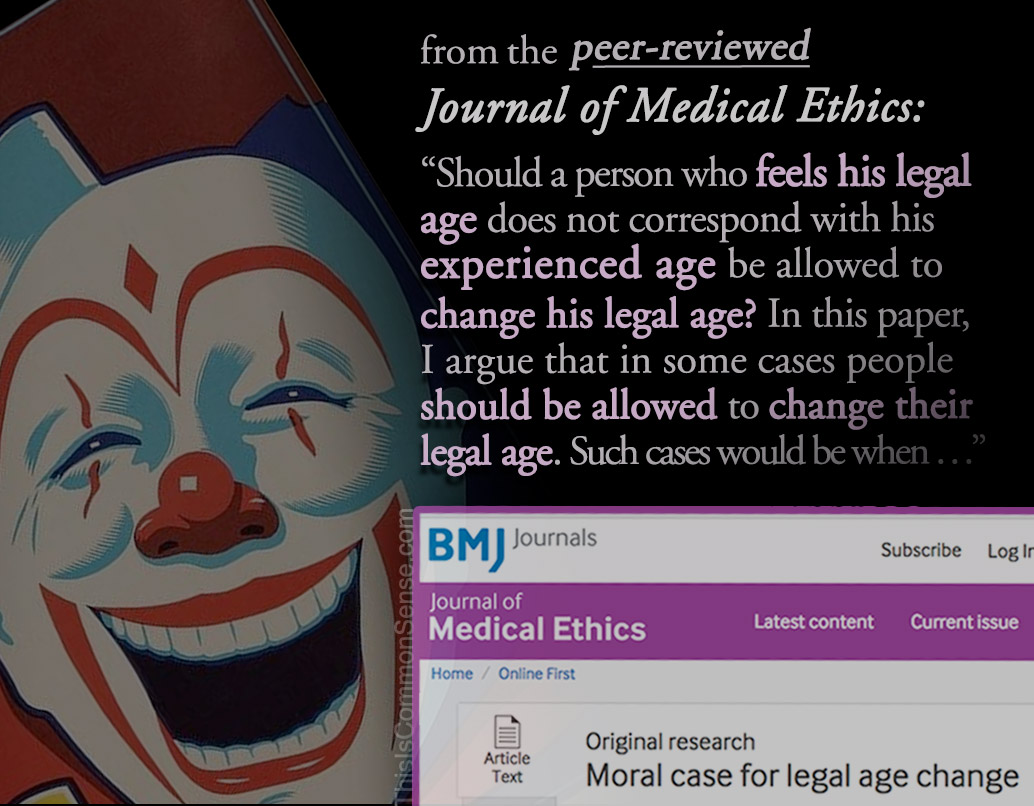
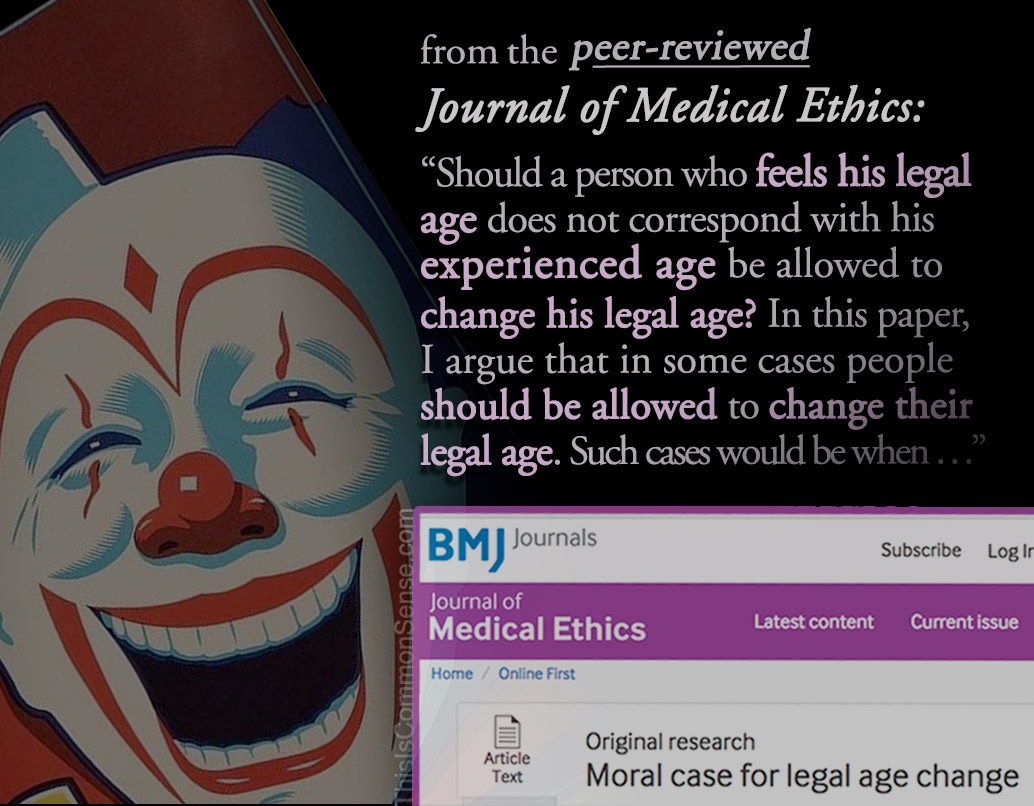
Räsänen has had a paper published in the Journal of Medical Ethics, a peer-reviewed academic publication. Entitled “Moral case for legal age change,” it has attracted attention.

To be expected when you write something this absurd: “Should a person who feels his legal age does not correspond with his experienced age be allowed to change his legal age?”

Well, the question answers itself. 

No.

But Räsänen answers yes, “in some cases people should be allowed to change their legal age.” He lists those cases as when

  1. “the person genuinely feels his age differs significantly from his chronological age”
  2. “the person’s biological age is recognised to be significantly different from his chronological age”
  3. “age change would likely prevent, stop or reduce ageism, discrimination due to age, he would otherwise face.”

Witness how far the idiocies of post-structuralist, post-modernist, post-somethingist intersectionalism have brought us: to insisting that the State should adapt to our feelings rather than merely acknowledge simple facts.

Hopefully, the author carefully explains the difference between “legal age” and “chronological age.” That latter sounds like a pleonasm, to me, a redundancy. But then, I haven’t even read Henri Bergson, the philosopher who made hay with “dureé.”

We can only hope Räsänen takes care, here, because we certainly won’t read it, right?

If you think I need to read the whole article to comment on it, hey: I’ve trans-read it.

This is Common Sense. I’m Paul Jacob.


PDF for printing

ethics, post-modernism, age, science, academy, college

See all recent commentary
(simplified and organized)
See recent popular posts

Categories
free trade & free markets ideological culture too much government

Finns Fail at Fix

Finland’s government-run health care system is a mess. 

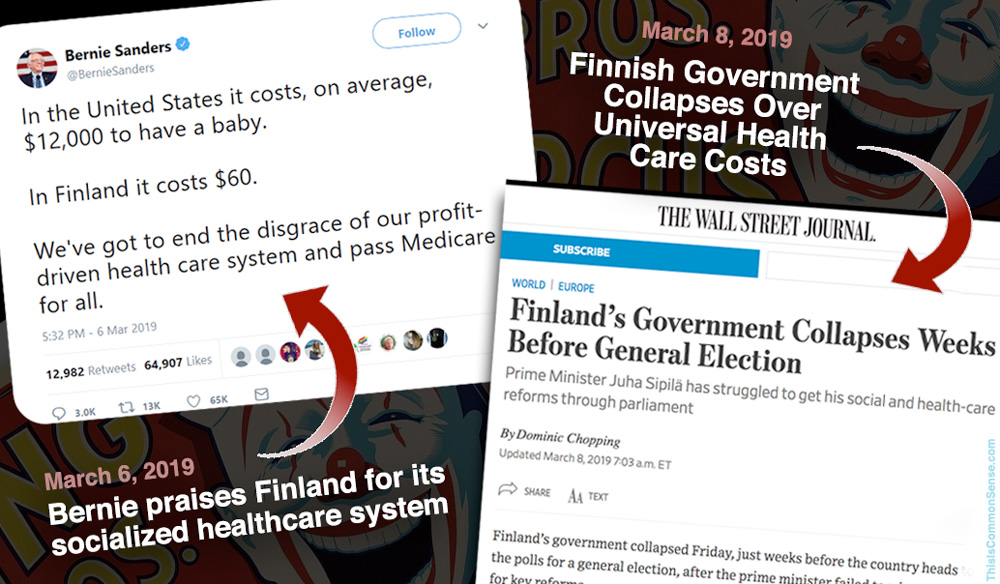
This normally wouldn’t faze me much. I have to navigate our American mess, er, system. But Finland’s medical service delivery system is relevant to Americans — as is Denmark’s and Norway’s and Sweden’s — because the current crop of Democratic presidential hopefuls tout these “Scandinavian socialist” programs as models to follow.

Yet Finland’s program is in crisis.

How bad is it?

Bad enough for Finland’s government to fold early, before an election, with Prime Minister Juha Sipilä throwing in the towel earlier this month. He had been struggling “to get social and health-care reforms that he made the cornerstone of his government’s four-year term through parliament,” The Wall Street Journal informs us. Finland’s health care system is somewhat decentralized, and that quality of service varies district by district. Silipä had been trying to centralize administration while also allowing for some privatization.

Left-leaning parties have balked at this, hence the impasse.

So, what is the lesson? A medical delivery system should be anti-fragile, capable of functioning despite incompetents or corrupt officials in government, despite voting blocs at loggerheads. A vast segment of the service industry should not be held in hock to the political machinations of special-interest groups.

Behind all of it, though, is the looming demographic crisis: the population of Finland, like here in America and throughout the First World, is aging. This puts heavy stressors on welfare-state systems run on a Ponzi-like re-distributive basis.* Of course costs will increase and service levels will fall, given how it’s all set up.

But once in place, government-run medical systems do not heal themselves.

This is Common Sense. I’m Paul Jacob.


* An endemic problem for socialists, which they try to ignore. See “Finland: Government Collapses Over Universal Health Care Costs, #Bernie2020 Hardest Hit.”

PDF for printing

Bernie Sanders, Finland, health care, socialism, single payer, costs, spending

See all recent commentary
(simplified and organized)
See recent popular posts

Categories
ideological culture Popular

The Ominous Linkages

What does a 16-year-old Swedish girl have in common with a popular 29-year-old U.S. Representative?

Environmentalism and socialism.

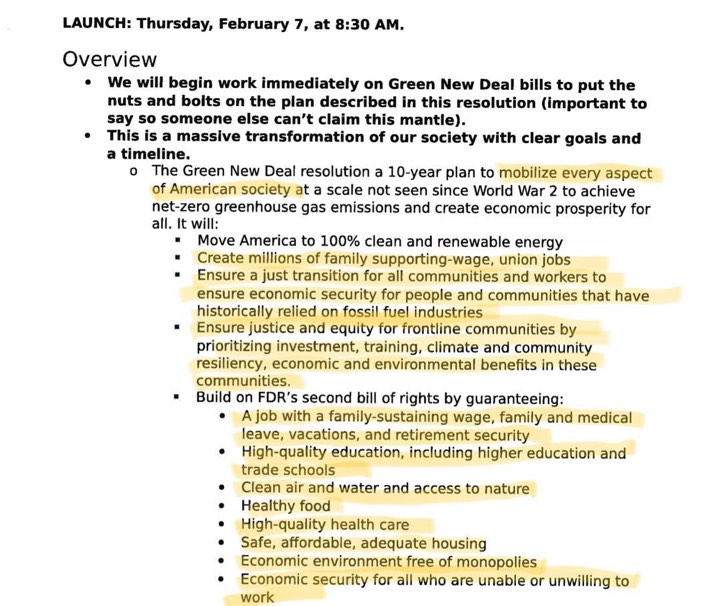
The young woman is Greta Thunberg, who spear-headed a “global movement of schoolchildren striking to demand climate change action.” The Representative is AOC, er, Alexandria Ocasio-Cortez (D-N.Y.), who last month launched her “Green New Deal.”

Sixteen-year-old Thunberg has been nominated for a Nobel Peace Prize. Rep. AOC hasn’t been nominated yet, but if Barack Obama could be awarded a Nobel merely for being elected. . . .

But back to that linkage: the Swedish youngster was nominated by three adult members of the Socialist Left Party; AOC calls herself a socialist.*

But what’s the deeper link? 

The solution, apparently: socialists want to destroy capitalism, or at least commandeer it; and environmentalists obsessed about anthropogenic global warming believe it’s caused by burning fossil fuels and by bovine flatulence — both made worse by capitalism, which has allowed the masses (not just the elites) to harness petroleum for power as well as raise gigantic herds of cattle for eating and milk-production. The direct control that socialism entails serves, say its advocates, as the only way to curtail carbon emissions.

A more likely story? Socialism would make us so much poorer that it is inconceivable that most of us would be able to afford to drive cars or eat steaks or drink milk.

Regardless of their so-called “green” policy obsessions, Ms.Thunberg and Rep. AOC are green in a more profound sense, of lack of experience — the latter because she’s young, the former because she’s a miseducated ideologue.

This is Common Sense. I’m Paul Jacob.


* It is also worth noting that the much of AOC’s much-ballyhooed Green New Deal has nothing to do with climate change and everything to do with typical leftist social engineering.

New Green Deal, FAQ, socialism, environmentalism, global warming, climate change,

PDF for printing

Alexandria Ocasio-Cortez, Alexandria Ocasio Cortez, Green New Deal, socialism, Greta Thunberg,

See all recent commentary
(simplified and organized)
See recent popular posts
Categories
Accountability ideological culture initiative, referendum, and recall

March Sanity

“A public debate on the merits of a measure can reveal its flaws,” the Bismarck Tribune calmly and reasonably editorialized yesterday, “and then we have to trust voters to do the right thing.”

“Why are some legislators so afraid to allow North Dakota voters to decide what is in their constitution?” an earlier Fargo Forum editorial asked. The Forum dubbed one bill — giving the legislature a partial veto on voter-enacted constitutional amendments — “The Voter Nullification Act.” 

On the voter initiative, North Dakota’s elected representatives are of a much different mind than these newspapers or the people of North Dakota.

The Flickertail State is hardly alone on this. 

Michigan’s legislature made their ballot initiative process more difficult in last December’s lame-duck session. Arkansas politicians have been stabbing at the initiative with rules and regulations for years, and they’re back at it this session. On a recent trip to the Missouri capitol, I heard elected officials privately argue that voters deciding issues directly — without going through the legislature — was a “bastardization” of our republic. 

Take Idaho’s Senate Bill 1159, which would hike up the signature requirement from 6 to 10 percent of voters, a 67 percent increase, while also reducing by two-thirds the time allowed for petitioning. The legislation’s stated purpose? “[T]o increase voter involvement.”

“It is odd,” wrote former state Supreme Court Justice Jim Jones in the Idaho State Journal, “that some in the Legislature now wish to drive a stake into the heart of that people-driven legislative process.”

It’s not really very odd. Legislators routinely put their political self-interest before the people — especially when it comes to voters having a democratic check on their power. 

This is Common Sense. I’m Paul Jacob.


PDF for printing

North Dakota, initiative, citizen initiative, ballot initiative, democracy, suppression

See all recent commentary
(simplified and organized)
See recent popular posts

Categories
ideological culture Popular too much government

The Hilarity of a Serious Threat

Is today’s politics tragic or comic?

Take the current Democratic Party obsession with socialism. There is nothing more tragic than full-blown socialism: mind-control and the snitch society; purges and mass starvation, with millions upon millions dead. But give them credit: the trendy new Democrats say they’re only for the Nordic Model of . . . well, the European term for it is social democracy.*

But they sure seem to push for evermore government.

Worse yet, they too often defend actual Communist countries — as Bernie Sanders (BS) has done.

This suggests an unfunny ending to their mad rush to power.

So the proud proclamations of the s-label from BS and Alexandria Ocasio-Cortez (AOC) should concern us, as should the eagerness with which the majority of Democratic presidential candidates have signed onto AOC’s over-the-top proposed takeover of the economy in her “Green New Deal.”

And yet . . . these politicians are absurd, on the face of it as well as when we drill down.

It’s hard not to regard absurdity as comic. 

The b.s. doesn’t end with BS.

Sure, our current president is a comic figure, too. And the pathetic nature of most GOP movers and shakers on Capitol Hill make them worthy of satire.

But it is also the case that Trump is funny in a way no one else is: he is playing a role and making many chortle. On purpose.

Too bad we couldn’t move him from the Presidency to a new Constitutional role, like Troll-in-Chief. There he could ensure, through mockery alone, what he promised in his State of the Union Address: America will never become a socialist country.

This is Common Sense. I’m Paul Jacob.


* Denmark, Sweden, etc., support extensive markets and a surprisingly hands-off approach to business — comparable to that of the U.S., and in some ways more lax — combined with extremely high taxes and vast transfers of wealth. You could call this “democratic socialism,” but . . . why?

PDF for printing

socialism, comedy, tragedy, Bernie Sanders, democratic socialism

See all recent commentary
(simplified and organized)
See recent popular posts
Categories
ideological culture national politics & policies too much government

Warren’s No Socialist

Senator Elizabeth Warren knows that when people trade, both sides gain. She made that clear last year, in a fascinating interview in The Atlantic. But then she went blithely on, saying that she could fix markets by creating a “level playing field.”

Markets create value, but Mrs. Warren asserts that “when the markets are not level playing fields, all that wealth is scraped in one direction.” 

How? People are still trading, even in bumpy playing fields. 

She turns to the crisis of 2008, when many people discovered that they had entered into unsustainable mortgages. She explains how her shiny new regulatory program leveled that playing field.

But her scheme did not even out the bumps in the mortgage industry that existed before the crash:

  • the moral hazard of Fannie Mae and Freddie Mac, 
  • the previous congressional “fix” that pushed banks to accept poor people as good loan risks when they were not (in the name of racial justice, of course), 
  • the regulatory rule that created ratings agencies sans competitive market incentives, and
  • the Federal Reserve policies that fed the whole housing bubble mania.

She just added another burdensome layer of government.

Politicans sure love to pile on.

Now she offers a new scheme, a child-care program that Reihan Salam, this week again in The Atlantic, says “risks increasing the federal deficit, driving up the cost of child care, and squeezing stay-at-home parents.” 

And Mr. Salam says that last risk is one Warren should understand particularly well, since she had “made her reputation as a public intellectual by warning against it.”

Warren’s no socialist — she wants to “save capitalism”! Yet by only adding to government kludge, she might as well be one.

This is Common Sense. I’m Paul Jacob.


PDF for printing

Elizabeth Warren, housing bubble, crash, regulations, finance

See all recent commentary
(simplified and organized)
See recent popular posts