Categories
Accountability folly free trade & free markets general freedom moral hazard nannyism national politics & policies responsibility too much government U.S. Constitution

According to Logic

“Polling on every possible option confounds all logic,” or so writes Tiana Lowe about ObamaCare and its repeal, at National Review.

“Americans overwhelmingly dislike the individual mandate and prioritize lowering the cost of health care over all other health problems in the country,” Ms. Lowe elaborates, “but a majority of Americans do not want to roll back Obamacare’s guaranteed coverage of pre-existing conditions. Just a quarter of Americans are happy with Obamacare as-is, but a mere 12 percent favor the now-dead Senate health-care bill.”

Perceptively, she notes that the situation is as bad or worse for politicians, who want to “have their cake and eat it too.” The problem with politicians is pretty obvious: they lie because they are afraid of confronting the truth.

But it seems to me, on the evidence Lowe herself provides, Americans mostly have it right.

We want to lower costs of health care. Well, that should be the first priority. It should’ve been government’s highest priority, since government caused our predicament.

A huge supermajority is unhappy with ObamaCare, which makes sense. The Affordable Care Act is not affordable. But the Senate health-care bill was worse than ObamaCare, so folks were right to oppose it.

The only real issue? Many Americans don’t seem to understand that the “pre-existing coverage” mandate necessarily raises costs. Forcing insurance companies to pay for non-eventualities* requires them to pass those extras onto customers in general. Here is where leadership would be of help.

And where it has failed, our President most of all.

Lowe criticizes Trump for not pushing the Senate’s bill more effectively. I’m thankful for that.

This is Common Sense. I’m Paul Jacob.


* Insurers wager against unpredictable future illness or accident, not the sucker’s bet of paying for an existing predicament.


Printable PDF


Categories
Accountability crime and punishment folly free trade & free markets local leaders nannyism national politics & policies too much government

Messed Up State

After lamenting Illinois’s fiscal decline into America’s “most messed up” state yesterday, lo and behold, today we find the State of Nevada messed up, too.

On marijuana.*

Question 2, passed by voters last November, legalized recreational use of what we used to call “weed” by those 21 years of age and older. The measure also stipulated that — for the first 18 months only — alcohol distributers are solely permitted to carry marijuana from wholesalers to the new retail dispensaries.

Why provide a monopoly to alcohol distributors?

“[T]he state’s powerful alcohol lobby worried that legalized weed would cut into liquor store sales,” explained the Los Angeles Times. Proponents added that provision as “a concession.”

But still not a single alcohol distributor has been approved to distribute marijuana.

So, with pot now flying off the shelves of Nevada’s 47 marijuana dispensaries, there is no lawful way to replenish those shelves. Nevada’s DOT (which requested from the governor an official declaration of a state of emergency) warns: “this nascent industry could grind to a halt.”

That’s not just a bummer for pot smokers; it has the governor and the DOT in a state, too. “A 10% tax on sales of recreational pot — along with a 15% tax on growers — is expected to generate tens of millions of dollars a year for schools and the state’s general fund reserves,” notes the Times.

Legalize marijuana, sure. And realize that the politics of it can be more toxic than the drug itself.

This is Common Sense. I’m Paul Jacob.


*Is that why the slogan “A World Within, A State Apart” is now featured on the state’s website?


Printable PDF


Categories
free trade & free markets general freedom nannyism national politics & policies property rights responsibility

Mr. Jetson, Call Your Office

Increasingly, people are worrying about robots.

They’re taking our jobs, we’re told. Soon, all we’ll have left are robots. Massive unemployment!

While some find this scenario utopia and bliss,* it sounds dreadful to me.

Silver-plated lining is, I doubt it. This kind of worry about technology making laborers obsolete has been around at least since Ned Ludd, who broke factory machinery to save jobs back in 1779.

How is this next wave of technology any different? If technology destroyed jobs on net, we’d all be unemployed now.

Economist Deirdre McCloskey takes this historical view. Writing in Reason, she says today’s high-tech “innovations have actually raised real wages, correctly measured, because a human supplied with a better tool can produce more outputs. And the point of an economy is production for consumption, not protection of existing jobs.”

We’ve always been losing jobs. And new ones are created. Our worry shouldn’t be the jobs lost to new tech, but the lack of new ones coming into existence because of the oldest tech of all: government.

But you know what industry is least resistant to jobs vanishing to robots? Government itself. Sure, some reductions in public sector jobs have occurred, mainly as a result of decreased revenues in the recent “recession.” The job losses there have not been filled by robots, though. Permanent employee positions have been destroyed . . . too frequently replaced by outsourced consultants.

Could robots replace large swaths of public employees? Maybe that wouldn’t be good, actually. The worst-case scenario might be this: government becoming efficient.

We don’t want bad and efficient government.

Kludge may be better.

This is Common Sense. I’m Paul Jacob.


* Some even see in this development a sort-of science-fiction rationale for making socialism at long last plausible — robots as the new slave class; all the humans in the leisure class! Yeah, right.


Printable PDF


Categories
Accountability folly free trade & free markets ideological culture media and media people national politics & policies

Next Bubble to Pop?

There was a great and wondrous moment, a decade and a half ago, when economist Paul Krugman, Nobel Laureate and New York Times’s unregistered shill for the Democratic Party, suggested that what the economy really needed was another housing bubble.

What he wrote, specifically, was this: “To fight this recession, the Fed needs more than a snapback; it needs soaring household spending to offset moribund business investment. And to do that, as Paul McCulley of Pimco put it, Alan Greenspan needs to create a housing bubble to replace the Nasdaq bubble.”

Krugman later reinterpreted that statement in a clever (if not convincingly honest) way. After the subprime loan industry collapsed in 2008, he attributed that bust to financial market malfeasance, not the Fed-inflated bubble we got . . . and that he had previously called for.

Now we are looking at several ready-to-burst bubbles:

  • The student loan debt problem seems scary.
  • The sovereign debt problem is undoubtedly more dangerous and far larger, but is perhaps still able to take on more fake money — all the world’s 1s and 0s have to go somewhere!
  • So the current bets seem to be on a huge auto loan industry bubble, about to pop.

Loan terms have increased in duration, and the average amount new car buyers are financing has jumped over 17 percent in five years. The idea has been “to continually lower monthly payments,” says David Stockman, “so people can get behind the wheels of vehicles they can’t really afford.”*

Which bubble does Krugman favor? I don’t have the stomach to check.

But, be certain, as we play pop goes the bubble, he’ll play pop goes the weasel.

This is Common Sense. I’m Paul Jacob.


* Stockman seems to be echoing warnings made by Eric Peters, of Eric Peters Autos.


Printable PDF


Categories
Accountability folly free trade & free markets general freedom local leaders moral hazard nannyism national politics & policies property rights responsibility too much government

Against Flexibility?

Do politicians have any idea what they are doing?

In Oregon, Senate Bill 828 just passed the Senate and is now being favorably reviewed in the House. The law would require “large employers in specified industries to provide new employee[s] with estimated work schedule and to provide current employee with seven days’ notice of employee[’s] work schedule.”

But will the measure help employees? Really?

The notion is called the “Fair Work Week.” Pushed by Democrats, it has gained bipartisan support. The basic idea: allow time (under full force of law) for workers to manage their own schedules and personal economies.

Trouble is, in the name of making work easier to manage, it attacks flexibility.

Which is something many workers want. More than notification.

Indeed, the study commissioned by the City of Seattle for their similar regulatory scheme acknowledged that reducing flexibility is not necessarily a godsend for workers.

“A more predictable schedule,” the report noted, “is not always one that an employee would prefer. A schedule known with certainty is a cold comfort if it yields too little income to survive.”

The report went on to explain that many of the labor market’s scheduling inconveniences are themselves the result of other government regulations, such as ObamaCare.

Christian Britschgi, writing at Reason, predicts that passing the Oregon law would mean “a fairer worker week” for some, but for others, “no work week at all.”*

Meanwhile, the Seattle study noted that it was workers in small businesses who are most likely to be discomfited by last-minute scheduling changes. The Oregon law applies only to big businesses.

This is Common Sense. I’m Paul Jacob.


* A standard, negative consequence of most “well-intended” legislation.


Printable PDF


Categories
folly free trade & free markets general freedom ideological culture moral hazard nannyism national politics & policies property rights responsibility too much government

Minimally Mugged By Reality

It should shock no one: forcing businesses to pay steep minimum wages ends up pushing some businesses out . . . of business. Yesterday I looked at what minimum wage laws can do to low-skilled workers. Today, consider the employers. When we make it harder to turn a profit, it becomes harder to profit. Businesses that can’t at least break even close their doors.

Many business owners are inclined to promote, politically, politicians who in turn support minimum wage hikes. Do they change their minds when mugged by reality? Alas, the trauma alone won’t convert a person to principled allegiance to free markets.

I was reminded of this fact by a story about business owners in Minneapolis who stress their Sandernista credentials.  

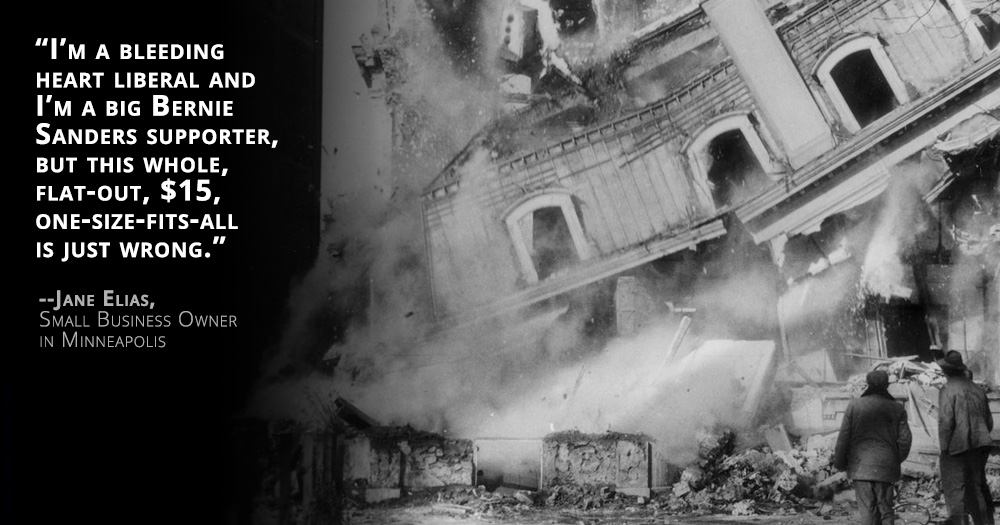
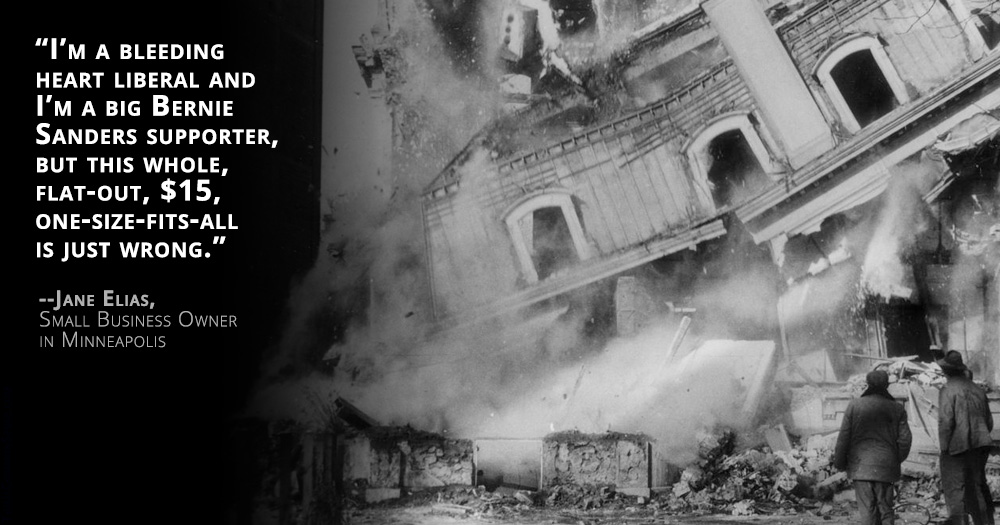
“I’m a bleeding-heart liberal and I’m a big Bernie Sanders supporter,” says businesswoman Jane Elias, an art store owner. “But this whole flat-out, $15, one-size-fits all is just wrong.” Another victim, restaurant owner Heather Bray, says she’s a “proud, proud progressive.” But: “The arithmetic doesn’t work. People will not continue to go to budget-conscious restaurants when they’re no longer budget-conscious.”

So . . . arbitrary minimum-wage demands don’t add up in light of the demands of running their businesses under their particular circumstances. Well, no disagreement here. But take it further, please. Keep doing the math. The bottom line is that everybody, not just you — and always, not just sometimes — has the right to make his own decisions about his own life and property.

And profit by it.

This is Common Sense. I’m Paul Jacob.


Printable PDF


Categories
free trade & free markets general freedom local leaders national politics & policies political challengers property rights responsibility too much government

The Real ObamaCare Opposition

Senate Majority Leader Mitch McConnell (R-Ky) has introduced a bill to compromise between the House’s recent Affordable Health Care Act and the current “ObamaCare” Affordable Care Act. Though there seems to be some “what the heck, go with it” enthusiasm for it on Capitol Hill, it’s not coming from Senators Rand Paul of Kentucky, Ted Cruz of Texas, Ron Johnson of Wisconsin and Mike Lee of Utah.

‘‘Currently, for a variety of reasons, we are not ready to vote for this bill,” their joint statement from yesterday reads.

Their objections? Well, they agree that there are “provisions in this draft that represent an improvement to our current healthcare system but. . .”

— and this is a big but

“it does not appear this draft as written will accomplish the most important promise that we made to Americans: to repeal Obamacare and lower their healthcare costs.’’ Their opposition, the Boston Globe tells us, puts the TrumpCare wannabe in jeopardy.

Dr. Rand Paul is the key figure in the opposition. One of Capitol Hill’s ongoing amusements has been to watch the junior Kentucky senator repeatedly pit himself against his state’s senior member — who, the Globe tells us, now threatens “to bring the bill to a vote next week even if he doesn’t have the necessary votes.”

Pressure tactics.

Which you need to put an obviously bad bill through Congress.

Too many mainstream Republican congressmen lack the courage of their constituents’ convictions. They apparently do not really believe that a freed-up health care system and insurance market can work to the general good.

At least, not in time for the next election.

This is Common Sense. I’m Paul Jacob.


Printable PDF


Categories
crime and punishment folly free trade & free markets general freedom nannyism national politics & policies responsibility too much government

Serving Consumers? Punish!

New media ballyhooer Douglas Rushkoff made waves this week. Citing an un-named friend who went hysterical about Amazon.com’s purchase of Whole Foods, he asserted that such “unease is widespread, and has raised new calls for breaking up Jeff Bezos’s impending monopoly by force.”*

The company has “surely,” he claimed, “reached too far.”

Apparently, serving customers exceptionally well is bad for business.

Yes, he almost totally ignored the pro-consumer benefits of Amazon. Had to — his case makes no sense when you factor in us consumers. He focused, instead, on Amazon’s success in terms of its recent “online and offline retail sales growth” and its control of 40 percent of cloud storage and streaming services.

He went on to spin a bizarre fantasy about how disruptive bigness is in business. His economically illiterate farrago reminds me of the sad case made against pre-antitrust Standard Oil, a company which, during the whole time of its growth prior to break-up, kept on producing more fuel at ever-decreasing prices.** Broken up because of . . . fears about how businesses change. And of bigness itself.

As long as consumers are being served, this reaction strikes me as paranoid. When businesses get big (and even near-monopolistic) and then cease to serve customers, they fail. While serving customers, there is no call for fretting over businesses that move from one success to another  — which is what Rushkoff has the gall to worry about.

The call for Amazon’s break-up over-sells government and necessarily under-serves consumers.

This is Common Sense. I’m Paul Jacob.


* Rushkoff’s piece in Fast Company was the first I heard of such a “call.” Rushkoff is the coiner of the term “media virus” and a sort of populist pusher of market skepticism.

** For the bizarre story of the Standard Oil case, and how it made no economic sense whatsoever, see Dominick T. Armentano, Antitrust: The Case for Repeal (Ludwig von Mises Institute, 1999), p. 41-43, and Antitrust and Monopoly (Independent Institute, 1990), pp. 57-60.


Printable PDF


Categories
Accountability folly free trade & free markets general freedom initiative, referendum, and recall local leaders moral hazard porkbarrel politics responsibility too much government

Go Nats?

Just a few miles away from where I live sits the stadium of the Potomac Nationals. I’m a fan. I’d hate to see the team we call the P-Nats leave.

But . . . Hasta la vista.

The owner of this minor league affiliate of Major League Baseball’s Washington Nationals is demanding a new stadium. He threatens to move out of Prince William County, Virginia, if he does not get it.

The Prince William County board of supervisors has already expressed interest in floating bonds to raise the $35 million the fancy new stadium would require — with the privately owned team paying the money back, with interest, over the next 30 years.

Compared to other crony-ish deals around the country, not such a terrible taxpayer swindle. Still, zillions of wrongs don’t make this right. County taxpayers would be on the hook in case of default. And if the marketplace believed the team could actually make such payments, a bank or other investors would come to the rescue.

Thankfully, a monkey wrench has been thrown into the deal. A county supervisor has proposed that voters should get a chance to decide, via a November referendum. The board of supervisors will consider the referendum tonight.

Voters should get the final say. But if there is a referendum, as much as I love having the team here, I will vote NO. I don’t cotton to forcing others to pay for my preferred entertainment.

Government has certain legitimate roles. Subsidizing sports is not one.

Even if the new stadium would be closer to my home than the old one.

This is Common Sense. I’m Paul Jacob.


Printable PDF


Categories
free trade & free markets general freedom national politics & policies responsibility

The Poverty Retirement Non-plan

A “conundrum” is “an intricate and difficult problem” or “a question or problem having only a conjectural answer.”*

In his June 8 article, “The Jobs Conundrum,” economist Gerald P. O’Driscoll focuses on a very big problem that we do not have sure answers to, yet.

Unemployment figures are down, but the number of non-working adults in the prime of their lives is up. O’Driscoll explains: “Unemployment” is a term of art and does not mean simply the number of people not working. It comprises the number of people not working and who are looking for a job.” Many aren’t “unemployed” for the simple reason that they are not trying to be employed.

They are, I suppose you could say, in early retirement, mostly a kind of poverty retirement.

Economists call it a drop in “labor force participation.” It used to be that men in the prime of life not looking for work constituted a mere 6 percent of the population. Now it’s 15 percent.

O’Driscoll, I notice, doesn’t engage in much conjecture to explain why. He merely insists, instead, that the trend is big, unemployment figures don’t track it, and that it has huge consequences.

I’ve heard some interesting (and puzzling) theories about the whys, of course. Blame feminism; blame the welfare state; blame the Chinese!

But even before we settle on a definitive answer, many movers and shakers now contemplate establishing — and are even experimenting with — a universal basic income as a way to alleviate this problem.

My conjecture? It would make the problem worse.

This is Common Sense. I’m Paul Jacob.


* The original, primary meaning of “conundrum” — “a riddle whose answer is or involves a pun” — is not relevant to this pun-free column.


Printable PDF