Categories
Accountability crime and punishment folly free trade & free markets general freedom judiciary local leaders moral hazard nannyism Second Amendment rights too much government U.S. Constitution

Ought Implies Cantifornia

“Strip away the absurdity,” writes Scott Shackford at Reason, “and it’s essentially a very technical ruling.”

Shackford is explaining a bizarre recent judgment of the California Supreme Court.

Politicians in Sacramento had, years ago, passed a gun control measure requiring gun manufacturers to “implement microstamping technology that would imprint identifying information on bullets as they were shot from semi-automatic weapons.” In 2014, Smith & Wesson announced that it would pull some guns from the California market rather than comply. Why? The technology just wasn’t ready yet.*

Since California’s Civil Code contains a section reiterating an old commonsense principle to the effect that the “law never requires impossibilities,” the National Shooting Sports Foundation sued to block the law.

But the group just lost.

The Court did say it could protect citizens from punishment, but it refused to nullify the legislation on constitutional grounds.

Unanimously.

Why do this? Apparently to protect California politicians in their ongoing social engineering schemes.

The dollar costs of trying to comply with impossible demands are huge, of course. But the biggest costs may be more subtle.

In moral philosophy, it is a truism to say that “ought implies can.” In natural law as understood long ago, an impossible law was thought not a law at all, justifiably ignored by anyone and everyone.

In a just state, flouting of maddening regulations like California’s would lead not merely to the defense of the absurdly put-upon citizen — as this court ruling still allows — but also to the nixing of the “impossible” law.

This is Common Sense. I’m Paul Jacob.


* Shackford notes that “a cynic might theorize that this is the law’s actual intent.” I wouldn’t limit that suspicion to folks given to cynicism. Pragmatists and political scientists and almost anyone else would be placing bets on that, too.


PDF for printing


Categories
Accountability crime and punishment folly free trade & free markets general freedom ideological culture moral hazard nannyism national politics & policies privacy property rights responsibility too much government

Working to Boost Unemployment

Some government officials work overtime to throw people out of work.

What I’m referring to differs from losing your job or business because of slack performance or slackening sales. Instead, you lose the right to earn your living a certain way so that the government can benefit competitors at your expense.

Occupational licensing is great at dis-employing people. The regulations are especially galling when the work being regulated obviously requires no formal training in order to be done well and safely.

Hair braiding, for example.

The Institute for Justice — which has done incredible work over the years representing victims of destructive government mandates — just won a victory for hair braiders in Iowa. Thanks to IJ’s efforts, a new law there exempts braiders from having to waste time and money getting a cosmetology license in order to practice their craft.

Such battles are never won permanently, of course. Washington, D.C., recently started requiring day care providers to get a college degree or lose their job. (As I have argued in a Townhall column, the same “logic” would justify forcing people to get college degrees to become parents.) IJ is helping affected parties to challenge the absurd law.

It is time for a new licensing requirement. Nobody gets to become a local, state or federal lawmaker unless he first writes a million times in a row, “I will never help violate the rights of any man or woman to earn an honest living.”

This is Common Sense. I’m Paul Jacob.


PDF for printing


Categories
crime and punishment folly free trade & free markets general freedom initiative, referendum, and recall local leaders nannyism national politics & policies privacy

Legalize Cancer Fighting

“Do all former congressmen have to get cancer before we’re gonna get medical marijuana or recreational marijuana?”

That’s what Reason TV’s Nick Gillespie asked Billy Tauzin at the Cannabis World Congress and Business Exposition. Tauzin’s a former Representative for Louisiana’s 3rd District. He moved from Congress to lobbying for Big Pharma — I mean, PhRMA, a drug lobbying group — and then to Lenitiv Scientific, where he works now.

The company produces “a line of innovative, high quality cannabis and hemp-derived CBD products,” its website informs. These products, says the former Republican politician, are so effective that he now expresses some regret that he could not have had access to such drugs when he was fighting cancer more than a decade ago. Today’s cancer patients have it easier, because of cannabis-derived products, including CBD.

Hence Gillespie’s question — which almost answers itself.

With a No.

The number of states that have legalized or decriminalized marijuana for recreational or medicinal uses (or both) is growing all the time, usually without the help of politicians with or without cancer.

The movement has mostly been carried on by We, the People through initiative and referendum. Especially the crucial early steps.

But politicians are beginning to follow our leadership.

Which, in a society where citizens are in charge, is all to the good.

Though powerful opposition remains, Tauzin speculates, “I think if we took a silent vote, secret ballot, we’d win tomorrow easily.”

So, given a little more time for Congress to catch up with the culture, freedom can prevail, no cancer necessary.

This is Common Sense. I’m Paul Jacob.


PDF for printing


Categories
crime and punishment free trade & free markets general freedom ideological culture media and media people moral hazard national politics & policies privacy property rights responsibility U.S. Constitution

Wouldn’t Freedom Be … Easier?

To bake or not to bake, that is the question.

Actually, the question was may a state discriminate against Christians in regulating “public accommodations”? The Supreme Court has decided, in a supermajority 7-2 ruling, that the Colorado Civil Rights Commission wrongly prosecuted a Christian baker who would not make a special wedding cake for a gay couple — while the Commission shrugged when it came to bakers who wouldn’t bake Bible verse cakes.

The ruling came down along the lines I suspected in December: Equal protection. This narrow ruling focused “on what the court described as anti-religious bias on the Colorado Civil Rights Commission when it ruled against baker Jack Phillips,” Fox News informs us.

In his majority opinion, Justice Anthony Kennedy censured the “Commission’s hostility” to Phillips. And Kennedy recognized the root problem, the “difficult questions as to the proper reconciliation of at least two principles”:

  1. “the authority of a State and its governmental entities to protect the rights and dignity of gay persons”;
  2. “fundamental freedoms under the First Amendment, as applied to the States through the Fourteenth Amendment.”

Ah, discrimination. Has picking at this, like a scab, really increased comity? It sure would be easier were we to stick to freedom of association.

Wouldn’t that dredge up less animus?

States should not engage in invidious discrimination. Sure. Vital.

But businesses? Must they serve anyone and everyone? Even when it requires the baker or florist to create something custom — or the pianist to perform? Especially when customers can easily go to a competitor?

Besides, in Colorado, anti-discrimination laws were used by government to persecute Christians.

This is Common Sense. I’m Paul Jacob.


PDF for printing


Categories
Accountability crime and punishment folly free trade & free markets insider corruption media and media people moral hazard national politics & policies porkbarrel politics property rights responsibility too much government

Déjà vu All Over Again

One of the stand-bys of the post-2008 mortgage finance bust, at least from left-of-center policy mavens, has been to ask: why has no banker gone to prison? They played a game of fraud and got rich. What a protected class — Cronyism! Plutocracy! Capitalism!

The why is much easier to understand if you read up on Round Two of the aughts’ boom-bust scenario, as in Prashant Gopal’s coverage in Bloomberg, “Getting Rich on Government-Backed Mortgages.” Gopal spotlights a non-bank mortgage broker, Angelo Christian, who is making a killing selling houses to people with horrible credit, just as happened before 2008.

“Christian can do this kind of deal because he is, in effect, making the loan on behalf of the federal government through its most important affordable housing program,” Gopal writes. “It’s a sweet deal: He gets his nearly risk-free commission. [His client] puts no money down. If things go south, the government ultimately bears the risk.”

So, should he go to jail?

Not really. He’s merely doing Congress’s bidding.

Gopal notes that it is not banks that dominate this round. They are under too much scrutiny. But non-banking loan intermediaries like Mr. Christian are swarming like flies on a cow’s behind.

There’s a problem in Gopal’s account though. “No one is saying the system is close to another collapse.”

Well, plenty of people are saying that.

The Cassandras are just not being heeded.

Of course, they don’t know when the bust will happen.

They just know it will.

This is Common Sense. I’m Paul Jacob.


PDF for printing

Photo by Images Money on Flickr.


Categories
Accountability free trade & free markets general freedom media and media people national politics & policies responsibility too much government

Working for Whom?

Two articles on Sen. Rand Paul appeared in my Reason feed the other day. Up top.

So it was hard not to look.

They were “John McCain: It ‘Wasn’t Incorrect’ to Say Rand Paul Was ‘Working for Vladimir Putin’” and “Rand Paul’s Plan to Balance the Budget by 2023 Will Get a Senate Vote This Week.”

The latter story is the bigger one, of course. In it, Eric Boehm asked, “Do Republicans have the guts to impose strict spending caps?”

His answer was “probably not.” Good guess.

“Passing the Kentucky Republican’s so-called ‘Penny Plan’ would be a dramatic reversal for Congress,” Boehm wrote, “which earlier this year approved enormous spending hikes that busted Obama-era spending caps and threaten to put the country on pace for a $1 trillion annual deficits. . . . Paul tells Politico that it will be a ‘litmus test for Republicans who claim to be conservative, but are only too happy to grow the federal government and increase our debt.’”

I am afraid the litmus paper has turned . . . red. As in red ink. As in accumulating debt till we drop.

Yesterday Paul’s plan was voted down, 21-76.

In the other Reason piece, Matt Welch noted that Arizona’s senior senator stands by his calumny, last year, against Kentucky’s junior senator. Paul had delayed “ratification of Montenegro’s entry into the North Atlantic Treaty Organization (NATO).” McCain, a gung-ho NATO expansion proponent, accused Paul of “working for Vladimir Putin.”

If Putin really seethes with ill will towards America, wouldn’t he want to see the country burdened with debt?

So, on this vote, those 76 senators who didn’t “stand with Rand” are undoubtedly working for Putin.

This is Common Sense. I’m Paul Jacob.


PDF for printing


Photo of Rand Paul by Gage Skidmore | Photo of John McCain from Wikimedia Commons


Categories
Accountability folly free trade & free markets ideological culture local leaders moral hazard nannyism property rights too much government

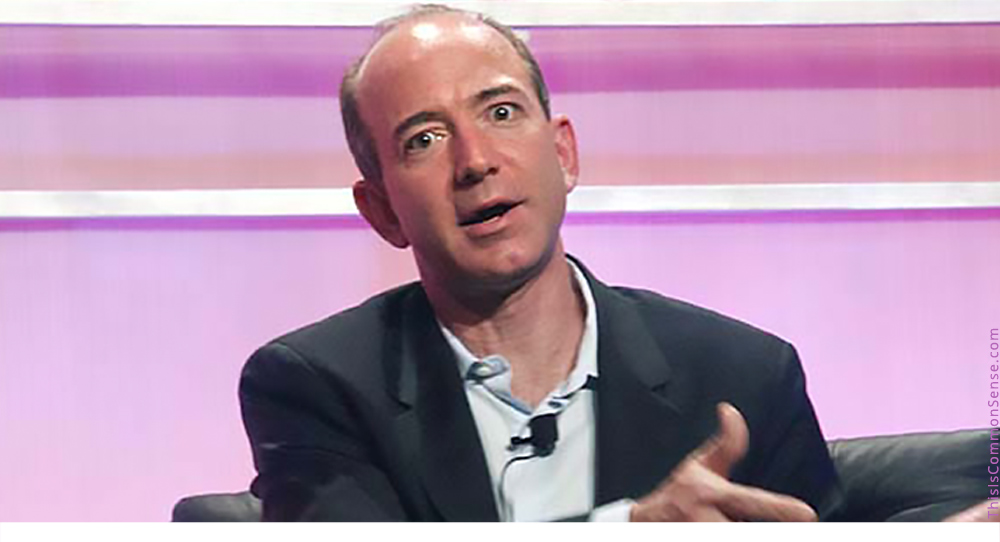
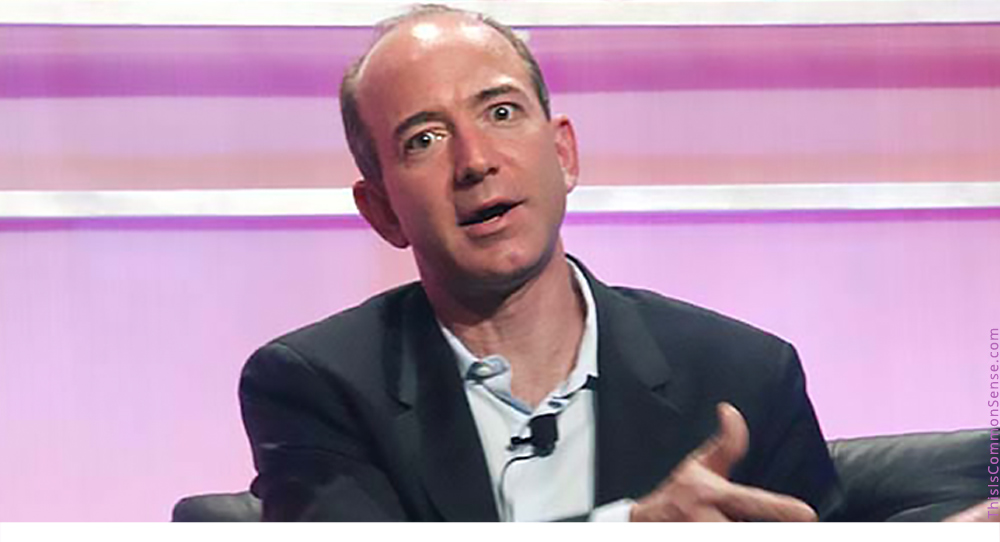
Amazon’s Jeff Bezos Is …

A half a year ago, when trying to make sense of the much-publicized search for Amazon’s “HQ2” — a second headquarters city, away from Seattle — I concentrated on the subsidies that cities and metro areas were apparently throwing at Amazon.

It all seemed desperate, indecent.

But there was a story behind the story. Amazon has every reason to be looking for an escape route from the Evergreen State’s biggest city.

The city’s leadership is nuts.

“Seattle City Council members have finally released draft legislation,” the Seattle TimesDaniel Beekman wrote last month, “for a new tax on large employers that would raise $75 million next year to address homelessness.”

The council blames the big companies for enticing workers into the city, thereby driving up rental costs and housing prices.

The tax would be on employee hours, would go into effect next year, and “in 2021, it would be replaced by a 0.7 percent payroll tax on the same category of companies,” explains the Seattle Times.

Now, if you tax something you discourage that something. That’s why progressives like sin taxes on sodas and fast foods. To discourage consumption.

So when progressives seek to tax big producers, they are apparently trying to tax away the housing crunch by driving away big business.

Amazon reacted. It put a halt to an expansion project.

“Jeff Bezos is a bully,” said Kshama Sawant, the confessed socialist, speaking for the council. “I think we are in broad agreement on that.”

If that is her attitude, and that of the council — and the consensus of the city’s denizens — then what Amazon’s Jeff Bezos really is?

A “good businessman.”

This is Common Sense. I’m Paul Jacob.


PDF for printing

Photo by JD Lasica


Categories
crime and punishment free trade & free markets general freedom media and media people moral hazard nannyism national politics & policies property rights too much government U.S. Constitution

The Studio System: The Sequel

Evermore virtue signaling, everless virtue — that pretty much encapsulates Oscars’ night. The industry that brought us Harvey Weinstein and the occasion for #MeToo made the 90th Academy Awards two months ago unwatchable for most of us.

Now, as the Academy of Motion Pictures Arts and Sciences loses touch with audiences around the country, Netflix appears to have decided to horn its way into the Oscars. “Netflix will reportedly begin purchasing movie theatres,” informs The Independent, “to help it get ahead in the race for Academy Awards.

The streaming giant has aimed to land an Oscar nod since the release of its first original feature in 2015, Beasts of No Nation

I have not seen that film, but I have made time for some entertainment (and a few documentaries) on Netflix. After Stranger Things and Wormwood, I think I can safely repeat a point I’ve made before: this is the new Golden Age of Television.

But Netflix wants more prestige than the TV industry’s “Emmys.”

Whether the company succeeds with the Oscars, notice: Netflix is becoming a major studio — complete with “vertical integration.” Just what the Supreme Court tried to kill in 1948 when it ruled against the studio system’s “monopoly” status.

That decision, plus the rise of broadcast television, dealt a death blow to the studios — and arguably movie quality.

Maybe a new studio system (also courtesy of Amazon Prime, Apple, and other players) will make for a renaissance.

For feature-length films.

If we can just keep government out of it.

This is Common Sense. I’m Paul Jacob.


PDF for printing


Categories
Accountability free trade & free markets general freedom local leaders moral hazard Regulating Protest responsibility

Less Bullying, S’il Vous Plaît

I oppose unions. Or, to speak more precisely, I oppose those tactics too often used by unions intended to render societies hostage to their demands — as we’re seeing in France.

For the last few months, a series of strikes has been conducted by various unionized workers in protest of reforms proposed by President Emmanuel Macron. Rail workers are a major focus of the fracas.

Ultimately SNCF, France’s state-owned railway company, should be privatized. But reducing too-generous pay and benefits, including automatic annual pay raises, is a step in the right direction. The Macron administration hopes to begin opening up the state railways to competition by 2023. The unions and their allies are willing to cripple the French economy to prevent any reforms.

It’s fine for employees to voluntarily get together to ask for better working conditions, or even to go on strike to protest terms of employment they regard as unfair. It’s fine, that is, if they also understand that employers have an equal right to replace them if willing and able to do so.

Workers should only peacefully petition employers. Nobody has an inalienable right to a particular job or to a particular wage higher than they can voluntarily negotiate.

According to the BBC, “Just over 11% of the French workforce is unionised,” one of the lowest levels in the EU. May the decline there and everywhere accelerate until unions cease bullying the entire French society, or any society.

This is Common Sense. I’m Paul Jacob.


PDF for printing


Categories
Accountability crime and punishment folly free trade & free markets general freedom media and media people moral hazard nannyism national politics & policies property rights Regulating Protest too much government U.S. Constitution

That Something You Do

Congress grilled Facebook CEO Mark Zuckerberg, last week, and as usual ended up roasting itself.

“Zuckerberg has already experienced the worst punishment of all,” quipped comedian Trevor Noah on The Daily Show. “He had to spend four hours explaining Facebook to senior citizens.”

Utah Sen. Orrin Hatch, retiring after his 42nd consecutive year in Washington, asked, “How do you sustain a business model in which users don’t pay for your service?”

“Senator,” Zuckerberg incredulously replied, “we run ads.”

Inc. magazine reported the obvious: “several of our elected leaders asked questions that were highly uninformed, or in some cases just plain weird.”

Uninformed. Weird. That’s them, alright.*

Still, the Washington establishment seems to seriously think these same congressmen ought to be re-writing privacy rules.

“Elected officials know the public wants them to do something to protect their privacy,” announced Chuck Todd, host of NBC’s Meet the Press. “The question now turns to what is that something?”

“Americans are largely together on this issue,” Todd said, citing a recent poll where a similar “66 percent of Democrats and 68 percent of Republicans say they want more control over the information companies have about them.”

But Democrats and Republicans are together on something else: Only 21 percent of Democrats and a tiny 14 percent of Republicans “trust the federal government” to act on the issue.

The senators, though obviously “confused about basic topics,” Emily Stewart wrote at Vox,  “seem to agree they want to fix something about Facebook. They just have no idea what.”

Please Congress: DON’T “do something.” Don’t do that thing you do.

This is Common Sense. I’m Paul Jacob.


* Reason TV has a very funny video on the Zuckerberg hearing.


PDF for printing