Categories
Accountability folly general freedom media and media people Second Amendment rights too much government

Simplistically Wrong

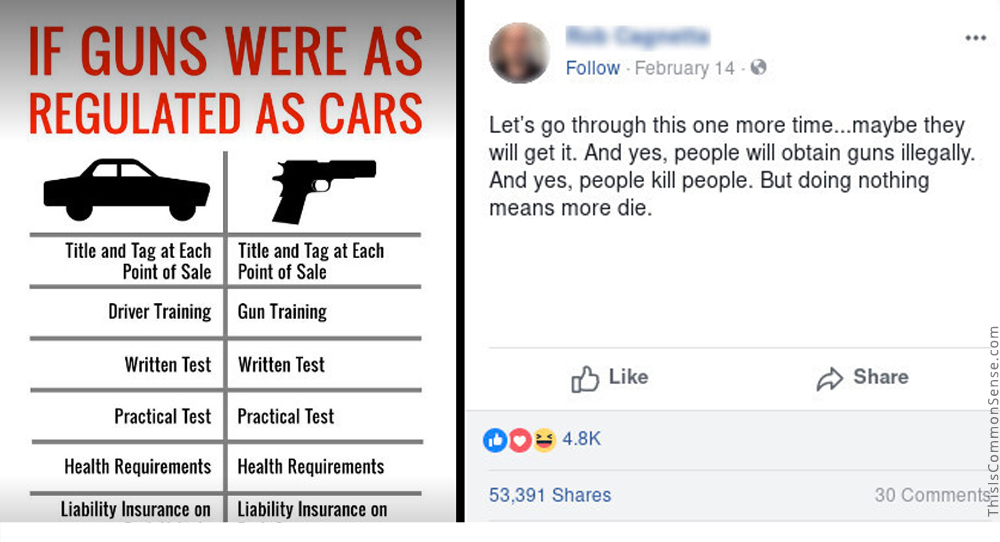
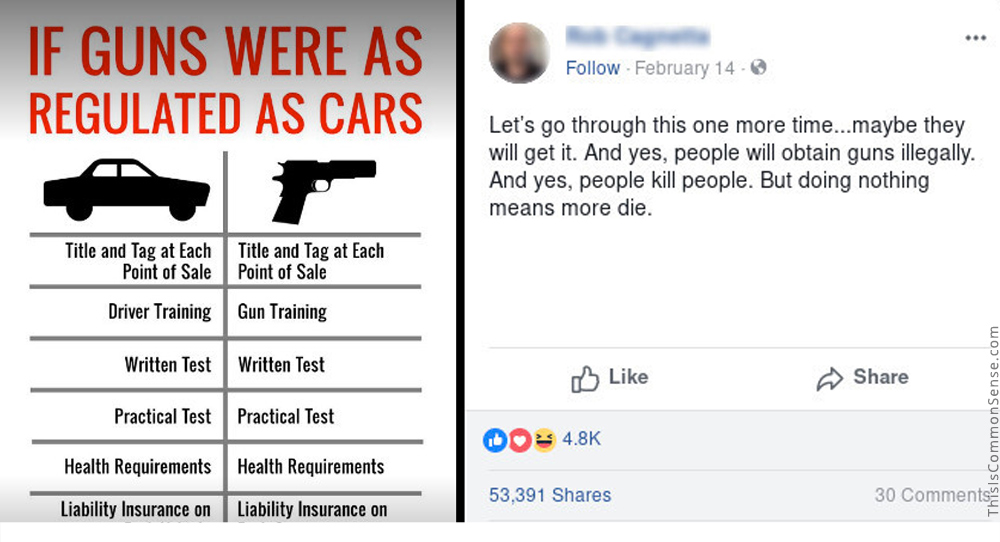
A clever “meme” made the rounds earlier this year showing, in two columns, what it would be like were guns regulated like cars.

How reasonable that would be!

“Title and tag at each point of sale”; “Driver training”/“Gun training”; Liability insurance on each vehicle/gun”; etc. It seems sound, no?

No.

The memester failed to address a context: our car and driver regulations apply to vehicles and drivers on government-run roads. On your own property you can drive all sorts of vehicles, unregulated. And it is on their own property that most gun owners’ firearms stay most of the time.

So, treating “guns like cars” would put government deeper into our private affairs.*

The meme came into an economist’s view packaged under the slogan “doing nothing means more people die.” He saw problems. For example, “someone might propose that each person above the age of 10 years old be interned in a mental-health camp, until and unless experts appointed by the state certified that he or she was not a danger to society.”

Same logic — we cannot do nothing, can we?

Another economist dubbed the problem we have identified here as “a simplistic model of public policy.” Policy advocates tend to assume that if you change a policy we get only one effect. Not true.  

A third economist (I’m going for a trifecta!) discovered that even adding safety features to cars comes at a cost in human life: feeling safer, drivers compensate . . . and it is non-drivers who suffer. More drivers hit more pedestrians.

Be cautious when you drive, sure. Be cautious when you shoot, of course.

But be cautious, especially, when you prescribe new laws.

This is Common Sense. I’m Paul Jacob.


* Not to mention that gun rights are specifically enshrined in the Constitution and vehicle rights . . . not so much.
PDF for printing


Categories
Accountability folly free trade & free markets ideological culture local leaders moral hazard nannyism property rights too much government

Amazon’s Jeff Bezos Is …

A half a year ago, when trying to make sense of the much-publicized search for Amazon’s “HQ2” — a second headquarters city, away from Seattle — I concentrated on the subsidies that cities and metro areas were apparently throwing at Amazon.

It all seemed desperate, indecent.

But there was a story behind the story. Amazon has every reason to be looking for an escape route from the Evergreen State’s biggest city.

The city’s leadership is nuts.

“Seattle City Council members have finally released draft legislation,” the Seattle TimesDaniel Beekman wrote last month, “for a new tax on large employers that would raise $75 million next year to address homelessness.”

The council blames the big companies for enticing workers into the city, thereby driving up rental costs and housing prices.

The tax would be on employee hours, would go into effect next year, and “in 2021, it would be replaced by a 0.7 percent payroll tax on the same category of companies,” explains the Seattle Times.

Now, if you tax something you discourage that something. That’s why progressives like sin taxes on sodas and fast foods. To discourage consumption.

So when progressives seek to tax big producers, they are apparently trying to tax away the housing crunch by driving away big business.

Amazon reacted. It put a halt to an expansion project.

“Jeff Bezos is a bully,” said Kshama Sawant, the confessed socialist, speaking for the council. “I think we are in broad agreement on that.”

If that is her attitude, and that of the council — and the consensus of the city’s denizens — then what Amazon’s Jeff Bezos really is?

A “good businessman.”

This is Common Sense. I’m Paul Jacob.


PDF for printing

Photo by JD Lasica


Categories
Accountability education and schooling folly government transparency insider corruption local leaders moral hazard nannyism national politics & policies responsibility too much government

Reading, Writing & Racketeering

When I attended a public school — many decades ago, in a galaxy far, far away — teachers told students that cheating was unacceptable and would be punished.

Harshly.

Today, the idea has students laughing — all the way to graduation.

Last year, after DC Public Schools officials breathlessly announced massive improvements in graduation rates, several honest teachers broke ranks, and an investigation uncovered massive fraud: a whopping one of every three graduates across the city resulted from falsified records.

Many students played hooky for a third or even half the school year. Administrators also pressured teachers to improve grades to hike the graduation rate.

“The problem,” Washington Post columnist Colbert King concluded, “is systemic indeed.”*

You see, employment evaluations and cash bonuses for teachers and administrators were — and still are — tied in part to student graduation stats. It turns out that an incentive to good work can also serve as an incentive to cheat. Could it be that government employees grading their own work does not encourage honesty?

Just months after confirmation of the worst fears of public school corruption, new allegations against teachers and administrators at Roosevelt High School more than suggest fudging attendance records is ongoing.

“This growing environment of fear and mistrust,” asserts Elizabeth Davis, president of the Washington Teachers’ Union, “has never been addressed and continues to be a disservice to students and teachers.”

City officials have had plenty of time to address the issue. And of the common sense idea that the best way to avoid fear and mistrust is to follow the rules?

Crickets.

This is Common Sense. I’m Paul Jacob.


* Nor is the fraudulent behavior limited to dishonestly boosting graduation rates. Former DCPS Chancellor Antwan Wilson resigned back in February after it became public knowledge that his daughter jumped 600 other students on a waiting list for her school. A recent Post story about enrollment fraud, whereby non-residents grab spots at prestigious schools such as the Duke Ellington School of the Arts, without paying the non-resident fee, was entitled, “Stop enrollment fraud? D.C. school officials are often the ones committing it.” Two-thirds of pending cases involve a current or past DCPS employee.


PDF for printing


Categories
Accountability folly government transparency local leaders media and media people too much government

Low Bigotry Expectations

“Man, it just started snowing out of nowhere this morning, man. Y’all better pay attention to this climate control, man, this climate manipulation,” explained Washington, D.C. Councilman Trayon White back in March.

White (who is black) went on to accuse “the Rothschilds” (who were Jewish financiers) of “controlling the climate to create natural disasters they can pay for to own the cities, man.”

Man. Oh. Man.

White later apologized, taking up the invitation of the Jewish Community Relations Council of Greater Washington to tour the Holocaust Museum. During the tour one of White’s staffers referred to the infamous Warsaw Ghetto as “a gated community.” Then, before the tour’s end, the councilmen unceremoniously bugged out.

Next, news broke that Councilman White had used his constituent services account,* which the Washington Post reports “must [by law] benefit D.C. residents,” to send $500 to a Nation of Islam event in Chicago.

At which Minister Louis Farrakhan denounced Jews.

The Post noted how all this “turned into a test of the ability of city officials to handle the explosive race and class resentments that can arise in a city whose prosperity masks a troubling gap between its haves and have-nots.”

Even D.C. Council member Elissa Silverman (who is Jewish) echoed the partial excuse that White “represents the poorest parts of our city, . . . whose residents feel like they haven’t benefited, and the remarks were directed at a community that’s largely affluent here, and seen as powerful.”

Is bigotry against an entire religion wrong or not so much, depending on the race or socio-economic status of the people espousing the bias?

No, man.

This is Common Sense. I’m Paul Jacob.


* Why do we have programs allowing politicians to hand out free money? This never ends well.


PDF for printing


Categories
education and schooling folly ideological culture media and media people moral hazard privacy

The Propriety of Cultural “Appropriation”

Young Keziah Daum committed a terrible crime. She wore a traditional Chinese dress and displayed it online.

No wonder she was chastised by hordes of frothing guardians of cultural purity.

Many Chinese themselves say they find the criticism baffling. Perhaps they are burdened by common sense. They are probably not sociologically sophisticated enough to mind when an American orders Chinese takeout, either.

“Puritanism is the haunting fear,” H.L. Mencken once explained, “that someone, somewhere, may be happy.”

Cultural appropriation” is the currently favored bludgeon wielded by today’s “puritans” to ruin enjoyment. According to this misbegotten notion, it is somehow wrong-souled to enjoy somebody else’s culture.

The very idea is hard to pin down. It is unduly fuzzy. How? Well, borders between countries or groups are pretty arbitrary as cultural boundaries. To try to be consistent, enemies of culture-grabbing would have to berate any partaking of culture not strictly one’s own.

Alas, the amount of culture a person can produce single-handedly is paltry.

Nor can anybody create any unit of culture without being influenced by — “appropriating” — the creations of others. Cultural creators have shamelessly “appropriated” each other’s stuff for millennia, a process that accelerated with improvements in travel and communication.

Should all seven billion of us live our lives in separate cubicles?

Enemies of “cultural appropriation” subscribe to every kind of silliness when they attack watching foreign films or wearing socks, dresses or Halloween costumes that evoke the culture of another country, state, town, or block.

No matter from whom they stole the idea of “cultural appropriation,” they should give it back.

This is Common Sense. I’m Paul Jacob.


PDF for printing


Categories
folly general freedom ideological culture moral hazard national politics & policies

Include/Exclude

The right of free assembly is central to a free society. Not everyone understands this.

Last week, conservative/“cultural libertarian” provocateur Milo Yiannopoulis went into the Churchill Tavern in New York to dine with fellow gay journalist Chadwick Moore.

Also in the establishment? The New York City chapter of the Democratic Socialists of America. When the socialists noticed Milo they stood up, faced him, and shouted at him, chantingNazi scum, get out!

Milo is not a Nazi, but his past gentle treatment of the alt-right counts as “Nazi” on the left.*

The left has been pushing for an inclusivist** reading of the right of free assembly for decades. You see, state laws in the South, prior to 1964’s Civil Rights Act, allowed and enforced white business discrimination against African-Americans, such as refusing service and accommodations. Leftists argue that there is no right to refuse service or exclude customers; they strenuously criticize those libertarians and conservatives who argue that a right to associate implies a right not to associate . . . giving them no credit for long opposing laws requiring discrimination.

Yet now we see many on the left banding together to deny others their free association rights by exclusionary tactics.

This was a group of customers, of course, so this is more similar to antifa violence than business discrimination. But Brooklyn politicians echo the logic, now proudly denying free assembly rights to NRA members — on ideological grounds.

Mob action for exclusion? Politicians siding with the mob?

There’s a word for this — fascismo.

Or, in the vulgar tongue, “Nazi scum.”

This is Common Sense. I’m Paul Jacob.


* Cenk Uygur of The Young Turks articulates this point — Milo’s insistence that he is not alt-right carrying no weight, apparently.

** Rather than rule-of-law liberal, or libertarian.


PDF for printing


Categories
Accountability folly general freedom incumbents media and media people moral hazard nannyism national politics & policies political challengers porkbarrel politics responsibility too much government

Twirling Towards Freedom?

Does Bernie Sanders remind you of “Citizen Kang”?

Vermont’s [S]ocialist Senator is whipping up a new plan for America: to “guarantee a job with at least a $15-per-hour wage and health benefits to every adult American ‘who wants or needs one,’” we are told.

What was it that the slavering alien Kang promised* in The Simpsonseighth season opening episode? Well, we know how that episode ended, with Homer Simpson revealing the ’90s’-era presidential candidates to be aliens in disguise, Kang being elected, humanity enslaved, and Homer uttering the immortal words “Don’t blame me, I voted for Kodos.”

And then Kodos, in cahoots with Kang, cracking the whip on Homer.

One shouldn’t have to read George Fitzhugh, the antebellum sociologist who attacked the very idea of free markets and free labor, insisting that slavery is a good thing and the very best form of socialism, to know that socialism and slavery go together hand in glove, whip in hand.

In an age of handouts for nothing, at least Sanders’ socialist proposal suggests productivity. But paying for it by nixing corporate “tax breaks”** is absurd. “Republicans have long opposed a federal jobs guarantee,” Fox News tells us, “saying such a plan would be too expensive and impractical.” And it’s productive people who would pay for it, making them de facto slaves to the system . . . even more than they are now.

But when socialists talk about “jobs,” worry about a more direct form of slavery.

And yes, I can imagine Bernie, with his four houses, flicking the whip.

I won’t be voting for him, if he runs.

Or for Kodos.

This is Common Sense. I’m Paul Jacob.


* Actually, Kang was known not for a promise but for his campaign speech (as Bill Clinton), saying, “[W]e must move forward, not backward; upward, not forward; and always twirling, twirling, twirling towards freedom!”

** The only funding source mentioned in the reports I read.


PDF for printing


Categories
crime and punishment folly general freedom moral hazard national politics & policies Popular privacy responsibility The Draft too much government U.S. Constitution

Leave Those Kids Alone

Congress created The National Commission on Military, National, and Public Service “to consider and develop recommendations concerning the need for a military draft, and means by which to foster a greater attitude and ethos of service among American youth.”

Is it possible that Congress and the commissioners have never considered the inherent contradiction between forcing people into the military against their will and fostering an “ethos of service”?

Today, I will get perhaps two minutes to address this commission at a hearing in Denver, Colorado, answering* these questions it has posed:

Is a military draft or draft contingency still a necessary component of U.S. national security?

The military draft has never at any time in the history of this country been a necessary component in U.S. national security.  

Are modifications to the selective service system needed?

No. The Selective Service System, the people who force very young men into the military against their will, needs to be ended. Not modified. Not expanded to women. End draft registration. Close the agency.

The United States should forswear any use of conscription. A free country need not force people into the military to defend it.

Is a mandatory service requirement for all Americans necessary, valuable, and feasible?

Necessary? Not on your life. Americans have always stepped forward — not only to defend their own country, but also in hopes of defending people across the globe.

Valuable? That’s a bad joke. People forced to kill and die in Vietnam and other conflicts and those imprisoned for refusing to take part in such a system fail to see any value. The draft has been disastrous.

What is valuable are the lives and rights of the young. They are free citizens, not Congress’s pawns.

Feasible? No. Because too many of us will fight you, refusing to go along. Even if it means our imprisonment.** Plus, a conscripted army is a poor substitute for the All Volunteer Force.

The draft is unnecessary, divisive and dangerous.

How does the United States increase the propensity for Americans, particularly young Americans, to serve?

Be worthy of the voluntary service of the American people.

If the government is responsible, then people will respond to protect it.

Commit to raising an army of soldiers and service providers by persuading citizens to freely serve their communities and their country. In short, this commission and this Congress should commit to freedom.

That would be truly inspiring.

This is Common Sense. I’m Paul Jacob.


* I will also be submitting a longer, more formal statement in testimony.

** As regular readers know, I was one of 20 young men prosecuted for refusing to register for the draft in the 1980s.


PDF for printing


Categories
Accountability crime and punishment folly free trade & free markets general freedom media and media people moral hazard nannyism national politics & policies property rights Regulating Protest too much government U.S. Constitution

That Something You Do

Congress grilled Facebook CEO Mark Zuckerberg, last week, and as usual ended up roasting itself.

“Zuckerberg has already experienced the worst punishment of all,” quipped comedian Trevor Noah on The Daily Show. “He had to spend four hours explaining Facebook to senior citizens.”

Utah Sen. Orrin Hatch, retiring after his 42nd consecutive year in Washington, asked, “How do you sustain a business model in which users don’t pay for your service?”

“Senator,” Zuckerberg incredulously replied, “we run ads.”

Inc. magazine reported the obvious: “several of our elected leaders asked questions that were highly uninformed, or in some cases just plain weird.”

Uninformed. Weird. That’s them, alright.*

Still, the Washington establishment seems to seriously think these same congressmen ought to be re-writing privacy rules.

“Elected officials know the public wants them to do something to protect their privacy,” announced Chuck Todd, host of NBC’s Meet the Press. “The question now turns to what is that something?”

“Americans are largely together on this issue,” Todd said, citing a recent poll where a similar “66 percent of Democrats and 68 percent of Republicans say they want more control over the information companies have about them.”

But Democrats and Republicans are together on something else: Only 21 percent of Democrats and a tiny 14 percent of Republicans “trust the federal government” to act on the issue.

The senators, though obviously “confused about basic topics,” Emily Stewart wrote at Vox,  “seem to agree they want to fix something about Facebook. They just have no idea what.”

Please Congress: DON’T “do something.” Don’t do that thing you do.

This is Common Sense. I’m Paul Jacob.


* Reason TV has a very funny video on the Zuckerberg hearing.


PDF for printing


Categories
Accountability folly general freedom government transparency moral hazard national politics & policies porkbarrel politics responsibility too much government

While the Clock Ticks

Pushing annual federal spending over a trillion bucks into the red?

It has consequences.  

“Our debt is growing, and it’s growing fast,” writes Veronique de Rugy at Reason. “Though it’s a shame that lawmakers passed tax cuts without cutting spending to offset short-term losses in revenue, there’s no doubt that Social Security and Medicare deficits are almost entirely to blame for our impending debt crisis.”

Ms. de Rugy, a senior research fellow at the Mercatus Center, has a typo in the version of her article that I read (it has probably since been corrected): “Based on current trends, the debt held by the public is set to reach $15.7 trillion by the end of this year and continue rising to $28.7 trillion by 2028.” She surely meant “$25.7 trillion,” since the current debt clock figure shows the U.S. public debt at over $21 trillion. Still, $25.7 seems a bit high . . . but at this point we can leave the exact numbers to the professionals.

We just know that the debt’s too damn high.

As de Rugy explains, it has present as well as future cost. And, yes, entitlements are the biggest problem — but even more than Ms. de Rugy suggests. Congress owes the Social Security “trust fund” (in Al Gore’s infamous and non-existent “lock box”) nearly $3 trillion.

Our solons would have to (painfully) switch from revenue deficits to revenue surpluses just to pay off its debt to a much-relied upon institution.

What will happen, though, is surely this: Congress will borrow more from elsewhere to pay what Social Security needs — which all too soon will be a lot more than $3 trillion.

That’s not Common Sense. (But I am Paul Jacob.)


PDF for printing