Categories
First Amendment rights Fourth Amendment rights privacy too much government

What Does the FBI Do?

“The FBI began surveilling a Catholic priest in 2023,” wrote James Lynch last week, “after the clergyman refused to divulge details about a recently arrested parishioner who was converting to Catholicism and seeking spiritual guidance.”

The agency’s Richmond Field Office “tracked the priest’s movements and coordinated with several other FBI offices and a foreign law enforcement agency to gather intelligence on the clergyman and his priestly organization,” Lynch summarizes.

This is all based on a new House Judiciary Committee report entitled “How the Biden-Wray FBI Manufactured a False Narrative of Catholic Americans as Violent Extremists.” *

“The FBI attempted to violate the priest-penitent privilege,” the report continues, “on the faulty reasoning that the Richmond subject under investigation seeking spiritual guidance had not been baptized or completed catechism.”

You may be asking yourself, is the FBI out of its mind?

Certainly, out of this hemisphere. Consider that FBI agents have also extended their reach way beyond U.S. borders to focus on wrongthink elsewhere.

According to investigative journalist David Ágape, “the FBI has helped Brazil censor its citizens,” working with the Soros’ Open Society Foundation to promote censorship in Brazil and a secret judicial police force targeting “people deemed to be spreading false information.”

Was the FBI nurturing censorship in foreign lands to later re-import them here?

From its beginning, the Federal Bureau of Investigation has had trouble staying within constitutional limits. I guess we should not be shocked that it doesn’t obey jurisdictional limits, either. 

Hopefully, Director Kash Patel will rein in the agency. It won’t be easy.

This is Common Sense. I’m Paul Jacob. 


* According to the committee, “The report reveals that contrary to testimony from former Federal Bureau of Investigation (FBI) Director Christopher Wray, the 2023 Richmond memorandum that derisively labeled traditional Catholics as ‘racially or ethnically motivated violent extremists’ was not an isolated incident. Under the new leadership of Director Kash Patel, the FBI has cooperated considerably with the Committee’s subpoena, and has produced over 1,300 pages of additional documents related to the Richmond memorandum that the Biden-Wray FBI did not disclose.”
Note: You can also mouse-over the asterisk in the main text to see the footnote.


PDF for printing

Illustration created with Krea and Firefly

See all recent commentary
(simplified and organized)
See recent popular posts

Categories
First Amendment rights international affairs

Leave Our Speech Alone

Secretary of State Marco Rubio has announced that foreign officials who act to censor U.S. speech on U.S. soil won’t get visas.

They shouldn’t “issue or threaten arrest warrants on U.S. citizens or U.S. residents for social media posts on American platforms while physically present on U.S. soil. . . . [Or] demand that American tech platforms . . . engage in censorship activity that reaches beyond their authority and into the United States. We will not tolerate encroachments upon American sovereignty, especially when such encroachments undermine the exercise of our fundamental right to free speech.”

The policy is the least the U.S. can do to combat despots of even “friendly” countries who target speech in the U.S. or demand that U.S. firms abet local repression.

It would also be reasonable to tie trade agreements to willingness to abstain from censoring U.S. speech and bullying U.S. companies that protect speech and privacy. But a White House report on a recent agreement with the UK says nothing about these matters.

American companies have sometimes withdrawn from foreign markets or offered truncated products rather than cooperate with censorship or surveillance. When Britain demanded a global back door to iPhone encryption, Apple removed an encryption feature from iPhones for users in the UK. Better than rendering the feature useless everywhere in the world.

But it would be better still if a country like the United Kingdom simply agreed to leave us alone. Pretend we’re allies and so forth; pretend that they, too, think freedom is a good thing.

This is Common Sense. I’m Paul Jacob.


PDF for printing

Illustration created with Krea and Firefly

See all recent commentary
(simplified and organized)
See recent popular posts

Categories
First Amendment rights Voting

Lawmaker May Vote

It was not a hard call. But it wasn’t unanimous. The United States Supreme Court ruled 7-2 to reinstate Laurel Libby’s voting rights as a Maine state representative until her lawsuit protesting the punishment of her speech is resolved. 

The Court did not address her right to speak on legislation. So, while Libby is now being allowed to vote, she’s still not being allowed to speak on legislative questions.

Maine’s Democratic lawmakers had stripped Libby of her right to speak on and vote on legislation because they objected to a social media post in which Libby expressed disapproval of letting a boy participate in a girls’ track competition.

The boy’s name was already public knowledge, as I explained when I covered the story earlier this month. But the fact that Libby referred to him by name (first name) in her post was the hook on which her colleagues sought to hang her.

The dissent of one of the two dissenting Supreme Court justices, Justice Ketanji Brown Jackson, seems partly motivated by her view that “the case isn’t an emergency in need of Supreme Court intervention since there are no significant upcoming votes where Libby’s participation could change the outcome.”

An astonishing sentiment. 

We don’t know for sure what questions might come up in the last weeks of Maine’s legislature session. In any case, the purported significance of legislative matters has no bearing on the question of the justice of simply annulling, over a political disagreement, the voters’ decision about who should represent them.

This is Common Sense. I’m Paul Jacob.


PDF for printing

Illustration created with Krea and Firefly

See all recent commentary
(simplified and organized)
See recent popular posts

Categories
First Amendment rights ideological culture

Antidemocracy in Maine

Laurel Libby, a Republican state legislator in Maine, has been censured by Democrats in the Maine House of Representatives for a February 17 social media post in which she expressed disapproval of allowing “trans” girls (boys) to compete in high school sports for girls.

The alleged reason for the censure? Her post mentioned the winner of a girls’ track championship who is publicly known to be the winner and publicly known to be male.

Censuring Libby for stating her views would be bad enough. But the legislature went beyond putting its disapproval (or the Democratic majority’s disapproval) on record.

Representative Libby isn’t being allowed to speak as a representative during session. And she’s not being allowed to vote until she apologizes. 

For stating her views on a public question. 

Nor was she even allowed to defend herself when the House voted along party lines 75-70 to censure her.

This qualifies as tyranny, another mile down the slippery slope of eroding — or dynamiting — democratic norms and practices. The tyranny is not that of an autocrat but of the majority. In this case, the tyranny of a majority of partisans in a legislature.

It is also an attack on free speech. As the Foundation for Individual Rights and Expression observes, people elect representatives to “vote according to their conscience and express themselves freely on controversial topics.”

Rightly, Laurel Libby has refused to remove the Facebook post criticizing the policy of the Maine Principals’ Association. Wrongly, her constituents continue to be deprived of her voice and vote in the legislature.

She is asking the U.S. Supreme Court to redress this injustice. Let it act, and fast.

This is Common Sense. I’m Paul Jacob.


PDF for printing

Illustration created with Midjourney and Firefly

See all recent commentary
(simplified and organized)
See recent popular posts

Categories
First Amendment rights international affairs

Like a Bad Jankowicz

Nina Jankowicz is back.

During the Biden administration, Jankowicz, scourge of “disinformation,” lost her perch as head of an incipient Disinformation Governance Board. 

People learned that the Board existed; were aghast; got it closed.

If only government censorship were always so easy to kill.

Now this nag, with no prospect of getting a job muzzling people she disagrees with from the Trump administration, is making a nuisance of herself internationally.

She’s preaching to the European Union, which Jonathan Turley calls “the global hub for censorship efforts,”warning that the Trump administration wants “to force EU institutions to roll back regulation like the DSA [Digital Services Act],” which seeks to impose a regime of online censorship.

We want the right to say false things if we’re not trying to defraud anyone. Why? For several reasons, but we often inadvertently say untruths.

We also want the right to say true things. 

When people disagree with each other, both can’t be 100 percent right, but they can both be trying to find the truth. And discourse is often crucial to finding it. Truth doesn’t arrive readymade in the form of secure and impenetrable revelation.

Neglecting all this, censors like Jankowicz and the EU’s mandarins prefer to enforce current government viewpoints and punish contradictions of them that exceed a certain threshold of annoyingness.

They seem unaware of the great fact that even governments (!) can be mistaken.

By the way, if you haven’t listened to Jankowicz warble her censorship rap to the tune of “Supercalifragilisticexpialidocious,” you really should do so in expiation of whatever sins you may have committed in this life.

This is Common Sense. I’m Paul Jacob.


PDF for printing

Illustration created with Krea and Firefly

See all recent commentary
(simplified and organized)
See recent popular posts

Categories
First Amendment rights international affairs Internet controversy social media

X Marks the Censor

The European Union’s censors are outraged that Elon Musk’s social media platform, Twitter-X, flouts their demands to gag users.

So they’re gearing up to fine X more than a billion dollars. The EU will also be demanding “product changes.”

Another EU investigation reported by The New York Times “is broader and . . . could lead to further penalties,” but amounts to the same thing: punishing Musk’s free-speech company for disobeying orders to prevent and punish speech.

All this is rationalized by a new EU law to compel social media platforms to police users. One would be hard put to find a clearer case of governmental censorship-by-delegation. It’s not even taking place behind closed doors, as was the case regarding the U.S. Government and Twitter before Mr. Musk bought the platform. 

These European censors brag about it.

X says it will do its best to “protect freedom of speech in Europe.”

If push comes to shove and EU goons do not back down, what X should do has been indicated by the smaller platforms social media platforms Gab and Kiwi Farms.

First, refuse to pay a penny of any imposed fine. 

Second, block access to X within the European Union, advising all account holders who try to log on why having an EU IP address is now a bad idea and why using a good virtual private network (VPN) to access X is now a good idea.

By disguising point of origin and encrypting traffic, a good VPN can help people living under tyrannical regimes like the European Union to evade censorship.

This is Common Sense. I’m Paul Jacob.


PDF for printing

Illustration created with Krea and Firefly

See all recent commentary
(simplified and organized)
See recent popular posts

Categories
First Amendment rights international affairs Internet controversy social media

Against British Censorship

The dictates of the neo-redcoat British government, led by Prime Minister Keir Starmer, are out of control.

Starmer’s Labour government wants the whole world to obey its censorship demands. The latest is that its Office of Communications, called Ofcom, is threatening the American social media platforms Gab and Kiwi Farms with mega-steep fines for unwaveringly safeguarding the freedom of speech of users. 

Which of course Gab and Kiwi Farms have every right to do.

Ofcom says it’ll sock Gab with fines of up $23 million USD for refusing to censor its users per UK orders. 

“We will not pay one cent,” says Gab CEO Andrew Torba.

Gab is not only not cooperating with Ofconjob’s insanity, it has also reported the Starmer government to the U.S. Trade Representative and the U.S. Department of Justice in hopes that the U.S. government will retaliate against the United Kingdom for trying to gag social media in the United States.

Kiwi Farms, threatened with the same fine of up to 10 percent of worldwide revenue, is telling UK users who want to use the site to access it through a VPN or Tor in order to protect their online traffic and disguise which country they’re from. Otherwise, they’re out of luck.

Kiwi has also reported success in obtaining pro bono counsel for dealing with “the UK’s attempts to enforce its censorship regime in the United States.”

As the U.S. president famously said in Butler, Pennsylvania: “Fight! Fight! Fight!”

This is Common Sense. I’m Paul Jacob.


PDF for printing

Illustration created with Krea and Fireflly

See all recent commentary
(simplified and organized)
See recent popular posts

Categories
crime and punishment First Amendment rights international affairs

How We Tear Up

“We revoked her visa,” Secretary of State Marco Rubio told a reporter asking about Rumeysa Ozturk, a Tufts University student from Turkey, detained recently by plainclothes officers of U.S. Immigration and Customs Enforcement (ICE) in the process of deporting her.

“Her only known activism,” the Associated Press relates her friends saying, “was co-authoring an op-ed in a student newspaper that called on Tufts University to engage with student demands to cut ties with Israel.”

A federal judge is now preventing her deportation.

Citing those who “want to participate in movements that are involved in doing things like vandalizing universities, harassing students, taking over buildings, creating a ruckus,” is how Rubio explained the rationale for the ousting. “We gave you a visa to come and study and get a degree, not to become a social activist, to tear up our university campuses.”

But there’s the rub, isn’t it? 

Obviously, those who “tear up” by committing acts of violence and intimidation, breaking our laws, should be deported. 

Yet, what about those merely speaking or writing words — whether you like them or loathe them, or their speaker — that tear up the university’s status quo in the minds of listeners? Or might, if allowed voice?

Any “alien” in our country legally has a First Amendment right to speak. Even our Highest Court has so ruled

The Trump administration appears to have vast legal authority to remove aliens from U.S. soil . . . except perhaps the way they’re doing it. Deportation cannot be a selective punishment for speech, which is protected. 

“America was built on free speech, so if we don’t have that, then what?” said Carina Kurban, a Lebanese American, at a recent rally in defense of Ozturk. “Then where do we go?”

This is Common Sense. I’m Paul Jacob.


PDF for printing

Illustration created with Krea and Firefly

See all recent commentary
(simplified and organized)
See recent popular posts

Categories
First Amendment rights privacy

What’s Really at Stake in Maine

It’s “bad-penny” time in the Maine legislature, as in “back like a”: a bill threatening the privacy of political donors.

LD951, introduced and foiled in the previous session, would force nonprofit organizations that take a position on policy measures “to not only report their donors, but their donors’ donors,” which Philanthropy Roundtable compares to legislation in Arizona that did become law — a law now being challenged in court. 

Like Arizona’s law, LD951 would impose cumbersome regulations and steep fines while obstructing free speech and free association. The obviously intended result being for nonprofits to not take such positions.

According to LD951, the public has a “compelling interest” in knowing who political donors are; otherwise, how can voters “make informed decisions and hold elected officials accountable”?

This is one of those vague dicta that melts into a puddle when you try to think about it.

Say you’re a 2024 voter deciding between Harris and Trump. Before you can decide, must you know who is donating to each campaign, name by name, and ponder those names before you can possibly. . . . No?

Last I checked, you can indeed assess views, character, programs, competence even without an exhaustive review of donor lists.

Meanwhile, donors, and donors to donors, often have a compelling interest in anonymity. Not because they’re ashamed of their political commitment but because they know that there are wackos out there ready to hound people because of what they believe in.

The insanos might even scrawl Nazi symbols on — or even set ablaze — their automobiles!

The people willing to be public punching bags? They are called candidates. Others may prefer to remain behind the scenes.

This is Common Sense. I’m Paul Jacob.


PDF for printing

Illustration created with Krea and Firefly

See all recent commentary
(simplified and organized)
See recent popular posts
Categories
First Amendment rights insider corruption

The Biden’s Four Ways

In response to controversies about pandemics, elections, and whatnot, Congress did not quite pass — nor President Biden quite sign — a new law abridging the freedom of speech, or of the press. (As far as I know.)

Biden’s government did act, regardless, with the force of law to shut people up. According to the Media Research Center’s new report on Biden censorship — ready to be shared with all who contend that his administration perfectly respected our freedom of speech — the cabal I call The Biden censored Americans using four approaches:

Direct action. For example, ordering a big tech firm or a judge to censor somebody. White house advisors, agency bureaucrats, and others exerted this kind of pressure.

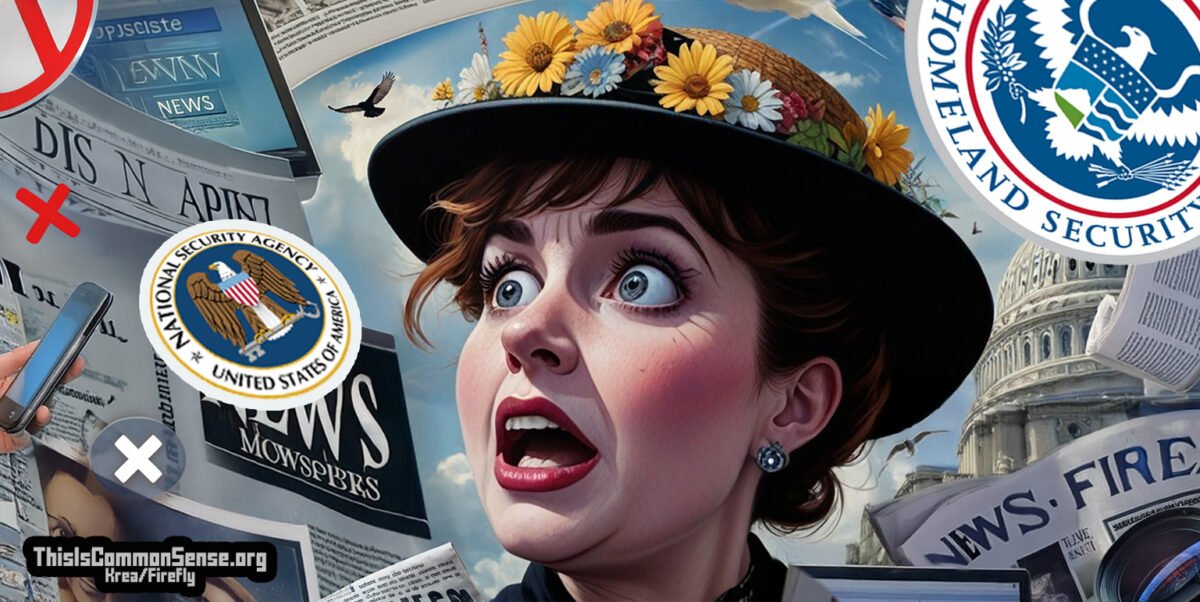
Policy or rulemaking. Examples include the State Department’s agreement with foreign nations “to pressure Tech platforms to censor more” and Homeland Security’s attempt to create a Disinformation Governance Board to police speech.

Partnerships with state and private actors to censor speech. Biden’s National Security Council collaborated with the UK’s Counter Disinformation Unit to impose UK censorship on Americans.

Grants to organizations to attack and flag utterance of incorrect speech, which the government could then censor.

These were effectuated, by MRC’s count, with 57 initiatives.

As soon as he began his second term, President Trump issued executive orders to combat such muzzling of debate. Congress must do its part too.

No matter what defenses are put in place, though, we will see further attempts by government goons to gag us. We must be vigilant.

This is Common Sense. I’m Paul Jacob.


PDF for printing

Illustration created with Krea and Firefly

See all recent commentary
(simplified and organized)
See recent popular posts