Categories
Accountability crime and punishment government transparency ideological culture media and media people national politics & policies too much government

Smoke But No Gun

The Republican memo soaking up so much attention paints an ugly picture of a republic gone off the rails — but it should not be mistaken for The Facts.

We have smoke, sure. And the smoke can be seen, not unreasonably, as a sign of . . . a vast insider conspiracy.

But we have only second-hand information; the “smoking gun” has yet to be presented.

The House Intelligence Committee Report memo relates to the behavior of the FBI and its use of a dossier prepared by a former British intelligence officer, Christopher Steele. This operative was hired by Fusion GPS, a political research firm, which was under contract first with a conservative website, The Washington Free Beacon, and then with the Democratic National Committee and the Hillary Clinton for President campaign. His assignment was to research an alleged connection between Trump and the Russian government.

Steele dug up some interesting stuff, which would have been more persuasive had not some of it been obviously fabricated (I’m thinking of the infamous Russian prostitution story). The dossier got into the hands of the FBI by a circuitous route* and was used, says the memo, to get FISA warrants to electronically surveil a Trump campaign operative, Carter Page. Tellingly, the FBI never told the FISA court the specific origin of the dossier.

To get to the truth, we need more — the FISA warrants themselves, at the very least.

There may be a proverbial smoking gun somewhere in this mess. The missing-then-discovered text messages of two partisan FBI agents do suggest a conspiratorial mindset.

That being said, let’s not jump to conclusions. Alan Dershowitz is right: a non-partisan investigation is necessary.

This is Common Sense. I’m Paul Jacob.


* Including Sen. John McCain!

PDF for printing


Categories
Accountability crime and punishment government transparency incumbents term limits

The Smoking Russian Donut

“Politicians in prison garb,” headlined a recent Sun Sentinel editorial, “shake trust in government.”

It was not a fashion statement.

“What is it about a long career that makes some politicians — not all, let’s be clear about that — feel the rules don’t apply to them?” asked the paper, which serves Florida’s Broward and Palm Beach counties.

This week, after spending the last 24 years in Congress, former Rep. Corrine Brown (D-Fla.) began serving a five-year term in federal prison. Brown was convicted of 18 separate fraud and corruption counts stemming from her use of a public charity to benefit herself.

Not to be outdone, last week the FBI arrested Hallandale Beach Mayor Joy Cooper on various corruption charges following a six-year undercover sting operation. “From what is now known,” the editorial board judged “the case against Cooper” to be “devastating.”

There are taped conversations, reportedly, between FBI agents posing as “wealthy land owners [seeking] political favors” and the mayor, discussing pay (her) to play (with the city). At one point, undercover agents say a bribe was delivered to the mayor in “a Dunkin’ Donuts bag stuffed with $8,000 in cash and checks from people with a ‘bunch of Russian names.’”

Russians?

“If not so tragic,” the paper wrote of the corruption, “it would be laughable to imagine Russians colluding to control the Hallandale Beach city election.”

Humor is needed, truly. Yet, the Sun Sentinel concluded instead that “term limits are needed in Hallandale Beach.”

Of course.

And needed for Congress.

Now more than ever.

This is Common Sense. I’m Paul Jacob.


PDF for printing


Categories
Accountability crime and punishment folly general freedom local leaders moral hazard nannyism national politics & policies Popular privacy Regulating Protest too much government

The Last Straw

How much should we fine waiters who destroy our planet?

For how long should they go to jail?

I don’t know where you would hold such an evildoer after the earth has been destroyed. Or where he’d go when released. But we’re speaking hypothetically. Assume that planet-destroyers can be imprisoned on the moon, which let’s just say still orbits the earth’s decimated remains. Or assume that after being destroyed, the planet can be reconstructed. After serving his sentence, then, the waiter would be released to a reconstructed earth.

In that case, a maximum $1,000 fine as suggested by Ian Calderon, Democratic majority leader of the California State Assembly, seems only fair. However, a maximum of six months in jail is excessive. In my opinion, planet-destroying waiters should suffer no more than 100 days in jail.

Calderon has proposed a bill, AB-1884, to fine and/or imprison waiters who offer unsolicited plastic straws to restaurant patrons. In response to criticism of his silly and vicious bill, Calderon says hey, it’s “NOT a ban” on straws! Oh, okay. Anyway, “Penalties are based on the code section the bill is currently in, which it will be amended out of,” which sounds like Calderon was prior to the uproar . . . what, joking?

As long as we’re amending, let me amend my own implication that people who offer, use, make or sell plastic straws* are in fact helping destroy earth. Just kidding!

The earth will survive plastic straws. Will it survive the Calderons of the world?

Open question.

This is Common Sense. I’m Paul Jacob.


* Not that I’m confirming or denying ever using one myself.


PDF for printing


Categories
crime and punishment First Amendment rights general freedom ideological culture media and media people moral hazard nannyism national politics & policies Regulating Protest too much government

Twitter’s Merkel Tactics or Merkel’s Twitter Tactics?

Is Twitter cooperating with Germany’s new crackdown on social-media speech because otherwise it risks steep penalties? Or is Twitter just doing what it would do anyway?

When Germany’s new law against unwelcome speech went into effect this year, many Germans protested. “Please spare us the thought police!” was the headline in one top-selling paper, Bild.

The law requires social-media sites to block unapproved content — which includes “hate speech” and “fake news” — within 24 hours or face exorbitant fines. (Of course, every piece of news, no matter how well or shabbily reported, gets decried as hateful “fake news” by somebody.) Under the new law, Twitter suspended the accounts of two officials of the political party Alternative for Germany who tweeted that Muslim men have violent proclivities. Hateful, fake, inexact, whatever, such tweets by themselves threaten nobody and violate nobody’s rights.

Did Twitter act only under duress here?

Well, in the U.S., the company is not ordered by our government to muzzle anybody except perhaps terrorists or persons directly instigating a crime. Yet Twitter regularly suspends or bans users whose speech it considers objectionable. Moreover, it has become notorious for especially targeting speech that can be regarded as on the right end of the political spectrum — while leaving intact the tweet-speech of left-wing micro-bloggers no matter how threatening or abusive.

I don’t say America’s government should become involved. It should certainly not compel Twitter to drop its double standard.

Instead, it is Twitter itself that should become involved . . . and drop its double standard.

This is Common Sense. I’m Paul Jacob.


PDF for printing


Categories
Accountability crime and punishment general freedom government transparency ideological culture moral hazard national politics & policies Regulating Protest tax policy too much government

Still at Large

Blogger Paul Caron, dean of Pepperdine Law School, still counts the days since we learned that the IRS was blocking applications for nonprofit status from right-leaning groups at the behest of former IRS honcho Lois Lerner.

Now years later, the agency can still arbitrarily victimize any one of us. Nor have Lerner and other bad guys been brought to justice. Lerner collects a six-figure pension, instead.

And so, on Day 1699, Caron highlighted Kimberly Strassel’s proposal that President Trump make 2018 “the year of civil-service reform — a root-and-branch overhaul of the government itself. Call it Operation Drain the Swamp.” Exhibit A? The IRS and civil “servants” like “Lois Lerner, the IRS official who used her powers to silence conservative nonprofits.”  

And on Day 1709, Caron called our attention to Lerner’s attempt to suppress a deposition she gave in June “for a civil suit that victims [of IRS targeting] brought in 2013.” Lerner thinks we have no right to know why she felt justified in discriminating against applicants for tax-exempt status based on their political viewpoint.

Unfortunately, not everyone cares about justice as much as Caron.

Consider an obtuse Washington Post editorial pretending that the IRS didn’t really target conservative groups. Instead, “conservative groups, their allies in Congress and the IRS itself all bear responsibility” for the appearance otherwise.

And the aftermath.

Uh huh. If only victims of the abuse of power would stop being so indelicate as to object!

This is Common Sense. I’m Paul Jacob.


PDF for printing


Categories
crime and punishment folly general freedom moral hazard privacy too much government

Dutch Treat

Rotterdam police are gearing up for a new crime reduction scheme.

“They’ll soon begin a pilot program targeting young men in designer clothes that the police believe they couldn’t afford legally,” reports Quartz. “If it’s not clear how the person paid for the clothing, the police may confiscate it.”

A police spokesman for the Netherlands city confirmed both the test program and their confidence in their own clairvoyance, “We know they have clothes that are too expensive to wear with the money they get.”

Beyond the complete disregard for everyone’s basic rights, people worry the law will be applied discriminatorily against minorities. As one young resident warned, “Police won’t consider a white guy walking around in an expensive jacket to be a potential drug dealer. But it’ll be a different story with minorities.”

But surely the poor of all races will become suspects for the new “fashion police.”

“What is the next step if police start asking you how you got the clothes you are wearing,” Rotterdam lawyer Jaap Spigt queried DutchNews. “Will they soon be going through your home asking how you paid for your television or sofa?”

Thank goodness, I don’t live in Rotterdam.

Wait a second . . . the civil asset forfeiture policies at work right now in the U.S. permit police to take money and property — including clothing — without even charging a person with a crime. Simply taking stuff on the assertion of it being either involved in or the proceeds from criminal activity is precisely what’s happening in Rotterdam.

How long before Americans are stopped and partially stripped on the street by police who determine they are guilty of criminally overdressing sans trial?

At least, my poor fashion sense is trending up.

This is Common Sense. I’m Paul Jacob.


PDF for printing


Categories
Accountability crime and punishment government transparency media and media people moral hazard national politics & policies privacy Snowden

Clapper into the Clink?

Lying to Congress is a strange crime. A number of people have been prosecuted for it over the years, but Congress isn’t a court of law and, more to the point, Congress may present the densest source of lies in the United States.

The idea that it would be illegal for a citizen to lie to a den of liars is, well, a bit amusing.

But it is illegal, and definitely should be illegal, for government functionaries to give false testimony before Congress.

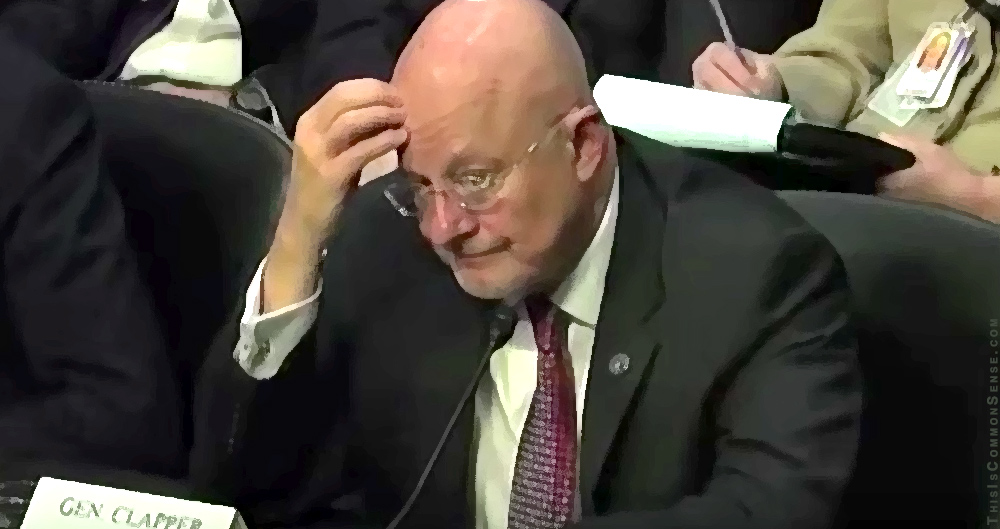
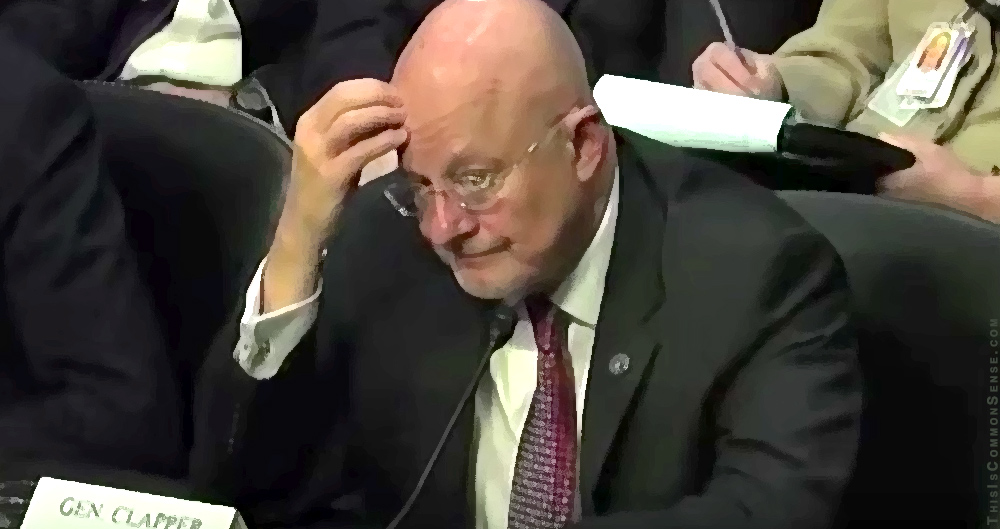
That’s why the case of the admittedly “untruthful”* James Clapper is so aggravating. When asked by Senator Ron Wyden, on the Senate floor, about data collection of phone calls by the U.S. federal government, he — the director of national intelligence under President Barack Obama from 2010 to 2017 — lied through his teeth.

And had not Edward Snowden leaked information on the National Security Administration’s metadata collection program, we would not have learned anything about it.

No wonder, then, that several congressmen want to prosecute Clapper before March 12, when the Statute of Limitations runs out on his crime. Steven Nelson at the Washington Examiner quotes Rep. Ted Poe (R-Tex.), Rep. Thomas Massie (R-Ky.), Rep. Louie Gohmert (R-Tex.), and Rep. James Sensenbrenner (R-Wis.) as all being in favor of siccing federal prosecutors on the forked tongue spymaster.

Senator Wyden warns that letting lies such as Clapper’s go unaddressed encourages Americans to be cynical about government, and “makes it possible, even probable, for hucksters and authoritarians to take power.”

Too late?

This is Common Sense. I’m Paul Jacob.


* Clapper’s March 2013 whopper at the Senate Intelligence Committee hearing was that the NSA was “not wittingly” collecting “any type of data at all” on millions of Americans. Later, to MSNBC, he characterized his artful dodge as having been “the least untruthful” way for him to respond.


PDF for printing


Categories
Accountability crime and punishment First Amendment rights general freedom government transparency local leaders moral hazard Regulating Protest too much government U.S. Constitution

Lock Her Up

“Who Are We?” I asked Sunday at Townhall.com.

Today’s question: What have we come to?

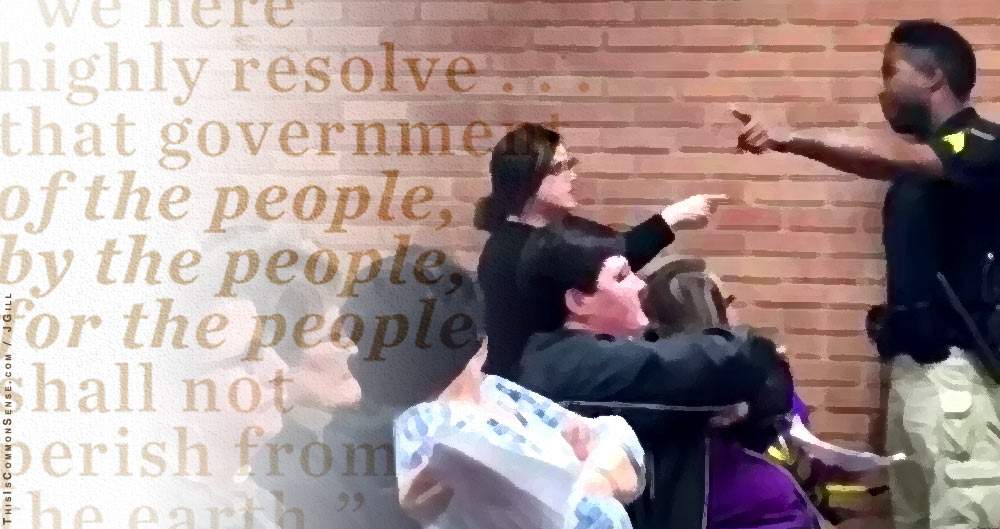
Under a seemingly click-bait headline in The Atlantic, “Can Government Officials Have You Arrested for Speaking to Them?” Garrett Epps examines last week’s outrageous handcuffing and arrest of a Louisiana teacher, Deyshia Hargrave, for speech displeasing to the Vermilion Parish school board at a public meeting.

The elementary school teacher complained about a $30,000 raise the board was giving the superintendent, noting that teachers had not seen an increase in nearly a decade. After asserting that the raise would be “basically taken out of the pockets of teachers,” she was ruled out of order by the school board president and then asked to leave the premises. She calmly left the meeting room . . . only to be forced to the floor, handcuffed and arrested once in the hallway.

Police claimed the arrest was for “remaining after having been forbidden” and “resisting an officer.”

The school district announced it won’t press charges. Very funny. Anyone can see from the video that her treatment was excessive.

Next month, the U.S. Supreme Court will hear oral arguments in Lozman v. Riviera Beach, Florida, where an arrest was clearly retaliatory, but the city is newly claiming another violation it could have used to arrest Mr. Lozman.

Does this after-the-fact adding on of charges provide governments with an escape clause? As Epps argues, a Lozman decision “could either rein in, or embolden, the tiny-handed tyrants who rule county buildings and city halls around the country.”

If respectfully challenging our so-called public servants in meetings designed for that can lead to being arrested, handcuffed and dragged off, we no longer live in ‘the land of the free.’

This is Common Sense. I’m Paul Jacob.


PDF for printing


Categories
Accountability crime and punishment folly free trade & free markets general freedom moral hazard nannyism national politics & policies too much government U.S. Constitution

The Ninth and the Tenth of It

When Attorney General Jeff Sessions rescinded the Obama Administration enforcement guidelines regarding the states that have legalized (in their 29 different ways) marijuana, last week, supporters of freedom expressed some worry.

But we had to admit, one excuse for Sessions’s nixing of the mostly hands-off policy seemed to make sense on purely legal grounds. If we want to liberalize drug laws, then our Cowardly Congress should do it.

Definitely not the Executive Branch.

And yet, over at the Volokh Conspiracy, Will Baude argues that “the rule of law” does not require “renewed enforcement of the Controlled Substances Act.”

If anything, he argues, it “requires the opposite.”

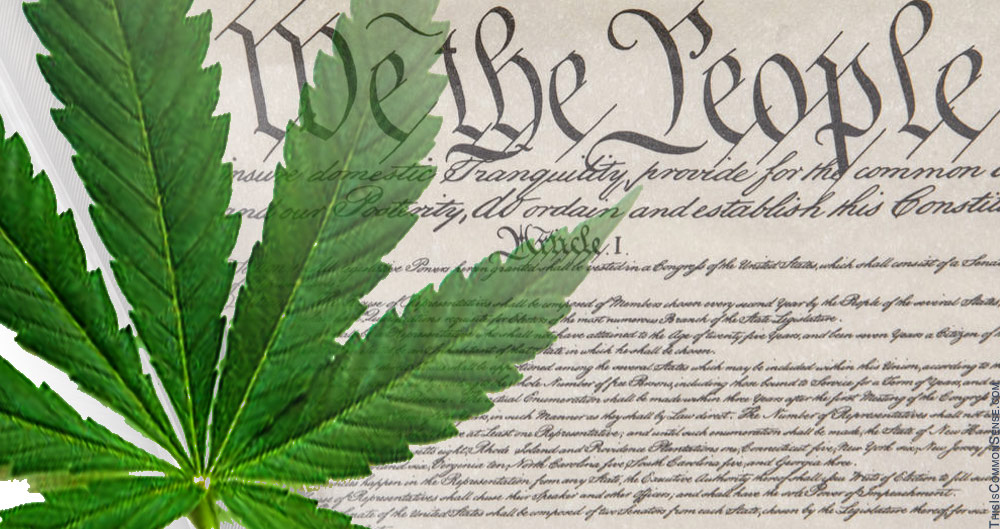
Baude mostly rests his case on the Constitution’s Commerce Clause, which does not authorize regulation of intra-state trade. An issue on which the AG does possess a duty to weigh in.*

This rubs against FDR-Era constitutional theory, of course, which treats all commerce as regulate-able interstate trade. But this makes no sense. The Tenth Amendment declares that states possess powers not given to the federal government. An interpretation of the Constitution cannot be justified if it effectively nullifies other parts of the Constitution. (If all trade is “inter” state, what’s left for the states? Powers to do what? And how could there be any constraints on federal power?)

And then there is the Ninth Amendment, which states that the people retain rights not listed in the Constitution.

When citizens assert rights — such as the option to cultivate, sell, buy or ingest a common and quite hardy plant — in their states (largely through ballot initiatives), the federal government should butt out.

This is Common Sense. I’m Paul Jacob.


* “Members of the executive branch have their own obligation to interpret the Constitution,” Baude writes, “and if a federal law is unconstitutional in part then the executive branch, no less than the courts, should say so. It is the Constitution, not the Court, that is the ultimate rule of law in our system.”


PDF for printing


Categories
crime and punishment folly free trade & free markets general freedom nannyism too much government

Beaver State Bliss

The Great State of Oregon is not at DEFCON 1. Nor are Beaver State residents gnashing their teeth over a new law that went into effect earlier this week.

News reports proclaimed: “People in Oregon are freaking out about the thought of pumping their own gas under a new law.” But don’t believe everything you read.

For starters, Oregon’s new law doesn’t actually force anyone to do anything. It merely allows “retailers in counties with a population of less than 40,000 . . . to have self-service gas pumps.”

But a Facebook post by KTVL CBS 10 News in Medford took it an apparently frightening step further, asking, “Do you think Oregon should allow self-serve gas stations statewide?” The post went viral nationwide because of responses such as this:

I’ve lived in this state all my life and I REFUSE to pump my own gas . . .

This [is] a service only qualified people should perform. I will literally park at the pump and wait until someone pumps my gas.

Oregon is one of only two states — New Jersey, the other — where gas stations are banned from permitting customers to put gas in their own cars. Folks in the other 48 states have managed, as one Facebooker explained, “to pump gas without spilling the whole tank and triggering a Star Wars-style explosion.”

Still, if Oregonians so revere their regulatory regime, protecting them from the indignity of pumping gas, why change the law even partially?

Well, for economic reasons. As you might expect, gas stations across rural Oregon were closing at night, stranding many motorists.

Freer markets offer greater protection for real people . . . those not too perplexed by the prospect of pumping their own petrol.

This is Common Sense. I’m Paul Jacob.


PDF for printing