Categories
Accountability folly general freedom ideological culture media and media people moral hazard nannyism national politics & policies too much government U.S. Constitution

Statues and Limitations

“Should they take down the Jefferson Memorial?”

That is what PBS’s Charlie Rose asked Al Sharpton. Now, the “Reverend” is not my go-to source for political insight, but his answer* caught my attention.

“I think that people need to understand that, when people that were enslaved and robbed of even the right to marry and had forced sex with their slave masters, this is personal to us,” replied Rev. Sharpton. “My great-grandfather was a slave in South Carolina . . . Our families were victims of this.”

Asked if this precluded “public monuments” for “everyone associated with slavery,” Sharpton argued: “When you look at the fact that public monuments are supported by public funds, you are asking me to subsidize the insult to my family.”

One can attack the messenger, Sharpton, sure. But what if we instead think of him as our neighbor? I certainly wouldn’t want to insult a neighbor, much less make him pay for the privilege.

Notably, the Reverend embraced privatization, suggesting, “You have private museums.” Privatizing controversial monuments would certainly solve Sharpton’s stated problem.

Of course, the logic behind taking down statues or dismantling the Jefferson Memorial — or merely privatizing them — might also lead to changing the names of cities, counties and states, rivers and mountains. And it’s not just Washington and Jefferson — twelve presidents were slave owners, including Union General U.S. Grant.

Who knows how many are undeservedly memorialized?

Frankly, I’ve never liked the name of my Virginia county: Prince William. A liberty-loving people ought not be stuck with such a monarchial brand.

Let the people decide.

But by vote, not street brawl.

This is Common Sense. I’m Paul Jacob.

 

* This exchange begins at the 15:22 mark in the interview.


PDF for printing


Categories
Accountability folly free trade & free markets local leaders nannyism property rights responsibility too much government

How to Ruin a Thoroughfare

Cities require some planning. But the further beyond a certain minimum, the greater the ease with which a central planning authority can be captured — by zealots with more stars in their eyes than brains in their heads.

Portland, Oregon, is a case in point. Students from Portland State University had this brainchild: “Better Naito,” a project to transform SW Naito Parkway to “enhance the lives of pedestrians and bikers along the Waterfront,” as Jessica Miller of Cascade Policy Institute explains. Their notion was to reduce “car capacity from two lanes to one” during the peak season (actually more than half the year), opening up the cordoned-off lane to folks walking and riding bicycles.

I’m not kidding.

Though proponents of the program enthuse about the “positive feedback” from the public, they tend not to deal with complaints from adjacent business owners, who now “see fewer shoppers” and must accommodate “employees who experience longer commutes.”

Opponents are organizing. The Portland Business Alliance promotes its petition with a simple question: “How Exactly Is ‘Better Naito’ Better?

Portland is a prime example of the New Urbanism in action, which seems set on creating cramped places for people to live and discouraging folks from using their own cars. I’ve talked about this before, focusing on planning critic and Cato Senior Fellow Randal O’Toole. He has long been fighting the city planning cranks who appear dubious about their very job: providing roads and sewers and waterways that serve the all a city’s citizens, native, newcomer, and traveler alike.

My advice? Sign that petition, if you vote in Portland.

The rest of us better plan to take a hard look at our city planners.

This is Common Sense. I’m Paul Jacob.


PDF for printing


Categories
Accountability crime and punishment general freedom ideological culture moral hazard national politics & policies Regulating Protest responsibility U.S. Constitution

Saturday’s Violence

After delivering the final address at the Liberty International World Conference in Puerto Rico, Friday night, I learned that there had been violent clashes between white nationalists and counter-demonstrators in Charlottesville, Virginia.

A dozen people required medical treatment after being sprayed with mace.

Then, after traveling to the airport with new friends from Kazakhstan, China, and socialist-torn Venezuela, I began my eight-hour trek home. I had the subject for my weekend column, I decided: the lack of reports of even one arrest.

Last I checked, dousing folks with a chemical agent was a crime.

“Men in combat gear, some waring [sic] bicycle and motorcycle helmets and carrying clubs and sticks and makeshift shields,” the Washington Post reported as I landed for my connecting flight home, “fought each other on the downtown streets, with little police interference.”

By the time I touched down in Washington, DC, James Field had driven his car into a crowd of counter-protesters, killing Heather Heyer and seriously wounding many others. A searing and sobering event.

My column, mostly written in transit, focused on the police response to political violence. From Trump rallies last year to the events at UC-Berkeley that “shut down” planned speeches . . . to attacks on Charles Murray and others at Middlebury College . . . to this Saturday’s events in Charlottesville, policing has been tepid at best.

People have a right to speak, to assemble, to protest, to let out a primal political scream. Our governments must protect that right, without regard to viewpoint, by preventing and policing against acts of violence.

When violence succeeds without consequences — garnering tons of attention for its perpetrators — we are likely to see more violence.

Government is not doing job one.

This is Common Sense. I’m Paul Jacob.


PDF for printing


Categories
Accountability crime and punishment folly ideological culture moral hazard national politics & policies responsibility

Excepting Responsibility

Responsibility: demand it of others, expect it demanded of you.

So you might think that those who try to redress old grievances with compensatory (“reverse”) discrimination would be a bit more careful.

Yesterday I wrote about the bizarre Google Memo case, wherein an employee was fired for (basically) warning of a groupthink ideological monoculture at Google . . . thus proving him right.*

Last weekend I wrote about racial quotas in college entrance.

In both cases, there’s this idea that moderns in general and white males in particular must “accept responsibility” for the past.

And the evidence is undeniable: Our pale-faced ancestors — or more likely a very small percentage of other white people’s ancestors — held human beings in bondage. So, too, did almost all peoples around the world; slavery’s old. Here in these United States, after our bloodiest war, our forebears ended that ancient crime. Then there was another century of Jim Crow discrimination, with systemic violence committed against blacks in many areas of the country, often with government acquiescence or involvement.

Harvard and other educational institutions are trying to right those wrongs.

But there’s a problem: the principle behind their affirmative action schemes is lunatic: Each person of one race bears responsibility for the crimes committed by any person of that same race.

Far better is individual responsibility. Individuals have every right to compensation for any harm another has caused them, certainly. But folks have no right to create new harms against innocent people who happen merely to be of the same race or gender as those who have caused them past harm.

Justice is supposed to be blind, not crazy.

This is Common Sense. I’m Paul Jacob.
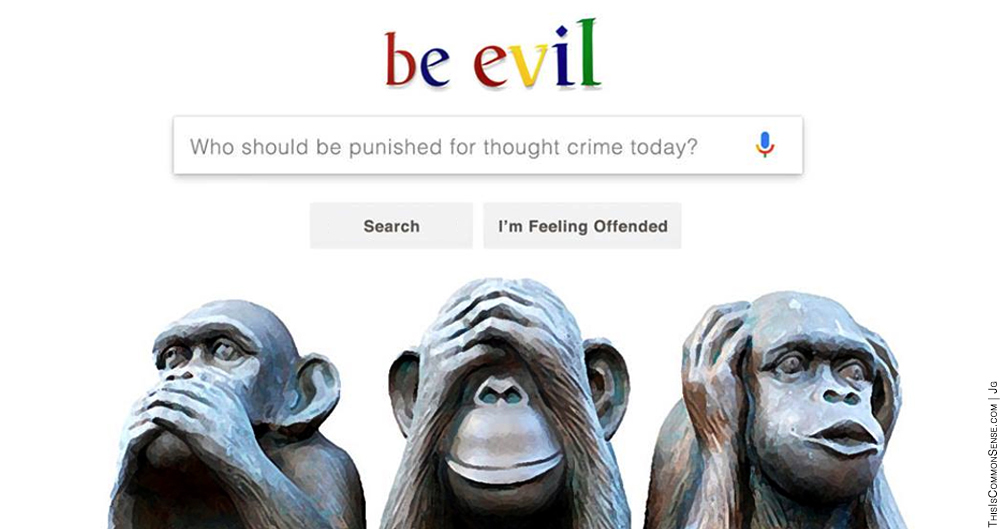
 

* The author, it is worth noting, addressed this monoculture in his title, “Google’s Ideological Echo Chamber.” I wonder if being proven right by one’s enemies compensates for job loss.


PDF for printing


Categories
Accountability folly general freedom ideological culture moral hazard nannyism national politics & policies

Google Has the Memo

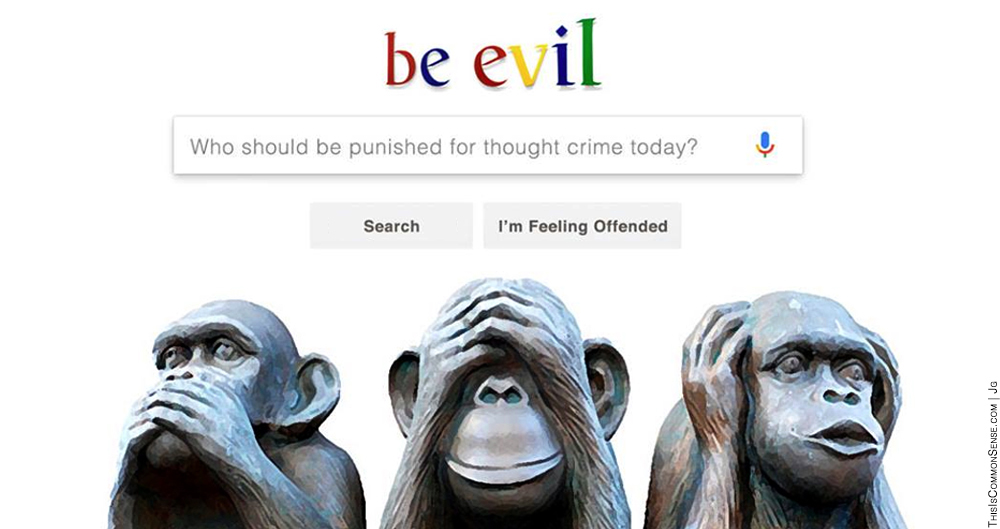
A Google employee, James Damore, internally distributed a memo, reprinted by Gizmodo* to widespread (if inch-deep) horror. The memo controversially takes apart Google’s efforts to increase its number of female employees.

Per the memo, it is surely unjust to discriminate against members of some groups in the cause of opposing alleged discrimination against members of other groups.**

But Damore (who has now been fired for his temerity) undermines this case. In the opening gambit we hear a note of appeasement: “I value diversity and inclusion. . . .”

Sounds harmless. Yet . . .

I don’t know about you, but when hiring somebody to do a job, I don’t rationally pursue “diversity and inclusion” in addition to the goal of hiring someone skillful, punctual, cooperative, bottom-line-enhancing. Not if I’m free to use my best judgment. I’d only also consider impacts on “diversity and inclusion” to avoid suffering politically-induced legal costs if I don’t.

The memo has other problems, but surely we can all agree: discriminating against members of particular groups is an unjust way to enhance workforce “diversity” . . . even if racial-sexual-age-height-width “diversity” were a legitimate goal for a company with the purpose of selling technology.

I’ve argued elsewhere against affirmative action in universities. Quotas based on group characteristics are always unjust when the qualifications for achieving a reasonable purpose have nothing to do with those group characteristics. That’s true whether we’re talking about students or workers, and whether the persons being sacrificed to serve “diversity” are white, black or Asian, male or female, gay or straight.

This is Common Sense. I’m Paul Jacob.
 

* Conveniently, Gizmodo neglected to include Damore’s extensive links to research that backed up his points, or his killer graph — even in its update.

** It is also far from self-evident that the disproportionately high number of male technology workers finds its root cause in sexual discrimination.


PDF for printing


Categories
Accountability ballot access initiative, referendum, and recall local leaders national politics & policies political challengers U.S. Constitution

Free to Choose

“I think that the most effective way one could possibly move toward greater freedom in the United States, toward a smaller role of government, would be if we could only have a more democratic society.”

Who said that? A Democrat?

No.

The speaker quickly added, “I don’t mean a capital-D, I mean a small-d.”

“That is, I mean if we could have referenda,” the late Milton Friedman explained back in 1987.

The Nobel Prize winning economist — and co-author with wife Rose of the bestselling Free to Choose* — was referring to the initiative and referendum process, whereby citizens vote on laws, and in the case of initiatives directly place measures onto the ballot.

Citizens enjoy initiative and referendum rights in twenty-four states and roughly 60 percent of cities throughout the country.

“The public at large has always shown itself,” Dr. Friedman observed, correcting himself, “has almost always shown itself to be more libertarian in its views than have their elected representatives.”**

Friedman was not suggesting that a bad law becomes good because it was passed at the ballot box. He simply weighed the odds between two distinct sets of voters. Legislators are a small group, the personal power of each one so closely tied to government that politicians’ personal interests often compete against the public’s. Conversely, the much larger group of voting citizens almost defines the public interest.

Perhaps I was channeling the great doctor of economics when I was once asked, “Do you trust the people?”

My reply?

“No. But I trust the people a whole lot more than I trust the politicians.”

This is Common Sense. I’m Paul of Jacob.


* The book was first published in January 1980, in tandem with PBS’s airing of the popular “Free to Choose” series.

** He spoke this at a California Libertarian Party conference. Tough crowd.


PDF for printing


Categories
Accountability general freedom ideological culture media and media people moral hazard national politics & policies Regulating Protest

Gatekeeping 2.0

There once was opinion hegemony, almost a monopoly. Official gatekeepers kept unwanted ideas — including some of mine, including many I strongly oppose — out of public consideration.

Then came the online media revolution, which switched influence from corporate, academic-approved media outlets to truly new media, like Facebook, Twitter and YouTube.

And now? The counter-revolution.

We saw it obviously in the downgrade and then banning of Milo Yiannopoulis’s Twitter, last year. Since then, new measures surface on a regular basis.

We helots, we commonfolk, must not be allowed actually to affect an election!

Or the hearts and inquiring minds of Americans, Europeans, and others worldwide.

Unless that opinion has received the imprimatur of the Center-Left.

I’ve written about this return of the Gatekeeper mentality before. The latest malefactor is YouTube, which locked Dr. Jordan Peterson out of his account this week* as well as put in place new policies to hobble the social sharing elements of YouTube.**

A week or so earlier, Patreon, an online crowdfunding patronage web service I’ve been thinking about trying out, cancelled independent journalist Lauren Southern’s account. Patreon managers charged that her most recent endeavor might cause “loss of life,” but, tellingly, “showed no evidence or proof, are allowing no appeal and have acted as judge, jury and executioner” — as one concerned netizen not inaccurately summarized.

The company’s CEO calmly explained himself to Dave Rubin on YouTube. Does he convince you?

I catch a whiff of panic.

This is Common Sense. I’m Paul Jacob.

 

* Dr. Peterson’s account has since been reinstated, no explanation given.

** You can learn all this and more on YouTube itself — so the platform hasn’t been shut down as such. Instead, a new Artificial Intelligence will restrict videos that do not even break YouTube terms of service, removing Likes, Comments, and Search features.


PDF for printing


Categories
Accountability education and schooling free trade & free markets general freedom local leaders national politics & policies responsibility too much government

SEZ Ed

The great barrier to educational advance in our time is the federal government. The second great barrier? Your state government. The third great barrier? Your local government.

Proposals to break up government-subsidized and -enforced school monopolies have ranged from tax credit proposals and voucher programs to charter schools and (the biggest success so far) home schooling.

But it may be time to advance something a little . . . more daring. Break the stranglehold of government on dysfunctional schooling.

How?

Apply the “free trade zone” (FTZ) idea to education.

We remember the FTZ proposal because of its rise in popularity amongst academics and policy wonks in the 1980s and 1990s. But the notion is an old one. And in China, where they are called “special economic zones” (SEZs) — and it is this term that is catching on — they have been amazingly successful, the former fishing village of Shenzhen being the most obvious example.

What about America? Take a devastated region, like inner-city Chicago or Detroit,* and simply nullify the regulations and rules. (This probably would require federal enabling legislation on top of state leadership.) With the ensuing freedom and opportunity, entrepreneurs, established businesses and schools, teachers, community groups and activists could cook up new solutions to the oldest schooling problem there is:

actual education.

I’ve heard whispers of this Educational SEZ idea for some time now.

It is time for rational and quite public discussion.

And then the shouting.

This is Common Sense. I’m Paul Jacob.

 

* Of course, any area could work. The reason to focus on demonstrably failed educational regions is that such areas have lost hope, and thus the politically resistant are likely to give in and allow it.


Printable PDF


Categories
Accountability incumbents initiative, referendum, and recall term limits

The Junk Bond State

What a pleasure — comparing notes with Nick Tomboulides, executive director of U.S. Term Limits, my old job.

Speaking on a panel last week at the Young Americans for Liberty National Convention,* Illinois came up. Nick agreed that if the Land of Lincoln had a term-limited legislature, we would never have heard the end of it: “Term limits are a failure!”

Illinois, you see, is a failed state, confessing the lowest credit rating in history.

Only a notch above junk bond status.

The media would have incessantly blamed “inexperience” for the fiscal implosion.

In reality, though, Illinois is a career politician’s paradise. Speaker Michael Madigan (D-Chicago) has spent the last 45 years in the legislature and all but two of the last 34 years as the chamber’s top banana.

Oh, it’s been a great ride for this longest-serving House Speaker in modern history. He’s grown wealthy while “serving” in office — and provided himself with a lucrative (and curiously gamable) state pension.

On the panel, Mr. Tomboulides highlighted “Ranking the States by Fiscal Condition,” a recent study by the Mercatus Center at George Mason University. Though only 15 of the 50 states have term-limited legislatures, those term-limited states represent a majority, eight of the top 15 ranked states. Among the states ranked at the very bottom, none have term limits.

“For years they’ve warned that term limits would lead to inexperience which would produce fiscal ruin,” Tomboulides wrote at the U.S. Term Limits blog. “This report proves the opposite is true — that term limits states do better than those run by prehistoric politicians.”

And yet, somehow, not once have Nick or I seen the state’s financial woes blamed on careerism.

This is Common Sense. I’m Paul Jacob.

 

* Feel good about the future: Very smart group of young folks at this YAL event.


Printable PDF


Categories
Accountability general freedom ideological culture initiative, referendum, and recall local leaders moral hazard national politics & policies

Reactionary America

With the meteoric transit of Anthony Scaramucci — into the Trump Administration and then, in an eye-blink, out of it — I have never been more convinced of the vital importance of state and local activism.

Yes, it’s been a chaotic week in Trumptown. The new White House Director of Communications vulgarly communicated himself into administrative excommunication. So to speak.

Everybody’s heard the vulgarisms; we’ve all processed the insanity. It looks like Mr. Scaramucci is one of those professionals who think everybody else is an idiot, and in so thinking it, proves himself to be what he himself despises. @#$%&?!

The man nicknamed “The Mooch” screwed the pooch, as we now say, and we can all shake our heads and . . .

what?

What is the lesson?

We have long known the worst: our national politics is broken. It has been for a very long time. Is it possible we never recovered from the LBJ and Tricky Dick fiascos of my childhood? The parties have become more ideological and less regional, while the regions have become . . . less rational. The only word seems to be . . .

reactionary.

The press reacts to the president’s tweets, and the president tweets in response to media reaction.

Progressives hate progress; conservatives conserve nothing.

“Reactionary” is the apt word, despite all the term’s past Marxist associations, because no one seems able to think forward, independent of partisan oppositionalism.

Don’t drive yourself crazy with this. Look homeward; think locally, act locally, and let’s build on a solid foundation.

This is Common Sense. I’m Paul Jacob.


Printable PDF