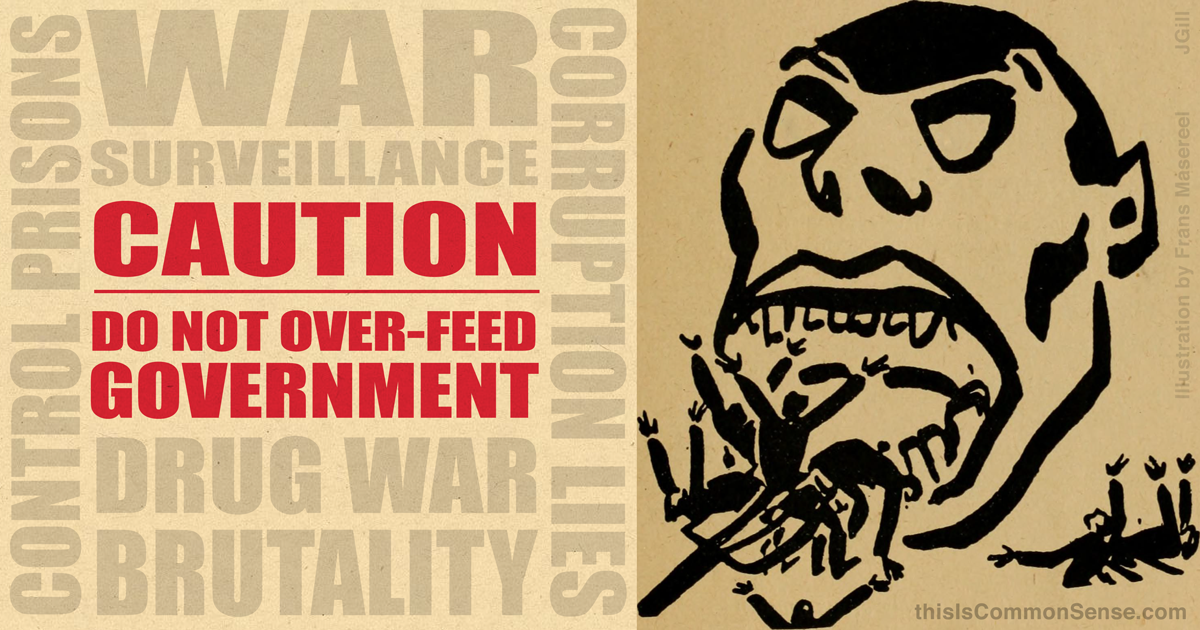
Caution: Do Not Over-Feed Government!
Get a high-resolution screensaver of this image. Click on the image below to open large version that you can download.
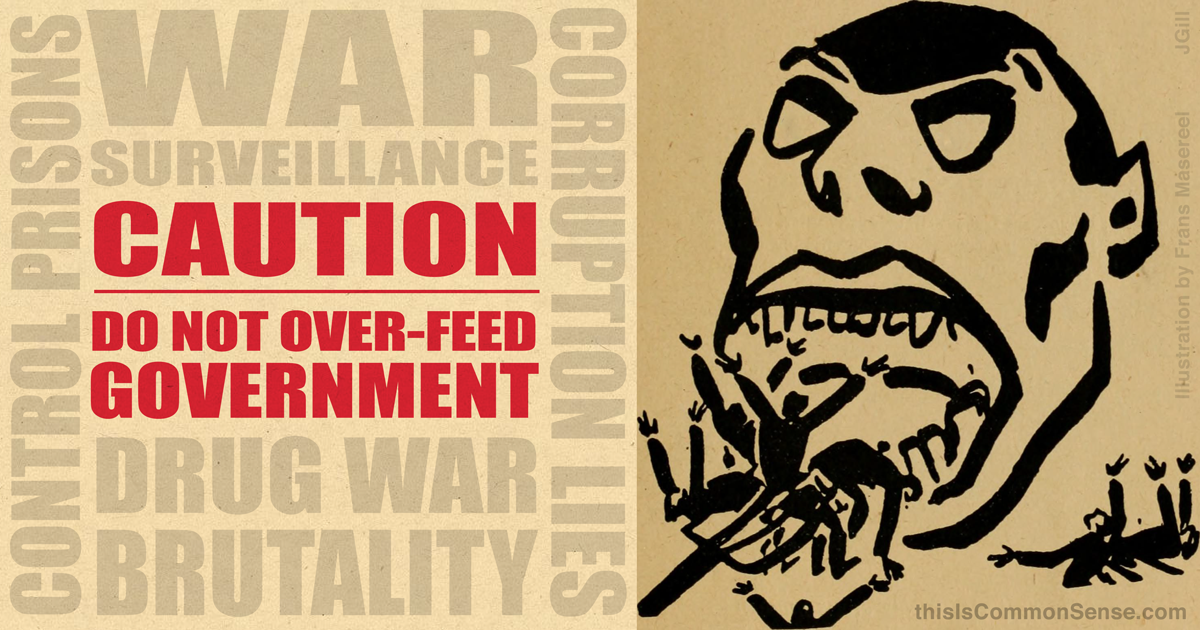
Caution: Do Not Over-Feed Government!
Get a high-resolution screensaver of this image. Click on the image below to open large version that you can download.
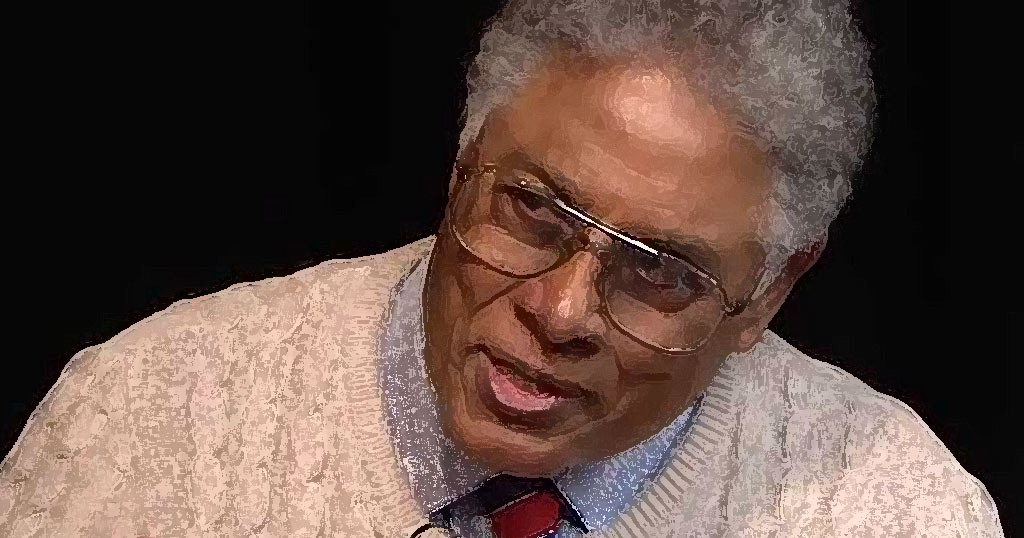
Thomas Sowell, who retired from his syndicated column last week, may be the greatest public intellectual of our time.
Though he is “an original,” an iconoclast, his work is best seen as the carrying on of a tradition. Or two.
Consider his most famous research area: race. An African-American, Sowell is the age’s most persuasive dissident to the dominant strains of racial advocacy. He brought much common sense to a subject beset with unhinged passion.*
And yet even here he was obviously drawing on traditions that, if not well known, were firmly established.†
One of Sowell’s most important contributions, in books such as A Conflict of Visions and The Vision of the Anointed, is his distinction between two very different ways of looking at the social world:
For many conservatives, this is Sowell at his best. But is it original? A few of my readers could probably lecture me on its origins in a famous essay by F. A. Hayek, “Individualism: True and False.”‡
Over at the Foundation for Economic Education, David R. Henderson addresses the one area where I tend to disagree with Sowell: foreign policy. Henderson gently calls out Sowell’s apparent credulity regarding the dishonesty of our war party leaders. Sure, Henderson writes, “[t]here are downsides to distrust. . . . But there are upsides too.”
Mourning the loss of trust in presidents, Sowell blames it on presidents lying to us in recent decades. But, as Henderson notes, “war presidents” lying to us about war is not new — providing examples.
Pity that Sowell, of all people, does not see the pattern here.
This is Common Sense. I’m Paul Jacob.
* See Sowell’s Ethnic America: A History, Race and Culture: A World View, and The Economics and Politics of Race: An International Perspective; but also popular argumentation, such as Pink and Brown People and Black Rednecks and White Liberals. And then there is the important Civil Rights: Rhetoric or Reality?
† Economists W. H. Hutt and Gary Becker, at the very least, provided the background for Sowell’s research with their respective books The Economics of the Colour Bar and The Economics of Discrimination.
‡ See F. A. Hayek, Individualism and Economic Order. In another essay, Hayek provides Sowell with the seed of Knowledge and Decisions.
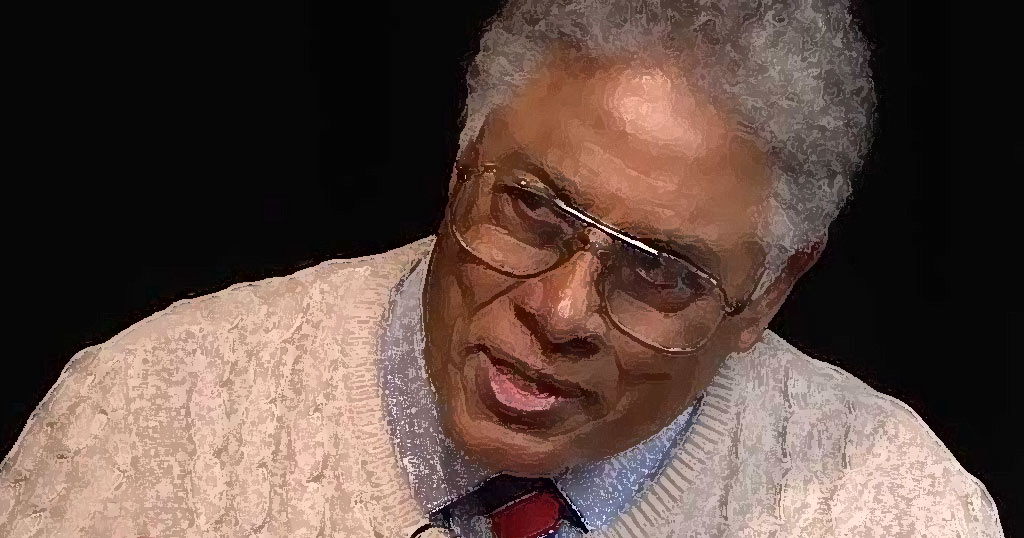

It’s a truism in politics: the pendulum swings. Now, around the world, we see a deep swing rightward:
Over the weekend, the Washington Post reported on events in Poland. There, the Law and Justice Party is not only making sweeping changes of a pro-family, religious conservative nature, it has also grown in popularity.
Fearing an anti-intellectual “neo-Dark Age,” the Post finds cause for that worry in the fact that the Poles are downplaying evolutionary science in government school curricula.*
Before the big freak out, note the why of this: the dominant progressive-left paradigm has proven itself incapable of dealing with the challenges of the present age — most being caused by their own policies. Worse yet, those on the vanguard left have become moral scolds and petty language tyrants.
Yes, political correctness is one of the big offenders, here.
So, of course there’s a backlash.
But, turnabout being fair play, if the move to the “right” goes too far — as it probably will — we can expect another swing leftward.
Isn’t it time to give that pendulum bob a whack, to initiate something like an equilibrium position? Many of today’s problems are caused by partisans trying to force their kind of change down others’ throats. There is an alternative: limit government, setting it to just a few tasks, letting society evolve naturally, without forced central planning.
That would be “evolutionary,” and thus neither rightist nor revolutionary-left. Call it neo-Enlightenment.
This is Common Sense. I’m Paul Jacob.
* Poland’s new government has become scary, by reducing transparency, limiting press access, purging the government news network of anti-rightist journalists, hiking subsidies to traditional families and the elderly, shelving the gay marriage issue and allowing local governments to cut back on granting public protest permits. Not all of these are equally frightening, of course. Why should any government be allowed to maintain a government-run news agency? (Ideological purges come with the territory.)

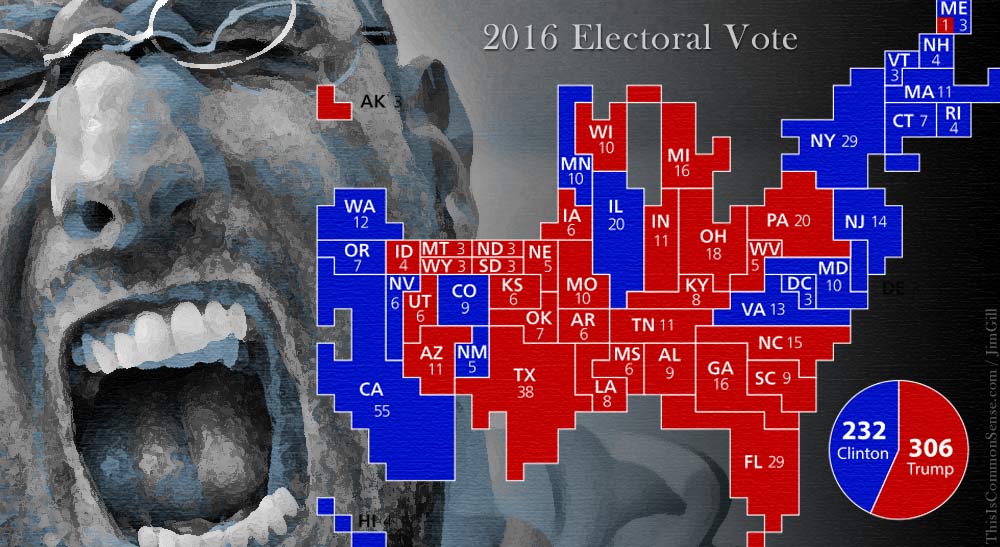
Today the Electoral College meets to elect the 45th President of these United States.
But if they fail to cast the required majority for a candidate, the contest goes into the House of Representatives, where each state gets one vote — Wyoming and California equally weighted — and a state’s vote can only be cast for one of the top three Electoral College vote-getters.
Of course, only two candidates won electoral votes, because only they won states. Donald Trump won 30 states comprising 306 electoral votes; Hillary Clinton won 20 states with 232.
That’s the arithmetic. But, as I explored at Townhall yesterday, nothing in the Constitution requires an elector pledged to Trump or Clinton to vote for that candidate.* They can vote their conscience.
That’s why in recent days, Nancy Pelosi’s daughter, Christine, a California elector, petitioned to have electors receive an intelligence briefing about Russian hacking — hoping to sway electors.
Her petition was denied.
Desperation showing, a group of Hollywood actors led by Martin Sheen starred in a Unite for America video talking down to — er, directly to — Republican electors. Asserting that the Electoral College was designed by “Hamilton himself” to prevent an “unfit” “demagogue” (they mean Mr. Trump) from attaining the presidency, the actors claim to “stand with” and “respect” GOP electors, who could be heroes in Hollywood (no honor more tempting!) if only they’d cast their vote for someone other than Trump.
Anyone! — who meets presidential qualifications. “I’m not asking you,” three actors in a row assure, “to vote for Hillary Clinton.”
As much as I support the idea of voting one’s conscience and as much fun as this election has been, I think we’ve all now had enough. Let’s prepare ourselves to help Mr. Trump do what’s right and stop him from doing what’s wrong . . . with a clear conscience.
This is Common Sense. I’m Paul Jacob.
* Some electors do sign a loyalty pledge to the candidate and there are state laws, almost certainly unconstitutional, which penalize electors who do not vote for the candidate they are pledged to.

Original (cc) photo by Crosa on Flickr
The first I heard of an actual enumeration of federal “intelligence agencies” was from Hillary Clinton. In the final presidential debate, she claimed that the truths spilling out of the Podesta emails had been revealed courtesy of Russian hackers, and she knew this because all 17 U.S. “intelligence agencies” had briefed her.
Seventeen!
The number, at least, does not come from a secret source. Business Insider had popularized it. “These 17 Agencies Make Up The Most Sophisticated Spy Network In The World,” Paul Szoldra informed us three-and-one-half years ago in a fascinating listicle.
Call me paranoid . . . but if I am told that the government has 17 spy agencies, I wonder about one more: The Really, Really Secret Infodump Agency. There is, after all, no official definition of “government agency”; the federal government doesn’t even publish an official overall count, intelligent or otherwise.
Besides, the prime number 17 just seems too . . . contrived. Sixteen or 18? Boring numbers. But 17? Its numerological magic lends plausibility to “the most sophisticated spy network in the world.”
Of course, when Mrs. Clinton insisted that all 17 had concurred that the Russians were on Trump’s side, I did not believe her. And now that mainstream media outlets — in an apparent frenzy to prove themselves a more reliable fake news source than the Twittersphere, blogosphere, Facebook-o-sphere and Breitbart combined — run with nearly the same story, I don’t believe them, either.
It is as if they’ve had their talking points delivered in a secret dossier.
Reasons for doubt? All the anonymous sources, all the hedges on the order of “may be linked to” and “‘one step’ removed.”
Fake news. Brought to you by the number 17.
This is Common Sense. I’m Paul Jacob.
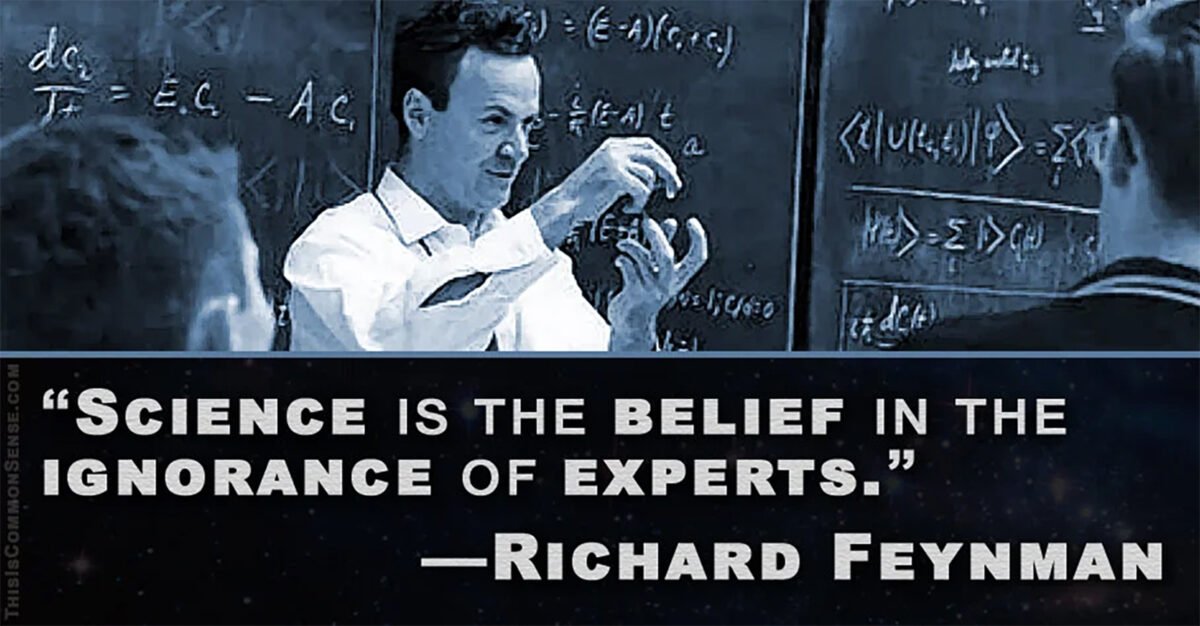
Richard Phillips Feynman May 11, 1918 – February 15, 1988) was an American theoretical physicist known for his work in the path integral formulation of quantum mechanics, the theory of quantum electrodynamics, and the physics of the superfluidity of supercooled liquid helium, as well as in particle physics for which he proposed the parton model. For his contributions to the development of quantum electrodynamics, Feynman, jointly with Julian Schwinger and Sin-Itiro Tomonaga, received the Nobel Prize in Physics in 1965.
“Science is the belief in the ignorance of experts.”
(address “What is Science?“, presented at the fifteenth annual meeting of the National Science Teachers Association, in New York City (1966), published in The Physics Teacher, volume 7, issue 6 (1969), p. 313-320)
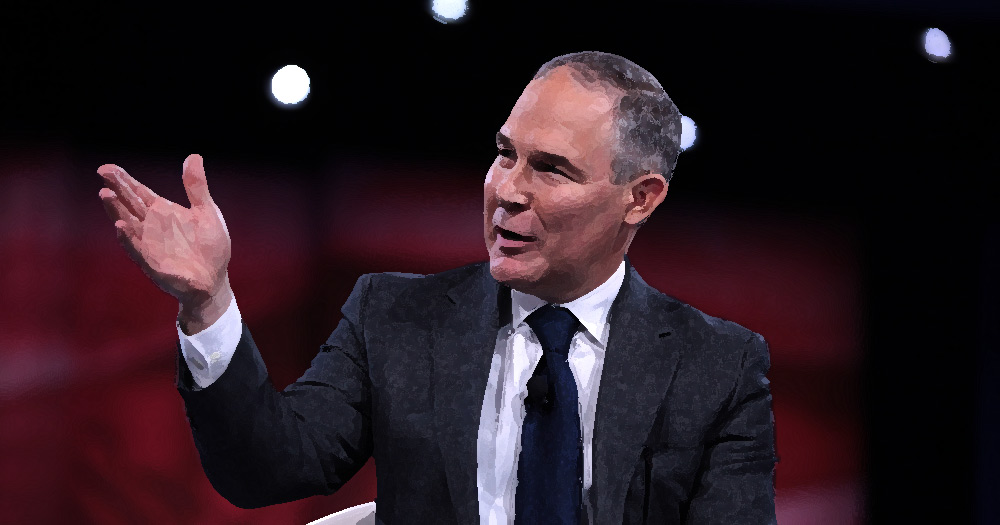
I know Scott Pruitt, Donald Trump’s pick to head the EPA; he replaced the egregious Drew Edmondson as Oklahoma Attorney General.
Pruitt seems like a good man.
But Sen. Bernie Sanders (I-Vt) says different. “Mr. Pruitt’s record is not only that of being a climate change denier, but also . . .”
Wait: that “climate change denier” charge is everywhere. But all I’ve seen is assertion.
It would indeed be weird were he — or anyone — to deny the reality of climate change. Way back in my Seventies’ youth, I saw all sorts of climate change articles . . . predicting a new Ice Age.
Decades later, the headlines began to change: Global Warming was in.
But note: those Seventies’ articles usually mentioned that the world had been heating out of the recent Little Ice Age, with the thaw beginning before the dreaded Industrial Revolution.
I bet that what our new Trump pick really believes is that
Betting aside, what does Pruitt believe? The Advocate actually repeats the disproven “97 percent of climate scientists” meme to pile on the abuse*, but did link to a National Review article Pruitt co-authored with Alabama’s attorney general.
They did not deny climate change, merely insisting that “the debate is far from settled.” More importantly, they argued that governments should not intimidate energy companies in service to the climate cause. Instead, they called for open debate.
Shocking!
This is Common Sense. I’m Paul Jacob.
* The Advocate also irrelevantly charged Pruitt with “transphobia.” But then, Trump’s Small Business Administration pick, Linda McMahon, has also been tarred with the “climate denier” charge, which is as irrelevant to an SBA head as vegetarianism would be for a Secretary of Treasury.

Original (cc) photo by Gage Skidmore on Flickr

When President Obama announced last week that he wants my daughter to register for the draft — as a symbol of the nation’s commitment to gender equality and a “ritual of adulthood” — believe me, I noticed.
Sure, the symbolism rings hollow, I wrote at Townhall. The president is on his way out and Congress just agreed on a defense authorization bill blocking any Christmas-time sign-up of women by the festive folks at Selective Service.
Still, President O’s symbolism is all wrong.
Free societies don’t require the involuntary service of men and/or women for their defense, much less celebrate conscription as a secular rite. Our All-Volunteer Force is the most effective military in the world. Its leaders neither need nor desire to swell its ranks with draftees — even if, heaven forbid, a major war bubbles forth from all the foreign conflicts and interventions in which we’re currently engaged.
As for the “it’s just registration” argument, and promises by politicians that they don’t support a draft. Well, it’s registration for the draft. Per politicians’ promises, I rest my case.
Yet, this comment at Townhall called me back into service: “Has this author been against draft registration for the last 30+ years or is it just because his little princess might have to register? If men have to do it, so should women.”
With slight edits, I replied: “I oppose the draft on principle . . . As Daniel Webster pointed out, government has no constitutional authorization to conscript citizens. The draft further violates the 13th Amendment. Conscription has been the hallmark of dictators and totalitarian regimes, not America. We’ve had a draft rarely in our history.
“In 1980, I refused to register for the draft when Jimmy Carter brought it back. Candidate Ronald Reagan said, ‘The draft or draft registration destroys the very values that our society is committed to defending,’ and pledged to end registration as president. But Reagan reversed himself and prosecuted 13 of us who had spoken out against the policy and refused to register. I served six months in a Federal Correctional Institution (without being corrected) — the longest of anyone post-Vietnam.
“Here are the reasons I resisted at the time (1985) and a more recent reflection (2010).
“My daughter will make her own decision, and I’ll be supportive. But it is a terrible policy that will diminish our military defense, while also violating . . . ‘the very values our society is committed to defending.’
This is Common Sense. I’m Paul Jacob.
* Today, Tuesday, Dec. 6, 2016, marks the 32rd anniversary of my arrest by the FBI for violating the Military Selective Service Act by refusing to sign a draft registration form.
Additional Information
Common Sense: Needless List
Townhall: Draft the Congress and Leave My Kid Alone (2003)
Townhall: Americans Gung-Ho to Draft Congress (2004)


Don’t worry, scientist Roger Pielke, Jr., informs us. He is doing fine — he has tenure.
It is too bad, though, that he no longer works in climate science.
He was drummed out of that endeavor by journalists, big-monied foundations, and the White House.
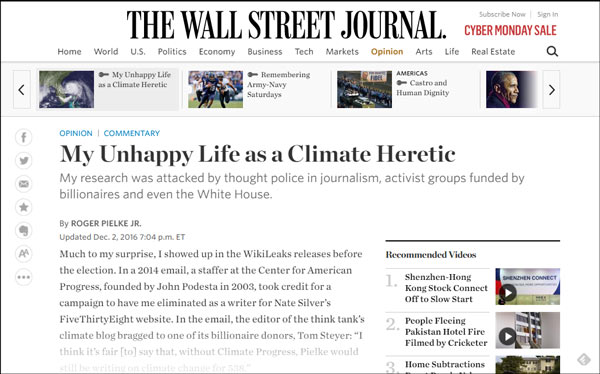
Are you skeptical? Well, drill down into the Podesta emails on WikiLeaks. There you can read infamous billionaire Tom Steyer gloating, “I think it’s fair [to] say that, without Climate Progress, Pielke would still be writing on climate change for 538,” a popular website. Pielke has not been published there at all since 2014.
Pielke had made the mistake of publishing the results of his research. He claims not to be heretical on the main points of the current orthodoxy. But Pielke ticked off all the wrong people with his demonstration that the evidence did not back up the climate change movement’s much-repeated charge that the weather has gotten more traumatic as the planet has gotten warmer.
Pielke relates all this in a fascinating Wall Street Journal commentary, “My Unhappy Life as a Climate Heretic.” Pielke is actually somewhat philosophical about the political and foundational forces arrayed against him — expressing more dismay at his betrayal by journalists and academics.
“You should come with a warning label,” jested one journalist who had merely quoted him. “Quoting Roger Pielke will bring a hailstorm down on your work from the London Guardian, Mother Jones, and Media Matters.”
This “hailstorm” is more widespread and damaging than the results of global warming itself. It effectively distorts both scientific research and the news.
Thus, a political orthodoxy rides herd over public opinion. Over us. By squelching good journalism and honest science.
This is Common Sense. I’m Paul Jacob.


“To paraphrase Bernie Sanders, America is sick and tired of hearing about liberals’ damn bathrooms.”
Finally. Some sense from the New York Times.
Mark Lilla, in “The End of Identity Liberalism,” delivers a valuable lesson about political correctness — without once mentioning the term “political correctness.”
Now this is a lesson we can get behind.
The problem is “diversity.” The center-left became so obsessed with it that it helped sink the last election for Hillary Clinton, Democrats at large, and the coherence and legacy of President Barack Obama.
“However interesting it may be to read, say, about the fate of transgender people in Egypt,” Lilla wrote in the Friday think piece, “it contributes nothing to educating Americans about the powerful political and religious currents that will determine Egypt’s future, and indirectly, our own.”
Fixating on diversity of gender identity and racial make-up in business and government has scuttled the rights-oriented approach of the older liberalism.
Alas, Lilla is not talking about the liberalism of J.S. Mill or Lord Acton. He is talking about FDR.
But compared to today’s “identity liberalism,” FDR’s burdensome promises look like sheer genius. And Lilla understands at least one thing about diversity: “National politics in healthy periods is not about ‘difference,’ it is about commonality. And it will be dominated by whoever best captures Americans’ imaginations about our shared destiny.”
He does not bring up the real liberal message: that the way to find commonality is to avoid making government all things to all people. It is to limit its scope, instead, so the president of the United States isn’t every school’s bathroom monitor.
Perhaps an essay on The End to Hubristic Liberalism is required?
Another day. And probably another paper.
This is Common Sense. I’m Paul Jacob.

Original (cc) photo by James Cridland on Flickr