Categories
crime and punishment education and schooling general freedom national politics & policies responsibility Second Amendment rights too much government

Good Men With Guns

We hear too much about “successful” mass murderers — from news readers, journalists, and so-called experts.

And it is hard not to think about the disturbed gunmen who kill as a way to feel powerful for a few seconds as they seek revenge for whatever they hate about their lives.

Now families in Sante Fe must deal with the horror.

We don’t hear as much about the good men who interrupt such rampages.

A report about how a killer was stopped on May 24 begins with these matter-of-fact words: “A gunman who opened fire at an Oklahoma restaurant Thursday evening was confronted by two people who saw what was happening, got their guns and shot him dead, police said.”

The gunman was able to wound three people. But before he could hurt others, Carlos Nazario and Bryan Wittle, outside the building as the shooting began, quickly grabbed firearms from the trunks of their vehicles and ended the threat.

A week earlier, Mark Dallas, a police officer on duty in Dixon High School in Dixon, Illinois, had exchanged gunfire with a recently expelled student, stopping him before anyone else could be shot. The attack took place in a gym where many students were gathered for a graduation rehearsal.

Mark Dallas happened to be an officer of the law. But you don’t need to be a policeman to use a gun justly and well in a bad situation. What you need is training and presence of mind — the willingness and ability to protect yourself and others.

And you need the gun.

This is Common Sense. I’m Paul Jacob.



PDF for printing

Photo by Ken on Flickr


Categories
Accountability crime and punishment folly general freedom ideological culture media and media people moral hazard nannyism privacy property rights responsibility tax policy too much government U.S. Constitution

Brave New Paternalism

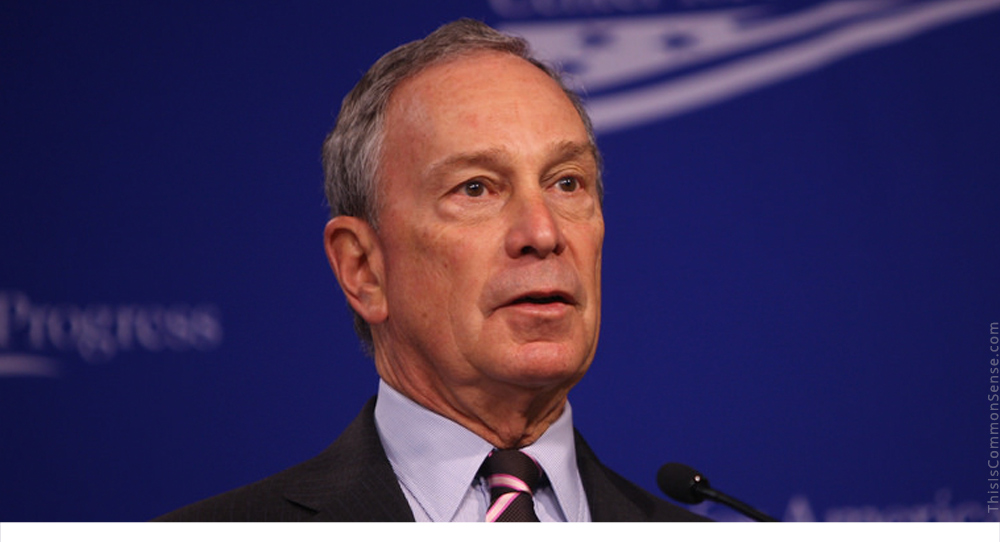
Michael Bloomberg is rich. He’s also in politics — a public health crusader.

And, for years, he “has personally funded and promoted all sorts of regressive taxes and regulations in an attempt to push people around,” the folks at Americans for Tax Reform tell us. “He uses the coercive power of the government to force people to live their lives as he sees fit.”

Onstage at a globalist event, One-on-One with Christine Lagarde — who is managing director of the International Monetary Fund — Bloomberg blurts out his approach to government policy regarding what he calls “those people.”

“If you raise taxes on full sugary drinks,” he says, “they will drink less and there’s just no question that full sugar drinks are one of the major contributors to obesity and obesity is one of the major contributors to heart disease and cancer and a variety of other things.”

Against the charge often made that such taxes fall heaviest upon the poor, he is forthright. Regressive? “That’s the good thing about them because the problem is in people that don’t have a lot of money.”

Notice that he is not talking about a public service campaign to help people learn how to drink (and eat) better. And he is not talking about removing all the government policies that have encouraged bad eating and drinking habits (as well as lethargy) — the government programs to encourage the overuse of high fructose corn syrup; the welfare state’s poverty trap that stifles life at the lower incomes; the subsidized consumption of food and drink — he wants to add another government program.

He can only see betterment by increased governmental bullying.

This is Common Sense. I’m Paul Jacob.


PDF for printing

Michael Bloomberg, tax, policy, nanny state, vice, social engineering, statist, technocrat

Photo by Center for American Progress

Categories
Accountability crime and punishment general freedom ideological culture moral hazard nannyism national politics & policies privacy too much government U.S. Constitution

Hooray for Congress!

When Congress behaves badly, I criticize. When it works well, I applaud.

I’ve waited a long, long, long time to put my hands together in polite applause.

It happened yesterday.

The U.S. House of Representatives passed a Senate bill, largely along party lines, to give those facing a terminal illness the “right to try.” That is, the right to try experimental drugs and treatments that haven’t yet been approved by the federal Food & Drug Administration (FDA). 

Of course, Congress doesn’t actually give us rights. We have always had the common law right — indeed, the human right — to freely seek a path to wellness when we are ill.

From time immemorial. Even before the FDA.

So, this legislation was, more correctly put, a way to announce that the congressionally-created FDA would stop blocking our freedom . . . provided we are dying and the government-approved medical establishment has no more licensed hope to offer.

The bill now goes to President Trump. “People who are terminally ill should not have to go from country to country to seek a cure,” he declared in his last State of the Union, “I want to give them a chance right here at home.”

Democrats overwhelmingly disagreed. 

“This will provide fly-by-night physicians and clinics the opportunity to peddle false hope and ineffective drugs to desperate patients,” argued Rep. Frank Pallone (D-N.J.).

Rep. Jan Schakowsky (D-Ill.) likewise charged that the legislation “puts patients at risk by allowing the sale of snake oil.”

But of course these patients are dying. That’s already as “at risk” as it gets. Our right to live includes a right to try to live.

This is Common Sense. I’m Paul Jacob.
 

PDF for printing


Categories
crime and punishment education and schooling general freedom ideological culture responsibility Second Amendment rights too much government

What to Do

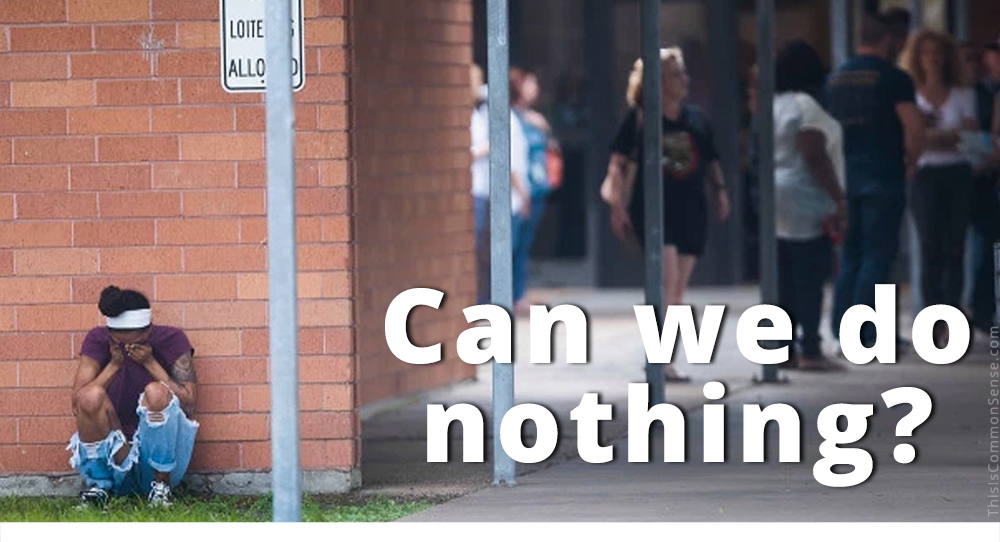
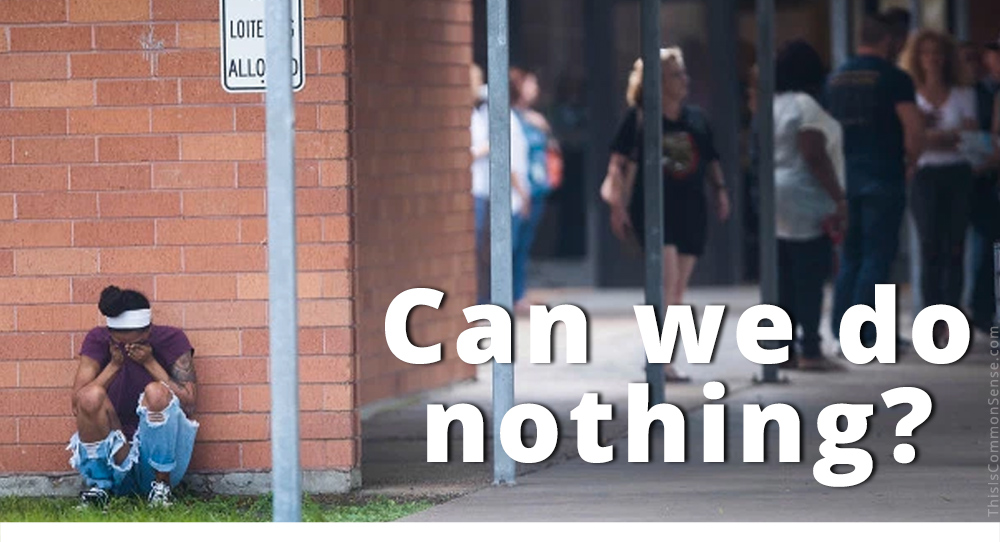
Another school shooting — more dead and injured, many more terrified by the violence. And, in its wake, more demands for

  • gun control,
  • schools as hardened targets, and
  • mental health initiatives.

Oh, and finger-pointing at video games, too.

So what should we do?

  1. Stop publicizing the names of these school shooters and plastering their faces all over the media.

I’m specifically not calling for any new law or government regulation. These criminals’ names must be publicly available. Let’s not reduce transparency in government one iota. Instead, let’s demand that our favorite media do the public-spirited thing: don’t make these killers personally infamous. I’ve written about this danger, which even the ancients recognized, before.

  1. Fix the background check database. The main system for preventing bad people from getting guns relies totally on checking gun purchasers against a database that is full of holes.

Late last year, a man convicted of domestic violence and with documented mental health issues passed the background check to purchase the weapon he used to murder 26 people in a Texas church. The Air Force had failed to transmit his criminal record to the FBI. If our elected officials, on both sides of the “gun control” issue, are serious about saving lives, they will concentrate first on making certain the background check database is complete, and systematically updated.

  1. Give students greater choice.

Being a teenager isn’t easy. The more choice they have in the schools they attend and the type of bullying education they receive, the better — not only for their education, but for their mental well-being, too.

Let’s face it: we cannot prevent all future acts of violence. And should be wary of those who claim they can. Still, we can take action. 

This is Common Sense. I’m Paul Jacob.

 

PDF for printing


Categories
Accountability free trade & free markets general freedom media and media people national politics & policies responsibility too much government

Working for Whom?

Two articles on Sen. Rand Paul appeared in my Reason feed the other day. Up top.

So it was hard not to look.

They were “John McCain: It ‘Wasn’t Incorrect’ to Say Rand Paul Was ‘Working for Vladimir Putin’” and “Rand Paul’s Plan to Balance the Budget by 2023 Will Get a Senate Vote This Week.”

The latter story is the bigger one, of course. In it, Eric Boehm asked, “Do Republicans have the guts to impose strict spending caps?”

His answer was “probably not.” Good guess.

“Passing the Kentucky Republican’s so-called ‘Penny Plan’ would be a dramatic reversal for Congress,” Boehm wrote, “which earlier this year approved enormous spending hikes that busted Obama-era spending caps and threaten to put the country on pace for a $1 trillion annual deficits. . . . Paul tells Politico that it will be a ‘litmus test for Republicans who claim to be conservative, but are only too happy to grow the federal government and increase our debt.’”

I am afraid the litmus paper has turned . . . red. As in red ink. As in accumulating debt till we drop.

Yesterday Paul’s plan was voted down, 21-76.

In the other Reason piece, Matt Welch noted that Arizona’s senior senator stands by his calumny, last year, against Kentucky’s junior senator. Paul had delayed “ratification of Montenegro’s entry into the North Atlantic Treaty Organization (NATO).” McCain, a gung-ho NATO expansion proponent, accused Paul of “working for Vladimir Putin.”

If Putin really seethes with ill will towards America, wouldn’t he want to see the country burdened with debt?

So, on this vote, those 76 senators who didn’t “stand with Rand” are undoubtedly working for Putin.

This is Common Sense. I’m Paul Jacob.



PDF for printing


Photo of Rand Paul by Gage Skidmore | Photo of John McCain from Wikimedia Commons


Categories
Accountability folly general freedom media and media people Second Amendment rights too much government

Simplistically Wrong

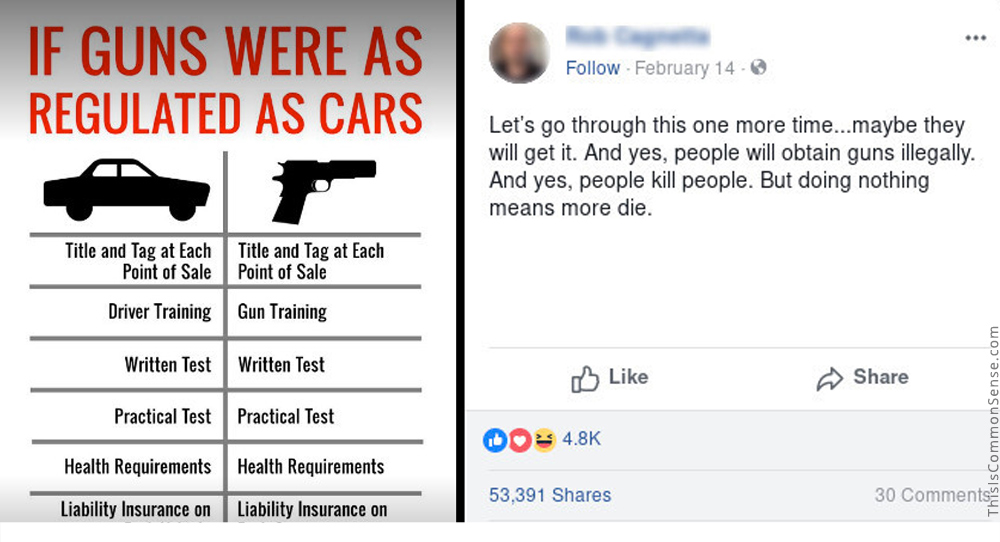
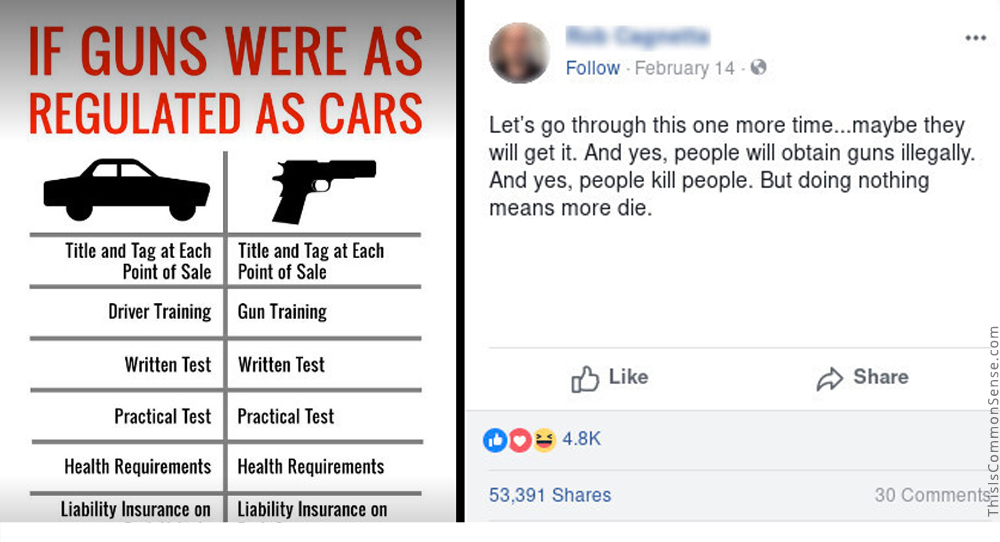
A clever “meme” made the rounds earlier this year showing, in two columns, what it would be like were guns regulated like cars.

How reasonable that would be!

“Title and tag at each point of sale”; “Driver training”/“Gun training”; Liability insurance on each vehicle/gun”; etc. It seems sound, no?

No.

The memester failed to address a context: our car and driver regulations apply to vehicles and drivers on government-run roads. On your own property you can drive all sorts of vehicles, unregulated. And it is on their own property that most gun owners’ firearms stay most of the time.

So, treating “guns like cars” would put government deeper into our private affairs.*

The meme came into an economist’s view packaged under the slogan “doing nothing means more people die.” He saw problems. For example, “someone might propose that each person above the age of 10 years old be interned in a mental-health camp, until and unless experts appointed by the state certified that he or she was not a danger to society.”

Same logic — we cannot do nothing, can we?

Another economist dubbed the problem we have identified here as “a simplistic model of public policy.” Policy advocates tend to assume that if you change a policy we get only one effect. Not true.  

A third economist (I’m going for a trifecta!) discovered that even adding safety features to cars comes at a cost in human life: feeling safer, drivers compensate . . . and it is non-drivers who suffer. More drivers hit more pedestrians.

Be cautious when you drive, sure. Be cautious when you shoot, of course.

But be cautious, especially, when you prescribe new laws.

This is Common Sense. I’m Paul Jacob.


* Not to mention that gun rights are specifically enshrined in the Constitution and vehicle rights . . . not so much.

PDF for printing


Categories
Accountability folly free trade & free markets ideological culture local leaders moral hazard nannyism property rights too much government

Amazon’s Jeff Bezos Is …

A half a year ago, when trying to make sense of the much-publicized search for Amazon’s “HQ2” — a second headquarters city, away from Seattle — I concentrated on the subsidies that cities and metro areas were apparently throwing at Amazon.

It all seemed desperate, indecent.

But there was a story behind the story. Amazon has every reason to be looking for an escape route from the Evergreen State’s biggest city.

The city’s leadership is nuts.

“Seattle City Council members have finally released draft legislation,” the Seattle Times’ Daniel Beekman wrote last month, “for a new tax on large employers that would raise $75 million next year to address homelessness.”

The council blames the big companies for enticing workers into the city, thereby driving up rental costs and housing prices.

The tax would be on employee hours, would go into effect next year, and “in 2021, it would be replaced by a 0.7 percent payroll tax on the same category of companies,” explains the Seattle Times.

Now, if you tax something you discourage that something. That’s why progressives like sin taxes on sodas and fast foods. To discourage consumption.

So when progressives seek to tax big producers, they are apparently trying to tax away the housing crunch by driving away big business.

Amazon reacted. It put a halt to an expansion project.

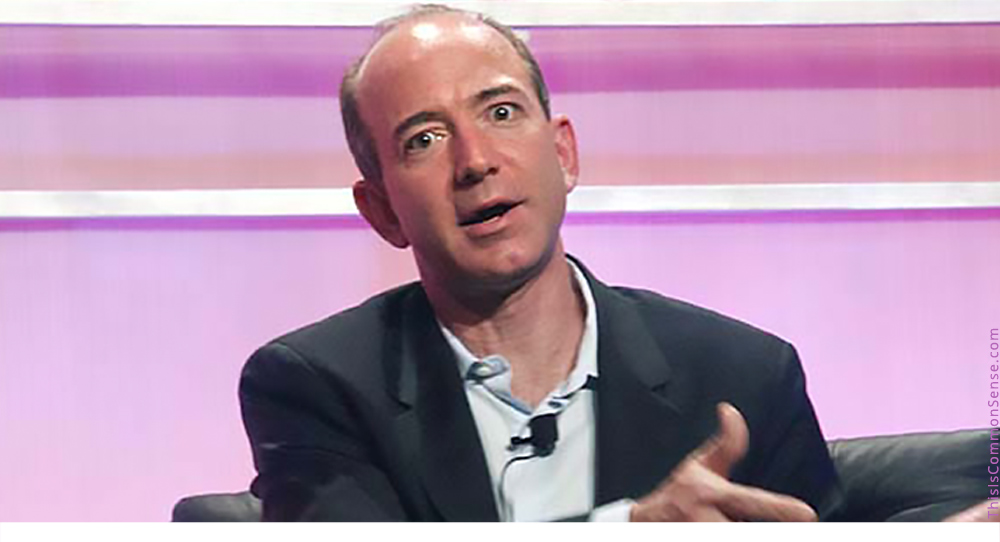
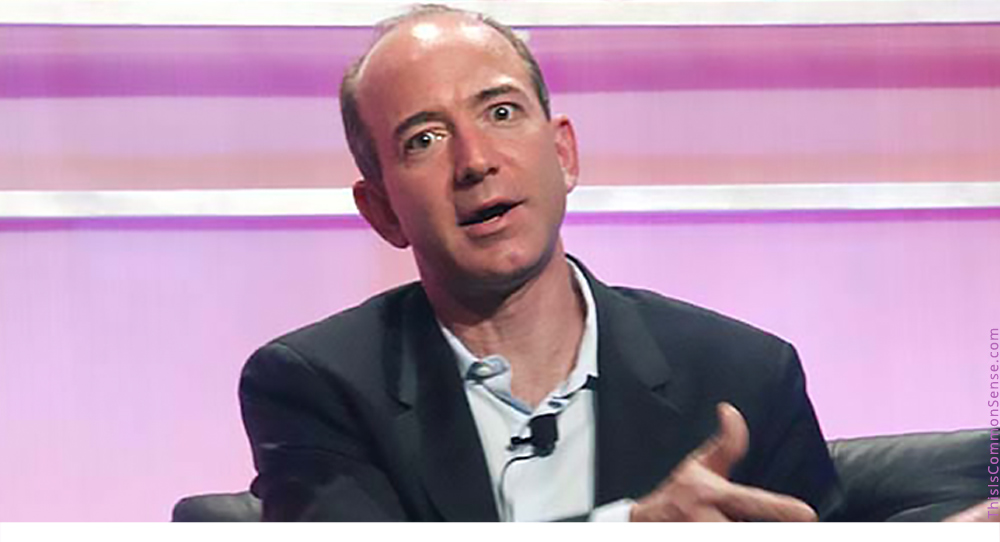
“Jeff Bezos is a bully,” said Kshama Sawant, the confessed socialist, speaking for the council. “I think we are in broad agreement on that.”

If that is her attitude, and that of the council — and the consensus of the city’s denizens — then what Amazon’s Jeff Bezos really is?

A “good businessman.”

This is Common Sense. I’m Paul Jacob.


PDF for printing

Photo by JD Lasica


Categories
Accountability education and schooling folly government transparency insider corruption local leaders moral hazard nannyism national politics & policies responsibility too much government

Reading, Writing & Racketeering

When I attended a public school — many decades ago, in a galaxy far, far away — teachers told students that cheating was unacceptable and would be punished.

Harshly.

Today, the idea has students laughing — all the way to graduation.

Last year, after DC Public Schools officials breathlessly announced massive improvements in graduation rates, several honest teachers broke ranks, and an investigation uncovered massive fraud: a whopping one of every three graduates across the city resulted from falsified records.

Many students played hooky for a third or even half the school year. Administrators also pressured teachers to improve grades to hike the graduation rate.

“The problem,” Washington Post columnist Colbert King concluded, “is systemic indeed.”*

You see, employment evaluations and cash bonuses for teachers and administrators were — and still are — tied in part to student graduation stats. It turns out that an incentive to good work can also serve as an incentive to cheat. Could it be that government employees grading their own work does not encourage honesty?

Just months after confirmation of the worst fears of public school corruption, new allegations against teachers and administrators at Roosevelt High School more than suggest fudging attendance records is ongoing.

“This growing environment of fear and mistrust,” asserts Elizabeth Davis, president of the Washington Teachers’ Union, “has never been addressed and continues to be a disservice to students and teachers.”

City officials have had plenty of time to address the issue. And of the common sense idea that the best way to avoid fear and mistrust is to follow the rules?

Crickets.

This is Common Sense. I’m Paul Jacob.



* Nor is the fraudulent behavior limited to dishonestly boosting graduation rates. Former DCPS Chancellor Antwan Wilson resigned back in February after it became public knowledge that his daughter jumped 600 other students on a waiting list for her school. A recent Post story about enrollment fraud, whereby non-residents grab spots at prestigious schools such as the Duke Ellington School of the Arts, without paying the non-resident fee, was entitled, “Stop enrollment fraud? D.C. school officials are often the ones committing it.” Two-thirds of pending cases involve a current or past DCPS employee.


PDF for printing


Categories
education and schooling general freedom ideological culture moral hazard nannyism national politics & policies too much government

Grading Democracy on the Curve

Voters, we are told, are amazingly ignorant. So, what to do?

“Ultimately, the ideal democracy is one in which as many citizens as possible vote,” writes Dambisa Moyo at The Guardian, “and the voters are armed with the most objective information. Yet today only a fraction of the electorate are voting, and many are armed with a diet of hyped-up statistics and social media propaganda.” Among her proposals is a voting booth access test: “why not give all voters a test of their knowledge?”

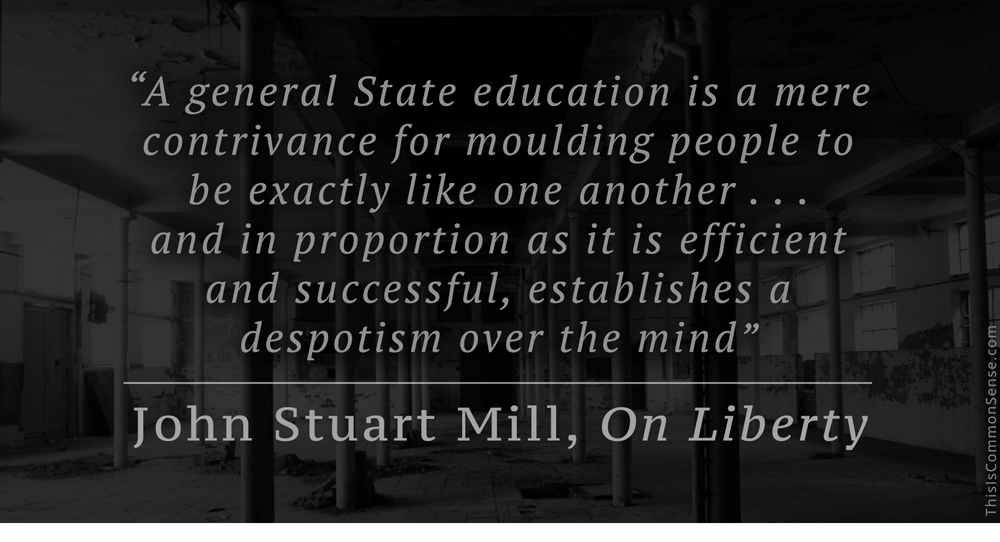
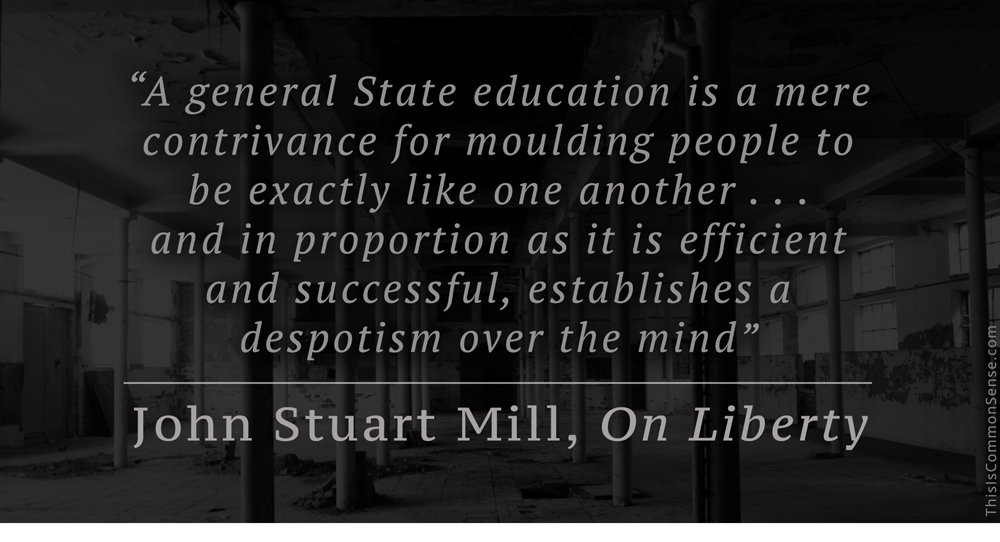
I can think of a whole bunch of reasons, as can Ilya Somin, over at Volokh Conspiracy, who considers just a few. One of the more interesting is this: whereas Moyo has no wish to shove poor people out of the voting booth, and so envisions public schools to teach to the test — “the knowledge needed should be part of the core curriculum” — Somin quotes John Stuart Mill about the very political dangers of the very idea of public schooling: “A general State education,” wrote Mill in On Liberty, would inevitably be devised to please and serve “the dominant power in the government, whether this be a monarch, an aristocracy, or a majority of the existing generation” and must constitute “a despotism over the mind.”

Though Moyo does observe incumbency and political careerism as big problems, she is innocent of the more fundamental issues.

Indeed, she does not consider the obvious: today’s voter ignorance of politics and government is in no small part the result of government schools.

For politicians, general ignorance is not a bug, it’s a feature.

Let’s look for solutions to political problems that do not give politicians more power.

This is Common Sense. I’m Paul Jacob.



PDF for printing


Categories
crime and punishment general freedom ideological culture initiative, referendum, and recall local leaders national politics & policies political challengers property rights Regulating Protest too much government

A Sanctuary from Centralization

Defiance . . . nullification. It is a trend.

I take it as a sign of our contentious times that we now witness states in open rebellion against centralized control from the Imperial City of Washington, D.C., while cities and counties are also rattling the chains set by their respective state capitals.

The sweep of marijuana decriminalization and legalization is only the most obvious. The rise of “sanctuary cities” defying federal government immigration laws — often backed up by state legislatures — has been a contentious issue, with progressives supporting this sort of nullification and conservatives opposing it.

But the latest development does not hail from the left.

In Illinois, a number of rural governments have taken a cue from the immigration debate by “declaring themselves sanctuary counties for gun owners,” we learn from the AP’s Don Babwin, writing in the Chicago Tribune. “The resolutions are meant to put the Democratic-controlled Legislature on notice that if it passes a host of gun bills . . . the counties might bar their employees from enforcing the new laws.”

An Effingham County Board Member calls “sanctuary” an attention-getting “buzzword,” reporting that “at least 20 Illinois counties and local officials in Oregon and Washington have asked for copies of Effingham County’s resolution.”

Now, cities and counties do not have an analogous relationship to their state governments as do states to the federal government: the states created the “United States of America,” while cities and counties are also state creations.

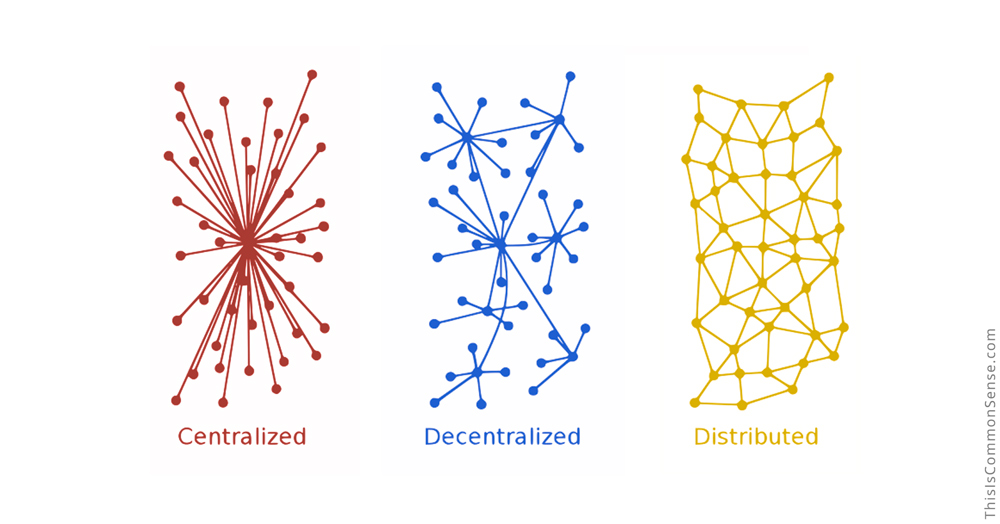
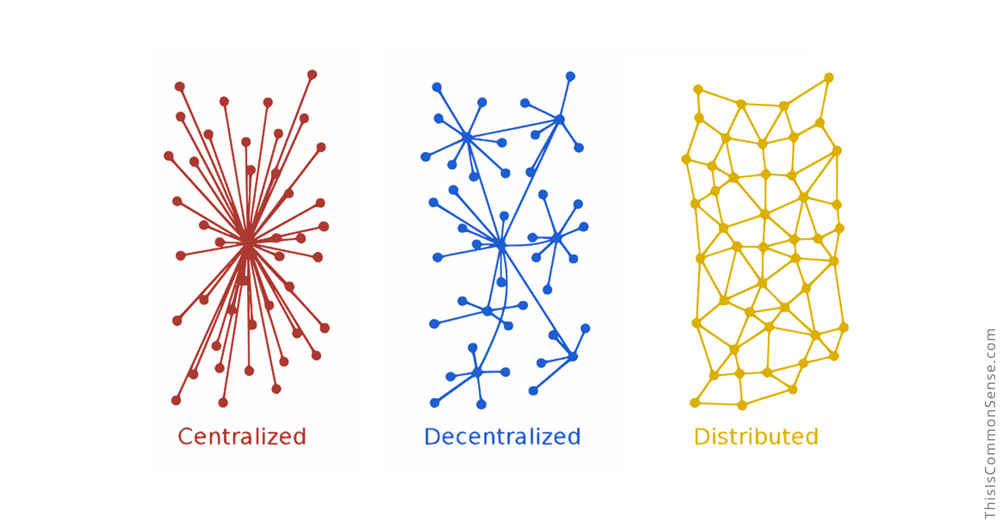
Yet this move is important. It shows a growing recognition of the tyrannical nature of centralized power.

And the usefulness of decentralization.

This is Common Sense. I’m Paul Jacob.
 

PDF for printing