Categories
Internet controversy social media

We Hear a Rumble

Build it and they will come. 

What’s the “it”?

Rumble.

And who’s the “they”? 

The superstars censored by YouTube.

Not just superstars and the censored, of course. Plenty of producers and viewers are migrating to Rumble simply because they’re sick of seeing discussion squelched on dogma-guarding platforms like Google’s YouTube.

But it sure is a boost for Rumble and the cause of open discussion on the interwebs when Dan Bongino, who had about 900,000 subscribers on YouTube when it booted him, has two million subscribers and counting on Rumble.

House Republican Leader Kevin McCarthy joined Rumble late last year and in just a few months has acquired over 53,000 subscribers. Not Bongino level, but not bad.

Among others joining Rumble recently are Bitcoin Magazine, the financial news channel Benzinga, and Reason magazine.

Fast-growing Rumble boasts of an “independent infrastructure designed to be immune to cancel culture” and a mission “to restore the Internet to its roots by making it free and open once again.”

That’s the opposite attitude and ambition of the big-tech hall monitors, constantly thumping their chests about how efficiently they’re censoring “misinformation.” (Good thing these people aren’t in charge of water-cooler chit-chat.)

The growing success of Rumble and other alternatives shows we’re not forever stuck with Google, Twitter, Facebook, et al. even if we’re stuck with their censorship.

This is Common Sense. I’m —

Oops. Almost forgot to mention that This Week in Common Sense is on Rumble too. Drop by, sign up, and chat with us in the comments. We’ll even let you disagree.

— Paul Jacob.


See all recent commentary
(simplified and organized)
See recent popular posts
Categories
Thought

Jeremy Bentham

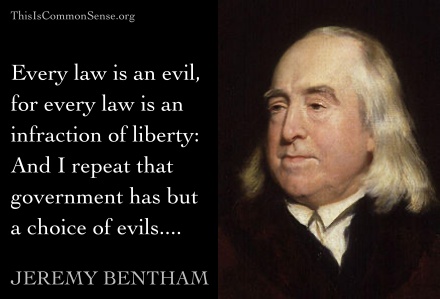
Every law is an evil, for every law is an infraction of liberty: And I repeat that government has but a choice of evils: In making this choice, what ought to be the object of the legislator? He ought to assure himself of two things; 1st, that in every case, the incidents which he tries to prevent are really evils; and 2ndly, that if evils, they are greater than those which he employs to prevent them. 

Jeremy Bentham, Principles of Legislation (1830), Ch. X: “Analysis of Political Good and Evil; How they are spread in society.”
Categories
Today

April Fool’s Day

On April Fools’ Day, 1957, the BBC offered for viewers of the current affairs program “Panorama” the infamous spaghetti harvest report hoax.

By sheer coincidence (?), one definition of “noodle” is “fool.”

Categories
Accountability deficits and debt national politics & policies subsidy

What a Relief

Based on a quick look at the Edward M. Kennedy Institute for the United States Senate’s splash page, I wasn’t immediately sure what, precisely, the institute’s raison d’être might be. On the top menu bar there’s a slogan: “Just Vote.” Big clue? 

On the About page, though, we are told its mission: “educating the public about the important role of the Senate in our government, encouraging participatory democracy, invigorating civil discourse, and inspiring the next generation of citizens and leaders to engage in the civic life of their communities.”

As for the vision thing, that’s supplied by its namesake, Ted “I Survived Chappaquiddick” Kennedy: “To preserve our vibrant democracy for future generations, I believe it is critical to have a place where citizens can go to learn first-hand about the Senate’s important role in our system of government.”

I guess that explains why the institute’s Boston location sports a replica room of the U.S. Senate chambers.

Which costs serious money, of course.

Paid for entirely by the ultra-rich Kennedys?

Fact check: no. 

Some of it is paid for by you and me — courtesy of Congress and COVID!

You see, part of last year’s $350 billion in pandemic relief went to Boston’s memorial outfit for its once-favored now-deceased multi-millionaire politician. Five million bucks, it turns out, was used (the AP tell us) to pay off the institute’s debt. 

But don’t worry: the Kennedy Institute wasn’t singled out. Relief funds — which you might think would focus on struggling local libraries, community centers, and the like — also went to building a posh hotel and a minor league baseball stadium. And much, much more.

While politicians are good at spending money, especially for “emergencies,” they aren’t good at spending it well.

This is Common Sense. I’m Paul Jacob.


PDF for printing

See all recent commentary
(simplified and organized)
See recent popular posts

Categories
Thought

W.S. Jevons

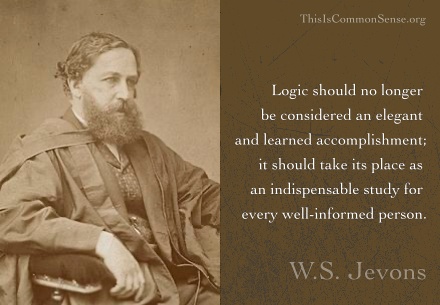
Logic should no longer be considered an elegant and learned accomplishment; it should take its place as an indispensable study for every well-informed person.

William Stanley Jevons, Elementary Lessons on Logic (1870), Preface.

Categories
Today

Bangorian

On March 31, 1717, a sermon on “The Nature of the Kingdom of Christ,” by Benjamin Hoadly, the Bishop of Bangor, provoked the Bangorian Controversy.

The sermon’s text was John 18:36, “My kingdom is not of this world,” and from that Hoadly deduced — supposedly at the request of King George I himself, who was present in the assembly — that there was no Biblical justification for any church government. Hoadly identified the church with the kingdom of Heaven, noting that Christ had not delegated His authority to any representative.

King George’s preference for the Whig Party, and for latitudinarianism in ecclesiastical policy, is widely thought to have been a strategic maneuver to degrade church power in political government.

Categories
defense & war general freedom public opinion

Fight-or-Flight Fact Check

“Majority of Americans Would Stay and Fight if Russia Invaded U.S.,” read Newsweek’s headline for its report earlier this month about a Quinnipiac University poll.

Overall, “55 percent said they would stay and fight,” the article informed, “while 38 percent said they would flee the country, like the over 1.5 million people who have fled Ukraine as Russia continues its attack on Ukrainian cities and villages.”

The Quinnipiac survey asked, “If you were in the same position as Ukrainians are now, do you think that you would stay and fight or leave the country?”

“Looking at political affiliation,” Newsweek noted, “Republicans were more likely to say they would stay and fight, with 68 percent saying they would do so, as opposed to 40 percent of Democrats.”

Yet, weeks later, Newsweek delivered a fact check to readers concerning a claim made in a social media post: “60% of Democrats say they wouldn’t fight if America was invaded.”

Their fact-checker rated it false, because only 52 percent of Democrats said they would “leave,” with 8 percent not sure. Case-closed.

Yet, the fact-checker kept the case open, suggesting that perhaps folks had also misunderstood the question. “Indirect evidence” of this “can be surmised” by the response to another question: “If Russian President Vladimir Putin goes beyond Ukraine and attacks a NATO country, would you support or oppose a military response from the United States?

“In this hypothetical, 88 percent of Democrats were supportive of a military response,” the fact-checker noted, “more than both Independents (77 percent) and Republicans (82 percent).”

But hold on . . . supporting a military response by others, thousands of miles away, is not the same thing as deciding to personally fight an invading army.

It’s a fact. Check it.

This is Common Sense. I’m Paul Jacob.


PDF for printing

See all recent commentary
(simplified and organized)
See recent popular posts

Categories
Thought

Jeremy Bentham

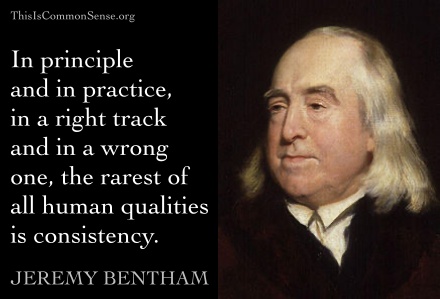
[I]n principle and in practice, in a right track and in a wrong one, the rarest of all human qualities is consistency.

Jeremy Bentham, An Introduction to the Principles of Morals and Legislation (1789; 1823), Ch. 1: Of the Principle of Utility.
Categories
government transparency initiative, referendum, and recall insider corruption term limits

Pucker Up

“Never have so few applied so much lipstick to such a pig.”

That’s what term limits activist Kurt O’Keefe told the Michigan Board of Canvassers last week, as it considered the official title for a citizen initiative that he argues is anything but.

The Detroit attorney points out that the proposed ballot measure — sponsored by a group named Voters for Transparency and Term Limits — actually comes from “current and future politicians” and “current and future lobbyists.”

These insiders, who’ve “never been in favor” of term limits, seek to replace the 6- and 8-year cap now in place in the House and Senate, respectively, with a 12-year overall limit in both houses. At the hearing, proponents argued that the ballot title should declare simply that their measure reduces the current term limits — even though it would double terms in the House and up the Senate cap by 50 percent.

The initiative would also allow former Speakers and previously termed-out legislators to return like the undead to their former capitol haunts. 

“This is a trick,” warned U.S. Term Limits National Field Director Scott Tillman. “We know it is a trick. They know it is a trick. They had to sweeten it up with transparency.”

That’s the lipstick.

Yet, the transparency fix, instead of simply enacting a financial disclosure system, orders the legislature to do so. Of course, the legislature cannot be forced to legislate, so the measure encourages endless lawsuits against the legislature. 

As if to further show just how sincere these politicians are, their “voters” front-group has raked in $5 million from “unknown sources,” according to the Michigan Information & Research Service. 

They are transparent only in their self-serving insincerity.

Oink oink.

This is Common Sense. I’m Paul Jacob.


PDF for printing

See all recent commentary
(simplified and organized)
See recent popular posts
Categories
Thought

W.S. Jevons

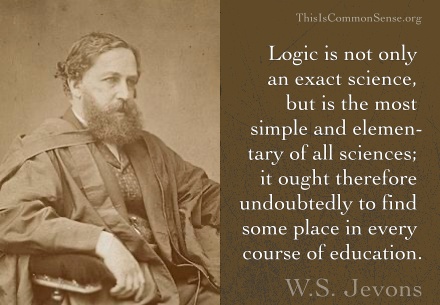
Logic is not only an exact science, but is the most simple and elementary of all sciences; it ought therefore undoubtedly to find some place in every course of education.

William Stanley Jevons, Elementary Lessons on Logic (1870), Preface.