Ut ameris, amabilis esto.
If you want to be loved, be lovable.
Ovid (Publius Ovidius Naso), The Art of Love, Book II, line 107.

Ut ameris, amabilis esto.
If you want to be loved, be lovable.
Ovid (Publius Ovidius Naso), The Art of Love, Book II, line 107.

And it’s not just about pandemic measures like mask mandates. In February, San Francisco voters overwhelmingly recalled three school board members over their fixation on wokeness to the exclusion of in-person education. And the school board’s antics in liberal Loudoun County, Virginia, turned last year’s race for governor into a referendum on whether parents have any say-so at all.
They do, apparently.
Though I have covered the enormous growth of alternative education during the pandemic — here and here, for instance — I have been looking for more specifics.
“Relative to pre-pandemic levels,” Corey DeAngelis with the American Federation for Children told Attkisson, “homeschooling has at least doubled,” and now accounts for “closer to 4 million students.”
Too good to be true? I double-checked. The U.S. Census Bureau used the same language as Attkisson and DeAngelis: “the global COVID-19 pandemic has sparked new interest in homeschooling and the appeal of alternative school arrangements has suddenly exploded.”
At the end of the 2019-2020 school year, “about 5.4% of U.S. households with school-aged children reported homeschooling,” according to their Household Pulse Survey. “By fall, 11.1% of households with school-age children reported homeschooling.”
The increase was five-fold for “respondents identified as Black or African American,” with 16.1% homeschooling.
“Still more students have left for religious schools,” reminds DeAngelis, “or other private schools.”
Attkisson also pointed to a jump in support for school choice.
Parents of the world unite.
This is Common Sense. I’m Paul Jacob.
See all recent commentary
(simplified and organized)
See recent popular posts

On April 8, 1913, the 17th amendment to the Constitution, providing for the popular election of U.S. senators, was ratified.
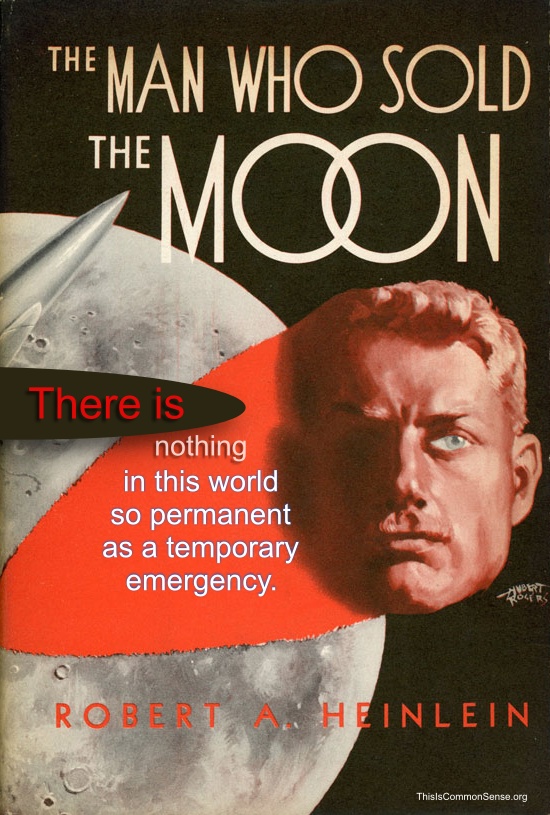
There is nothing in this world so permanent as a temporary emergency.
Robert A. Heinlein, The Man Who Sold the Moon (1951), p. 100.
Mass psychology is not simply a summation of individual psychologies; that is a prime theorem of social psychodynamics—not just my opinion; no exception has ever been found to this theorem. It is the social mass-action rule, the mob-hysteria law, known and used by military, political, and religious leaders, by advertising men and prophets and propagandists, by rabble rousers and actors and gang leaders, for generations before it was formulated in mathematical symbols. It works.
Robert A. Heinlein, Methuselah’s Children (1941; 1958).
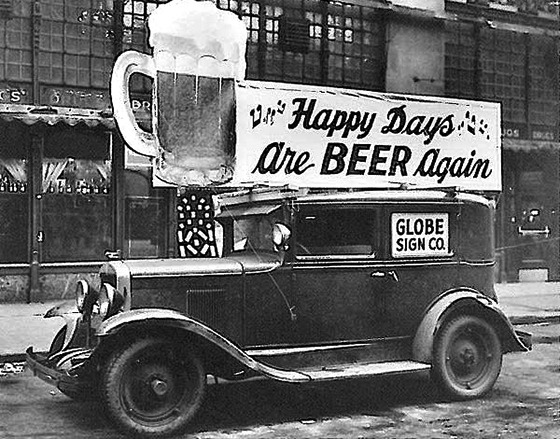
On April 7, 1933, Prohibition in the United States was repealed for beer of no more than 3.2 percent alcohol by weight — eight months before the ratification of the XXI amendment, which repealed the 18th (or Prohibition) Amendment.
The enabling legislation was the Cullen-Harrison Act, which figured the low alcohol content as the excuse to get around the 18th Amendment’s prohibition of intoxicating beverages. The act passed Congress on March 21, 1933, and was signed into law by Franklin Delano Roosevelt the next day.

But as the pandemic progressed, we learned some things.
Over time, I became more skeptical of much good coming from mask-wearing.
Now that the panic portion of the pandemic is mostly over — and what a long panic it was! — we should be able to more calmly review.
Two months ago, Vinay Prasad, an actual epidemiologist, looked carefully at the CDC’s study allegedly showing a high medical efficacy in universal mask-wearing during a major contagion. The study, he argued, was plagued with “very poor quality data, insufficient to support community masking, particularly for years on end. Cloth masks had especially bad data. Data to support masking kids was absolutely absent.” And the CDC’s own reporting of what its study actually found was unreliable and . . . well, dishonest.
Take the case of Dr. Anthony Fauci. “Pre-pandemic, community masking was discouraged because the pre-existing evidence was negative,” explained Prasad. “This is why Fauci was critical of it in early March 2020 on 60 minutes.”
But many of us were perhaps unduly pro-mask because Fauci appeared to be protecting the supply of masks used by medical professionals, thus, lying for a strategic reason. It was hard not to learn a . . . dubious . . . lesson: Fauci lied to protect professional mask use, so masks for the masses likely worked well.
Then he changed tune. And went off the deep end, ignoring his previous statements and advocating double- and triple-masking!
Still, the most ominous issue about mask mandates is how it became “a marker of politics. Good liberals wear them and bad conservatives don’t.”
Prasad does not go where Matthias Desmet and others have: showing how mask mandates became a means to induce panic and the politicization of medicine.
Voluntary masking without mandates — as has been commonly the case in Japan, for example — provides important signals about infection rates, and allows people to negotiate their own physical distancing. Universal mask mandates spoil the informative aspect and instead serve tyrants and mass hysteria.
This is Common Sense. I’m Paul Jacob.
See all recent commentary
(simplified and organized)
See recent popular posts

Vices are those acts by which a man harms himself or his property. Crimes are those acts by which one man harms the person or property of another. Vices are simply the errors which a man makes in his search after his own happiness. Unlike crimes, they imply no malice toward others, and no interference with their persons or property. In vices, the very essence of crime — that is, the design to injure the person or property of another — is wanting. It is a maxim of the law that there can be no crime without criminal intent; that is, without the intent to invade the person or property of another. But no one ever practices a vice with any such criminal intent. He practices his vice for his own happiness solely, and not from any malice toward others. Unless this clear distinction between vices and crimes be made and recognized by the laws, there can be on earth no such thing as individual right, liberty, or property, and the corresponding coequal rights of another man to the control of his own person and property.

On April 6, 1930, Mohandas K. Gandhi raised a lump of mud and salt, declaring, “With this, I am shaking the foundations of the British Empire.”
Thus began the Salt Satyagraha.

. . . bloße Erfahrung ist keine Wissenschaft.
Experience by itself is not science.
Edmund Husserl, Pure Phenomenology: Its Method and Its Field of Investigation; Inaugural Lecture at Freiburg im Breisgau (May 3, 1917); Die reine Phänomenologie, ihr Forschungsgebiet und ihre Methode.