Ride, si sapis.
Laugh if you are wise.
Marcus Valerius Martialis (Martial), Epigrammata, II, 41.

Ride, si sapis.
Laugh if you are wise.
Marcus Valerius Martialis (Martial), Epigrammata, II, 41.
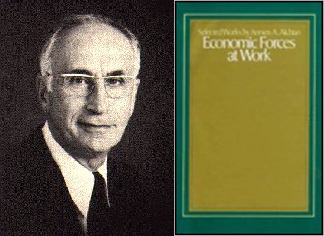
On April 12, 1914, American economist Armen Alchian was born. His contributions to economic theory and teaching were many and varied — his textbook, co-authored with William R. Allen, University Economics (also titled Exchange and Production), was widely considered one of the finest intermediate texts in microeconomics — but he remains perhaps best known for his work on property rights.
Alchian died in 2014, in late February, at the age of 99.

As with other October surprises, the case was immediately politicized.
“Democrats on Thursday made it clear they felt President Trump was at least in part to blame for an alleged scheme to kidnap the governor of Michigan,” government-subsidized NPR noted, “citing the president’s divisive rhetoric that has often found support among white supremacists and other hate groups.” CNN used the phrase “domestic terrorist plot” in relating presidential challenger Joe Biden’s laying of blame against Donald Trump.
Six men were charged in federal court with directly conspiring to nab the governor. Two have pled guilty to the federal charges, but on Friday the trial ended very differently for the four other would-be abductors.
“A federal jury acquitted two men of conspiring to kidnap Michigan Gov. Gretchen Whitmer, and deadlocked on the counts against two others,” reported The Washington Post, “apparently agreeing to some degree with defense claims that FBI agents entrapped the men in a violent plot shortly before the 2020 election.”
“The Whitmer kidnapping plot,” Reason’s Robby Soave explained months ago, “was extensively directed and encouraged by agents of the government.”
This was not just a bungled prosecution.* This was the result of a wrongheaded and dangerous policy that, instead of lawfully monitoring suspected criminals to prevent violence, actively nurtures and encourages crimes.
And breaks the story in early October of an election year.
Sure, I know the government is here to help — but even “domestic terrorists”?
This is Common Sense. I’m Paul Jacob.
* “Suffice it to say,” Soave wrote about the FBI’s handing of the case, “it’s very hard to tell the cops from the criminals in this matter.” For instance, “the government’s star witness, FBI Agent Robert Trask, was fired by the agency after beating his wife following an orgy at a swingers party.”
See all recent commentary
(simplified and organized)
See recent popular posts
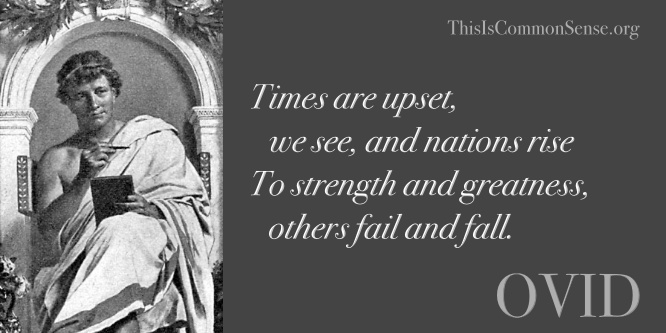
Sic tempora verti
cernimus atque illas adsumere robora gentes,
concidere has.
Times are upset, we see, and nations rise
Ovid (Publius Ovidius Naso), The Metamorphoses, Book XV, lines 420–422 (trans. A. D. Melville).
To strength and greatness, others fail and fall.
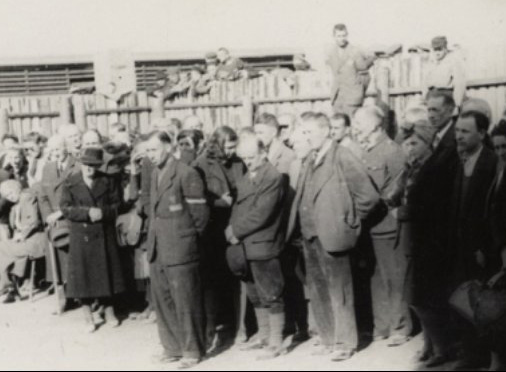
On April 11, 1945, the American Third Army liberated the Buchenwald concentration camp, near Weimar, Germany, a camp that would later be judged second only to Auschwitz in the horrors it imposed on its prisoners.
Among those in the camp saved by the American soldiers was Elie Wiesel, who would go on to win the Nobel Peace Prize in 1986.
Shown in photograph: German citizens ushered to the camp by American soldiers, post-conquest.
Paul Jacob gets new glasses and our weird and wacky world becomes a little bit clearer. Coincidence? Well, it’s Paul’s weekend podcast covering the big stories of the week, as seen through a lens, the lens being the ideas articulated on this here website:
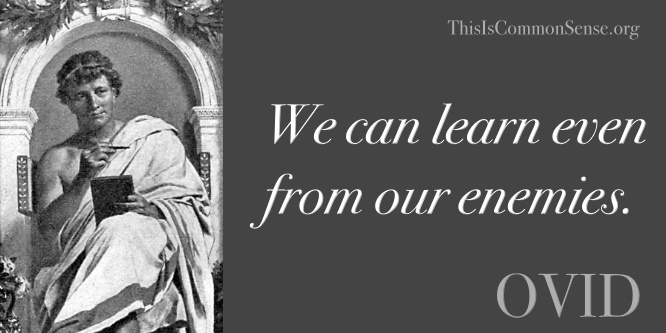
Fas est et ab hoste doceri.
We can learn even from our enemies.
Ovid (Publius Ovidius Naso), The Metamorphoses, Book IV, 428.
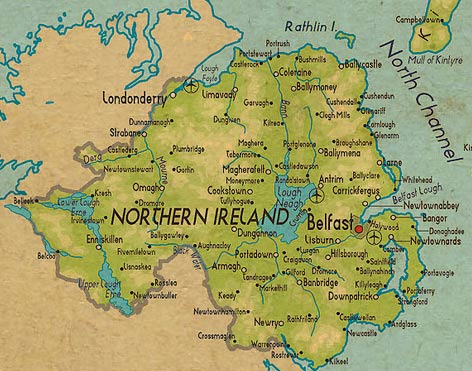
On April 10, 1998, the Northern Ireland peace talks ended with an historic agreement, dubbed the Belfast, or Good Friday Agreement. The accord was reached after nearly two years of talks and 30 years of conflict.
The agreement was approved by voters across the island of Ireland in two referendums held on May 22, 1998. The agreement came into force on December 2, 1999.
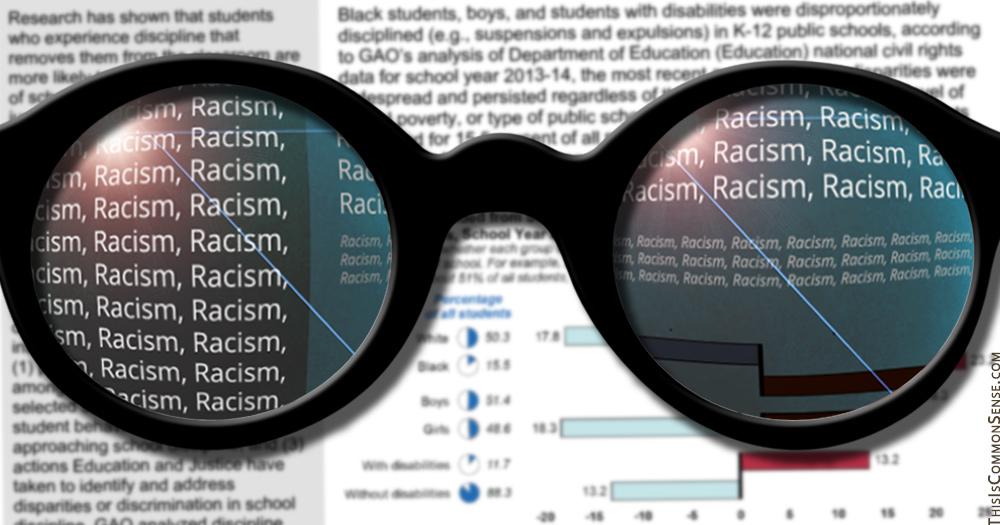
Paul Jacob dons new glasses to see through the political realm:
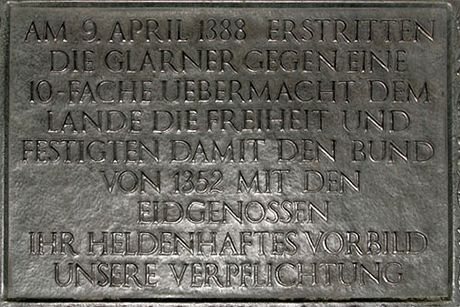
Despite being outnumbered 16 to one, forces of the Old Swiss Confederacy proved victorious over the Archduchy of Austria in the Battle of Näfels, April 9, 1388.
On this date in 1991, Georgia declared its independence from the Soviet Union.