Categories
Thought

C.S. Peirce

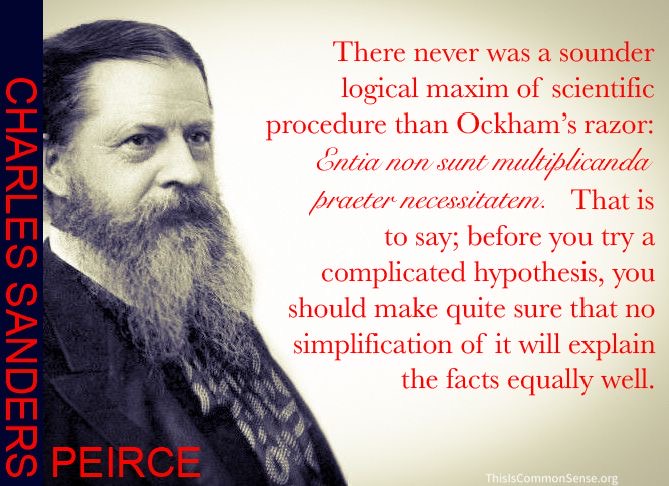
There never was a sounder logical maxim of scientific procedure than Ockham’s razor: Entia non sunt multiplicanda praeter necessitatem. That is to say; before you try a complicated hypothesis, you should make quite sure that no simplification of it will explain the facts equally well.

Charles Sanders Peirce, Lectures on Pragmatism delivered in Cambridge, Massachusetts (March 26 – May 17, 1903).

Categories
Today

Only Nine?

On July 22, 1937, the U.S. Senate voted down Franklin Delano Roosevelt’s court packing scheme.

Categories
international affairs privacy

Delivering to Evil

Will Americans who demand the outing of anonymous donors to political causes listen to Jianli Yang?

One reason that people donate to organizations anonymously — just as they want their votes and other personal information to remain confidential — is to avoid being harassed by political opponents.

But being bullied in a restaurant is hardly the worst that can befall donors stripped of anonymity.

Jianli Yang is a Chinese dissident. In 2008, after spending years in a Chinese prison for his activism, he founded Citizen Power Initiatives for China, a US-based organization working to advance rights and democracy in China.

Yang notes that Chinese supporters of his organization, even if residing outside of China, “can face extreme consequences when they are identified by the Chinese government.” Without the right to protect donor privacy, affirmed in a July 2021 U.S. Supreme Court decision on the associational rights of donors, donors can end up being punished by the Chinese government.

The risk isn’t just theoretical. In April 2021, one Mr. Lee, a businessman, was forced to appear on Chinese television to “confess” to supporting Citizen Power Initiatives for China. The government also sentenced Lee to eleven years in prison.

We must fight both the CCP and their wannabe branch in DC. Things are nowhere near as bad in this country as in China. But we don’t know what threats we will face the day after tomorrow even from our own government.

We need every First Amendment protection we can get.

This is Common Sense. I’m Paul Jacob.


PDF for printing

See all recent commentary
(simplified and organized)
See recent popular posts

Categories
Thought

Herbert Spencer

A thing must either exist or not exist — must have a certain attribute or not have it: there is no third possibility. This is a postulate of all thought; and in so far as it is alleged of phenomenal existence, no one calls it in question.

Herbert Spencer, ”Mill versus Hamilton — The Test of Truth,” The Fortnightly Review (July 1865).
Categories
Today

Monkeys & the Moon

On July 21, 1925, in Dayton, Tennessee, high school biology teacher John T. Scopes was found guilty of teaching evolution in a public school classroom, and fined $100. The ambiguous legacy of the trial would continue — for decades, even to the present — to reveal the tensions inherent within a school system run by government and funded by taxpayers.

Interesting fact rarely noted: Scopes was teaching a heavily “eugenics” view, which would hardly be considered scientific by most modern standards.


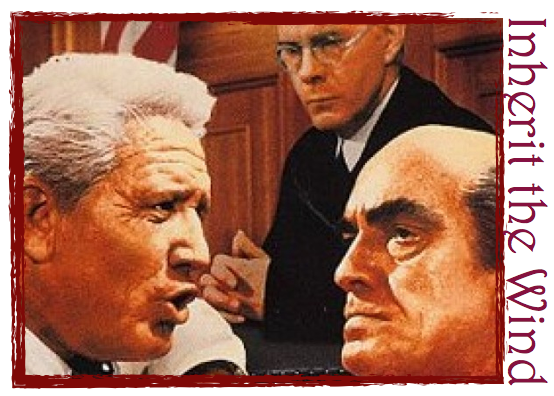
Pictured above, publicity for Inherit the Wind, a 1960 movie about the trial, but with the names changed, fictionalized. The movie starred Spencer Tracy in the Clarence Darrow (lawyer for the defense) role; Frederic March in the prosecutorial part, “Matthew Harrison Brady,” the pseudonymous name for politician William Jennings Bryan; Dick York as the defendant, Mr. Scopes; and Gene Kelly as the Baltimore journalist, a stand-in for H. L. Mencken, whose infamous coverage of the story shocked the nation almost as much as the trial itself. It was Mencken who dubbed the affair “The Scopes ‘Monkey’ Trial.”

At the end of the movie (spoiler alert!) the famous prosecutor dies in the courtroom. In the historical case, Bryan died five days after the verdict. The movie was based on the 1955 play of the same name, written by Jerome Lawrence and Robert Edwin Lee, directed by Stanley Kramer. The script was adapted by Nedrick Young (originally as Nathan E. Douglas) and Harold Jacob Smith.


Today is the 53rd anniversary of the Apollo 11 mission’s perambulation upon the Moon, on July 21, 1969. Neil Armstrong and Buzz Aldrin walked upon the surface of Mare Tranquillitatis for about two hours and 15 minutes. They spent over 21 hours on the surface, total, most of it inside the Lunar Module, at the site they called Tranquillity Base, before launching to rejoin astronaut Michael Collins in lunar orbit, and returning to Earth on July 24.

Categories
Internet controversy Second Amendment rights

Two Shooters in a Gun-Free Zone

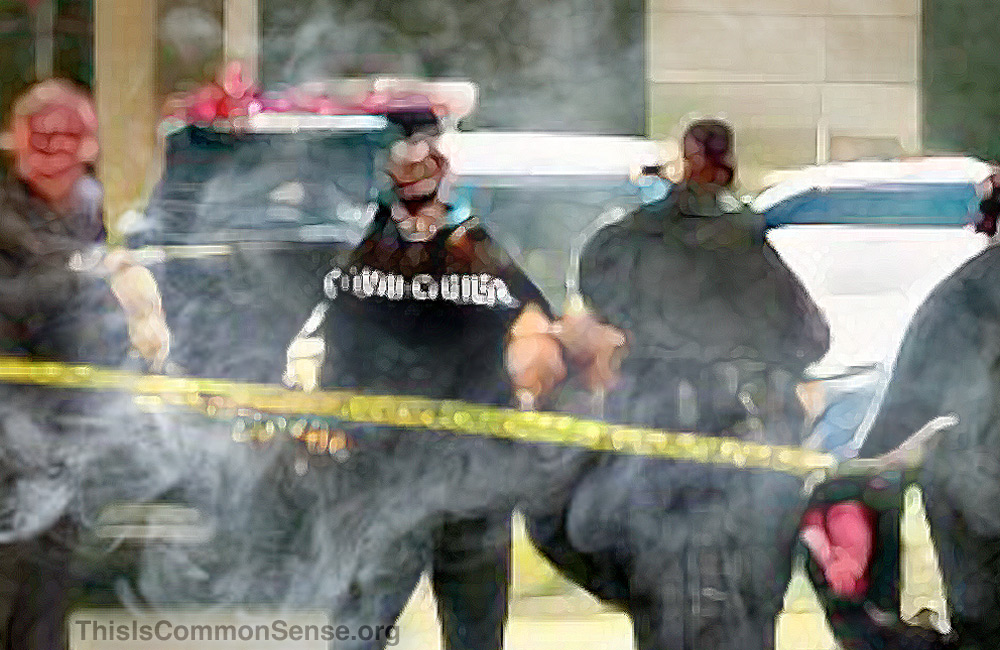
In Indianapolis, a 20-year-old man opened fire in Greenwood Park Mall and killed three people.

The Sunday shooter might have killed many others, his apparent plan, but another young man shot and killed him early in his rampage.

“The real hero of the day,” said Greenwood Police Chief Jim Ison, “is the citizen that was lawfully carrying a firearm in that food court and was able to stop the shooter almost as soon as he began.”

The 22-year-old man with a gun is Elisjsha Dicken. Careful observation that Dicken was carrying a firearm lawfully was perhaps necessary to preempt concern about any legal jeopardy for him. 

Indiana’s concealed carry law had only recently been liberalized.

But if I’d been there that day, perhaps spared by Dicken’s quick action, I suspect that my only thought would have been: “Thank God he was there, had a gun, and knew how to use it.” And if it turned out that my savior was carrying unlawfully, well, so what? 

Alive is alive.

This sentiment, however, is not universally shared. Folks who support citizen disarmament are unsurprisingly uncomfortable with honoring someone who does precisely what those of us who support citizen armament expect armed citizens to do: save lives when needed.

Leah Barkoukis, writing at Townhall, notes that some leftist Twitterati objected to Dicken’s carrying a gun into a mall that declares itself to be “a gun free zone.” A few even demanded prosecuting Mr. Dicken!

Understandably, mall spokespeople have evaded discussion of using their creaky legal grounds to do anything so preposterous. 

As anyone with sense knows, making a large public venue “gun free” is not an effective way to keep people safe. As Mr. Dicken demonstrated.

This is Common Sense. I’m Paul Jacob.


PDF for printing

craiyon credit

See all recent commentary
(simplified and organized)
See recent popular posts
Categories
Thought

C.S. Peirce

True science is distinctively the study of useless things. For the useful things will get studied without the aid of scientific men.

Charles Sanders Peirce, The Scientific Attitude and Fallibilism in Philosophical Writings of Peirce, selected and edited with an introducton by Justus Buchler, p. 49.

Categories
Today

The Count Tracy

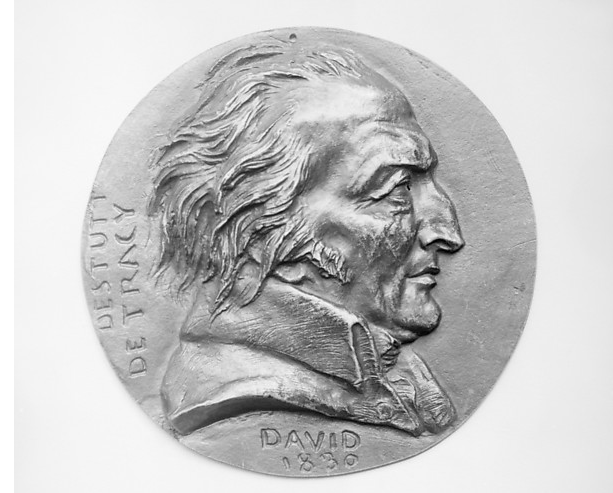
Born on July 20, 1754, Antoine Louis Claude Destutt, comte de Tracy, French philosopher and economist. Perhaps best remembered for coining the term “ideology,” he didn’t mean by that term what scornful Napoleon and communist Karl Marx later turned it into — for Destutt de Tracy ideology meant “the science of ideas,” a unified approach to all knowledge, from epistemology to social theory.

Though his family had been enobled twice, he renounced the title and entered the 1789 Estates General conference as a member of the Third Estate. During the Reign of Terror, he was imprisoned, and would have been executed had not Robespierre got to the scaffold ahead of him.

Two of his books became popular in early 19th century America, his commentaries on Montesquieu’s Spirit of the Laws, and his Traité de la volonté, which Thomas Jefferson, the editor of the American edition, retitled A Treatise on Political Economy. Tracy’s economics was of a deductivist stripe, familiar to readers of later economists such as Nassau Senior and Ludwig von Mises.

Destutt de Tracy’s political philosophy was republican, and his preferred economic policy was laissez-faire.


NASA’s Apollo 11 landed two humans on the Moon — Commander Neil Armstrong and lunar module pilot Buzz Aldrin — on July 20, 1969, at 20:17 UTC.

Categories
crime and punishment general freedom

Starbucks Gets Out

Though not a fan of Starbucks’s often obtrusive lefty politics, I sure like its beverages, such as the glorious Flat White. I’ll take a venti.

Thankfully, it appears that trendy politics has limits. Despite the company’s support for a Marxist organization that riots and rampages in the name of racial justice (I won’t name names, but the initials are BLM), CEO Howard Schultz is reluctant to tolerate crime that makes it unsafe to sell lattes.

In leaked video of an internal meeting, Schultz says he’s shocked “that one of the primary concerns that our retail partners [employees] have is their own personal safety.”

One way Starbucks will cope is by giving managers authority to do things like limit seating and close bathrooms. Employees will also be trained in conflict de-escalation and dealing with “active shooter scenarios.”

And Starbucks will close “not unprofitable” shops in areas where risks to employees and customers are most severe. This means closing 16 stores in which people feel unsafe because of crime and open drug use. The closures are taking place in such bastions of crime nurturing as Seattle, Portland, Los Angeles, Philadelphia, and Washington DC.

More shutdowns are to come, Schultz said, adding that “governments across the country and leaders, mayors and governors, city councils have abdicated their responsibility in fighting crime.”

Starbucks has — all companies have — every right to escape the resulting lawless conditions. 

Were they also to abstain from doing anything to promote such conditions, that would be whipped cream on top.

This is Common Sense. I’m Paul Jacob.


PDF for printing

See all recent commentary
(simplified and organized)
See recent popular posts
Categories
Thought

Arthur Latham Perry

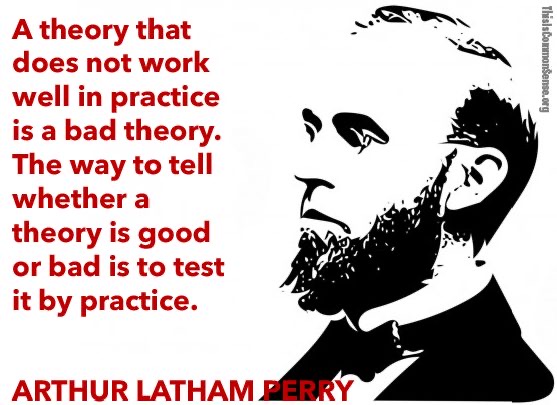
A theory that does not work well in practice is a bad theory. The way to tell whether a theory is good or bad is to test it by practice. Everything that is done at all, unless by mere chance, is done on some theory; and it is certainly better that things should be done on a good theory than on a bad one. What makes a theory good? Simply because it corresponds with and explains the facts.

Arthur Latham Perry, Elements of Political Economy (1869).