Categories
education and schooling folly general freedom

School Choice Reform at Last

How to get school choice reform? Keep fighting.

Last year, Texas Governor Greg Abbott, Republican, worked with families and school choice activists to pass school-choice legislation.

SB1 would have given parents who want to take their kids from public to private schools $8,000 a year for tuition, textbooks, and other expenses: taxpayer money that parents would have been able to spend as they saw fit instead of being forced to let public schools get it regardless of performance.

The educrats and their allies were opposed. “Public dollars belong in public schools. Period,” was the comprehensive argument of the Texas Democratic Party chairman.

With his own party constituting a majority of lawmakers in each legislative chamber, it seemed that Governor Abbott and families could have won anyway. The state senate did pass school-choice legislation. As it turned out, though, too many Republican lawmaker in the house were on the anti-choice team.

Which Republicans? The ones that Abbott and other friends of school choice targeted in this year’s primaries. They spent millions of dollars backing challengers who support school choice. And the governor appeared at campaign events to criticize incumbent Republicans who oppose it.

The net result? Of the current 21 anti-school-choice GOP representatives, only six to ten will be returning to the legislature in 2025. (The exact number won’t be known until runoffs on May 28.)

The elections may thus bring enough of a change in the state legislature to let school choice happen for parents and their students in Texas.

This is Common Sense. I’m Paul Jacob.


PDF for printing

Illustration created with PicFinder and Firefly

See all recent commentary
(simplified and organized)
See recent popular posts
Categories
Thought

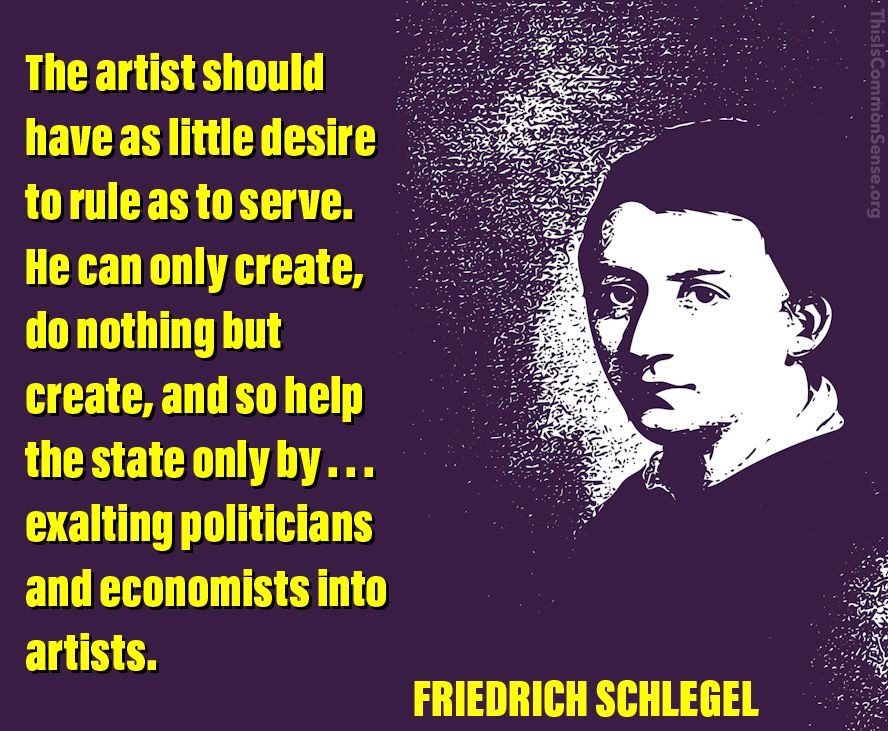
Friedrich Schlegel

Der Künstler darf eben so wenig herrschen als dienen wollen.
Er kann nur bilden, nichts als bilden, für den Staat also nur
das thun, dass er Herrscher und Diener bilde, dass er
Politiker und Oekonomen zu Künstlern erhebe.

The artist should have as little desire to rule as to serve. He can only create, do nothing but create, and so help the state only by . . . exalting politicians and economists into artists.

Karl Wilhelm Friedrich von Schlegel, “Ideas,” Lucinde and the Fragments, P. Firchow, trans. (1991), § 54.
Categories
Update

The Breaking of the Corporate Woke?

Among the biggest stories of the day is the wokification of corporate America.

The update? Corporations’ are pulling back from their activism, at least according to a report in The Epoch Times:

Wall Street titans appear to be having an increasingly hard time reconciling the conflicting goals of progressive activism and shareholder returns.

Until recently, many banks, asset managers, and insurers portrayed these goals as complementary, asserting that climate risk is financial risk and that the competence of management can be assessed by its commitment to social justice goals.

Today, however, those narratives are rarely heard.

Kevin Stocklin, “Corporations Are Losing the ESG Battle, Forcing Them to Hide Advocacy,The Epoch Times (March 08, 2024).

The story behind the story is perhaps even more interesting, for it shows how easy it is to control America’s corporations: control the investment groups that own most of the stocks.

Which reminds us of Peter Drucker’s claim that socialism was coming to America via retirement funds.

Drucker sounded so . . . optimistic . . . about that. Didn’t he?

But what if socialism is bad no matter how you achieve it?

Categories
Thought

Brian Aldiss

The day of the android has dawned.

Brian Aldiss, “Are You An Android?,” Science Fantasy #34 (April 1959).

Categories
Today

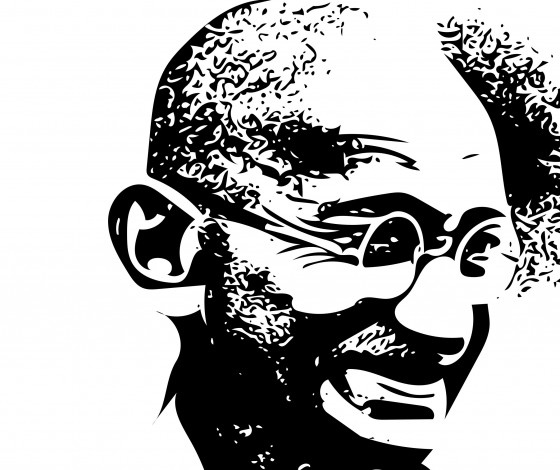
The Mahatma

On March 10, 1922, Mohandas Karamchand Gandhi (1869-1948), activist and theorist of non-violent revolution, was arrested in India, tried for sedition, and sentenced to six years in prison, only to be released nearly two years later for an appendicitis operation.

Categories
Update

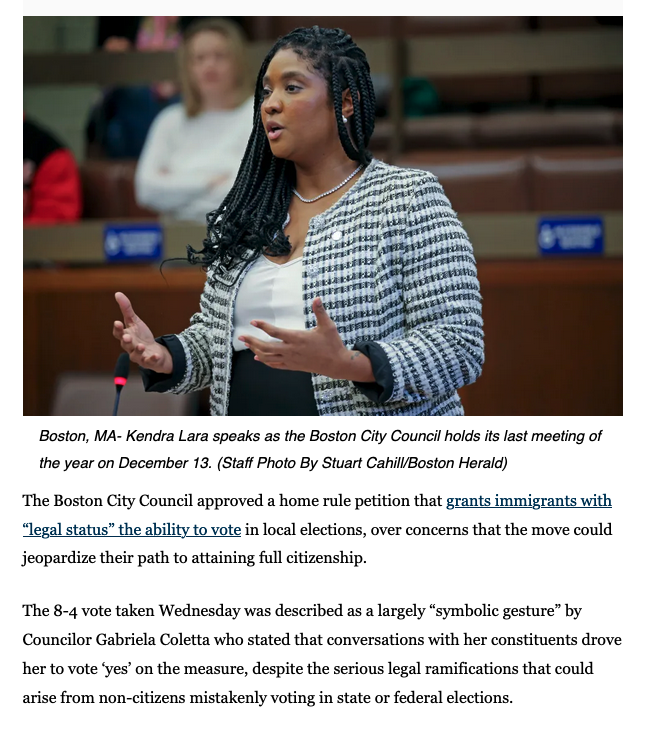
Blue Boston Democracy

The idea that one needn’t be a citizen to vote in America’s local, state and even federal elections is being flirted with in many of the country’s biggest, “bluest” cities. Coverage here, on this site, includes this piece from last year, about the strange political maneuverings in our “Alien National Capital”:

Now the wackos in Washington, D.C., have enacted a non-citizen voting measure that goes further. It allows Russian nationals working for Mr. Putin at their embassy in our nation’s capital to vote on city candidates and ballot issues and welcomes onto Washington’s voter rolls Chinese citizens here promoting Xi Jinping and the interests of his genocidal regime. 

The District of Columbia’s ordinance extends the franchise even to people here illegally, allowing anyone from anywhere in the world able to avoid deportation to cast a ballot. Legally.

We’ve updated this story in a number of ways, but in case you think this isn’t a movement of some kind, here is just one additional city from the current season:

Categories
Thought

Brian Aldiss

A community which cannot or will not realize how insignificant a part of the universe it occupies is not truly civilized. That is to say, it contains a fatal ingredient which renders it, to whatever extent, unbalanced.

Brian Aldiss, Non-Stop (1958).

Categories
crime and punishment national politics & policies regulation

Stop the Work Stoppers

Republican Representative Kevin Kiley of California has introduced H.J. Resolution 116 to block “the rule submitted by the Department of the Labor relating to ‘Employee or Independent Contractor Classification Under the Fair Labor Standards Act.’ ”

116 is a legislative attempt to thwart legislation by regulators.

Labor’s rule is modeled on the AB5 Act passed in California several years ago. Catering to unions, AB5’s idea was to kill the livelihoods of many gig workers or freelancers by making it much harder for companies and independent contractors to deal with each other.

The new rule, too, aims to kill competition with unions and expand the pool of employees who can be unionized.

AB5 caused a firestorm, leading to citizen initiatives, court battles, and victories and setbacks for besieged employers and freelancers. There’s been some backtracking of AB5, in part because sponsoring lawmakers realized that it hurt even favored constituencies. But California is still a land mine for would-be freelancers.

The Labor Department is trying to impose AB5-style reclassification on the national level now that national lawmakers have failed to pass legislation to do it.

These days, the many dictators in our government often regard legislative means of passing legislation as an option only of first resort. If that fails, well, stick it to the people some other way.

So Kiley — and, hopefully, an effective congressional majority — must pass a law saying no, regulators, you may not pass this law in the guise of a regulation.

This is Common Sense. I’m Paul Jacob.


PDF for printing

Illustration created with PicFinder and Firefly

See all recent commentary
(simplified and organized)
See recent popular posts

Categories
Thought

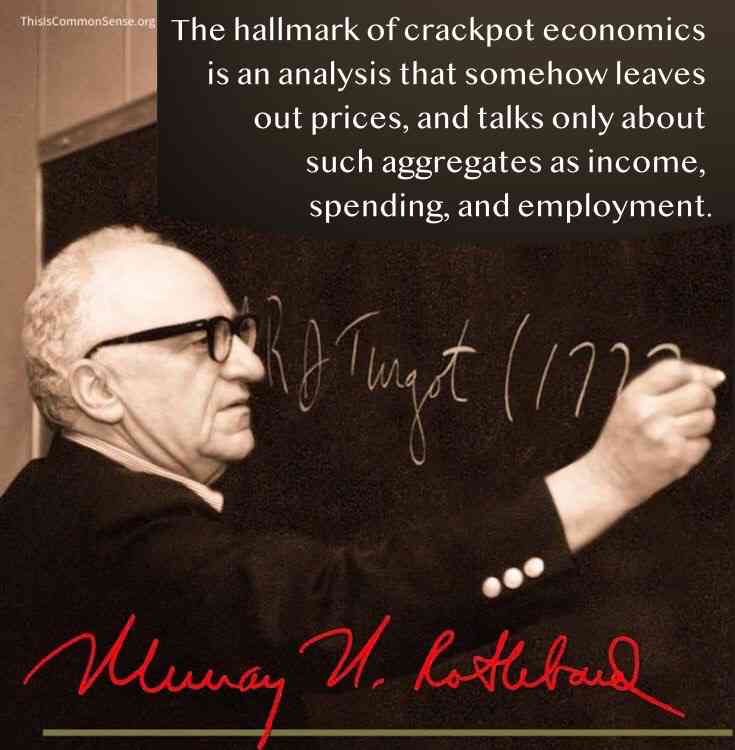
Murray N. Rothbard

The hallmark of crackpot economics is an analysis that somehow leaves out prices, and talks only about such aggregates as income, spending, and employment.

Murray N. Rothbard, “Keynesian Myths,” in Llewlyn Rockwell, Jr., ed., The Free Market Reader (2008), p. 51.
Categories
ballot access election law ideological culture

The Colorado Gambit Crushed

The Supreme Court unanimously nixed the clever scheme to keep Donald Trump off the Colorado ballot. The court explained its actions in the second paragraph of its anonymously written March 4th ruling: “Because the Constitution makes Congress, rather than the States, responsible for enforcing Section 3 against federal officeholders and candidates, we reverse.”

That’s it. The 14th Amendment, which the Colorado gambit relied upon, does make Congress the instrument for preventing “an insurrectionist” from serving in office.

So Colorado’s ploy to rig the 2024 election out in the open has been stopped. And good thing, too, since the political repercussions could have been . . . harrowing. 

A lot of commentary and reporting on the ruling has been devoted to pushing what was not covered. Take the CNN article by John Fritz and Marshall Cohen, “Trump’s on the ballot, but the Supreme Court left key constitutional questions unanswered.” It is hard not to interpret such headlines as providing excuses to partisan Democrats — in this case those at CNN — who had put so much hope in Colorado’s (and other states’) taking of the Trump matter into their own hands. 

“But while the unsigned, 13-page opinion the Supreme Court handed down Monday decisively resolved the uncertainty around Trump’s eligibility for a second term,” the article explains, “it left unsettled questions that could some day boomerang back to the justices.”

True enough, but so what? Take the first mentioned: “Could Democratic lawmakers, for instance, disqualify Trump next January when the electoral votes are counted if he wins the November election?”

Well, no. 

The 14th’s third section does not list presidents as barred by insurrection: “No person shall be a Senator or Representative in Congress, or elector of President and Vice-President,” it says. Electors of. But not the President and VP.

I’m sure the Supreme Court would be happy to expedite an opinion to that effect should the Democrats attempt anything that stupid.

This is Common Sense. I’m Paul Jacob.


PDF for printing

Illustration created with PicFinder and Firefly

See all recent commentary
(simplified and organized)
See recent popular posts