No moral system can rest solely on authority.
Sir Alfred Jules Ayer, Humanist Outlook (1968), p. 4.
Categories
A. J. Ayer

No moral system can rest solely on authority.
Sir Alfred Jules Ayer, Humanist Outlook (1968), p. 4.

On March 7, 1644, Massachusetts established the first two-chamber legislature in the American colonies.
One hundred thirty years later, to the day, British forces closed the port of Boston to all commerce.

Take nothing on its looks; take everything on evidence. There’s no better rule.
Mr. Jaggers in Charles Dickens’s Great Expectations (1860-61), Chapter 40.

On March 6, 1967, Soviet Premiere Joseph Stalin’s only daughter, Svetlana Alliluyeva (February 28, 1926 – November 22, 2011), defected to the United States. She later took the name Lana Peters, upon marriage to William Wesley Peters. The marriage was short-lived.
The March 6 date also marks term limits advocate and initiative organizer Paul Jacob’s birthday. He was born on the anniversary of the births of Michaelangelo, Cryano de Bergerac, and Alan Greenspan. He is also, obviously, the main reason that this site,

Steve Baker, reporter for Blaze Media, recently was forced to “self-surrender” to federal authorities for committing initially unspecified crimes.
Was doing his job the crime?
His fed-embarrassing journalism about the January 6 “insurrection” and the way many people have been incarcerated for years for little more than trespassing — was that the crime?
As video of the not-always- innocuous but often-innocuous goings-on of January 6 has been released, Baker has been among those examining the record and noting apparent contradictions in the official story.
When he turned himself in to the FBI last Friday, he was facing charges that the FBI had flatly refused to divulge. But now the Blaze reports that, three years after January 6 “insurrection,” Baker is being charged for things like “entering [restricted areas] without lawful authority” or “parading . . . in a capitol building.”
Trespassing. Arrested for trespassing three years later?
Or arrested for his reporting on the events of January 6 and its sequels over the course of those three years?
Before Baker turned himself in, the FBI did give him the information that he should arrive in shorts and flip-flops. So that, Glenn Beck writes, “it would be easier for them to put on the orange jumpsuit and ankle irons. Suffice it to say, he wore a suit and tie.”
This is Common Sense. I’m Paul Jacob.
See all recent commentary
(simplified and organized)
See recent popular posts
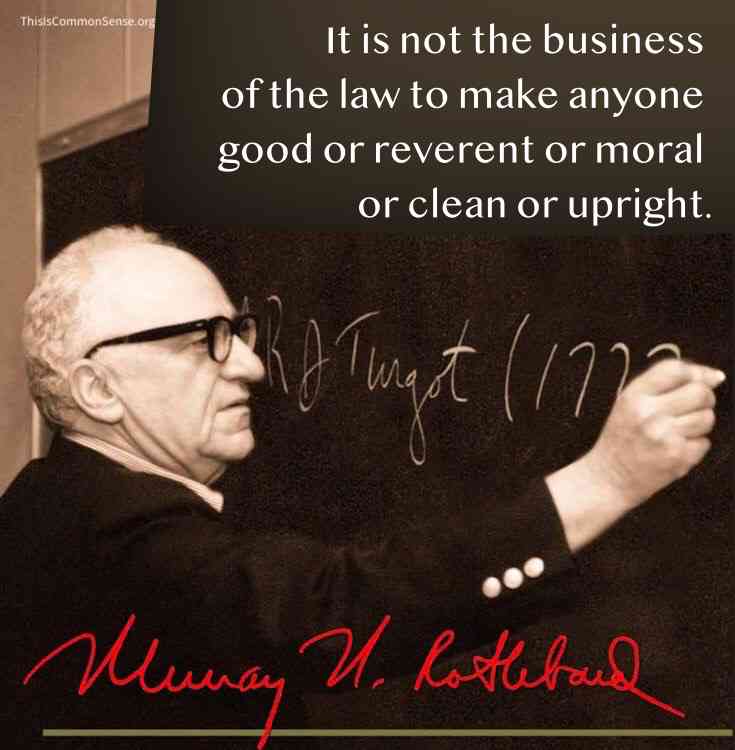
It is not the business of the law to make anyone good or reverent or moral or clean or upright.

On March 5, 1616, Nicolaus Copernicus’s book, De revolutionibus orbium coelestium, was placed on the Catholic Church’s Index of Forbidden Books. This censorship notwithstanding, the Earth continued to revolve around the Sun.
The book had been first published in 1543 in Nuremberg.
| In 1770, the Boston Massacre took place on March 5.
| Joseph Stalin, the longest serving leader of the Soviet Union, died at his Volynskoe dacha in Moscow on this date in 1953, after a cerebral hemorrhage.
| March 5 is magician Penn Jillette’s birthday.

Instead of relying on a strategy of promoting Hillary herself, Clinton insiders plied what they called “Pied Piper candidates,” Republican hopefuls who, they theorized, would shift mainstream candidates further “right,” thus making the ultimate winners unpalatable to enough general election voters to win Hillary the election. There were three they identified: Ted Cruz, Ben Carson, and Donald Trump.
We know how this worked out.
In California, Democrats are returning to
The serpentine Adam Schiff, who is running to fill the slot formerly occupied by Senator Diane Feinstein, has directed $11 million in the primary “to elevate a GOP candidate,” according to The Washington Post.
“The ads argue that Republican Steve Garvey — a congenial former pro baseball player for the Los Angeles Dodgers and San Diego Padres who voted twice for Donald Trump but won’t say if he will do so again — is too conservative for California and highlight his recent surge, in an apparent effort to consolidate support for him on the right.”
The idea is to boost Garvey with Republican primary voters in hopes that Garvey takes the second of two spots available for the November election under California’s Top Two system, becauseSchiff’s people think Garveyis easier to defeat than liberal Democrat “Rep. Katie Porter, whom Schiff and his backers would prefer to avoid facing come November in this left-leaning state.”
But can this strategy really work in California? The ads portray Garvey as more Trumpian than he probably is, and recent polling suggests that Schiff and Garvey are now neck-and-neck.
A review of the Clinton metaphor, “Pied Piper,” shows how slippery the strategy can be. The “Pied Piper of Hamelin” is a cautionary tale.
The Democrats’support may go the way of rats
This is Common Sense. I’m Paul Jacob.
Illustration created with PicFinder and Firefly
See all recent commentary
(simplified and organized)
See recent popular posts
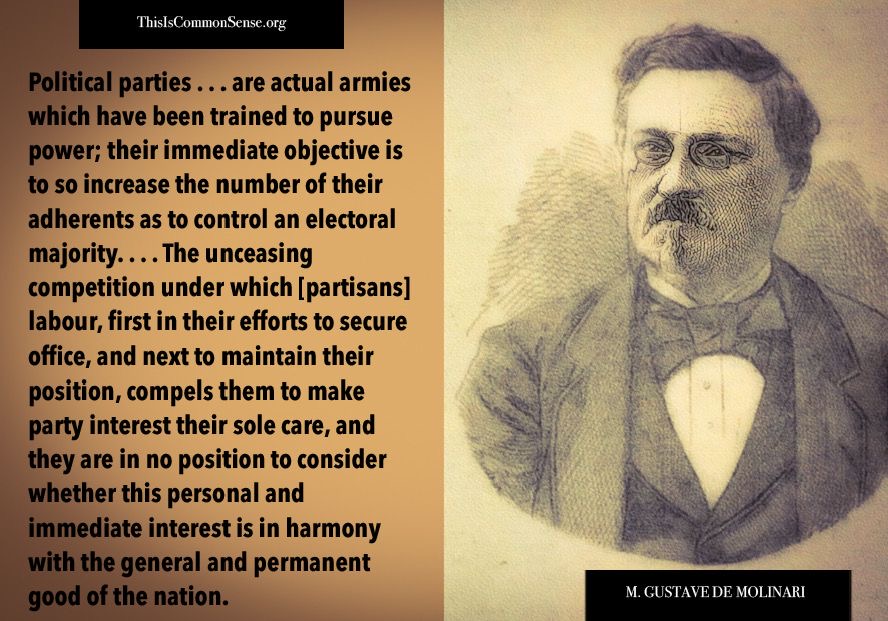
Gustave de Molinari, The Society of To-morrow (1904).
These associations, or political parties, are actual armies which have been trained to pursue power; their immediate objective is to so increase the number of their adherents as to control an electoral majority. Influential electors are for this purpose promised such or such share in the profits which will follow success, but such promises — generally place or privilege — are redeemable only by a multiplication of ‘places,’ which involves a corresponding increase of national enterprises, whether of war or of peace. It is nothing to a politician that the result is increased charges and heavier drains on the vital energy of the people. The unceasing competition under which they labour, first in their efforts to secure office, and next to maintain their position, compels them to make party interest their sole care, and they are in no position to consider whether this personal and immediate interest is in harmony with the general and permanent good of the nation.
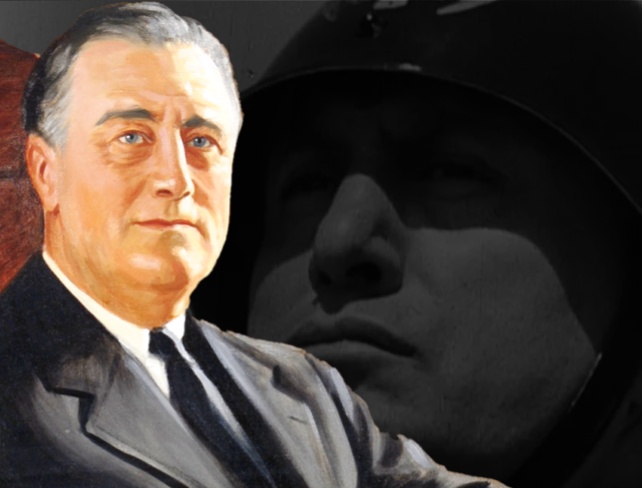
On March 4, 1933, newly inaugurated President Franklin Delano Roosevelt gave his customary address. The speech “brought a decidedly favorable reaction in the Italian press, especially his declaration that he will seek extraordinary powers to deal with the situation if necessary,” wrote The New York Times the next day. The Times went on to quote “Premier Mussolini’s Milan newspaper, Popolo d’Italia,” which stated that “The American people place their hope in decisive action by the new President and his speech truly satisfied public opinion.”
The Italian newspaper “said the bank moratorium in New York contributed perhaps more than any other factor in convincing even the most reluctant of the urgent necessity for the whole nation to rally around Mr. Roosevelt.” A Turin paper succinctly stated its appreciation for FDR: “Mr. Roosevelt is following the great principles established by the Fascist revolution and the genius of Il Duce.”
On March 4, 1789, the first bicameral Congress of the United States met in New York, New York, in accordance with the new Constitution.
Two years later on the same date, Vermont was admitted as the fourteenth state of the union.
In a twist in World War II allegiances, Finland declared war on Nazi Germany on March 4, 1945, beginning the Lapland War.