Categories
Common Sense national politics & policies Popular responsibility

My Privilege Isn’t White

“White privilege” is all the rage . . . on college campuses. But is there anything substantive to the notion?

As long as some folks view individuals as nothing more than their race, I suppose one can accrue a few advantages simply by being part of the largest racial group.

Moreover, as I explained at length in my Sunday column at Townhall.com, numerous government policies do indeed hit minorities harder.

The War on Drugs has ravaged the black community much more than the white community, for example. This may result more from the higher poverty rates for minorities than to race alone: Police and prosecutors are more likely to arrest and harshly prosecute the poor for no better reason than that the poor are less able to defend themselves, legally or politically.

That’s wrong. We very much need major reforms of unaccountable police power and abusive prosecutors as well as end the drug war.

But getting back to that trendy “white privilege” — it misses a big source of “unfair” advantage.

I’m white, but my privilege mostly isn’t. Of my many advantages, my skin pigmentation nowhere near tops the list.

Whatever success I’ve enjoyed derives mostly from this: I was reared by two parents who supported me, nurtured me, corrected me and cared about me every day from before I was born to now.

No government program, no amount of money, can best that gift.

The most critical element in the success of black and brown and yellow and peach and white kids is not a politician who cares, but a parent — or, better yet, two — providing a nurturing environment, including tough love.

We could all use more of the “unfair” advantage that parents provide.

This is Common Sense. I’m Paul Jacob.


Printable PDF

Categories
Accountability ballot access Common Sense general freedom government transparency

Pierce Petition Power

Pierce County, Washington, Executive Pat McCarthy charges that “a majority of the County Council bowed to political pressure, even though this could set a terrible precedent that the most basic administrative actions of government can be derailed by the simple act of signing a piece of paper.”

Yeah, right.

At issue is a $127 million construction project to build a new county administration building. Back in February, the Council voted 4-3 to move forward on the project.

The total cost of the new building, including financing fees and interest, will add up to $235 million according to Jerry Gibbs and a group called Citizens for Responsible Spending. These activists filed a petition to demand a public vote on the issue next November.

As is all too common these days, their grassroots effort was quickly countered by the big guns: the city filed a lawsuit against them, attempting to block the referendum.

The lawsuit didn’t sit well with people in Pierce County.

“Why don’t they want this voted on by the people?” asked Gibbs.

“This is absolutely an abuse of power,” decried resident Sheila Herron, “this is bullying of a private citizen.”

Council Chair Dan Roach argued that the power to launch a court challenge must come from the council, which had not discussed it. He warned his fellow city officials: “you are sending a very chilling” message to citizens not to “dare try to challenge what we’re doing as the government.”

Last week, the County Council voted 4-3 to drop the lawsuit, bowing to political pressure . . . from the people they represent.

In short, good government broke out.

This is Common Sense. I’m Paul Jacob.


Printable PDF

Categories
Common Sense meme term limits too much government

Don’t think legislators deserve a 150% pay raise?

The Arkansas legislature is on track to receive a massive pay hike. You can stop it.

Call (501) 682-1866

Learn more here.


Categories
Common Sense crime and punishment folly general freedom media and media people too much government

At Least We’re Not Turkey

Whenever I feel discouraged by the steady drumbeat of domestic assaults on liberty — from Obamacare to parents being accused of “child neglect” for letting their kids return from a playground by themselves — I try to remind myself:

Things Could Be Worse.

World history provides plenty of support for this dictum, but so does a glance at the newspaper. Like the story of how a single satiric Instagram post “could end up sending a former Miss Turkey to jail.”

An Istanbul prosecutor has been threatening to imprison Merve Büyüksaraç for up to two years for the heinous deed of insulting an official. Last summer she excerpted a satirical piece called “The Master’s Poem” that originally appeared in the magazine Uykusuz. Uykusuz has a habit of mocking Turkish politicians, including President Erdoğan.

“I shared it because it was funny to me,” she says. “I did not intend to insult Recep Tayyip Erdoğan.” Regardless of her motive, her post should not have put her at legal risk.

Buyuksarac is popular on social media — 15,000 followers on Instagram, double that on Twitter — a presence that makes her a target. The Turkish government doesn’t care whether she is an ardent dissident. They obviously just want to intimidate others with a readership who are inclined to ruffle the feathers of the powerful even a little.

So yes, things could be worse. Lots worse. They could also be a lot better. That’s what we have to fight for.

This is Common Sense. I’m Paul Jacob.


Printable PDF

Categories
meme

Arkansas Pay Raise

Arkansans to get a 150% salary increase.

Oh wait… that’s for Arkansas Legislators. Meanwhile household incomes in our state are down 5%. Call the Independent Citizens Commission TODAY to stop this outrage!

(501) 682-1866


Categories
Accountability folly government transparency incumbents initiative, referendum, and recall meme term limits too much government

Stop Phony Crony Pay Grab

Are people in Arkansas as stupid as their legislators think?

Last November, legislators tricked enough voters to narrowly pass Issue 3.

I’ve addressed before the measure’s dishonest ballot language, mis-identifying a doubling of allowed terms as the “setting of term limits.” And about a much-ballyhooed gift ban that has proven so weak that now most legislators are offered “free meals nearly every day.”

Perhaps the biggest of the tricks used to pass the measure was this: Hide from voters the measure’s establishment of an “Independent Citizens Commission” . . . a majority hand-picked by those same legislators.

This “Legislative Cronies Commission” (as it should be called) has announced it will unilaterally hike pay by an outrageous 150 percent!

The commission claims to have looked at legislative salaries in nearby states, except Texas and Mississippi — two states that just so happen to pay lower salaries. Economic factors were also considered, supposedly, but household income in Arkansas has actually dropped in the last decade.

The commission held only one poorly publicized hearing — at, get this, 10:00 am on a Monday, when most folks were working. No surprise, public comments have run ten to one negative. Letters and emails contain words and phrases such as “shameful,” “insult,” “actually sick to my stomach,” “a joke,” “ludicrous,” “appalled” and “slap in the face.”

This led Larry Ross, chief crony on the commission, to rudely dis citizens, telling the Arkansas Democrat-Gazette that he would look at the “quality” of comments, not the “quantity.”

Only a tsunami of public anger can stop this rip-off of Arkansas taxpayers. Act fast. A March 16 meeting is set to finalize the increase.

Tell the Independent [sic] Citizens [yeah, right] Commission what you think: call (501) 682-1866.

This is Common Sense. Paul Jacob.


 Printable PDF

Categories
Common Sense general freedom U.S. Constitution

Slavery & Racism

On Sunday, I marked an awful event in our history: The official beginning of chattel slavery as such in Britain’s American colonies.

At first, John Casor, an African indentured servant, had gained some control of his life. He charged his master, Anthony Johnson, a free black, with having forced him to labor longer than the term of his indentureship. He won, was freed, and then indentured himself to one Robert Parker.

But Johnson sued, and, on March 8, 1655, won Casor back — as a slave for life.

The case established a civil ground for slavery, also enabling free blacks to own slaves. Even as late as the Civil War, the South harbored families of obvious African descent who themselves owned African-Americans as slaves.

On the surface, American slavery wasn’t about race. But in the 1640 case of John Punch, sentenced to a life of slavery as criminal punishment for running away from his indentured servitude, his fellow escapees — whites — merely got longer terms of forced labor.

Racism, Thomas Sowell explains, became increasingly important to “the peculiar institution” as time went on. If you exalt the notion that “all men are created equal,” how do you square that with your slave-holding?

By denigrating the humanity of blacks.

This vile ugliness of racism is still with us, to some degree . . . and slavery, too — at least, in small pockets around the globe and in a much bigger way in the Muslim world. An estimated eleven million slaves are held in Africa and the Middle East. And black Africans are still the main victims.

Sunday was also the 240th anniversary of Tom Paine’s first American call for slavery’s abolition.

Ending slavery: it’s way past time.

This is Common Sense. I’m Paul Jacob.


Printable PDF

Categories
crime and punishment folly general freedom nannyism too much government

America’s Twilight Zones

On Friday I lamented the picking up, by local police, of two children, 10 and 6, for walking home from a local park . . .

and the subsequent two-month Montgomery County (Maryland) Child Protective Services investigation, which found the parents “responsible” for “unsubstantiated child neglect.”

Left unanswered? Whether parents “may” let their kids walk somewhere without supervision.

There’s no law, of course, against children walking in public without parents. But the “swarms of Officers” employed “to harass our people” aren’t limited by trifling things like laws.

This Kafkaesque episode reminds me of my experiences with campaign finance agencies.

In both cases, agencies rely upon meritless complaints to investigate, intimidate and impoverish people without any law being broken. All that’s required? An unelected bureaucrat’s arbitrary decision.

Take Lois Lerner. She ran the IRS division targeting conservative groups. Remember her allegedly lost emails? Irretrievable! Until someone actually looked for them.

Before violating people’s rights at the IRS, Lerner did so heading the Enforcement Division of the Federal Election Commission (FEC). A recent George Will column detailed her threats and very public and politically damaging harassment of Al Salvi, the Illinois Republican candidate for the U.S. Senate. Sure, he was fully acquitted in federal court . . . after his defeat.

Using a spurious complaint by former Rep. Mike Synar (D-Okla.), Lerner launched a political persecution against U.S. Term Limits, costing us nearly $100,000 in legal fees and much more in dislocated time and manpower.

Finding no evidence — there was none to find — the FEC finally closed the matter. But agency officials still issued a news release proclaiming that they believed we had violated the law.

An Oklahoma newspaper headline read, roughly, “National Term Limits Group Broke Law, Says FEC.”

Talk about “unsubstantiated.”

This is Common Sense. I’m Paul Jacob.


Printable PDF

Categories
Today

African Slavery In America…

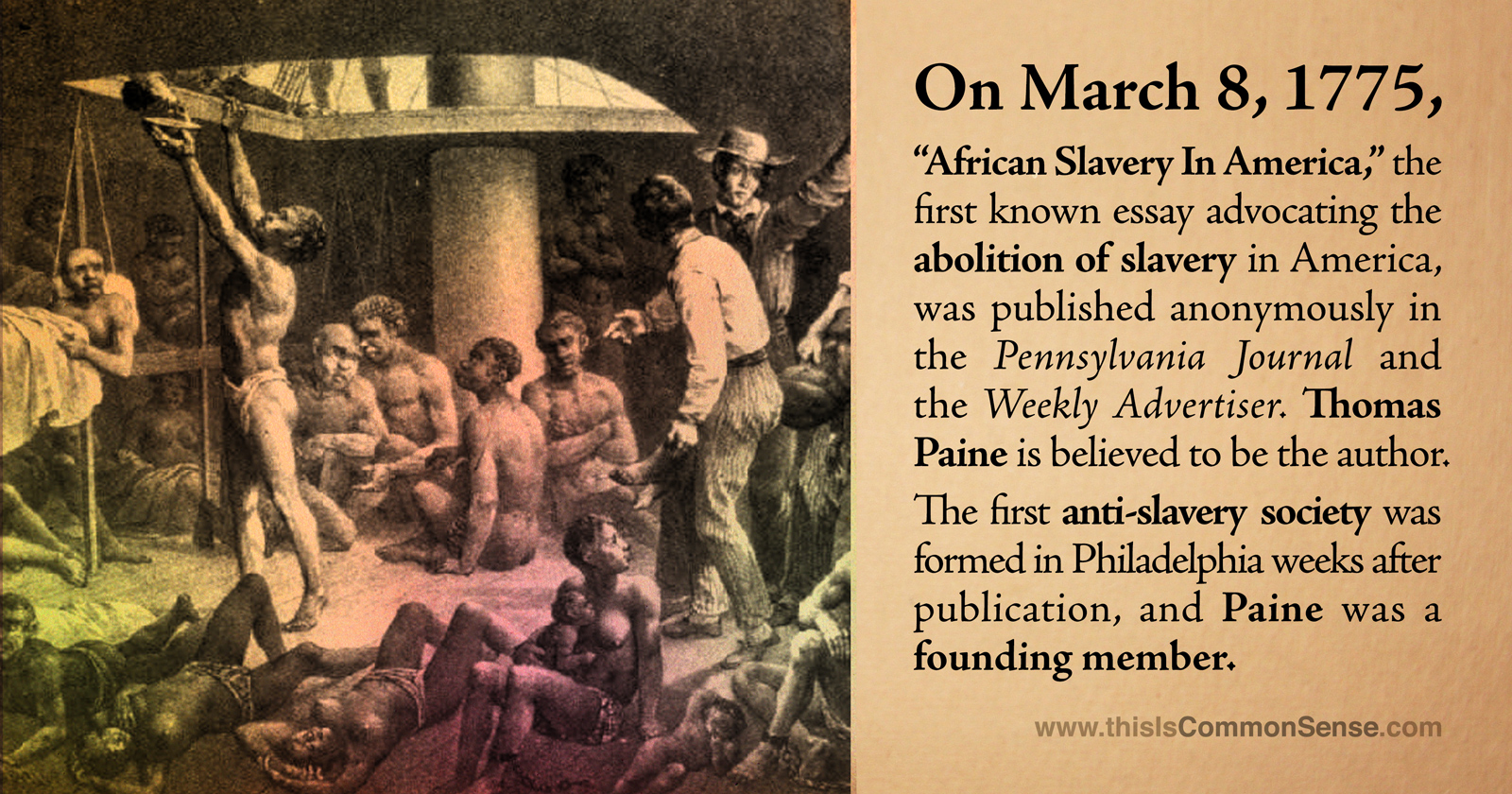
On March 8, 1775, “African Slavery In America,” the first known essay advocating the abolition of slavery in America, was published anonymously in the Pennsylvania Journal and the Weekly Advertiser. Thomas Paine is believed to be the author. The first anti-slavery society was formed in Philadelphia weeks after publication, and Paine was a founding member.

Exactly 120 years earlier, a court in Northampton County of the Virginia Colony ruled that John Casor, then working as an indentured servant to Robert Palmer, must be returned to Anthony Johnson as Johnson’s “lawful” slave for life. Ironically, Johnson was one of the original indentured servants brought to Jamestown, had completed his indenture to become a “free Negro” and the first African landowner in the colony. The case marked the first person of African descent to be legally-recognized as a lifelong slave in England’s North American colonies.


Categories
meme

An Argument in Favor of Term Limits

“As a lobbyist, I was completely against term limits, and I know a lot of people are against term limits, and I was one of the leaders, because why? As a lobbyist, once you buy a congressional office, you don’t have to re-buy that office in six years, right?”

—JACK ABRAMOFF, Former Lobbyist and Convicted Felon


Shared ideas matter. Please pass this along to friends.

Get a high-resolution screensaver of this image. Click on the thumbnail picture below to open a large version that you can download.

Abromoff_TermLimitsFINAL