Categories
free trade & free markets general freedom Ninth Amendment rights tax policy

Taxation Rules

It turns out the United States is a tax haven.

Haven? Heavens! I live here. I don’t feel that low-tax feeling when April 15 rolls around.

But the Cato Institute’s Dan Mitchell, an expert on all things tax-policy — a dirty job, but somebody’s gotta do it — says “The U.S. Is a Tax Haven . . . and That’s a Very Good Thing.”

He is a huge fan of international tax competition. He likes it when governments at least marginally decrease the tax burden on prospective producers and investors, so as to lure production and investment from other tax jurisdictions. In his opinion, “we need some way to restrain the greed of the political class.”

Fans of big government disagree. Tax competition hinders their master plans to control and plunder the rest of us.

Mitchell knows that we mere U.S. citizens tend to lug a big tax load. But the United States is in fact “a tax haven. Not for Americans, of course, but . . . we have some good rules for foreigners.” In addition to their ability to exploit the especially robust corporate privacy rules of a state like Delaware, foreign investors can avoid taxes on interest and capital gains on their stateside investments.

Now, Mitchell says, let’s apply those “same good policies to Americans.”

Hear hear! Havens I can access are even more appealing than those I can’t.

This is Common Sense. I’m Paul Jacob.


Printable PDF

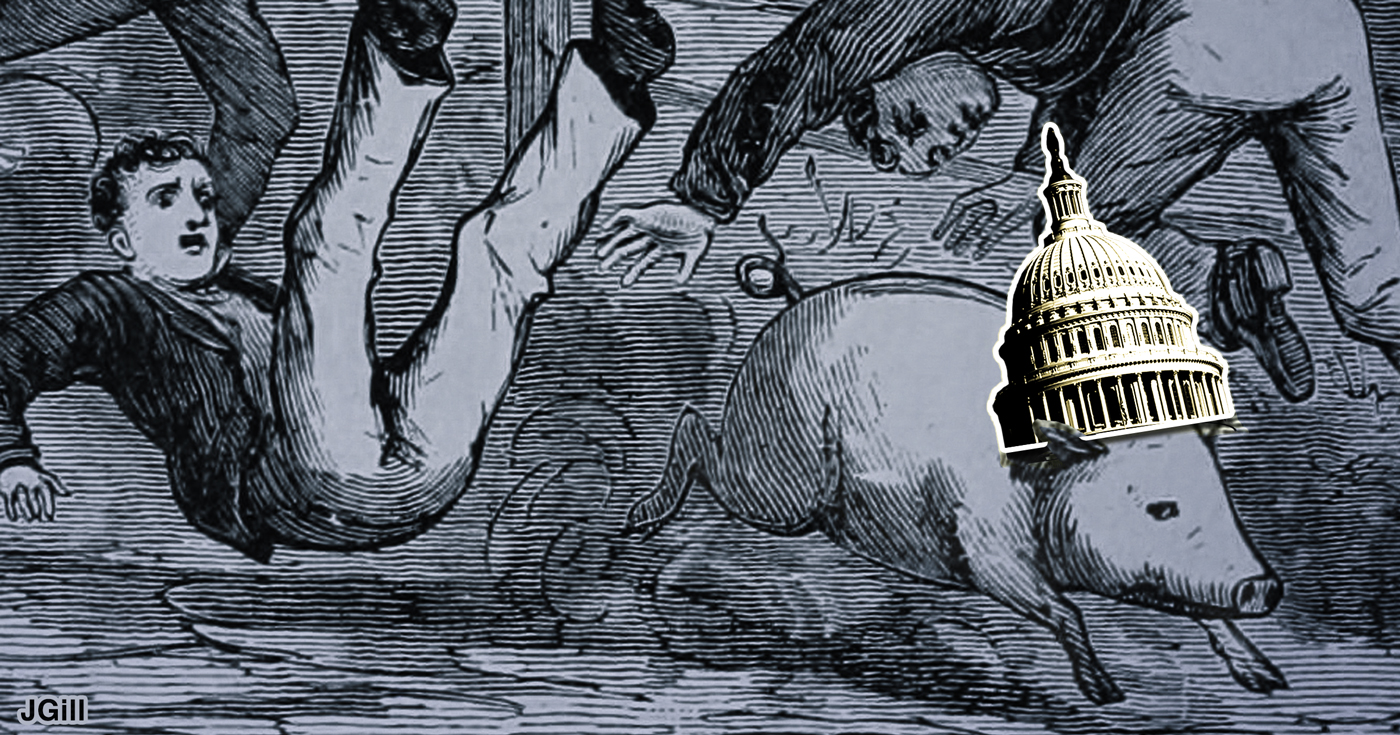
Overburdened Pack Mule


Categories
Common Sense general freedom ideological culture national politics & policies

Lions and Lambs

“March comes in like a lion, goes out like a lamb.”

Tell that to Indiana Governor Mike Pence, whose signing of the Religious Freedom Restoration Act (RFRA) into law at the end of March created a roaring controversy.

Does the law enable discrimination? Or protect religious freedom? Or both? Neither?

An Associated Press report explains: “Religious freedom laws like the one causing an uproar in Indiana have never been successfully used to defend discrimination against gays — and have rarely been used at all, legal experts say.”

Of course, discrimination continues. In 2014, a Texas restaurateur refused service to a gay couple. As a FindLaw.com article explains, the 1964 Civil rights Act “only prohibits discrimination on the basis of color, race, religion, or national origin, and says nothing about sexual orientation.”

So some states, such as New Mexico and Oregon, added legal protections for sexual orientation. But that’s led to reverse violations of rights — facing a $150,000 fine, a bakery closed its shop after the Oregon Bureau of Labor and Industries ruled it violated a lesbian couple’s civil rights by declining to make a wedding cake; a New Mexico photographer was found guilty of violating the state’s Human Rights law for declining to photograph a gay couple’s commitment ceremony.

In times’ past, both state and private violence enforced invidious racial discrimination. Thankfully, those days are gone — cafes, hotels and stores are open to all.

But the civil rights laws that prohibit discrimination in public accommodations cases are distinct from forcing photographers or florists or flutists to personally participate in a ceremony they choose not to.

This is Common Sense. I’m Paul Jacob.


Printable PDF

LIons and Lambs


Categories
folly government transparency porkbarrel politics too much government

Lagniappes à la Legislators

Finally, a legislator with the guts to strike directly at the root of the problem: the People.

Well, not all the people. Just the ones who speak out, who show a lack respect for their elected betters.

In recent years, the Arkansas Legislature has heroically tried to control the chaotic and dangerous excesses of freedom and democracy in the Natural State. Legislators have proposed laws clamping down on citizen petitions, requiring employees to friend their employers on Facebook, outlawing photography in public and . . . well, you get the picture.

Last November, legislators convinced voters to amend the state constitution to weaken term limits and establish an independent commission (appointed by legislators) to raise their pay 148 percent. How? By astutely telling voters that the amendment would “set term limits,” while saying nothing about the pay hike.

Legislators also cleverly curtailed the citizen initiative process, regulating paid petitioners in ways the state constitution prohibits. But they got a pass on that; the eminent state supreme court has ruled in their favor. Then, unwilling to rest on their laurels, legislators introduced a new bill requiring petition campaigns to conduct costly criminal background checks on their paid petitioners.

One opponent called this deeply thoughtful measure “mean-spirited” and “unnecessary.”

Sen. Jon Woods argued the legislation doesn’t go far enough. He filed Senate Bill 0401, which mandates that any person speaking out in any way not in sync with the legislature must shut up.

“Enough pussy-footing around. Let’s end all this free speech hogwash,” Woods said. “We’re the boss!”

For real?

Unfortunately, everything prior to the previous three paragraphs is 100 percent true. Yup, every day is April Fools’ Day at the Arkansas Legislature.

This is Common Sense. I’m Paul Jacob.


Printable PDF

Arkansas Fools


Categories
ideological culture national politics & policies too much government

Count to Ten

Yesterday I argued that the Ten Commandments can and should be promoted — privately. Promoting one’s religion is expected . . . outside of government. But do that as a government official and suddenly what most folks consider good common sense morality sows discord.

Why? Simple. Your religion is yours. But the government is ours. It’s supposed to be. But since we don’t all share the same religion, your monument on public property or public commemoration seems nothing more than you shoving yours at us.

With the Decalogue, it’s even trickier. The Ten Commandments aren’t numbered as such in either Exodus or Deuteronomy. Jews, Catholics, and various Protestant denominations differ on ordering them. What one group calls the Fifth Commandment another calls the Fourth. What most American Protestants call the Tenth Commandment is numbered as the Ninth and Tenth by Catholics. And so on.

So any enumerated Decalogue is not merely Judeo-Christian-centric, likely to make Buddhists, Hindus, Yazidis and Sikhs at the very least uncomfortable. It would necessarily be denominationally preferential.

I bet most Ten Commandment listings promoted by American politicians are not the ones Catholics have memorized, by order — or Jews, or even Lutherans and Episcopalians.

These differences usually appear quite small, of course, especially in light of the overwhelming similarities. Accordingly, any disagreements about the Ten Commandments remain friendly, and will likely stay that way — unless government chooses one version over another.

In politics, the doctrine of enumerated powers is divisive enough. Add in multiple, competing enumerations of the Ten Commandments? Too much to divide us.

This is Common Sense. I’m Paul Jacob.


Printable PDF

Counting the Commandments


Categories
general freedom ideological culture

Commanding Controversy

Is “Thou shalt create controversy” one of politicians’ Ten Commandments? Is “Thou shalt pass a law to solve every problem” their eleventh?

Meet Arkansas Senate Bill 939, which would authorize placing a monument to the Ten Commandments on capitol grounds. It passed the state senate last week, 27-3, and is headed to a similar slam-dunk in the House.

The Arkansas Democrat-Gazette reports that, according to authors Sen. Jason Rapert (R-Bigelow) and Rep. Kim Hammer (R-Benton), the effort “should be seen as a way to honor the historic role the biblical text has had in U.S. and Arkansas history and not seen solely as religious.”

No public dollars are involved, say proponents — private money is to purchase the obelisk. Opponents, many testifying, counter that the upkeep will still tap taxpayer money.

Not to mention the certain and certainly expensive litigation over the constitutionality of the endeavor.

I’m not one to shy from a constitutional battle, having launched more than a few of my own. But, well, I think the Ten Commandments might best serve as more than a prop.

Let me offer an alternative that (a) could actually get real people to read the Ten Commandments, no doubt with varied but valuable educational result, and (b) won’t cost the State of Arkansas one thin dime in maintenance or legal fees.

Download a copy of the Ten Commandments here. Share with others.

Reading and talking about the Decalogue has to be far better than picking an expensive fight about it.

No law necessary.

This is Common Sense. I’m Paul Jacob.


Printable PDF

Ten Commandments


Categories
folly general freedom too much government

All Wet

Which is worse, paying for stuff you use . . . or being constantly harassed for using it?

One consequence of widespread failure to charge market rates for water turns out to be hyper-regulation of hydro-usage, and the penalizing — even criminalizing — of using “too much” H2O.

To deal with drought, California now regards it as criminal to “waste” water. Don’t hose down that sidewalk! Las Vegas tries to save water by paying people to rip out their lawns. The EPA is developing technology to force hotels to monitor guests’ specific water usage.

In unhampered markets, sudden and big drops in supply tend to cause sudden and big rises in prices. People economize without being forced. If you must pay more for orange juice because of frozen crops, you either buy less juice or buy less of something else (if orange juice is your favorite thing). But the shelves don’t go bare.

The worse supply problems are, the higher the prices, the more customers economize, the more producers produce. So when there’s a local drought, what will a water company do (as opposed to an overweening water authority)? Charge more. Pipe in water from other states. Other solutions I can’t think of offhand . . . because I’m not running a water company. I lack the direct incentive that the possible profit from solving the problem provides.

Let people cooperate with each other. That is how they’ll solve their water problems — without governmental bullying.

The water will come like rain.

This is Common Sense. I’m Paul Jacob.


Printable PDF


Categories
crime and punishment general freedom

Big Brother Rides Along

Hertz has begun installing cameras in their rental cars as part of a system called NeverLost. But don’t worry, they’ve got no plans (they say) to use them (yet).

“The camera feature has not been launched, cannot be operated and we have no current plans to do so,” Hertz spokesman Evelin Imperatrice assures us. I guess Hertz is with St. Augustine about how all that exists time-wise is a vanishingly small present moment, inasmuch as the past is already gone, the future not yet here. Ergo, nothing to worry about.

Nevertheless, customers are worried.

“I even felt weird about singing in the car by myself,” says one.

“The system can’t be turned off from what I could tell,” reports another. “[And] the camera can see the entire inside of the car. I know rental car companies have been tracking the speed and movements of their vehicles for years but putting a camera inside the cabin of the vehicle is taking their need for information a little too far.”

I’m all in favor of extensive monitoring of police and others with government-conferred power over us, in a position to easily abuse that power. I’m not in favor of indiscriminate spying by everybody on everybody. Or of any gearing up to do that.

What to do? A little bit of tape over the lens, that’s one option. Another: boycott Hertz until they rip the cameras out. Or at least make them easy to turn off.

This is Common Sense. I’m Paul Jacob.


Printable PDF

Categories
Common Sense folly media and media people national politics & policies

Cruz Country

The cultural differences between left and right may be stronger than the political.

When Sen. Ted Cruz answered a question about his musical taste posed by a CBS news correspondent, and he announced that his preference switched after 2001, 9/11, the leftosphere fell of its rocker and into convulsions.

Why?

He said he switched from listening to classic rock to country, and did so because the country music culture responded to the 9/11 atrocity so much better than did rock-and-roll culture.

Confession: my musical tastes lean toward classic rock. But there’s no way I would get upset about a politician’s musical choices — unless he started listening to Wagner while reviving an interest in National Socialism.

But boy, on the left there was a lot of outrage and indignation. At least, Matt Welch of Reason quoted a good spattering of it, and I found more on Twitter and elsewhere. On Slate? Snark. A YouTuber tubed Cruz’s change as “pandering.” And in New York magazine, Jonathan Chait identified Cruz’s professed change-of-taste “an incredible testament to his personal willpower.”

Huh?

You may or may not like country music, or appreciate the last 30 years of it, or its origins, or its commercialization, or the twang, but that stuff’s really not that important.

A conservative found political reasons to change his listening habits. Wow. A matter  of self-definition? Whatever. It neither builds up nor undermines his philosophy or program.

Though certainly Conway Twitty’s “It’s Only Make Believe” provides more than a cultural context for understanding much of what happens in Washington.

This is Common Sense. I’m Paul Jacob.


Printable PDF

Categories
Accountability Common Sense government transparency term limits

The Article V Path

Can Americans term-limit Congress?

Twenty-three states had passed term limits on their congressional delegations by 1995 — many while simultaneously term-limiting state lawmakers.

Voters in most other states lack statewide initiative rights. But if the term limits passed by the 23 had been left alone, the pressure would have been enormous to bring term limits to the whole Congress.

Alas, in its 1995 Thornton decision, the Supreme Court ruled, five to four, that this method of building a more perfect union is constitutionally imperfect.

U.S. Term Limits currently backs an amendment that would originate in Congress to limit House members to three two-year terms and senators to two six-year terms. Just in case congressmen don’t get around to passing such an amendment, though, USTL has also endorsed the Article V path to term limits being promoted by Citizens for Self-Governance.

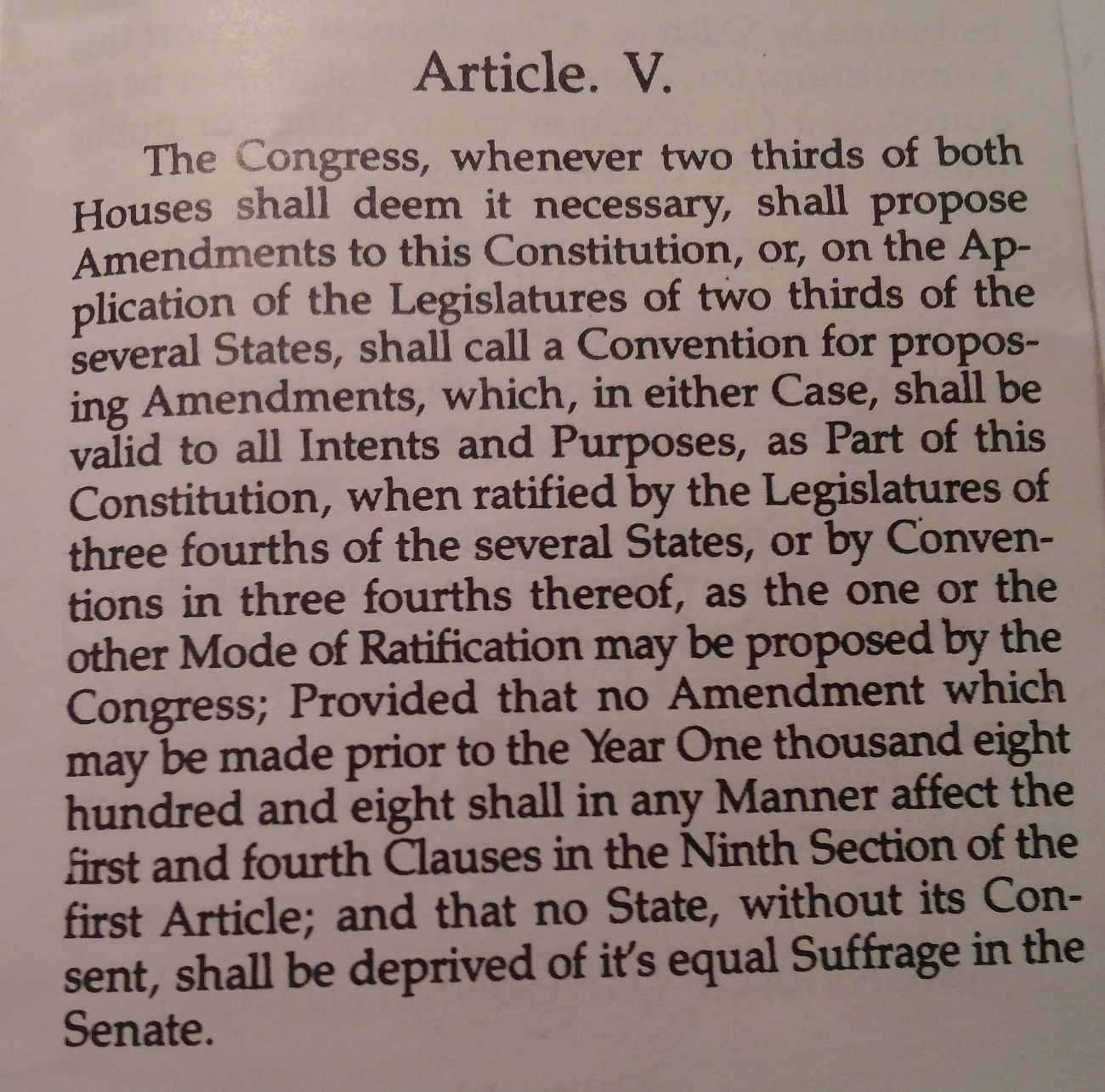
Article V of the Constitution authorizes states to call a constitutional convention if two thirds of them apply. In 2014, Georgia, Alaska and Florida did formally apply for a convention to consider term limits and other reforms. Lawmakers in many other states advocate similar applications. As with congressionally proposed amendments, any amendment offered by the states’ convention would then have to be ratified by three fourths of the states.

Is Article V a long shot? Yes. Every means of imposing congressional term limits has proven to be a long shot.

When we get there, it will be because one of the long shots paid off.

This is Common Sense. I’m Paul Jacob.


Click on the thumbnail below to see larger version

article-vScreenshot


Printable PDF

Categories
Common Sense general freedom individual achievement meme U.S. Constitution

Everything That Could Be Done

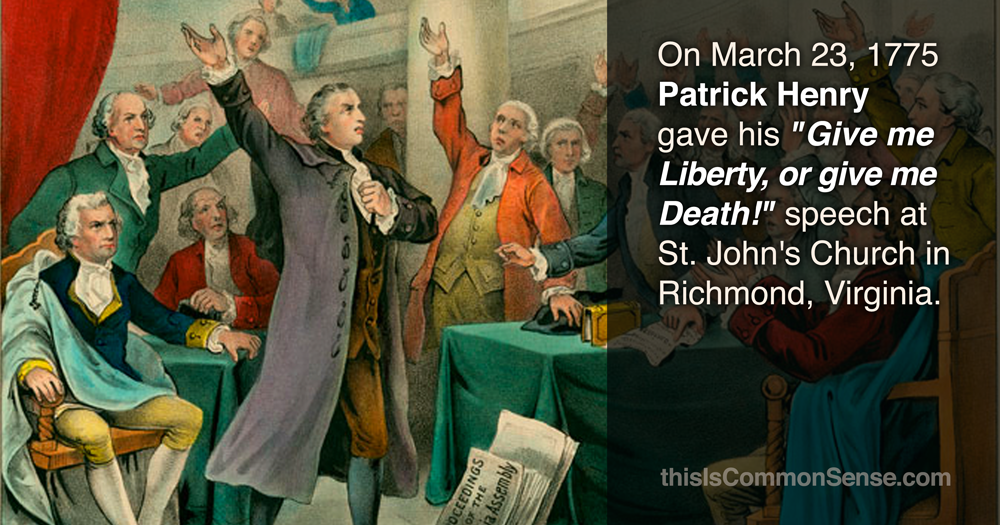
Two hundred forty years ago, the situation was dire. In the Virginia Colony, not too far from where I live, representatives to the Second Virginia Convention were debating the problems they were having with their “masters” in Britain — and the more dangerous, violent situation that was developing to the north.

Several days into the convention, Patrick Henry spoke. His speech was rousing. And it changed minds, concluding with the famous words “give me liberty or give me death!” — an ultimatum quite stark indeed.

Mr. Henry was for action, and waiting no longer. Addressing himself to the president of the convention, he said, “Let us not, I beseech you, sir, deceive ourselves longer. Sir, we have done everything that could be done to avert the storm which is now coming on.” And they had done a great deal, engaging in

– petitioning

– remonstration

– supplication

and, Henry went on, had even “prostrated ourselves before the throne.” And they got worse than the cold shoulder for all their efforts. They got the brush-off, the turn of the cold robe. Along with troops of occupation.

Hence the need for serious action.

Then, Americans were wrestling with the world’s most powerful nation: the British Empire. Today we again face the world’s most powerful empire: our own.

A federal regime similarly out of control in terms of spending and debt, arrogance and corruption, intrusiveness and incompetence. As if dictated by a know-it-all king of old, or a cabal of insiders acting as oligarchs.

Then it was a far-off Parliament; today it is our own far out-of-it representatives . . . duly elected.

We are engaged in a sort of class war, insiders vs. outsiders, and it is the insiders who are bringing the country to the brink of collapse.

The biggest difference between 1775 and 2015? We haven’t done all we can. There is much more to do. And possibly even succeed before the doom of another financial collapse, sovereign debt crisis, or . . . worse.

It often seems a Herculean task, but as Mr. Henry implored, “Sir, we are not weak, if we make a proper use of those means which the God of nature hath placed in our power.”

Let’s join together to give ourselves, our loved ones, and generations hence liberty.

This is Common Sense. I’m Paul Jacob.


Printable PDF

Read the entire speech here

Printable PDF of the entire speech here

Get a high-resolution screensaver of this day’s image. Click on the thumbnail picture below to open a large version that you can download.

The Meaning of "Liberal"