Categories
education and schooling term limits

Term Limits for School Boards

Statewide term limits on Florida’s school boards are finally here.

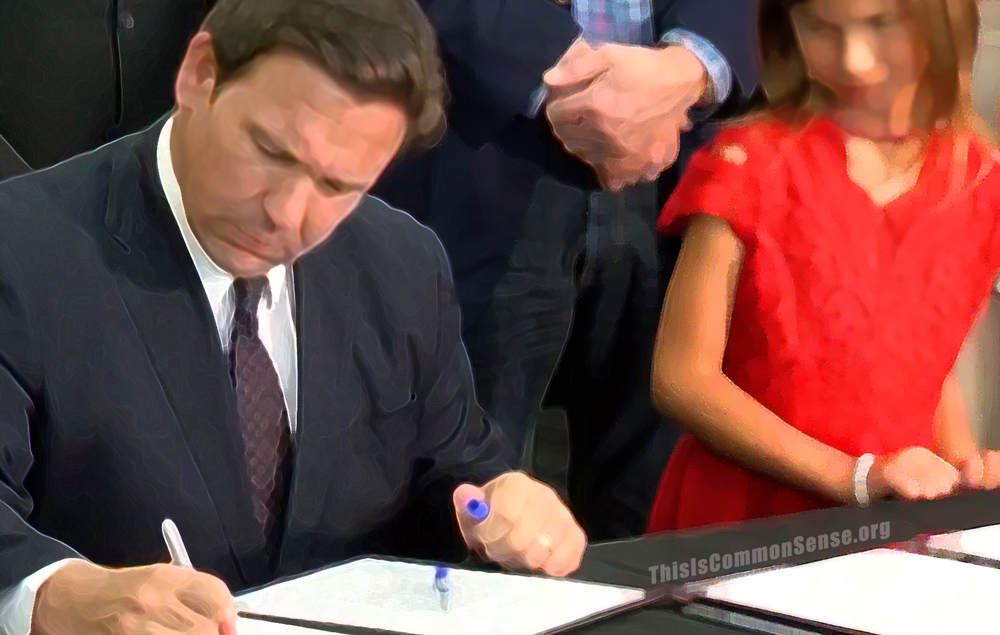
The limits passed by Florida’s legislature and signed into law by Governor Ron DeSantis are not the best one could hope for. State senators pushed for and got a 12-year limit rather than the eight-year limit preferred by house members.

Regardless, parents and children are better off with at least some legal limit on the tenure of board members and on their opportunity to abuse powersome curb in addition to the possibility of surmounting the overwhelming electoral advantages that incumbents typically enjoy.

Governor DeSantis agrees that the legislation reaching his desk should have been an eight-year limit.

“They did three terms . . . and I wouldn’t veto the bill just over that. But if it were a standalone measure, I would have insisted on just two terms for school board members because I think that’s enough time to go, serve, get stuff done.”

In 2018, the Florida Constitutional Revision Commission sent eight-year limits on school-board tenure to the voters as Amendment 8. But the Florida Supreme Court knocked the question off the ballot because the limits were combined with other measures to reform education, like more freedom for charter schools.

It is a near-certainty that voters would have passed the measure — a prospect that terrified those who benefit from rampant school-board corruption.

Sure, what has now been enacted is only a partial remedy. But it’s something.

I’m a firm believer in the philosophy that something good is better than nothing good.

This is Common Sense. I’m Paul Jacob.


PDF for printing

See all recent commentary
(simplified and organized)
See recent popular posts
Categories
Today

Economic vs. Political Means

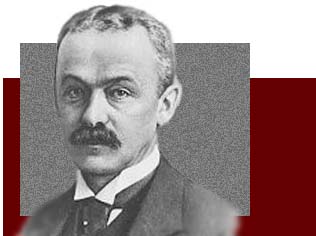
On March 30, 1864, German sociologist and economist Franz Oppenheimer was born. This sociologist is most famous for his 1908 book The State, in which he elaborated some consequences of two means for acquiring wealth, the “economic means,” by which he meant private production or by trade, and the “political means,” by which he meant forcible extraction from one group or person by another person or group. Oppenheimer taught in Palestine in the mid-1930s, and fled the Nazis to the United States, via Japan in 1938. In 1941 he became a founder of The American Journal of Economics and Sociology, and died two years later.

Categories
Today

Vargas

On March 28, 1936, Peruvian author Mario Vargas Llosa was born. This recipient of the 2010 Nobel Prize in Literature ran, in 1990, for the presidency of Peru, but lost to Alberto Fujimori. His novels include La casa verde (The Green House), La guerra del fin del mundo (The War of the End of the World), La fiesta del chivo (The Feast of the Goat), and Aunt Julia and the Scriptwriter, which was filmed as Tune in Tomorrow.

Categories
by Paul Jacob video

Watch: Of Minds Afire

Sam Adams didn’t say it. The Gray Lady admitted it. Texas didn’t do it. China did something. The Deep State is all over it.

What is “it”?

Depends.

Here are the contexts:

This Week in Common Sense, March 21 – 25, 2022. Also available as audio via podcatcher, or hosted on SoundCloud.

Categories
Today

South Korea

On March 26, 1991, local self-government in South Korea was restored after three decades of centralized control.

Categories
ballot access partisanship Voting

Are You Suppressed Yet?

Last August, the Texas Legislature considered changes to the state’s election process. Republicans called these changes “election integrity” while Democrats . . . well, they fled the Lone Star State for six weeks — even hanging out in the Washington swamp — to deny the majority party the quorum it needed to conduct legislative business.

Democratic Rep. Chris Turner said he left “because we are in a fight to save our democracy” against what he dubbed “nationwide Republican vote suppression efforts.”

Eventually, however, Democrats returned home and legislation was passed that The New York Times reported would “cement Texas as one of the most difficult states in the country in which to vote.”

Fast-forward to this year’s March 1 Primary Election, which The Hill reminds us “came amid the state’s new, more restrictive voting laws.” 

Well, a funny thing happened on the way to democracy’s grand destruction . . . Democratic turnout went not down but up! On the Republican side, the number of votes increased dramatically — by roughly 33 percent — “nearly 400,000 more than were cast in the 2018 primary, and more votes than had ever been cast in a midterm GOP primary.”

But there’s more.

In Harris County, the new voting law triggered an audit, which just so happened to find approximately 10,000 “mail ballots” that “were tabulated but not counted,” informs The Associated Press

Oops! Those Houston-area Democrats and Republicans (roughly 6,000 and 4,000 respectively) would have had their votes obliterated . . . save for the legislation roundly attacked as “anti-voter.”

So much for suppression.

This is Common Sense. I’m Paul Jacob.


Note: A week after the election, Harris County Election Administrator Isabel Longoria announced her resignation.

PDF for printing

voter suppression

See all recent commentary
(simplified and organized)
See recent popular posts

Categories
Today

To Montgomery

On March 25, 1965, civil rights activists led by Martin Luther King, Jr., successfully completed their four-day, 50-mile march from Selma to the capitol in Montgomery, Alabama.

Categories
Accountability government transparency international affairs

Lab Leak Not Disproved

A Wuhan wet market is ground zero of the pandemic;
COVID-19 could not have originated in a Wuhan laboratory.

At least, so say many “science reporters” commenting on recent research about the origin of the virus. Former New York Times science editor Nicholas Wade begs to differ.

Wade (whom we’ve cited before) says it’s possible that the virus jumped from an animal host or that it originated in a Wuhan lab. Although both can’t be true, “so far, no direct evidence exists for either.”*

He expounds:

  1. The cited research papers, still un-peer-reviewed, do not contradict circumstantial evidence of a lab origin.
  2. Nor do they show that the virus originated in the wet market. Even if the earliest known case were of a person attending the market, one can’t know whether he got infected there or brought the infection with him from a lab.
  3. One paper looks only at data from December 2019 and later. Yet the epidemic had been underway for weeks.
  4. The same paper claims that the distribution of cases with no overt connection to the wet market is so similar to that of the market-related cases that the former cases must also be connected to the market.

But the outside-the-market cases selected for study by Chinese authorities — by Xi Jinping himself for all we know — were not randomly selected. One criterion was proximity to the wet market.

So: massive selection bias.

And a pandemic of unscientific reporting.

This is Common Sense. I’m Paul Jacob.


* Wade does not consider some of the smoking-gun type evidence for gain-of-function we’ve mentioned in the past, like the Moderna patent.

PDF for printing

bat!

See all recent commentary
(simplified and organized)
See recent popular posts

Categories
Today

Coercive

On March 24, 1765, the Kingdom of Great Britain passed the Quartering Act, which required the Thirteen Colonies to house British troops.

On the same date in 1855, slavery was abolished in Venezuela.

Categories
media and media people national politics & policies

Shut Up, Spouse

“Stand down and let your better half do the job,” was the specific advice syndicated-columnist Kathleen Parker recently offered a woman, explaining that this woman’s “biggest mistake is that she thinks she’s important.”

Adding for emphasis: “She is not.”

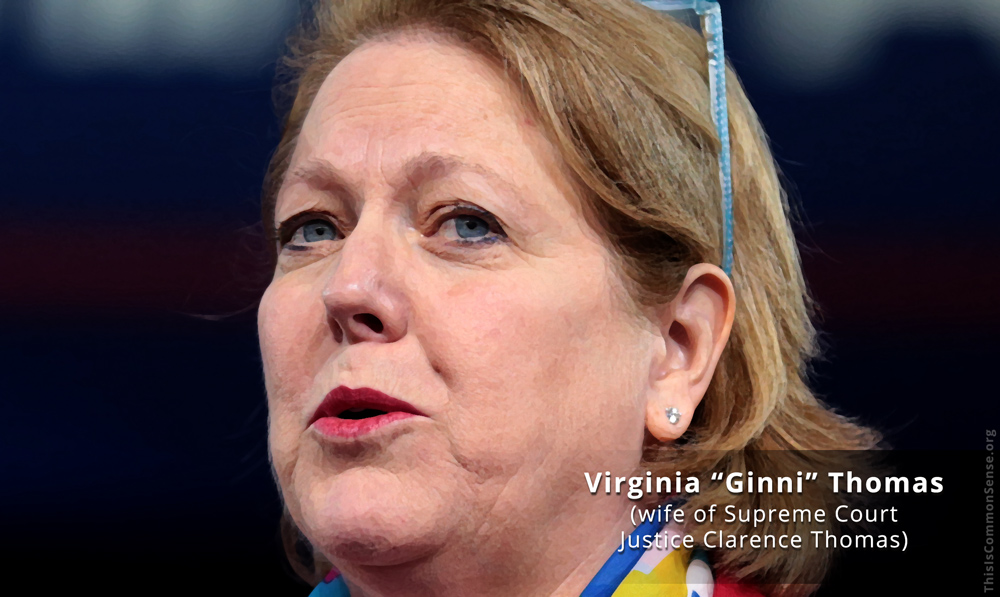
Parker is not writing about Hillary Clinton, Michelle Obama, or Dr. Jill Biden. Her subject? Virginia “Ginni” Thomas, the wife of Supreme Court Justice Clarence Thomas.

Recollecting Ginni attending her writing seminar decades ago, Parker describes Ginni then as a “sweet, eager-to-learn 40-something,” who was “quite likable.”  

“But,” claimed Parker, “something has happened to the Ginni Thomas whom I knew then.”

What exactly

“Today,” we are told, “she’s entrenched with various hard-right conservative groups” and is “anti-feminist, anti-affirmative action, and, perhaps worst of all to her critics, pro-Donald Trump.”

Lions and tigers and bears, oh my! . . . seems Ginni Thomas dares to hold opinions with which Parker disagrees.

Moreover, explained the columnist, Ginni “has not been idle in politics, advocating for issues that, importantly, could come before the court on which her husband serves” — as virtually any issue under the sun could. Parker connected Ginni’s political participation to calls “on Clarence Thomas to recuse himself from cases in which his wife has been active.”

Every spouse of a Supreme Court justice has (or arguably should have) political views of his or her own. And the right — and propriety — to act on them. 

Though Parker’s whole column is rich, the cream of the irony has to be first listing Ginni Thomas as an “anti-feminist” and then suggesting she shut up and leave politics to her husband.

This is Common Sense. I’m Paul Jacob.


PDF for printing

See all recent commentary
(simplified and organized)
See recent popular posts