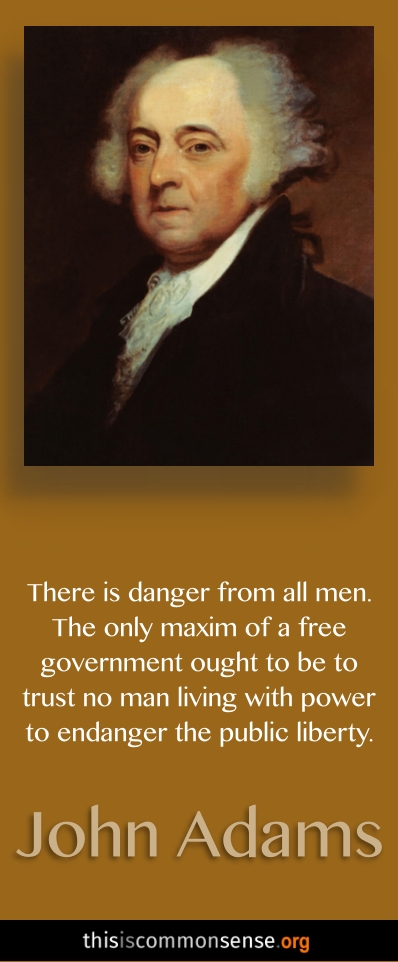
There is danger from all men. The only maxim of a free government ought to be to trust no man living with power to endanger the public liberty.
John Adams, in notes for an oration at Braintree (Spring 1772).
John Adams
There is danger from all men. The only maxim of a free government ought to be to trust no man living with power to endanger the public liberty.
John Adams, in notes for an oration at Braintree (Spring 1772).
July 3 marks the 1947 birthday of Dave Barry (pictured), American columnist and author.
Five years later on the same date, Puerto Rico’s Constitution was approved by the Congress of the United States.
Yesterday, on the 23rd anniversary of Britain’s 1997 handover of Hong Kong to China, the Chinese Communist Party (CCP) imposed a draconian national security measure on the previously semi-autonomous territory.
“The law effectively ends the long-cherished freedom of speech that Hong Kong residents have had,” reported The Washington Post, “putting them under the same threat of life imprisonment if they criticize Beijing’s government, as other Chinese nationals face.”
Supersizing police powers to “intercept communications and covertly surveil people” are also part of the CCP clampdown.
“In the past,” a pro-Beijing council member explained, “Hong Kong has been too free.”
In keeping with that sentiment, protests planned for yesterday were banned.
“They still came out,” however, noted a reporter with UK’s Sky News, “even though the cost of protest had been raised significantly on the first full day of the new law.”
“We are on street,” tweeted Joshua Wong, the young pro-democracy activist, “against national security law. We shall never surrender. Now is not the time to give up.”
“China is Hong Kong, Hong Kong is China, as of today, the first of July. It’s a sad day, but that’s what it is,” offered a woman protester. “I’ll still take to the streets. I’ll still say what I think. Because it is my right as a human being.”
More than 300 protesters were arrested yesterday.
Wong called on the “international community” to “continue to speak up for Hong Kong” and help protect its “last bit of freedom.”
This is Common Sense. I’m Paul Jacob.
See all recent commentary
(simplified and organized)
See recent popular posts
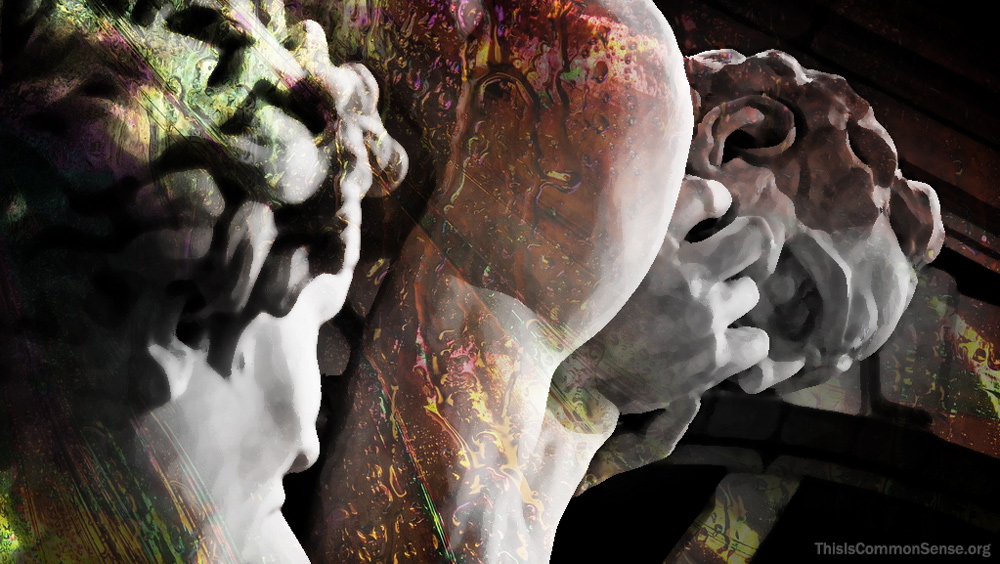
Remota itaque iustitia quid sunt regna nisi magna latrocinia? quia et latrocinia quid sunt nisi parua regna? Manus et ipsa hominum est, imperio principis regitur, pacto societatis astringitur, placiti lege praeda diuiditur. Hoc malum si in tantum perditorum hominum accessibus crescit, ut et loca teneat sedes constituat, ciuitates occupet populos subiuget, euidentius regni nomen adsumit, quod ei iam in manifesto confert non dempta cupiditas, sed addita inpunitas. Eleganter enim et ueraciter Alexandro illi Magno quidam comprehensus pirata respondit. Nam cum idem rex hominem interrogaret, quid ei uideretur, ut mare haberet infestum, ille libera contumacia: Quod tibi, inquit, ut orbem terrarum; sed quia ego exiguo nauigio facio, latro uocor; quia tu magna classe, imperator.
Augustine of Hippo, De Civitate Dei (c. 400 AD), IV, 4
Justice being taken away, then, what are kingdoms but great robberies? For what are robberies themselves, but little kingdoms? The band itself is made up of men; it is ruled by the authority of a prince, it is knit together by the pact of the confederacy; the booty is divided by the law agreed on. If, by the admittance of abandoned men, this evil increases to such a degree that it holds places, fixes abodes, takes possession of cities, and subdues peoples, it assumes the more plainly the name of a kingdom, because the reality is now manifestly conferred on it, not by the removal of covetousness, but by the addition of impunity. Indeed, that was an apt and true reply which was given to Alexander the Great by a pirate who had been seized. For when that king had asked the man what he meant by keeping hostile possession of the sea, he answered with bold pride, “What thou meanest by seizing the whole earth; but because I do it with a petty ship, I am called a robber, whilst thou who dost it with a great fleet art styled emperor.” St. Augustine, The City of God (c.400), IV, 4, Rev. George Wilson and Rev. J. J. Smith, translators.
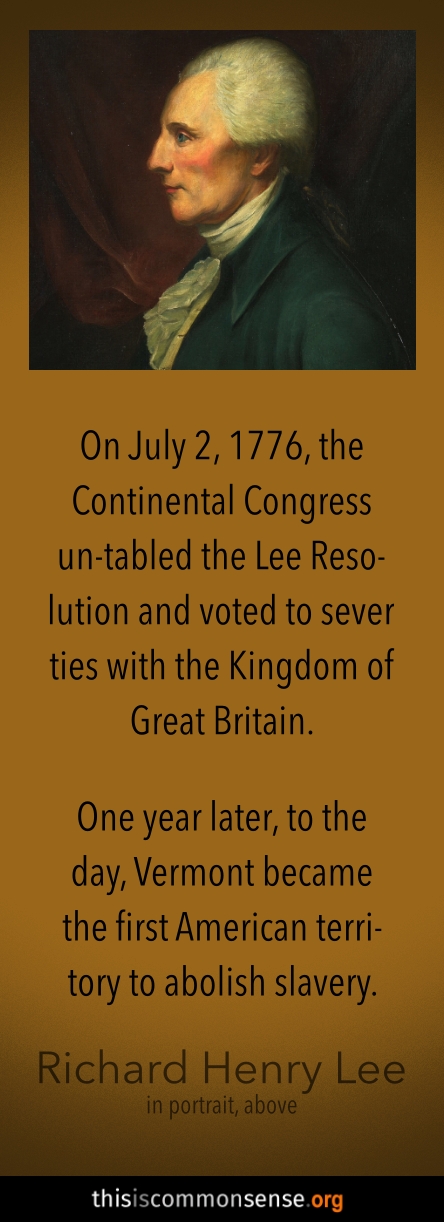
On July 2, 1776, the Continental Congress un-tabled the Lee Resolution and voted to sever ties with the Kingdom of Great Britain.
One year later, to the day, Vermont became the first American territory to abolish slavery.
On Monday, we considered how to get better representation in Congress for the 700,000 folks residing in our nation’s capital city, Washington, D.C.
Today, let’s tackle how the rest of us get any semblance of representation. We are sliced up into 435 congressional districts, each comprised of roughly 700,000 people electing a “representative” supposedly doing our business in Washington.
Are they doing our business?
The nearly universal and long-standing public disapproval of Congress answers that question.*
As the framers of the Constitution saw it, Congress would be the first and most powerful branch of government, as it would be closest to the people. The original idea was to create in members of Congress a “fidelity to their constituents,” James Madison wrote in Federalist No. 57, which “would be found very insufficient without the restraint of frequent elections. Hence . . . the House of Representatives is so constituted as to support in the members an habitual recollection of their dependence on the people.”
Madison goes on to say that congresspeople “will be compelled to anticipate the moment when their power is to cease.”
Yet well-funded congressional incumbents sporting 90 percent-plus re-election rates cycle after cycle, decade after decade — serving 20 and 30 and 50-plus years — cannot plausibly feel either compelled or dependent.
Looming large over the problem? Huge population districts.
The more voters in a district, the more expansive and expensive campaigns must be . . . and the bigger the need for help from special interests . . . and the more powerful those groups’ influence.
Conversely, the smaller a district is, the more influence constituents individually have on their representative.
It may seem paradoxical, but it isn’t: citizens will wield more power when there are more representatives in Congress.
This is Common Sense. I’m Paul Jacob.
* In April, after sending stimulus checks to the entire country, Congress did more than double its approval rating, though it is still seen unfavorably by a lopsided two-to-one margin.
See all recent commentary
(simplified and organized)
See recent popular posts

Millions more Americans have been infected with SARS-CoV-2 than are considered “confirmed cases,”* at rates ranging from 6/1 (Connecticut, early May) to 24/1 (Missouri, late April), making the fatality rate of COVID-19 much lower than feared.
Unfortunately, we cannot trust our news sources to be forthright about this.
The “death count” had been the pandemic’s repeated headline for months, Dr. Ron Paul noted yesterday, “all of a sudden early in June the mainstream media did a George Orwell and lectured us that it is all about ‘cases’ and has always been all about ‘cases.’ Death, and especially infection fatality rate, were irrelevant.”
There’s a reason for this re-focus. Since peaking in April, deaths, you see, “had decreased by 90 percent and were continuing to crash. That was not terrifying enough so the media pretended this good news did not exist.”
And the case number increases do look ominous, despite being almost innocuous: “This is not rocket science: the more people you test the more ‘cases’ you discover.”
And that is not the only change of spin regarding the pandemic, as Jeffrey Tucker dramatized on Twitter:
“Flatten the curve!”
“What does that do?”
“Pushes infections to the future”
3 months later
“There are new infections!”
“What should we do?”
“Flatten the curve!”
At Mr. Tucker’s stomping grounds, the American Institute for Economic Research, Gregory van Kipnis wrote last month that the “most frightening aspect of the coronavirus-19 (COVID-19) epidemic in the US is that it brought about exaggeratedly heightened fear of death.”
We have something to fear from the virus and its attack upon the respiratory system, but we have more to fear from fear itself.
That staple of propagandistic media.
This is Common Sense. I’m Paul Jacob.
* A confirmed case is of a patient who has seen a doctor for symptoms of the disease and has tested positive with the diagnosis seconded and logged by scientists associated with a national health agency.
See all recent commentary
(simplified and organized)
See recent popular posts

The great virtue of a free market system is that it does not care what color people are; it does not care what their religion is; it only cares whether they can produce something you want to buy. It is the most effective system we have discovered to enable people who hate one another to deal with one another and help one another.
On June 30, 1801, Frédéric Bastiat was born. Bastiat became one of the most important French Liberal School economists, following Condilliac and Jean-Baptiste Say, best known for his books Economic Harmonies and Economic Sophisms and two monographs, “The Seen and the Unseen,” and “The Law.” He was a brilliant stylist and perceptive critic of state-managed trade. His influence on conservative, libertarian and “limited-government thought” has been vast.
The emergency number of “999” was introduced in London, June 30, 1937, the first of its kind — arguably the best innovation in better government service in modern times.
“I was born without representation, but I swear,” Washington, D.C., Mayor Muriel Bowser vowed last week, “I will not die without representation.”
She has a point: 700,000 D.C. residents lack a voting representative in Congress.
On Friday, the U.S. House passed legislation — 232 to 180 with 19 members hiding in the cloakroom and refusing to vote — to make the nation’s capital city the 51st state. Not merely garnering a U.S. Representative, but also a lifetime guarantee of two U.S. Senators.
“D.C. will never be a state,” counters President Trump, explaining that Senate Republicans would be “very, very stupid” to allow two new U.S. Senators who are nearly certain to be Democrats. Senate Majority Leader Mitch McConnell quickly announced the Senate would not take up the bill.
But Republicans are not the only ones blocking representation.
As Rep. Andy Harris (R-Md.) pointed out, Maryland had originally ceded some of the land to create the federal District of Columbia, and could now take back the residential areas. Those citizens would add their own House rep for Maryland and be represented by Maryland’s two U.S. Senators.
Democrats refuse. Why? Because it is not about representation. The city must be turned into a state so that two new Democratic U.S. Senators can be pulled out of a hat.
There is yet another path to representation. Make a bi-partisan deal to add two states. In addition to the State of Columbia (51), add the State of Jefferson (52) — comprised of 21 northern counties trying to secede from the rest of California.
Better representation. No partisan advantage. Problem solved.
If anyone were interested in that.
This is Common Sense. I’m Paul Jacob.
See all recent commentary
(simplified and organized)
See recent popular posts