The people of the United States are entitled to a sound and stable currency and to money recognized as such on every exchange and in every market of the world.
Categories
Grover Cleveland
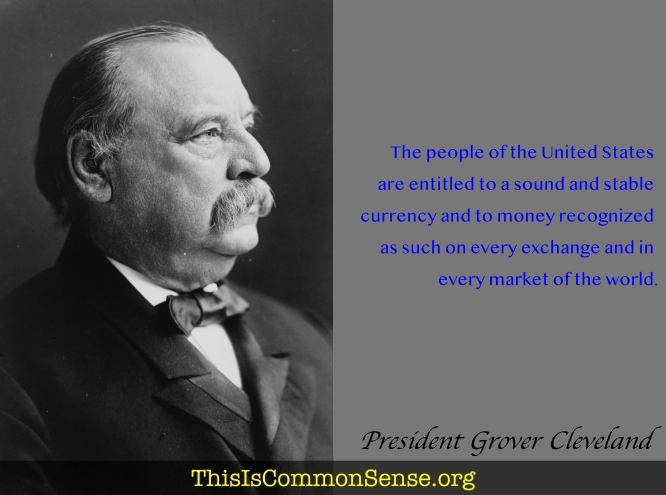
The people of the United States are entitled to a sound and stable currency and to money recognized as such on every exchange and in every market of the world.
On Feb. 15, 1898, the USS Maine, a battleship, exploded in the Cuba’s Havana harbor, killing 260 American sailors. An official U.S. Naval Court of Inquiry ruled in March 1898 that the ship was blown up by a mine, without directly blaming Spain. Nonetheless, Congress declared war and, within three months, the U.S. had decisively defeated Spanish forces. On December 12, 1898, the Treaty of Paris was signed between the U.S. and Spain, granting the United States its first overseas empire with the ceding of such former Spanish possessions as Puerto Rico, Guam, and the Philippines. In 1976, a team of American naval investigators concluded that the Maine explosion was likely caused by a fire that ignited its ammunition stocks, not by a Spanish mine or act of sabotage.
For our Townhall readers, an expansion on a theme from last week: the nature of interventionism.
Click on over, then come back here for more reading. Or, perhaps, discussion. And caution: concentration and “too big to fail” are not the only problems that are emerging in the wake of Dodd-Frank. As suggested in the Whac-A-Mole game, problems keep on coming.
One has to repeat the oft-repeated line from Santayana, here: “Those who cannot remember the past are condemned to repeat it.”
On Feb. 14, 278 A.D., Valentine, a priest in Rome during the reign of Emperor Claudius II, was executed. In order to facilitate the raising of an army for his unpopular military campaigns, the emperor outlawed all marriages and engagements. Valentine defied Claudius’s order and continued to perform marriages for young lovers in secret. Once discovered, Valentine was arrested and condemned by the Prefect of Rome to be beaten to death with clubs and to have his head cut off. The sentence was carried out on February 14. Valentine was named a saint by the Roman Catholic Church after his death.
Feb 14, 1989, at a meeting of the presidents of Nicaragua, Honduras, Guatemala, Costa Rica, and El Salvador, the Sandinista government of Nicaragua agreed to free a number of political prisoners and hold free elections within a year. In return, Honduras promised to close bases used by anti-Sandinista rebels. Within a year, the Sandinistas were defeated in Nicaragua elections.
The other day, when discussing Dodd-Frank’s ill effects on the financial system, I detected a pattern.
Politicians had identified the crash of 2007-2009 and “did something.” They rushed to reform the financial regulatory system in accord with their preconceived notions. Since then the financial system has become more concentrated, with community banks dropping off like flies.
The pols say they are defenders of the downtrodden, but they simply played into the hands of the “fat cats.”
It’s the way of ham-handed interventionism. Every fix puts us in a bigger fix, so to speak, as “unintended consequences” multiply in the negative.
 It’s like Whac-A-Mole, the arcade game: a mole pokes its head out of a hole. You hit it with a mallet. And then another mole pops up out of another hole. And you hit it. And you keep doing this, faster and faster, gaining points.
It’s sort of like economic policy. The voters see you hit something. Ding!
But more moles pop up.
In real life, it’s more like Hydra Whac-A-Mole. Bop one mole, out come two; bop another, up pop three. And it’s not just five holes on the board. It’s an infinity.
Interventionists cause more problems than they solve. Try to “solve” poverty by taking from the rich and giving to the poor? Soon, there’s not as much money in rich pockets to invest, and there are less jobs: the poor become trapped; they cease to improve themselves for work; their children lack role models; &tc., &tc., &tc.
Whac-A-Mole!
Or, as they might as well say in the halls of Capitol Hill: Hail, Hydra.
This is Common Sense. I’m Paul Jacob.
On Feb. 13, 1633, Italian philosopher, astronomer and mathematician Galileo Galilei arrived in Rome to face charges of heresy for advocating Polish astronomer Nicolaus Copernicus’s theory that the Earth revolves around the Sun. In April, Galileo pled guilty before the Roman Inquisition in exchange for a lighter sentence. Put under house arrest indefinitely by Pope Urban VIII, Galileo spent the rest of his life at his villa in Arcetri, near Florence, before dying in 1642.
On Feb. 13, 1945, the bombing of Dresden by the Royal Air Force and the United States Army Air Force began, lasting for three days. The inner city of Dresden was largely destroyed and early reports estimated 150,000 to 250,000 deaths. The German Dresden Historians’ Commission, in an official 2010 report published after five years of research, but years after the war, concluded there were up to 25,000 civilian casualties.
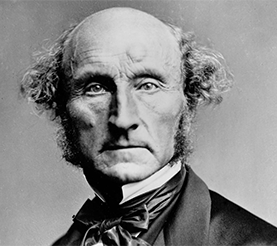
If all mankind minus one were of one opinion, and only one person were of the contrary opinion, mankind would be no more justified in silencing that one person, than he, if he had the power, would be justified in silencing mankind.
On Feb. 12, 1986, Soviet human rights activist Anatoly Scharansky was released after spending eight years in Soviet prisons and labor camps. The amnesty deal was arranged at a summit meeting between Soviet leader Mikhail Gorbachev and President Ronald Reagan. Scharansky had been imprisoned for his campaign to win the right for Russian Jews, forbidden to practice Judaism in the USSR, to emigrate.
On Feb. 12, 1909, the National Association for the Advancement of Colored People (NAACP) was founded.
On Feb. 12, 1593, approximately 3,000 Korean defenders led by General Kwon Yul successfully repelled more than 30,000 invading Japanese forces in the Siege of Haengju.
“The outrage over the Brown Bill, and it is outrage,” wrote The Argus Leader’s Jonathan Ellis, “is being voiced across the political spectrum.”
The Brown Bill, Senate Bill 166, is legislation introduced by South Dakota State Sen. Corey Brown (R-Gettysburg) to nearly double the number of signatures citizens must gather on petitions to place issues on the ballot.
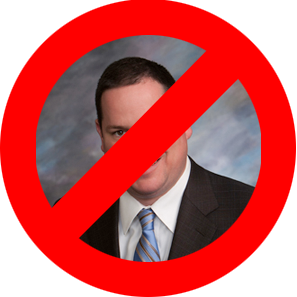 Er, I mean, it was legislation.
“I’m quite surprised that a lot of folks are willing to not engage in an intellectual conversation,” Sen. Brown said in scuttling a hearing where such a conversation might take place. He asked that his own bill be tabled and fellow legislators obliged, of course, meaning an inglorious demise for what had been “emergency” legislation.
Perhaps what surprised the good senator were so many folks lighting up the state capitol switchboard — fervently opposed to his move to make it more difficult for voters to have a say. An online Argus Leader poll showed 87 percent of South Dakotans against making it “harder for citizens to initiative measures.”
Then again, maybe public opposition to his bill didn’t surprise Sen. Brown one little bit. Legislators routinely slap emergency clauses onto legislation because that prevents voters from petitioning to refer that legislation onto the general election ballot.
South Dakota became the first state to enact statewide initiative and referendum back in 1898. The people cherish this process.
Not surprisingly, their politicians despise it.
Eternal vigilance.
This is Common Sense. I’m Paul Jacob.