Categories
First Amendment rights international affairs Internet controversy

UK Targets Wikipedia

It would be nice if Wikipedia were suing to challenge the United Kingdom’s entire Online Safety Act, not just the provision that most directly targets Wikipedia. 

Better something than nothing, however.

As Wikipedia describes it, the Act “creates a new duty of care for online platforms, requiring them to take action against illegal content, or legal content that could be ‘harmful’ to children where children are likely to access it. Platforms failing this duty would be liable to fines of up to £18 million or 10% of their annual turnover, whichever is higher.”

The Wikipedia Foundation objects to being classified as a category 1 service under the Act, a designation that imposes digital ID requirements on its contributors.

“Privacy is central to how we keep users safe and empowered,” says Phil Bradley-Schmieg, lead counsel for the Wikipedia Foundation. “Designed for social media, this is just one of several category 1 duties that could seriously harm Wikipedia.”

“Designed for social media” — in other words, do it to the other guys, not us.

“Volunteer communities working in more than 300 languages could be exposed to data breaches, stalking, vexatious lawsuits, or even imprisonment by authoritarian regimes,” Bradley-Schmieg adds.

True. But won’t those risks also be faced by those who surf in to say something on a social media platform and suddenly find themselves confronted with age-verification — ID — demands?

We need a tsunami of lawsuits against the UK’s global assault on privacy and freedom of speech.

This is Common Sense. I’m Paul Jacob.


PDF for printing

Illustration created with Krea and Firefly

See all recent commentary
(simplified and organized)
See recent popular posts
Categories
ideological culture social media

Left-Winged Wikipedia

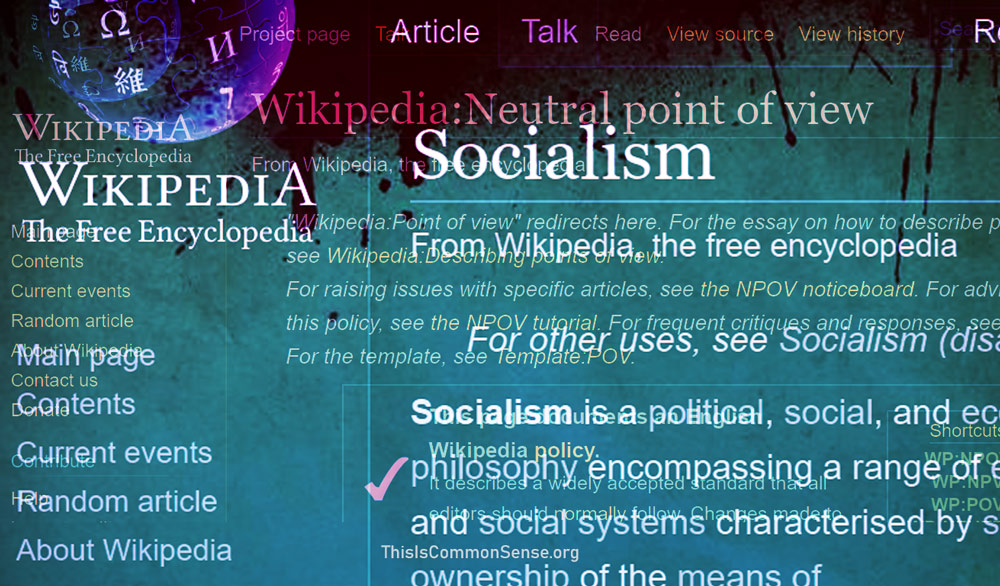
Wikipedia — the free online, once freely editable encyclopedia — started out upholding a principle about “neutrality.”

According to Wikipedia, this means that Wikipedia content “must be written from a neutral point of view (NPOV) . . . representing fairly, proportionately, and, as far as possible, without editorial bias, all the significant views that have been published by reliable sources on a topic.”

NPOV isn’t the same as objectivity, which is about getting at the truth by honest observation and logic, not primarily by balancing viewpoints about what’s true. But if good objective work by “reliable sources” has been done about a subject, Wikipedia’s neutrality standard requires that both the sludge and the good work be included. 

Somebody new to the subject has a fighting chance to be steered in the right direction.

NPOV still guides many Wikipedia articles where it is not really necessary, articles about elms and carburetors. The standard is now often ignored, however, in articles about controversial subjects. Like politics. Or socialism.

As I write, Wikipedia’s article on socialism mentions the kill list of “suspected high-ranking Communists” drawn up by Indonesia’s Suharto but not the many millions slaughtered under the commie-socialist regimes of the Soviet Union, China, Cuba, et al. Critiques of socialism are barely touched on. No NPOV here.

Such agitprop is guarded by non-neutral left-wing Wikipedia editors. Britannica is one alternative. Conservapedia was launched in 2006 as “a conservative, family-friendly Wiki encyclopedia,” and appears to be going strong. Wikipedia co-founder Larry Sanger, harshly critical of Wikipedia’s centralized propagandistic turn, is developing an alternative called Encylosphere.

It’s even mentioned in Wikipedia.

This is Common Sense. I’m Paul Jacob.


PDF for printing

See all recent commentary
(simplified and organized)
See recent popular posts