
Categories
defense & war general freedom public opinion

Fight-or-Flight Fact Check

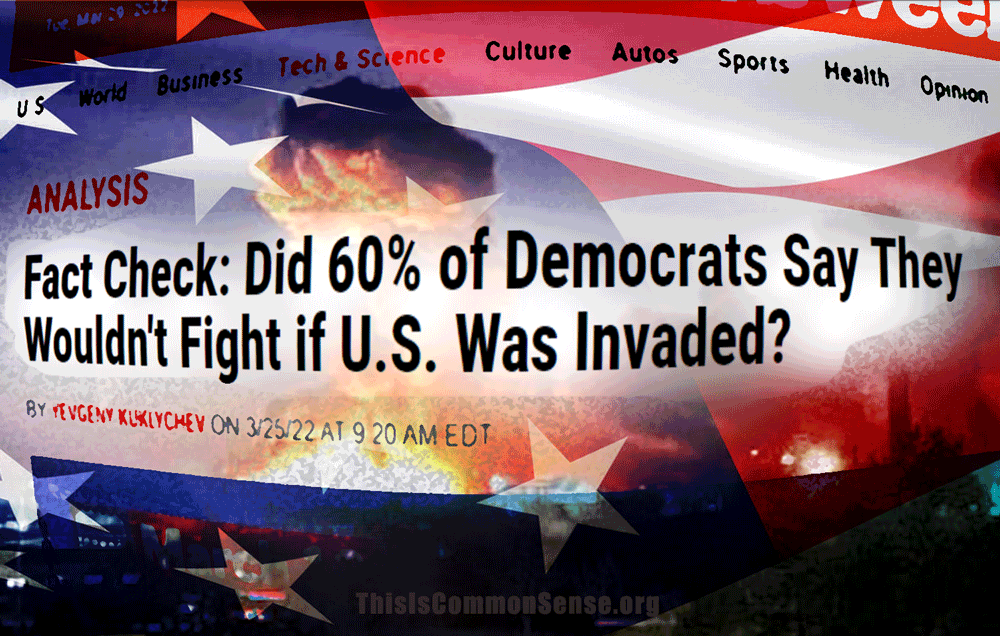
“Majority of Americans Would Stay and Fight if Russia Invaded U.S.,” read Newsweek’s headline for its report earlier this month about a Quinnipiac University poll.

Overall, “55 percent said they would stay and fight,” the article informed, “while 38 percent said they would flee the country, like the over 1.5 million people who have fled Ukraine as Russia continues its attack on Ukrainian cities and villages.”

The Quinnipiac survey asked, “If you were in the same position as Ukrainians are now, do you think that you would stay and fight or leave the country?”

“Looking at political affiliation,” Newsweek noted, “Republicans were more likely to say they would stay and fight, with 68 percent saying they would do so, as opposed to 40 percent of Democrats.”

Yet, weeks later, Newsweek delivered a fact check to readers concerning a claim made in a social media post: “60% of Democrats say they wouldn’t fight if America was invaded.”

Their fact-checker rated it false, because only 52 percent of Democrats said they would “leave,” with 8 percent not sure. Case-closed.

Yet, the fact-checker kept the case open, suggesting that perhaps folks had also misunderstood the question. “Indirect evidence” of this “can be surmised” by the response to another question: “If Russian President Vladimir Putin goes beyond Ukraine and attacks a NATO country, would you support or oppose a military response from the United States?

“In this hypothetical, 88 percent of Democrats were supportive of a military response,” the fact-checker noted, “more than both Independents (77 percent) and Republicans (82 percent).”

But hold on . . . supporting a military response by others, thousands of miles away, is not the same thing as deciding to personally fight an invading army.

It’s a fact. Check it.

This is Common Sense. I’m Paul Jacob.


PDF for printing

See all recent commentary
(simplified and organized)
See recent popular posts
Categories
general freedom international affairs media and media people

It’s Complicated

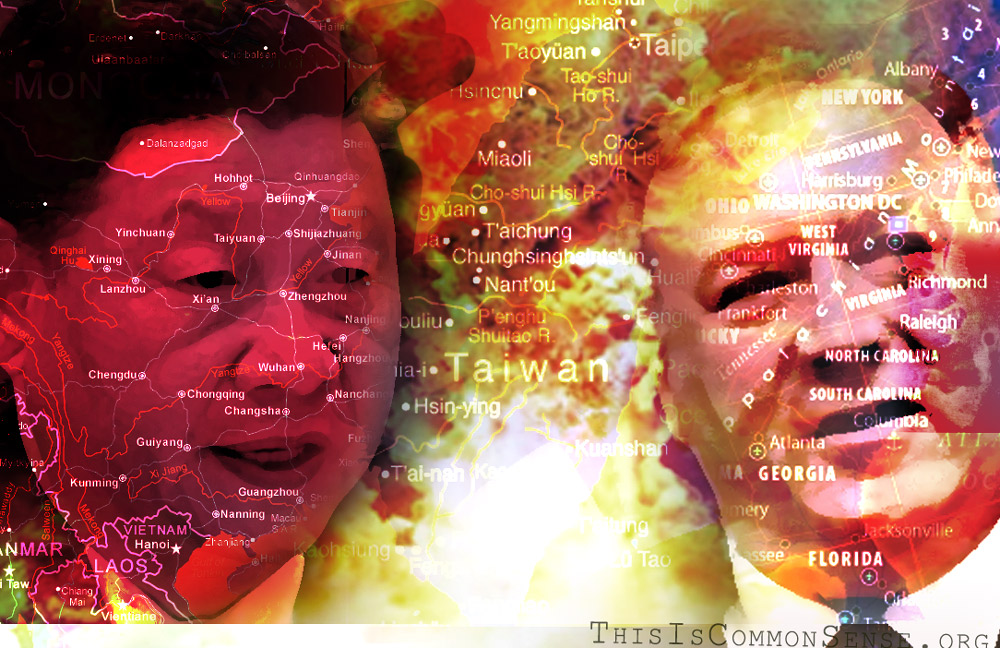
“You are living proof of this nation’s democracy,” former U.S. Secretary of State Mike Pompeo recently told his hosts in Taipei, Taiwan, accepting an award honoring his work to strengthen relations between our two countries. He was referring to a small group of protesters outside his hotel. 

“And,” Pompeo added, “you remind me of home.”

The Republican was making a simple but pertinent point. In a world of growing authoritarianism, genocide and war, Taiwan and America share very essential political values: Freedom, democracy, respect for human rights.

The visit irked China, of course, which claims Taiwan as a province and doesn’t like Americans stopping by, especially meeting with Taiwanese President Tsai Ing-wen . . . whom the Butchers of Beijing refuse to refer to as “president.” 

Totalitarians often seem especially displeased with the words people utter. Upon his arrival, Pompeo spoke of the beautiful island nation as — get this! — a “great nation,” further traumatizing the Chinese. 

In bigger news, however, Pompeo urged the United States to recognize Taiwan as a free and independent nation. It is, indeed. And I applaud the Trump Administration for opening up all manner of nation-to-nation dialogue and cooperation, and the Biden Administration for continuing that policy.

But it’s complicated.

The Chinese have long threatened to launch a bloody invasion in order to “reunite” Taiwan’s territory with the repressive People’s Republic of China (PRC) against the will of the Taiwanese. The PRC claims that any official announcement of “independence” by Taiwan or similar recognition by the U.S. is provocation for war.

Rather than fretting about the “independence” label, let’s concern ourselves with the strategic and tactical military means for Taiwan to resist the embrace the Chinazis have already clamped upon Tibet, Xinjiang, and Hong Kong.

This is Common Sense. I’m Paul Jacob.


PDF for printing

See all recent commentary
(simplified and organized)
See recent popular posts
Categories
free trade & free markets too much government

Production, It’s a Gas

Is this a news story?

“Electric-car baron Elon Musk calls for increasing U.S. oil and gas [production] to combat Russia.”

It’s news because of Russia’s invasion of Ukraine (and because gas has gotten awfully expensive) and because Musk is a major industrial figure. But a businessman calling for deregulation of an industry — is that also headline-worthy stuff?

Unfortunately, yes, given how businessmen so often want liberty for themselves along with ever-expanding restrictions for competitors (or the same restrictions for everyone as long as competitors end up getting hurt more).

I want a world in which we can make no sense of the word “but” in this opening paragraph:

“Tesla may be the world’s leading seller of plug-in electric vehicles, but CEO Elon Musk wants the U.S. oil-and-gas industry to ramp up production.” 

“But”?

Musk’s statement-by-tweet doesn’t help: “Hate to say it, but we need to increase oil & gas output immediately. Extraordinary times demand extraordinary measures.”

These words are not super-clear about what Elon Musk believes the government’s attitude should be toward markets during non-extraordinary times. War or no war, government policies safeguarding markets should not be resorted to only as emergency measures. No matter how much some may welcome sustained efforts to hobble an industry.

It’s rare that our businessmen clearly enunciate the principles of free enterprise that they are thought themselves to practice. We’re lucky if we get a tendency in that direction. 

I guess that’s better, at least, than a fervent statism that seeks to wipe out all economic freedom all the time.

This is Common Sense. I’m Paul Jacob.


PDF for printing

See all recent commentary
(simplified and organized)
See recent popular posts

Categories
international affairs Internet controversy social media

Starlink to Ukraine

Twitter’s policy of spasmodically censoring tweets and banning accounts, often without pausing to ponder what they are doing, has had at least one baleful effect in Ukraine. 

Last Wednesday, Twitter said it had “erred when it deleted about a dozen accounts that were posting information about Russian troop movements.” Obviously, the Russian invaders already know about their own troop movements. Losing this info could only hurt the people in Ukraine trying to defend themselves or run for their lives.

Innocent error? Anyway, Twitter said, in effect, “Our bad” and that it was now “proactively reinstating” affected accounts.

On the plus side, though, Ukraine official Mykhailo Federov was able to use Twitter to ask Elon Musk for help when the Russian assault knocked out the Internet in parts of the country.

“@elonmusk, while you try to colonize Mars,” Federov tweeted, “Russia try to occupy Ukraine! While your rockets successfully land from space — Russian rockets attack Ukrainian civil people! We ask you to provide Ukraine with Starlink stations. . . .”

That’s one way to get around the secretary barrier. And it worked.

“Starlink service is now active in Ukraine. More terminals en route,” was Musk’s tweet-response last Saturday.

Starlink satellites provides Internet access from space. No cables or optic fiber needed. Nothing for saboteurs to snip.

Good thinking, Mr. Federov. Thank you for the unreliably available platform, Twitter. Thank you, Elon Musk, for answering Ukraine’s cry for help and doing so as swiftly as possible.

This is Common Sense. I’m Paul Jacob.


PDF for printing

See all recent commentary
(simplified and organized)
See recent popular posts

Categories
general freedom ideological culture

The Pivotal Issue

A recent video about vaccination passports brought to mind an old parlor game: “If you could go back in time, would you kill Baby Hitler?”

Most civilized people realize the moral problems of this thought experiment. Sure, Baby Hitler grew up to be Nazi Führer Hitler, a mass-murderer worthy of assassination. But young Adolf wasn’t a monster. Yet. 

Moreover, every step on the way to becoming a monster was accompanied by situations in which civilized people could have stopped the coming horrors without murdering a child:

  • World War I was a choice (or set of choices).
  • The Versailles Treaty was a choice.
  • The Weimar Republic hyperinflation was the result of bad decisions.

More interesting than Killing Baby Hitler would be a parlor game about who could have stopped each horrific event that went into the rise of Hitler’s Third Reich. What decisions could they have made that would have changed history?

The point of these counterfactual exercises? To learn how to make better policy.

Such as in a pandemic, when governments are expanding their power over citizens with lockdowns and business shutdowns and mask and vaccine mandates. While in America many such mandates are being struck down as unconstitutional, beyond the authority of officials, in Germany and Austria vaccine passports are going into tyrannical effect.  

We need to take seriously the warning in the video mentioned at top, This Pivotal Moment. Stop vaccine mandates. Reverse the mandates in effect. Abolish internal passports. Resist this tyrannical notion of a two-tier society.

In Europe, masses of people have taken to the streets in defiance.

Open defiance is also necessary here . . . in “the land of the free.”

That’s how you stop Baby Hitler.

This is Common Sense. I’m Paul Jacob.


PDF for printing

See all recent commentary
(simplified and organized)
See recent popular posts

Categories
international affairs

Lack of Intelligence?

The quick collapse of the Afghan government and the takeover of the entire country by the vicious and barbaric Taliban was no intelligence failure, as Rep. Jackie Speier (D-Calif.) ridiculously charged Sunday.

U.S. intelligence officials had informed the Biden Administration, as well as previous ones, of the inevitable consequences.

Nor is this mess in any way a failure of the US military.

It is a political failure, through-and-through. 

While the withdrawal* could have been handled far better, the big mistake was thinking — for even a nanosecond — that we could remake Afghanistan into a pillar of freedom and democracy. 

Or anything remotely close.

The U.S. has been there for two decades, our longest war, and could have stayed another hundred years . . . and still, when we left, this would be the result. 

As this commentary warned repeatedly.**

I have come to support U.S. alliances with free peoples, within limits . . . the key limit being the American people’s degree of commitment. Such alliances would be more sustainable than our current role as world policeman, better protecting freedom from the admittedly serious danger presented by China and Russia, two exceedingly bad actors. 

We can occupy unfree peoples — for example, the Afghans — perhaps forever if we are willing to expend the blood (our sons and daughters) and treasure, but neither the U.S. nor any other country has shown the capability to remake peoples or nations. 

Liberation is beautiful. But if forced, it won’t take

This is Common Sense. I’m Paul Jacob.


* The U.S. Government bears some responsibility not to get people who work with it killed. We all seem to agree on that, even if we don’t agree on other issues regarding such interventions. So why does our government facilitate the placing of a price on many people’s heads and then cut and run without taking care to protect them? This is not a demand for perfection. But how about some quick visa paperwork and the offer of flights out of Afghanistan? In fact, fill out the stupid paperwork on the flight over here. 

** In 2012, 2013, 2014, 2015, 2016, 2017, 2018, 2019, etc.

PDF for printing

See all recent commentary
(simplified and organized)
See recent popular posts
Categories
The Draft

Slaves to “Equality”

“This will light up the right.” 

So Rollcall, the Capitol Hill newspaper, quoted an unnamed Republican aide.

At issue? Last week’s Senate Armed Services Committee vote to force young women to register for the military draft. That provision is contained in the gargantuan National Defense Authorization Act (NDAA). 

Only five senators voted against mandating draft registration for women — all Republicans. 

Two hawks, Senators Tom Cotton (R-Ark.) and Josh Hawley (R-Mo.), so opposed the change that they joined the beer-swilling Sen. Elizabeth Warren (D-Mass.) in voting against the overall NDAA.

“Our military has welcomed women for decades and are stronger for it,” Cotton explained on Friday. “But America’s daughters shouldn’t be drafted against their will.”

“It’s one thing to allow American women to choose this service, but it’s quite another to force it upon our daughters, sisters, and wives,” said Sen. Hawley, adding “compelling women to fight our wars is wrong.”

As is conscripting men.

This Wednesday, the issue will come before the House Armed Services Military Personnel Subcommittee, chaired by Rep. Jackie Speier (D-Calif.). “I actually think if we want equality in this country . . .” Speier has argued, “we should be willing to support a universal conscription.”

Speier’s empty homage to “equality” does nothing for women, of course . . . or national defense.

“It’s time to end military draft registration altogether,” tweeted Rep. Peter DeFazio (D-Ore.), “not extend it.” He joined a bipartisan group — Rep. Rodney Davis (R-Ill.) and Sens. Rand Paul (R-Ky.) and Ron Wyden (D-Ore.) — in a letter calling draft registration “expensive, wasteful, outdated, punitive, and unnecessary” and urging support for their legislation to end it. 

Finally, some common sense. 

I’m Paul Jacob.


PDF for printing

See all recent commentary
(simplified and organized)
See recent popular posts
More on the Draft and Registration:

1 — Draft the Congress and Leave My Kids Alone (December 28, 2003)

2 — Americans Gung-Ho to Draft Congress (January 4, 2004)

3 — Public Comment at the National Commission on Military, National, and Public Service (April 25, 2019)

Overview — https://thisiscommonsense.org/2019/01/01/paul-jacob-on-the-draft/

Categories
general freedom international affairs meme The Draft

Memorial Day

See all recent commentary
(simplified and organized)
See recent popular posts

Categories
international affairs

Afghan Angst

Declaring a coming end to “the forever war,” President Joe Biden announced last week that U.S. military forces will be leaving Afghanistan by September 11th* — a four-month-and-ten-day delay from the May 1 deadline that was set for troop withdrawal by the Trump Administration last year.

“Apparently, we’re to help our adversaries ring in the anniversary of the 9-11 attacks, by gift-wrapping the country and handing it right back to them,” chided Minority Leader Mitch McConnell from the Senate floor.

But wait a second . . . McConnell knows that negotiating for the enemy Taliban, the horrific human rights violator and sponsor of terrorism, to put down arms and join the government to share power has been the U.S. policy objective from the Obama Administration’s embrace in 2013 to the Trump Administration actually inking the agreement

Dealing the Taliban back into the political mix, after having gone to war to dislodge them, never made sense. But neither does an ad infinitum military occupation seem rational . . . chewing up generations of soldiers until Afghanistan miraculously metamorphoses into a sustainable democracy. Two decades of U.S. nation-building offer no serious promise that the mission could be accomplished in another decade. 

Or two. 

Or ever.

Plus, plugging the problem in Afghanistan has not worked more broadly. “The terrorist threat has changed dramatically since we went to war in Afghanistan 20 years ago,” National Security Advisor Jake Sullivan explained. “Al-Qaeda is in Yemen and Syria and Somalia. ISIS is across that border region in Iraq and Syria and in multiple countries in Africa.”

Policy futility is a bad thing. Recognizing it is good. 

This is Common Sense. I’m Paul Jacob.


PDF for printing

See all recent commentary
(simplified and organized)
See recent popular posts

Categories
government transparency

Why We Still Live

The year was 1983. One man, trusting his instincts and his knowledge of how technology can fail, averted catastrophe by not “pushing the button” to launch Soviet missiles at the United States.

It was September 26, and we celebrate it here, at Common Sense with Paul Jacob, as Petrov Day, after the day’s hero — indeed, the world’s hero — Stanislav Yevgrafovich Petrov. Though tensions were running high in the early Eighties, Petrov suspected a false alarm. Events proved him right.

Petrov is not alone on this specific heroes’ list. There’s also Vasily Alexandrovich Arkhipov, who averted disaster during the Cuban Missile Crisis. 

But the oddest list candidates might not be human.

A week ago or so, when I reported that a former head of the Israel space programs, Professor Haim Eshed, had talked, in an interview, about Israeli and American diplomatic relations with a “Galactic Federation” — yes, of extra-terrestrial aliens — I failed to mention that he had also claimed aliens had averted nuclear war.

Is he crazy? Lying?

Well, ufology lore and de-classifed military documents tell of repeated — and unnerving — UFO incursions into the operations of both Russian and American military nuclear missile installations. We could easily dismiss these claims when the U.S. military was denying any mysterious UFO reality out there — after all, people like to tell tall tales — but that’s not the case now, when the Pentagon has confessed that something very real and really weird is indeed going on in our oceans and atmosphere.* 

But the Pentagon is not admitting to treaties with alien civilizations. The “official position” of the U.S. military, despite increasing numbers of disclosures, is that the UFO phenomenon “appears to remain a mystery,” as Tim McMillan concludes his recent extensive survey of official congressional briefings for The Debrief

Still, the official, accepted reason we have not experienced massive thermonuclear war is merely game-theoretic: no winners being possible, as we learned in a popular movie a few months before Stanislav Petrov had to make his big decision, rational players wouldn’t start one.

Yet, Mutually Assured Destruction is initialized MAD, and those with limited faith in human reasonableness not unreasonably consider, at least, other explanations for our continued survival. 

So, hail Petrov; honor Arkihipov; and . . . consider . . . aliens?

This is Common Sense. I’m Paul Jacob.


 * As we have learned in the reporting, “Flying Saucers” aren’t the only form seemingly inexplicable UFOs take. The latest is “triangle.”

PDF for printing

See all recent commentary
(simplified and organized)
See recent popular posts