Categories
Accountability crime and punishment folly ideological culture moral hazard responsibility

Sticks & Stones

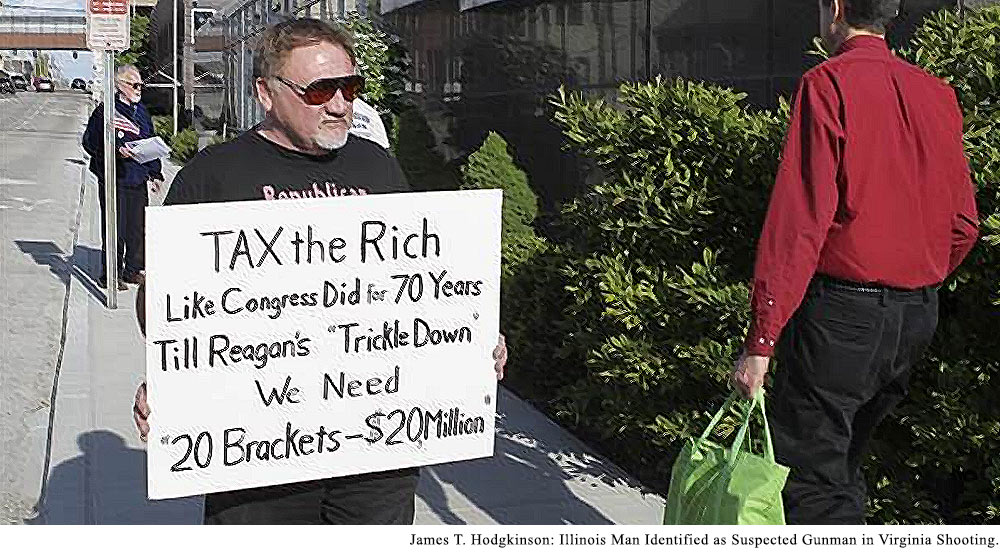
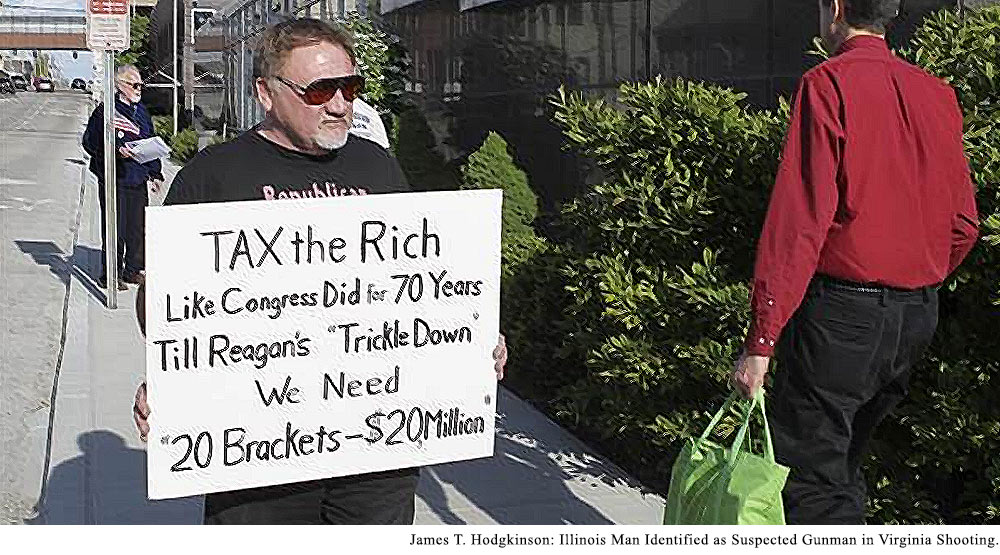
James Hodgkinson of Belleville, Illinois, came to Alexandria, Virginia, where for the last few months he lived in his van . . . undoubtedly down by the river. Yesterday, he wielded an assault rifle, attempting to massacre Republican congressmen at a park practicing for tonight’s annual charity Congressional Baseball Game.

He shot House Majority Whip Steve Scalise, who remains in critical condition; a lobbyist also in critical condition; a staffer, hit in the leg and released from the hospital; and two Capitol Police officers, who still shot and captured the shooter. Hodgkinson later died in custody.

Politically, the down-on-his-luck, 66-year-old assailant was a big fan of MSNBC’s Rachel Maddow and volunteered for Sen. Bernie Sanders’ presidential campaign. So, what does his act of violence say about Maddow? Nothing. How much is it Sen. Sanders’ fault? Zero.

The Washington Post reports that Hodgkinson was “angry with President Trump,” noting this violence came “amid harsh political rancor and a divided country.”

Michelle Malkin declared she had “warned for more than a decade about the unhinged left’s rhetoric.”

“The hatred is raw, it is undiluted, it’s just savage,” Rush Limbaugh offered. “These are the mainstream of the Democrat base, and I don’t have any doubt that they are being radicalized.”

It harkens back to then-President Bill Clinton’s success in blaming the 1995 Oklahoma City Bombing on “loud and angry voices” (read: Rush Limbaugh) who “spread hate. They leave the impression that, by their very words, that violence is acceptable.”

Sure, we should hold speakers accountable for dehumanizing verbal attacks on their opponents. But not for acts of violence these speakers do not commit, nor condone.

Condemn the violence. Stop using it to smear your opponents.

This is Common Sense. I’m Paul Jacob.

Printable PDF


Categories
Accountability education and schooling general freedom ideological culture national politics & policies

Parents in Context

Consider the intersection of freedom and decontextualized fragments.

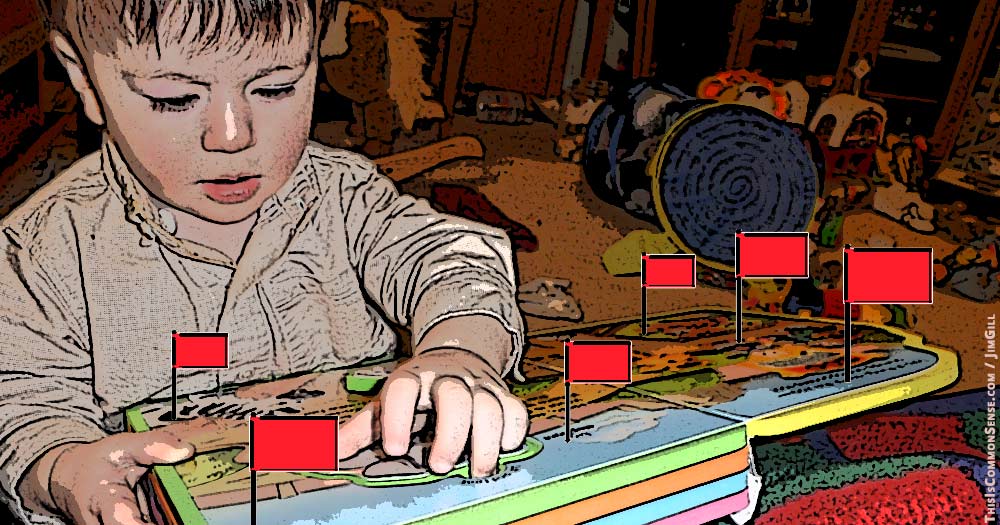
The specific “decontextualized fragments” in question appear in great and not-so-great works of literature, assigned in public schools for young adults to read: a graphic rape scene in Toni Morrison’s Beloved; racial slurs in Huckleberry Finn; sex, violence.

“Virginia regulators are drafting rules that would require school districts to red-flag objectionable teaching material and make it easier for parents to control what books their children see in the classroom,” reports the Washington Post.

Those regulations won’t be finalized for a year or more (because government bureaucracies are painfully slow). Yet an “earlier version of the language released on a state website drew hundreds of comments from the public,” the Post informs.

“Most parents were supportive of the change. . . .”

Teachers? Against.

Stafford County Public Schools literacy coordinator Sarah Crain worries about literature being wrongly labeled “sexually explicit.” To “reduce a book or a work down to something that is a mere decontextualized fragment of the work,” she argues, “actually impedes the ability for teachers and parents to have informed conversations.”

What about freedom?

Well, public schools aren’t primarily about freedom.

Teachers have a job to do; students follow instruction.

And it is pretty easy to see one reason for the opposition by “the professionals”: the new rules would entail more work.

Nonetheless, parents and their kids deserve as much choice as can be provided. And in every context.

Here, freedom means acknowledging the right of parents to decide. Not experts. Parents.

This is Common Sense. I’m Paul Jacob.

Printable PDF

education, parents, children, Virginia, freedom


Original photo credit: wealhtheow on Flickr


Categories
education and schooling national politics & policies responsibility

Half a Sawbuck for Civilization

Just gave a fiver to a sixth grader . . . to help the public schools.

He was going door to door, which I’ve had occasion to do, and he was nice and well-spoken. Glad to give.

And it was only five bucks — that’s what I had in my pocket. It was like buying a Starbucks venti-something.

No big deal.

But something does bug me.

What is it?

The fact that the school system sends kids around to pull on our heart-strings but when our homeschooled kids could benefit by taking part in sports or band or debate or other extra-curricular activities through the public schools, without enrolling as a full-time student, they’re told to “go play in traffic.”*

So, why did I give that screwed-up system anything that wasn’t taken at gunpoint?

For starters, a young person stood before me, not the governor or the school superintendent. I don’t want to approach their level of cold-heartedness.

Next, there is something I really do want: Community. My desire, as a committed individualist, is to grow and strengthen and be part of the community of folks who live close to my family.

There’s no contradiction here.

I want civilization. And five dollars is an awfully cheap price for a smidgen of it. I want that kid to receive a good education. I want our community to succeed, including him and all the other kids.

Why call yourself an individualist or libertarian and not work for voluntary community? Free individuals form better, more sustainable communities than those built on state power or authoritarianism.

Hey, maybe I should go door to door.

This is Common Sense. I’m Paul Jacob.
 

* For two straight legislative sessions, Gov. Terry McAuliffe has vetoed legislation allowing homeschoolers to participate in sports, band, debate and other such activities. On a county by county basis, Virginia public schools are free to permit or to block homeschoolers from taking academic classes and joining after-school clubs — with roughly half of counties deciding to accommodate homeschoolers.


Printable PDF

schools, schooling, home, education, civilization, illustration


Original (cc) photo by Swaminathan on Flickr


Categories
too much government

Diverse Drivers’ Data

The idea of a “Surveillance State,” where government watches and records our every move, is usually billed to us as a matter of protection.

That’s sure a good way to sell us tyranny.

True, we do sometimes receive protection from governments that keep tabs on us about what we do, where we go, who we see. But if this sort of thing doesn’t also give you the creeps, I am at a loss.

I hear from friends in the Libertarian Party of Virginia, where I live, that bills pending in the State House and Senate would limit the length of time state and local governments may keep data on citizens’ driving habits.

Right now, governments collect a lot of information via license-plate reading cameras, and there are no legal limits on how long the information can be kept; some jurisdictions do keep data indefinitely. AAA Mid-Atlantic, an automobile service organization, is backing the legislation, pushing for a legal limit. “AAA believes that the retention period should be limited to the time necessary to compare it with local and national crime data banks,” a press release states, adding that the limit should reflect the rather short amount of time required, which is “a matter of hours or days, not months or years.”

We don’t advocate limits on this kind of data to protect criminals, but to reduce temptation to those folks in government who might abuse their positions for personal gain or bureaucratic mission creep.

Governments tracking and recording our every move just isn’t safe — even if our safety is the professed goal.

This is Common Sense. I’m Paul Jacob.

Categories
insider corruption

Virginia’s New Boss

Virginia’s previous governor, Bob McDonnell, faces a federal prosecution, along with his wife, Maureen, for “illegally accepting gifts, luxury vacations and large loans from a wealthy Richmond area businessman who sought special treatment from state government.”

With that high-profile scandal unfolding, legislators came to the capitol this year ready to enact reforms. One bill sought to prevent corruption by banning campaign contributions and/or gifts to the governor of more than $50 from any entity seeking a grant from the Governor’s Opportunity Fund.

That fund, with a current balance of $35 million, is designed to promote economic growth by allowing the governor to personally dole out cash or loans to assist various commercial enterprises that “maintain or create jobs in the state.”

Not hard to imagine how such a fund could be used, in reality, to reward only those who reward the governor . . . or his campaign. And so, even in a session marked by major partisan warfare including an ongoing budget stalemate, every legislator in the state House and Senate, whether Republican or Democrat, came together to vote in the affirmative for the bill.

Unanimous.

Last week, Terry McAuliffe, the new governor and old Clinton confidante, vetoed this reform. Before killing it, McAuliffe offered a lame excuse about keeping the applicants to his slush fund confidential. So much for his big talk about transparency.

With the legislation now dead, let’s try an even better idea. End the Governor’s Opportunity Fund. Zero it out. No governor should have a slush fund to shower millions of dollars on crony companies. No such program should exist.

This is Common Sense. I’m Paul Jacob.

Categories
political challengers

Where’s Sarvis?

Republican Ken Cuccinelli and Democrat Terry McAuliffe each closed their arguments in last night’s Virginia gubernatorial debate with passion, gusto, and verve — but not for why voters should trust them to run state government for the next four years. Instead, each made the case why voters ought not trust the other guy.

“My opponent talks a lot about experience,” McAuliffe argued, “but his experience has been in dividing people by pursuing his own ideological agenda, introducing legislation that would outlaw most common forms of birth control. . . . Frankly, I think Virginia women have had just about enough of Ken Cuccinelli’s experience.”

Cuccinelli attacked his opponent’s business record, charging that McAuliffe had “driven jobs from the state,” adding, “Terry sold more visas to Chinese citizens as part of GreenTech than his failed company has sold [electric] cars. Terry will fight for Terry. . . .”

Those same messages are carpet-bombing across the commonwealth in 30-second spots. We’re told by each man that the other is unfit.

Both gents are on to something. And, not surprisingly, polls show more voters have a negative view of Cuccinelli than positive, with McAuliffe faring only slightly better.

Too bad Virginians are stuck with just these two unpopular choices!

Wait . . . what? Who? Well, yes, there is the Libertarian Party nominee Robert Sarvis.

I guess he didn’t have the 5 or 10 percent in the polls to be invited, but with voters so disgusted with the Elephant and Donkey Party nominees, why not give him a chance?

Wait, the latest Washington Post/Abt SRBI poll shows Sarvis with 10 percent support. Oh, maybe that’s why he wasn’t invited.

This is Common Sense. I’m Paul Jacob.

Categories
crime and punishment education and schooling ideological culture

Liars, Fools, Educators

There’s something very, very wrong with today’s public school culture.

I wrote that as a start for today’s excursion into the land wherein common sense has utterly fled . . . but without knowing whether I would dissect a Washington Times story about two Virginia Beach, Virginia, students suspended (perhaps for the entire year) for playing with an air soft gun in their own yards, or the Washington Post’s excellent coverage of a new test-score scandal.

The first story reflects both today’s crazed anti-gun culture and a sort of imperialism: educators seem to think that it’s their jurisdiction to judge how children behave at home, especially when it comes to toy guns, which they apparently deem inherently bad, etc., etc. Yes, Virginia educators insist on enforcing pacifism and disarmament as a settled matter, as if the Second Amendment didn’t exist.

Now, schools should not allow violence on school grounds or buses. And, if the kids who were playing with the toy guns were pointing and shooting with dangerous irresponsibility, and against city code, then maybe the school has a leg to stand on.

Nearby in Washington, D.C., in our second story, public school administrators have rigged the testing system to yield better math scores. Indeed, the district had boasted of a four-point gain. Then it was discovered that scores had actually declined, in part because of new rigorous tests. But instead of “biting the bullet” and taking a “temporary” hit, educators fiddled with the statistics and came up with phony bragging points.

Liars to the north of me; fools at another point in the compass, entirely.

This is Common Sense. I’m Paul Jacob.

Categories
property rights too much government

Pitchfork Rebellion

What if they threw a rebellion and everybody came?

Anything you do these days can get you in trouble with regulators, from serving water without the proper liquor license to (I kid you not) throwing a birthday party without the proper happiness-making license.

But being harassed for doing peaceful things with your own property isn’t about whether you’ve obtained the many licenses “required” to do them. It’s about whether you’ve caught the attention of some vindictive and cortex-deficient bureaucrat.

When Martha Boneta hosted a birthday party for a friend’s daughter on her Virginia farm, she forgot to get a birthday-party-for-little-girls permit; the county noticed; the county threatened fines. Zoning Adminstrator Kimberly Johnson went further, though, ordering Boneta to stop selling produce grown on her land.

Boneta finds it “rather odd” she’s being singled out, when so many Virginia farmers do likewise. Actually, she’d obtained a permit to sell produce, but since then the county’s regulations have grown more complicated. (Bureaucrats can grow things too!)

Supportive local farmers conducted a “pitchfork protest” outside the Board of Zoning Appeals. Alas, Boneta lost her appeal, but will pursue the case with the farmers’ help and that of the Institute for Justice. The travesty has also caught the attention of a local Tea Party group. Indeed, several of the “pitchfork farmers” are also members of the Tea Party chapter in Northern Virginia.

I didn’t obtain a permit to wish them all Good Luck, but I wish it anyway.

This is Common Sense. I’m Paul Jacob.

Categories
ballot access

Easy to Be Hard

Politicians often try to pass laws making it more difficult for citizens to petition issues onto the ballot, claiming that it’s too easy to gather all those signatures.

Speaking of easy, that’s awfully easy for politicians to say.

If they’re major party candidates, Democrats or Republicans, they usually don’t have to come up with any voter signatures at all to place themselves on the ballot. Even in the few states that require major party candidates to gather signatures, the numbers are nominal, a few hundred at most.

Funny, we certainly don’t hear former House Speaker Newt Gingrich or Texas Governor Rick Perry prattling on about how simple and carefree it is to gather thousands of signatures. That’s because presidential ballot access is sometimes much more difficult and both candidates just failed to collect the required 10,000 valid signatures to gain a spot on the Virginia ballot as Republican presidential candidates.

To place a statutory issue on the 2010 ballot in Nevada, a state sporting about a quarter of Virginia’s population, required 97,000 signatures. That’s ten times more than demanded of Gingrich and Perry. To place a statutory measure on the Arizona ballot requires 172,809 signatures; a constitutional amendment needs 259,213.

Governor Perry is challenging Virginia’s unconstitutional law banning non-residents from helping collect signatures. I hope he wins. But maybe the best way to prevent legislators from passing laws that make petitioning too difficult is to make those laws apply to them and how they get on the ballot.

This is Common Sense. I’m Paul Jacob.

Categories
folly

The Candy-Cane Killers

Tragic holiday horror! Diabolical kids with bad sweaters, scheming with Grinch-like dastardliness to stab at the heart of the season! Openly distributing thinly disguised blades . . .

Openly! Well, the school administrators were on the case in a jiffy.

The ten culpable kids at the Haymarket, Virginia, high school — called, by a cruel joke of destiny, Battlefield High — belonged to the secret commando unit “Christmas Sweater Club,” so-called because they wear “the craziest sweaters they can find.”

Just the kind of loosely-knit cover story you’d expect from such warped-and-woofed yarn spinners.

On the fateful morning, before classes began, club members ruthlessly tossed two-inch candy canes to arriving schoolmates. These student instigators told Channel 9 that school officials charged them with trying to “maliciously maim” their fellow students. “They said the candy canes are weapons because you can sharpen them with your mouth and stab people with them.”

By the time disciplinary notices were issued, however, the complaint had lapsed into something about “creating a disturbance.” Mom Kathleen Flannery related an administrator’s earnest appraisal: “Not everyone wants Christmas cheer.”

Lesson? Obviously, tiny candy canes in the wrong hands are dangerous, especially if converted by frenetic licking into ferocious little shivs that could turn a playground into a killing field!

Also, tiny brains in the wrong school officials’ heads can be dangerous, too . . . especially when they can’t be sharpened at all.

This is Common Sense. I’m Paul Jacob.