Categories
Twain on Congress and Liberty
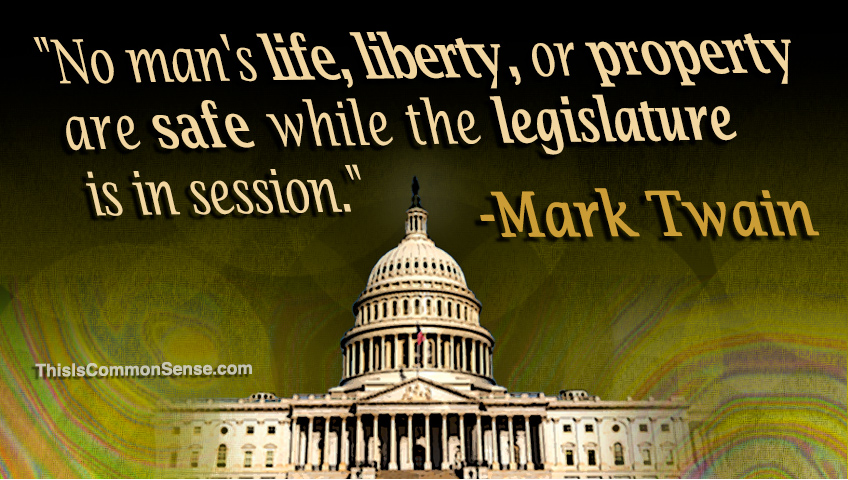
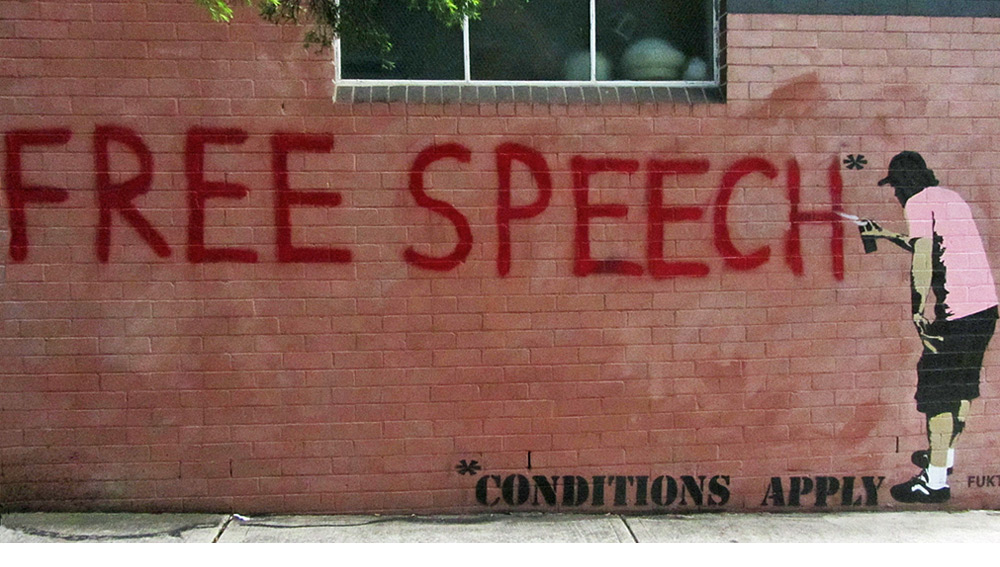
Justice Elena Kagan has a way with words. The conservative majority on the court, she said after two recent rulings, is “weaponizing the First Amendment.”
What a phrase! But what does it mean?
“Conservative groups, borrowing and building on arguments developed by liberals,” explains The New York Times, “have used the First Amendment to justify unlimited campaign spending, discrimination against gay couples and attacks on the regulation of tobacco, pharmaceuticals and guns.”
First: if “liberals” now find themselves not supporting the idea of particular freedoms, or freedom in general, are they really “liberal”?
Second: “borrowing arguments” is what we expect to happen. Logic isn’t partisan.
Third: the point of the Bill of Rights is to “weaponize” the defense of freedom.
Remember, it is freedom of speech; freedom of the press; freedom of association; freedom of exercising one’s religion. The First Amendment weaponizes their defense by disallowing Congress from legislating against them.
Now, it has long been a “problem” that these listed freedoms blend together. They all work together or don’t work at all. And each points to freedom more broadly.
Kagan wants to read freedoms narrowly — though liberals historically have, indeed, read them broadly.
She’s objecting to two recent rulings. The first prohibits states from requiring pregnancy centers to talk up abortion options to their clients. An obvious free speech issue. The second prohibits governments from backing unions in their extraction of “agency fees” from non-members. An incontrovertible issue of freedom of association.
Kagan and The New York Times apparently think that “liberalism” means defending some freedoms in some contexts, but denying freedom in others.
This is Common Sense. I’m Paul Jacob.

Illustration by Newtown grafitti

“My students are my kids . . . and I want to be able to protect them just like I would protect my own son,” says the Oho teacher, who participates in a program called FASTER Saves Lives. (“FASTER” stands for Faculty/Administrator Safety Training & Emergency Response.)
Since 2013, FASTER Saves Lives has trained teachers and other school employees to carry and shoot firearms. Although many lawmakers and school officials around the country oppose letting teachers bear arms in the classroom, a growing number sanction the practice.
It makes sense. Is there any better way to prepare for the possibility of having to defend your life and your students’ lives against an armed assailant bent on mass murder? (We can set aside the notion that aspiring murderers will scrupulously respect gun-control laws.)
People do have counterproposals. Congressional candidate Levi Tillman urges arming teachers with pepper spray. Well . . . there are problems, as blogger Tom Knighton elaborates. How do you get close enough to use the pepper spray before the killer squeezes the trigger again? What if he sees you coming?
And suppose you do spray the attacker? He won’t be immediately incapacitated. He may even be unaffected.
Some brave people have stopped a gunman by tackling him in mid-rampage. Great . . . if you have the ability and opportunity to do that.
On the other hand, suppose you’re neither strong nor nimble but can shoot, carry a gun, and shoot back — when the assailant is on the floor, bleeding: no more threat.
This is Common Sense. I’m Paul Jacob.


When Congress behaves badly, I criticize. When it works well, I applaud.
I’ve waited a long, long, long time to put my hands together in polite applause.
It happened yesterday.
The U.S. House of Representatives passed a Senate bill, largely along party lines, to give those facing a terminal illness the “right to try.” That is, the right to try experimental drugs and treatments that haven’t yet been approved by the federal Food & Drug Administration (FDA).
Of course, Congress doesn’t actually give us rights. We have always had the common law right — indeed, the human right — to freely seek a path to wellness when we are ill.
From time immemorial. Even before the FDA.
So, this legislation was, more correctly put, a way to announce that the congressionally-created FDA would stop blocking our freedom . . . provided we are dying and the government-approved medical establishment has no more licensed hope to offer.
The bill now goes to President Trump. “People who are terminally ill should not have to go from country to country to seek a cure,” he declared in his last State of the Union, “I want to give them a chance right here at home.”
Democrats overwhelmingly disagreed.
“This will provide fly-by-night physicians and clinics the opportunity to peddle false hope and ineffective drugs to desperate patients,” argued Rep. Frank Pallone (D-N.J.).
Rep. Jan Schakowsky (D-Ill.) likewise charged that the legislation “puts patients at risk by allowing the sale of snake oil.”
But of course these patients are dying. That’s already as “at risk” as it gets. Our right to live includes a right to try to live.
This is Common Sense. I’m Paul Jacob.


The First Amendment applies only against governments, but our free speech rights can be violated by nearly anyone.
These days, these rights are most notoriously and routinely violated by mobs of students . . . attending colleges and universities nearly all of which depend upon taxpayer subsidies.
David E. Bernstein, writing at the Volokh Conspiracy, in “USC Law Professor: Supporters of Campus Free Speech are ‘Preying on Vulnerable Teenagers,’” makes a number of points regarding a law professor’s published defense of nasty student reactions to a Federalist Society speaker . . . on a campus not his own.
Bernstein notes that “the article has to have the requisite references to the Emmanuel Goldsteins of the modern left, the Koch Brothers, who are mentioned four times for no discernable reason.” The reason, of course, is demonization. For a movement needs enemies.
The USC law professor argues that journalists should ignore campus speaking events that “goad” students into “tactical mistakes” by the “mean-spirited provocations” of “seasoned political operatives preying on vulnerable teenagers and inexperienced young adults.”* Bernstein shows that the “tactical mistakes” amount to peaceful and intellectual speakers being “harrassed, shouted down, and subject to or threatened with violence”; every reasonable person knows that disagreeing with the ideas someone communicates does not excuse violating that someone’s rights.
No matter how “provocative.”
Most chillingly, the speaker who incited student ire and accusations, etc., had been advised by “a security guard” before his “talk” to devise “an ‘exit strategy.’” This indicates that the American taxpayer needs an exit strategy from subsidizing anti-democratic mob activism.
And its professorial enablers.
This is Common Sense. I’m Paul Jacob.
* Don’t you find this language awfully coddling of people who should be treated as responsible for their actions, and who, by their attendance at an institution of higher learning, should be capable of listening to any point of view? I find it maddening.


Rotterdam police are gearing up for a new crime reduction scheme.
“They’ll soon begin a pilot program targeting young men in designer clothes that the police believe they couldn’t afford legally,” reports Quartz. “If it’s not clear how the person paid for the clothing, the police may confiscate it.”
A police spokesman for the Netherlands city confirmed both the test program and their confidence in their own clairvoyance, “We know they have clothes that are too expensive to wear with the money they get.”
Beyond the complete disregard for everyone’s basic rights, people worry the law will be applied discriminatorily against minorities. As one young resident warned, “Police won’t consider a white guy walking around in an expensive jacket to be a potential drug dealer. But it’ll be a different story with minorities.”
But surely the poor of all races will become suspects for the new “fashion police.”
“What is the next step if police start asking you how you got the clothes you are wearing,” Rotterdam lawyer Jaap Spigt queried DutchNews. “Will they soon be going through your home asking how you paid for your television or sofa?”
Thank goodness, I don’t live in Rotterdam.
Wait a second . . . the civil asset forfeiture policies at work right now in the U.S. permit police to take money and property — including clothing — without even charging a person with a crime. Simply taking stuff on the assertion of it being either involved in or the proceeds from criminal activity is precisely what’s happening in Rotterdam.
How long before Americans are stopped and partially stripped on the street by police who determine they are guilty of criminally overdressing sans trial?
At least, my poor fashion sense is trending up.
This is Common Sense. I’m Paul Jacob.
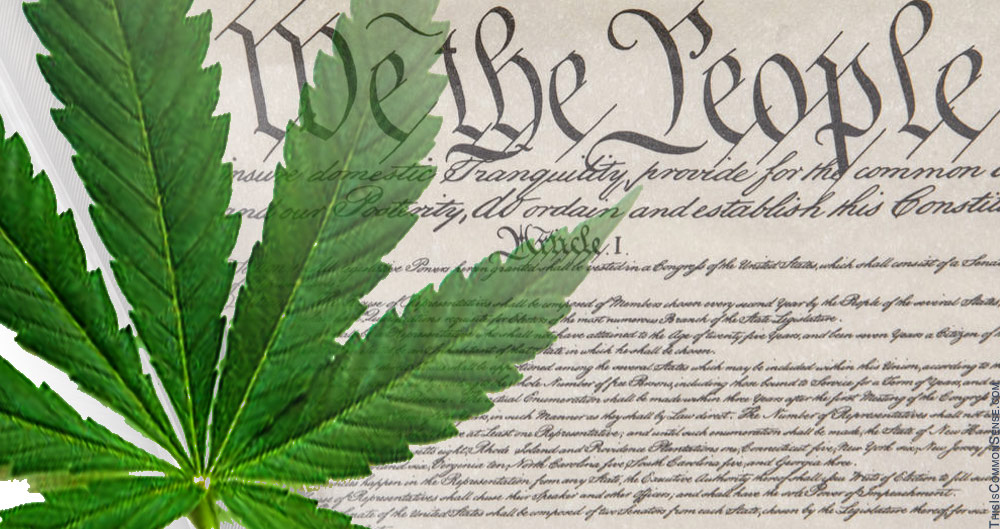
When Attorney General Jeff Sessions rescinded the Obama Administration enforcement guidelines regarding the states that have legalized (in their 29 different ways) marijuana, last week, supporters of freedom expressed some worry.
But we had to admit, one excuse for Sessions’s nixing of the mostly hands-off policy seemed to make sense on purely legal grounds. If we want to liberalize drug laws, then our Cowardly Congress should do it.
Definitely not the Executive Branch.
And yet, over at the Volokh Conspiracy, Will Baude argues that “the rule of law” does not require “renewed enforcement of the Controlled Substances Act.”
If anything, he argues, it “requires the opposite.”
Baude mostly rests his case on the Constitution’s Commerce Clause, which does not authorize regulation of intra-state trade. An issue on which the AG does possess a duty to weigh in.*
This rubs against FDR-Era constitutional theory, of course, which treats all commerce as regulate-able interstate trade. But this makes no sense. The Tenth Amendment declares that states possess powers not given to the federal government. An interpretation of the Constitution cannot be justified if it effectively nullifies other parts of the Constitution. (If all trade is “inter” state, what’s left for the states? Powers to do what? And how could there be any constraints on federal power?)
And then there is the Ninth Amendment, which states that the people retain rights not listed in the Constitution.
When citizens assert rights — such as the option to cultivate, sell, buy or ingest a common and quite hardy plant — in their states (largely through ballot initiatives), the federal government should butt out.
This is Common Sense. I’m Paul Jacob.
* “Members of the executive branch have their own obligation to interpret the Constitution,” Baude writes, “and if a federal law is unconstitutional in part then the executive branch, no less than the courts, should say so. It is the Constitution, not the Court, that is the ultimate rule of law in our system.”

“When do we say enough is enough?” asked California Senator Kamala Harris after Devon Patrick Kelley murdered 26 churchgoing Texans in cold blood, last Sunday.
“The terrifying fact is that no one is safe so long as Congress chooses to do absolutely nothing in the face of this epidemic,” argued Connecticut Senator Chris Murphy.
President Trump, on the other hand, not only pointed out that criminals will violate gun laws to acquire weapons, he speculated that had Stephen Willeford, the former National Rifle Association instructor, not come upon the scene, armed, “instead of having 26 dead, you would have had hundreds more dead.”
After previous mass shootings, Democrats pushed legislation that, even if it had been the law, would not have prevented that particular killer from obtaining the weapons. This time it’s different, since the killer should not, by current law, have been allowed to purchase the firearms he used. Kelley’s conviction for domestic violence, while serving in the Air Force, disqualified him.*
But the Air Force did not do its job, failing to report his record to the FBI. So the background check found . . . nothing.
“The Pentagon has known for at least two decades about failures to give military criminal history information to the FBI,” the Associated Press informed, “including the type of information the Air Force didn’t report about the Texas church gunman. . . .”
The Obama administration, through its command of the military, failed to execute the law designed to keep guns out of dangerous hands. And it sounds like this failure dates back to Bush and Clinton days.
Where does the buck stop?
We don’t need gun control; we need government control.
This is Common Sense. I’m Paul Jacob.
* Note also that the murderer, as Ben Shapiro recounted at National Review: “escaped from a mental institution in 2012, threatened his superior officers and attempted to smuggle weapons onto a military base to carry out those threats, cracked the skull of his infant stepson, beat his wife, abused a dog.”


More protests during the national anthem; more opposition to those protests by the Trump administration; more recriminations about the administration’s opposition to the protests. Ah, modern times.
Let’s review:
I love football, but haven’t followed the NFL for decades.
I love rights even more. And I think we certainly ought to be talking about and, more importantly, working on criminal justice reform. Let’s not lose sight of that in the controversy over the NFL protests.
Perhaps, the time for protest is ending. The time for action is now.
This is Common Sense. I’m Paul Jacob.
* Did Vice-President Mike Pence leave the Colts-49ers game as a PR stunt? Well, every move the president or the VP make is a public relations stunt. If that’s the primary attack on the VEEP’s actions, he has turned the corner and is in the clear.


It’s a sure thing — that most folks will like President Trump’s tax cuts. Though we don’t yet know all the details.
When it comes to taxes, less is more.
That is, if you’re paying taxes. It is no great mystery that people like it when their own taxes are reduced.
But what about reducing other people’s taxes?
“The core economic case for tax cuts is that they reduce the obstacles to creative and productive activities,” economist Don Boudreaux explained yesterday at the Café Hayek blog.
Cutting the corporate tax rate — which even former President Bill Clinton supported during last year’s campaign — won’t immediately appear in people’s paychecks, but can stimulate economic growth helping everyone. Recent experiences in both Britain and Canada bear this out.
Cutting taxes, of which “the rich” pay more, can also spur growth.
Yet, these ideas do not dominate popular discussions of tax cuts. Boudreaux lamented media reporting that treats any tax reduction as simply a “‘gift’ to high-income earners,” dubbing the coverage: “Biased. Benighted. Blind.”
“Suppose that freedom of the press were reported in the same way as . . . a ‘giveaway to the press’?” he asked. “Most people, of course, do not own newspapers or other media outlets.”
Boudreaux concluded, “When the press is free, the chief beneficiaries are the general public.”
Freedom — of both the press and to keep more of the fruits of our labors — helps the common man. As well as the uncommon man. A tax cut for me helps me directly, and you indirectly. And vice versa. Just as a free press is great for those in journalism as well as those of us not in journalism.
That is not blind, but eyes open; not benighted, but enlightened; not biased, but . . .
. . . Common Sense. I’m Paul Jacob.