Categories
education and schooling folly

Not Fired for Teaching

The headline states that a “USC Professor Who Used Chinese Word That Sounds Like English Slur” was “ ‘Not Dismissed Nor Suspended.’ ”

Sure. The professor was “only” removed from the course he was teaching.

Greg Patton, who teaches business communication at the University of Southern California, had been telling students about “filler words,” which for native English speakers is stuff like “uh, uh, uh.” We apparently don’t all grope for words in exactly the same way. If one grew up speaking Mandarin, one tends to say “nèi ge, nèi ge, nèi ge.”

No sooner had the example been provided than a contingent of the perpetually aggrieved lurched into action. 

Their failure to simply talk to Professor Patton, and the overkill of their response — including a letter claiming that his utterance “offended all of the Black members of our Class. . . . Our mental health has been affected. . . .” — suggests the disingenuousness of that response.

A USC dean issued an abject public apology. 

Patton also, regrettably, apologized.

Fortunately, many of Patton’s students, and others, rose to his defense, including Chinese class members who noted that Patton’s “use of ‘nei ge’ [was] an accurate rendition of common Chinese use, and an entirely appropriate . . . illustration of the use of pauses.”

If only the professor had been a mind reader and expert military strategist, he might have avoided this land mine. But training in proactive appeasement of bullies is not the solution here. 

What’s needed is a determination to stop appeasing bullies.

This is Common Sense. I’m Paul Jacob.


PDF for printing

See all recent commentary
(simplified and organized)
See recent popular posts

Categories
ideological culture partisanship

Ssshhh, Not Now

“Democrats need to keep their eye on the ball,” a Democratic Party strategist confided to The Washington Post on deep, dark background, “and not say things that are, on balance, a loser when everything is on the line.”

To what “loser” is this anonymous capital insider referring?

“D.C. Mayor Muriel E. Bowser gave [President Trump] ammunition,” informed The Post this week, by “publishing a sweeping list of historical figures whose names should be removed from public property or ‘contextualized.’”

Developed by a task force Mayor Bowser appointed this summer called DCFACES (District of Columbia Facilities and Commemorative Expressions), the report calls for “renaming 21 public schools, 12 recreational facilities, six public housing complexes and other sites.”

The Washington Monument and the Jefferson Memorial are both fingered, though they are on federal property, not city land. Still, plenty of statues, schools and other public buildings controlled by the city bear the names of such historically tainted folks as Ben Franklin, Alexander Graham Bell and Presidents James Monroe, John Tyler, Zachary Taylor and Woodrow Wilson.

“The mayor, her top advisers and the authors of the list,” The Post noted a day after the public release, “would not discuss it.”

What caught my attention, however, was the issue of timing. 

“The mayor usually has very good political instincts,” offered former D.C. Chamber of Commerce CEO Barbara Lang. “I was just surprised that this came out now, quite frankly.”

As The Post explained, Lang “believes Bowser should have waited to publish the report until after the presidential election.”

Why after? Because the issue is a “loser.” And the Dems do not want the public to know their lofty and ludicrous (and loser) goals and aspirations until after all votes are cast.

This is Common Sense. I’m Paul Jacob.


PDF for printing

See all recent commentary
(simplified and organized)
See recent popular posts

Categories
general freedom ideological culture responsibility

Racism as Health Crisis?

How can you tell when people really care? 

It is not when they mouth the right platitudes.

Or advance a carefully crafted political agenda.

What counts more? Something practical.

Michigan’s Governor Gretchen Whitmer cracked down further with COVID-related health care mitigation efforts this week. One stands out: on Wednesday she “declared racism a public health crisis, ordered implicit bias training for all state employees, and,” reports Paul Egan of the Detroit Free Press, “created a state advisory council to focus on issues affecting Black people in Michigan.”

“We have a lot of work to do to eliminate the systemic racism that Black Americans have experienced for generations,” the governor said.

Whitmer noted that black Michiganders are four times more likely to die from COVID-19 than white Michiganders — because, well, you probably do not need to read deeply into her communiqués or watch USA Today’s helpful video. The arguments are familiar.

And not completely without merit.

But notice what she did not say.

She did not advise darker-skinned people to take Vitamin D supplements and go outside and soak in more rays than they might, otherwise.

Vitamin D deficiency has been repeatedly linked as a co-factor for the development of severe COVID-19.

Race, not racism, may be what’s most relevant. Or, as the president might say, “it is what it is”: white skin more efficiently absorbs solar radiation to produce Vitamin D than higher-melaninned skin, an adaptation for northern climes where solar radiation is less intense than in the tropics.*

While this is certainly not the only factor in susceptibility to the virus’s worst effects, and it is still unproven — a word to the wise.

From the caring.

Not the politicians.

This is Common Sense. I’m Paul Jacob.


* “According to a CDC study published in 2006,” offered the Arizona Republic, “21% of non-Hispanic white people are at risk of having inadequate levels of vitamin D, versus 73% of Black people and 42% of Hispanic people.”

PDF for printing

See all recent commentary
(simplified and organized)
See recent popular posts
Categories
ideological culture initiative, referendum, and recall

Erecting Democracy

Though I opposed the 2003 U.S. invasion of Iraq, I was not at all offended when an Iraqi mob toppled the statue of Saddam Hussein. 

I liked it. That statue was a symbol of oppression.

In my mind, at least. 

I guess that’s the rub, eh? A symbol of oppression to one person might be an important piece of history to another.

Here in the good ole USA, we now have our own variant of statue roulette going on, of course. And I wonder: Can we not find a better way to decide public policy regarding statue removal than today’s status quo of leaving it up to roaming, violent mobs? Iconoclastic crowds that, we can see, have some trouble coherently identifying the enemy symbols they seek to vandalize.*

“[T]he choice in 2020 is very simple,” offers President Trump. “Do you want to bow before the left-wing mob or do you want to stand up tall and proud as Americans?”

Actually, cancel those calisthenics.

Let’s vote on the issue. 

Either lawmakers or citizens should initiate ballot measures, city by city, state by state, asking voters to choose: keep or remove said statute(s).

The advantages?

  • A more fair and democratic approach, for starters. 
  • Less public policy decision-making by mobs.
  • No one else need be critically injured from faulty statue-removal efforts.

Perhaps most important of all, a real discussion and debate can take place.

Where all sides can be heard. 

Whatever decisions get made regarding any given monument, we would at least better understand each other.

Let’s stop fighting and start voting.

This is Common Sense. I’m Paul Jacob.


* Monuments to famous abolitionists, Matthias Baldwin and John Greenleaf Whittier, as well as a memorial to fallen Union soldiers, who gave their “last full measure of devotion” to end slavery, have been defaced or destroyed. “The irony of vandalizing a monument to those who died to end slavery,” said a Friends of Matthias Baldwin Park member, “is lost on the morons who don’t know their history.” 

PDF for printing

See all recent commentary
(simplified and organized)
See recent popular posts

Categories
crime and punishment general freedom too much government

Unfriending the Police?

Defund the police?

First, take a moment to celebrate those on the American Left who have finally — miraculously — stumbled onto something they actually want the government to spend less money on. 

Second, consider policing expert and Washington Post columnist Radley Balko’s amply backed-up contention that “the evidence of racial bias in our criminal justice system” is “overwhelming.” 

Nonetheless, Mr. Balko notes that “lots of white people are wrongly accused, arrested and convicted” and “treated unfairly, beaten and unjustifiably shot and killed by police officers. White people too are harmed by policies such as mandatory minimums, asset forfeiture, and abuse of police, prosecutorial and judicial power.”

Even if police violence is “more of a problem for African Americans,” posits David Bernstein at Reason, “it’s not solely a problem for African Americans. Eliminating racism, in short, would still leave the U.S. with far more deaths from police shootings than seems reasonable.”

This is not an argument to ignore racism, but in favor of making effective changes in policy and law.

Maybe the solution to our police violence problems is not defunding departments, in a vast unfriending campaign, but to let up on some of their burdens, require them to do less. De-task.

For starters? Defund the War on Drugs! 

Drug prohibition has been a criminal justice disaster — filling our jails with victimless criminals whose problem is drug addiction. In a myriad of ways, the drug war has spawned greater police corruption and introduced more intrusive and dangerous policing.

Let’s have a frank conversation about . . . making practical changes to our criminal justice system.

This is Common Sense. I’m Paul Jacob.


PDF for printing

See all recent commentary
(simplified and organized)
See recent popular posts

Categories
ideological culture

Beautiful Colors, Ugly Terms

“My friends were asking for the ‘skin-color’ crayon,” explains 9-year-old Bellen Woodard. 

She realized the request was for the peach-colored crayon but, being the only black kid in her third grade Loudoun County, Virginia, classroom, she also knew her skin wasn’t peach-colored. As her mother told Washington Post columnist Theresa Vargas, it made her daughter feel “uncomfortable.”

Bellen used the term “dis-included.”

She and her mom discussed what to do and her mom proposed, “Just hand them the brown one instead.” But Bellen had an even better idea: “I think I just want to ask them what color they want because it could be any number of beautiful colors.”

Indeed.

“So that’s what she did,” wrote Vargas. “She started saying those words. She then heard her teacher say them, too. And soon, her entire class was talking about skin color in a way that went beyond peach.”

The third-grader also designed a kit called “More Than Peach” featuring not just peach-colored crayons but also colors such as “apricot,” “burnt sienna” and “mahogany.” In no time, her kits have been requested across the nation and now the Virginia Museum of History & Culture is adding one to their collection.

People come in so many wonderful hues and colors. It is something to celebrate — just as young Bellen Woodard has done.

Which reminds me of my distaste for the term “persons of color.” 

This term of art has become ubiquitous. Unlike Bellen’s efforts offering inclusion and understanding, “persons of color” serves to separate us. Because I’m labeled “white” . . . I’m “dis-included.” 

But I’m not white (a color) or translucent; I’m peachy — perhaps tan sometimes or bright red when sunburned. 

We are all persons of color. Beautiful colors. 

This is Common Sense. I’m Paul Jacob. 


PDF for printing

crayons, flesh, race,

See all recent commentary
(simplified and organized)
See recent popular posts

Categories
ideological culture Popular

A Deplorable Christmas

Just in time for Christmas, Rolling Stone released a recorded interview of Michael Moore showing the Roger & Me filmmaker in pure Scrooge mode.

Shortly before Election Day, 2016, Moore had famously characterized a likely Trump win as middle America’s rebuke of the establishment. “They’re not racist or rednecks,” he sympathetically said of the Trump voters he had talked to, “they’re actually pretty decent people.”

But white men, he now proclaims, are “not good people.”

What’s the ‘deplorable’ ratio? 

“Two-thirds of all white guys voted for Trump,” offers Moore. “That means anytime you see three white guys walking . . . down the street towards you, two of them voted for Trump. You need to move over to the other sidewalk because these are not good people that are walking toward you. You should be afraid of them.”

Before Trump’s election, sympathy; after, antipathy.

Why the change of heart?

He provides one clue. “I refuse to participate in post-racial America,” he fumes. “I refuse to say because we elected Obama that suddenly that means everything is ok, white people have changed. White people have not changed.”

Has it always really been about racism?

Another theory, though, would look at part of Moore’s 2016 prophecy: white working class men would be worse off with Trump.

Yet employment is way up; even Ford is moving back to Michigan, as Tim Poole notes. Could Moore be bitter because his enemy seems to be succeeding where his side has failed?

A movie now in the theaters may get to the real issue. Moore, by engaging in hatred and fear-mongering, has gone over to the Dark Side of the Force.

Power corrupts; partisan powerlust corrupts partisanly.

This is Common Sense. I’m Paul Jacob.


PDF for printing

See all recent commentary
(simplified and organized)
See recent popular posts

Categories
national politics & policies

Truth Squad

“I hesitate to contribute to this freak show,” Sen. John Kennedy (R-La.) told Tucker Carlson on Tuesday night. 

I know the feeling. 

“I don’t think President Trump is a racist,” added the senator. “I don’t think his original tweet was racist.”

While I haven’t peered into the president’s soul, I didn’t see racism in his tweet, either. But I did catch a whiff of other wrongs. 

Xenophobia, for instance. 

And nastiness.

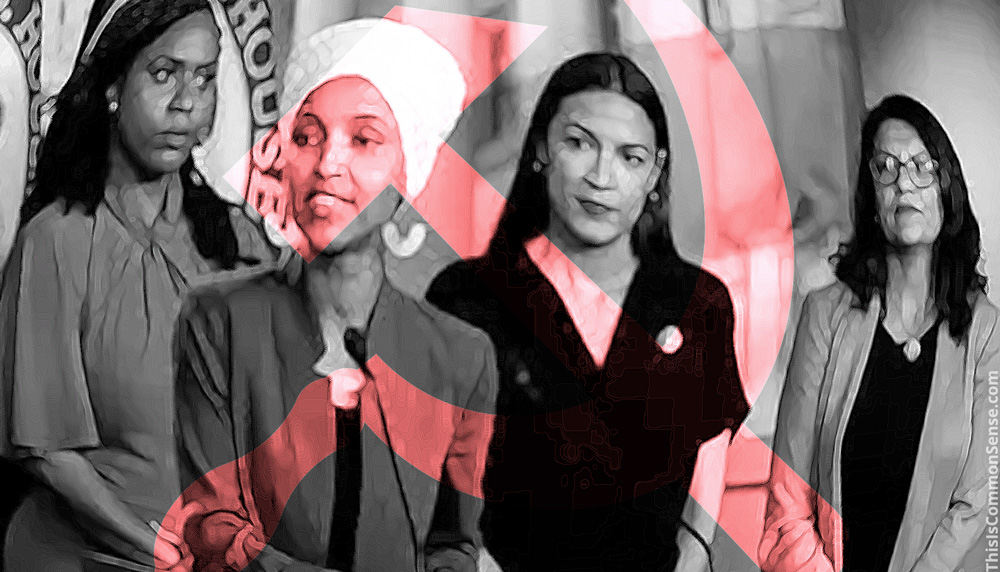
I didn’t like Mr. Trump’s attempt to paint “the Squad” — Congresswomen Alexandria Ocasio-Cortez (D-N.Y.), Ilhan Omar (D-Minn.), Ayanna Pressley (D-Mass.), and Rashida Tlaib (D-Mich.) — as somehow un-American or illegitimate by tweeting: “Why don’t they go back and help fix the totally broken and crime infested places from which they came.”

All but Rep. Omar were born here, and immigrant Omar is just as much an American citizen as was George Washington. 

“Our opposition to our socialist colleagues has absolutely nothing to do with their gender, with their religion, or with their race,” Rep. Liz Cheney (R-Wyo.) rightly said. “It has to do with the content of their policies.”*

Let’s note that only two, AOC and Tlaib, have chosen the socialist label. Reps. Omar and Pressley have not, though their policy positions seem in sync.

It may be, as NBC News reporter Jonathan Allen wrote, that Trump’s tweet was designed to “flip the script,” ending the feud between the Squad and Speaker Pelosi, because “he wants the Democratic Party stuck to its progressive fringe.” 

But the ends do not justify the means. Two wrongs don’t make a right. And our politics stinks. 

This is Common Sense. I’m Paul Jacob.


* Cheney added (and I concur): “They are wrong when they pursue policies that would steal power from the American people and give that power to the government.”

PDF for printing

the squad, Alexandria Ocasio-Cortez, lhan Omar,Ayanna Pressley,Rashida Tlaib, socialism, racism,

See all recent commentary
(simplified and organized)
See recent popular posts


Categories
ideological culture national politics & policies

Playing Cards with Democrats

“[T]he thing that really set me off this week,” former Sen. Claire McCaskill (D-Missouri) said on NBC’s Meet the Press, “was them going after Sharice Davids.”

The “them” are four freshman congresswomen — Rep. Alexandria Ocasio-Cortez (D-NY), Rep. Ilhan Omar (D-Minn.), Rep. Ayanna Pressley (D-Mass.) and Rep. Rashida Tlaib (D-Mich.) — but it was specifically Saikat Chakrabarti, Ocasio-Cortez’s chief of staff, who tweeted: “I don’t believe Sharice is a racist person, but her votes* are showing her to enable a racist system.” 

“This is the first Native American woman elected to Congress,” McCaskill exasperatedly explained regarding Rep. Davids. “She is the second openly lesbian member of Congress in history. She represents Kansas, from a district that has been held by the Republicans for cycle after cycle after cycle. . . . The notion that they’re going after her and playing the race card, what are they thinking?”

Perhaps they’re thinking that the race card has worked quite well before.

And isn’t McCaskill tossing out her own “Native American woman” card? Not to mention suggesting that Rep. Davids’ sexual orientation is yet another trump suit, making her further immune to criticism.

Which seems both profoundly racist and sexist.

This comes on top of a wargame of words between Speaker Nancy Pelosi and freshman Rep. Ocasio-Cortez, who, after being belittled by Pelosi on 60 Minutes, charged that the Speaker was “singling out . . . newly elected women of color.”

Perhaps there is another reason as well for this political fixation on race, gender, sexual orientation: the content of their . . . character?

This is Common Sense. I’m Paul Jacob.


* The issue at hand was emergency legislation to increase border funding for detainees at the infamous “concentration camps” (as AOC called them) for people caught illegally crossing the southern border of the U.S. The “them” voted against the funding.

race, card, color, racism, hate,

See all recent commentary
(simplified and organized)
See recent popular posts

Categories
education and schooling

Gaming a Newly Rigged System

Education is important. I want my young adult offspring to get into a great college or university.

Sadly, my bribery fund is empty.

Must she, then, rely only upon working hard for good grades and preparing for the Scholastic Aptitude Test (SAT)? 

No. There is a workaround: find a way to improve our family’s Adversity Score.

“The College Board plans to assign an adversity score to every student who takes the SAT,” The Wall Street Journal reports, “to try to capture their social and economic background, jumping into the debate raging over race and class in college admissions.”

This year 50 universities, including Yale, used these scores; next year, 150 will do so. Students are assessed on 15 not fully disclosed factors, things such as the level of crime and poverty in one’s high school and neighborhood, “the educational level of the parents,” and “family stability.” 

“An adversity score of 50 is average,” notes the Journal. “Anything above it designates hardship, below it privilege.”

Hmmm, how to climb (or descend) the “Overall Disadvantage Index”? What sacrifices to make?

My wife and I could divorce. Coming from a single parent household would improve our daughter’s opportunities in higher education.

We won’t sink her chances by upgrading our own educations. That’s obvious.

And crime-free homeschools certainly place kids at a distinct disadvantage in being disadvantaged. I guess we could move to a more dangerous neighborhood. 

Heck — what am I thinking?! — we can stay put and just commit crimes ourselves. Show some entrepreneurial initiative! Don’t be dependent on others, for heaven sake! Be the change we wish to see in our world.

On that one, though, I better check my exuberance with my wife . . . if our divorce hasn’t yet been finalized.

This is Common Sense. I’m Paul Jacob.


SAT, college, racism, race, fairness,

See all recent commentary
(simplified and organized)
See recent popular posts