Categories
ideological culture judiciary property rights too much government U.S. Constitution

Who’ll Oppose the Quasi-Commie?

Should we expect a four-year pitched battle?

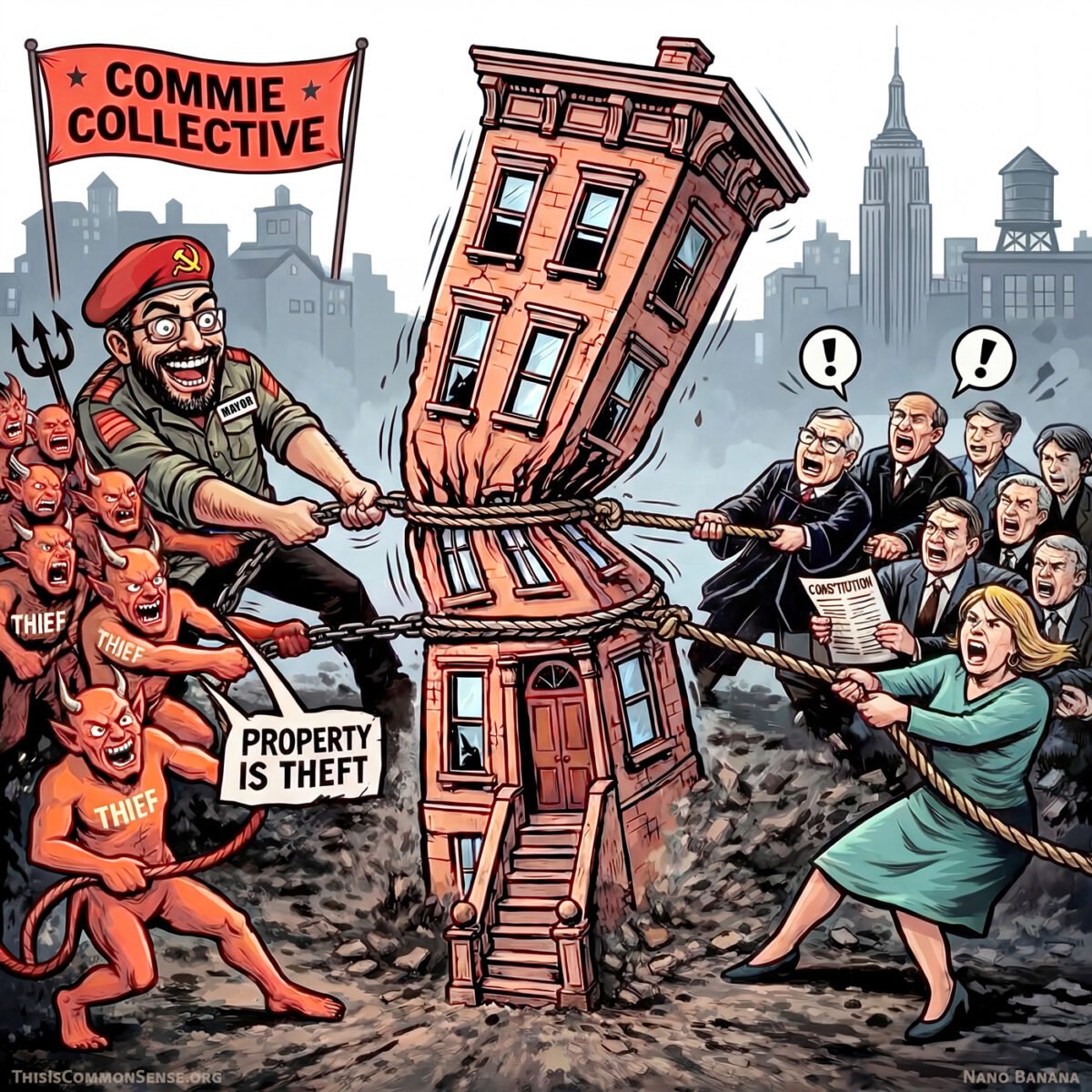
I see one brewing between the new communist mayor of New York City and those judges who respect law and the U.S. Constitution.*

Some say that Zohran Mamdani, though on record admitting his goal of seizing the means of production, is technically not a communist. Well, if allowed to fully impose all he wants on New Yorkers, maybe that would amount to going straight to a fascist model of totalitarian governance — bypassing the Maoist-Stalinist stage.

Giving him the benefit of the doubt.

But we do know that Mamdani was quick to hire such advisors as housing czarina Cea Weaver, who has lamented home ownership as a “weapon of white supremacy” and declared property as such to be something regrettably long treated as “an individualized good” that now must be treated as a “collective good.”

If you don’t own your house as an individual and have a spare room (or half a room), and somebody needs a place to live, could a Mamdani-and-Weaver-run Big Apple compel you to give space to a stranger that you don’t want around? If property becomes a “collective good” and all must cuddle in the warm bosom of the state-managed collective, the answer must be: yes.

But New Yorkers may not be quite doomed.

Not, anyway, if there are enough judges like David Jones, who recently interfered with an attempt by the Mamdani administration to interfere in the sale of many rental properties owned by Pinnacle Group.

Mamdani’s office says they’ll keep trying. 

Of course they will.

This is Common Sense. I’m Paul Jacob.


* Or the New York State Constitution, for that matter: see §7 (a), which clearly states that “Private property shall not be taken for public use without just compensation.” 

PDF for printing

Illustration created with Nano Banana

See all recent commentary
(simplified and organized)
See recent popular posts

Categories
ideological culture property rights

Hot in New York City

Zohran Mamdani was not yet the new mayor of New York City when the city council signaled that it would serve as willing accomplice in his assault on fundamental property rights.

In December, the city council passed legislation that had been hanging fire for several years, the Community Opportunity to Purchase Act (COPA), to further limit New Yorkers’ right to use and dispose of their own stuff.

COPA would give “give certain nonprofits . . . an early shot to bid on certain residential properties that go up for sale, before they hit the wider market.” The law pertains to buildings “with poor conditions or where an affordability provision is expiring.”

COPA’s advocates contend, as if this were a response to the objection about how the new law violates property rights, that it gives nonprofits an advantage in the housing market.

What happens if quite wealthy nonprofits with enough political pull make an offer that a property owner declines? Will the property owner have the right to say “I pass” and then make the property available for anybody to bid on?

If COPA is not dead on arrival, it will depress market prices as the city strongarms owners into making deals at lower-than-market prices. And I doubt that a Mamdani administration will simply playact at eroding and destroying property rights.

Mayor Mamdani took office yesterday, on January 1, 2026, dedicated to the idea of replacing “the frigidity of rugged individualism with the warmth of collectivism.” It doesn’t portend to be a very good year for New Yorkers opposed to the heat of the looters’ madness.

This is Common Sense. I’m Paul Jacob.


PDF for printing

Illustration created with Nano Banana

See all recent commentary
(simplified and organized)
See recent popular posts

Categories
litigation property rights

Miami’s Property-Grabbing Vice

All Chad Tausch wanted to do was add a few rooms to his Miami home.

In many cities, homeowners need a permit to make such additions. But although the city had no problem with his proposed construction, it required something more than a permit fee: half of Tausch’s front yard — without even offering to pay for it. No land surrender, no permit.

The city has been making the same demand of other homeowners who need alteration permits. 

The city has a plan, a goal: Pile up land that the city might one day use to widen roads. The Institute for Justice (IJ) has identified “more than 1,000 homes threatened by this scheme across 66 streets.”

“The right to prevent the government from unlawfully taking your property is a right recognized from the very start of this nation,” says Suranjan Sen, an attorney with IJ. “The city of Miami cannot simply decide to take your property away because it wants it.”

Well, thus far, the city has thus simply decided. It’s been operating the scheme for years. The question is whether it’s constitutionally entitled to do so; obviously, no.

Tausch didn’t submit to the extortion. Instead, he turned to IJ for help in challenging Miami’s practice in court. As a result of the litigation, the city has waived the land-for-permit requirement in his case.

Victory! But what about all those other homes on the 66 streets, which remain in jeopardy?

Well, the Institute for Justice is continuing the lawsuit, seeking to liberate all Miami homeowners from the city’s sneaky scheme.

This is Common Sense. I’m Paul Jacob.


PDF for printing

Illustration created with Nano Banana and Firefly

See all recent commentary
(simplified and organized)
See recent popular posts

Categories
Thought

James Madison

This term in its particular application means “that dominion which one man claims and exercises over the external things of the world, in exclusion of every other individual.”

In its larger and juster meaning, it embraces every thing to which a man may attach a value and have a right; and which leaves to every one else the like advantage.

In the former sense, a man’s land, or merchandise, or money is called his property.

In the latter sense, a man has a property in his opinions and the free communication of them.

He has a property of peculiar value in his religious opinions, and in the profession and practice dictated by them.

He has a property very dear to him in the safety and liberty of his person.

He has an equal property in the free use of his faculties and free choice of the objects on which to employ them.

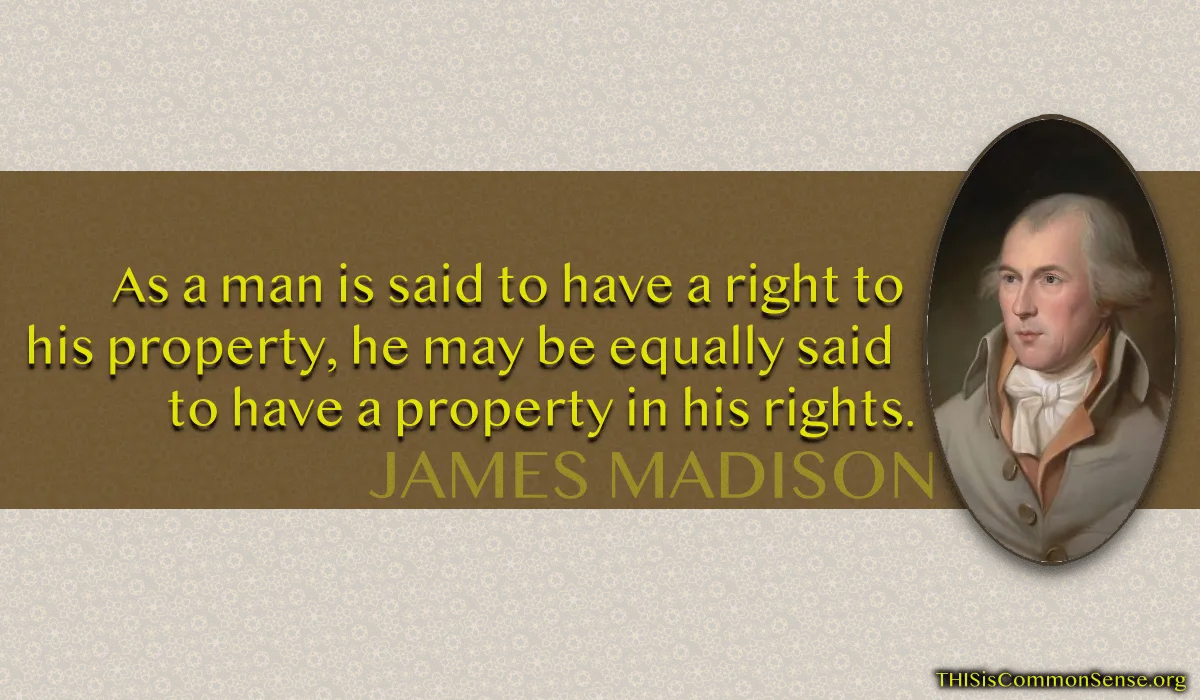
In a word, as a man is said to have a right to his property, he may be equally said to have a property in his rights.

Where an excess of power prevails, property of no sort is duly respected. No man is safe in his opinions, his person, his faculties, or his possessions.

Where there is an excess of liberty, the effect is the same, though from an opposite cause.

Government is instituted to protect property of every sort; as well that which lies in the various rights of individuals, as that which the term particularly expresses. This being the end of government, that alone is a just government, which impartially secures to every man, whatever is his own.

According to this standard of merit, the praise of affording a just securing to property, should be sparingly bestowed on a government which, however scrupulously guarding the possessions of individuals, does not protect them in the enjoyment and communication of their opinions, in which they have an equal, and in the estimation of some, a more valuable property.

More sparingly should this praise be allowed to a government, where a man’s religious rights are violated by penalties, or fettered by tests, or taxed by a hierarchy. Conscience is the most sacred of all property; other property depending in part on positive law, the exercise of that, being a natural and unalienable right. To guard a man’s house as his castle, to pay public and enforce private debts with the most exact faith, can give no title to invade a man’s conscience which is more sacred than his castle, or to withhold from it that debt of protection, for which the public faith is pledged, by the very nature and original conditions of the social pact.

That is not a just government, nor is property secure under it, where the property which a man has in his personal safety and personal liberty, is violated by arbitrary seizures of one class of citizens for the service of the rest. A magistrate issuing his warrants to a press gang, would be in his proper functions in Turkey or Indostan, under appellations proverbial of the most complete despotism.

That is not a just government, nor is property secure under it, where arbitrary restrictions, exemptions, and monopolies deny to part of its citizens that free use of their faculties, and free choice of their occupations, which not only constitute their property in the general sense of the word; but are the means of acquiring property strictly so called. What must be the spirit of legislation where a manufacturer of linen cloth is forbidden to bury his own child in a linen shroud, in order to favor his neighbour who manufactures woolen cloth; where the manufacturer and wearer of woolen cloth are again forbidden the economical use of buttons of that material, in favor of the manufacturer of buttons of other materials!

A just security to property is not afforded by that government, under which unequal taxes oppress one species of property and reward another species: where arbitrary taxes invade the domestic sanctuaries of the rich, and excessive taxes grind the faces of the poor; where the keenness and competitions of want are deemed an insufficient spur to labor, and taxes are again applied, by an unfeeling policy, as another spur; in violation of that sacred property, which Heaven, in decreeing man to earn his bread by the sweat of his brow, kindly reserved to him, in the small repose that could be spared from the supply of his necessities.

If there be a government then which prides itself in maintaining the inviolability of property; which provides that none shall be taken directly even for public use without indemnification to the owner, and yet directly violates the property which individuals have in their opinions, their religion, their persons, and their faculties; nay more, which indirectly violates their property, in their actual possessions, in the labor that acquires their daily subsistence, and in the hallowed remnant of time which ought to relieve their fatigues and soothe their cares, the influence will have been anticipated, that such a government is not a pattern for the United States.

If the United States mean to obtain or deserve the full praise due to wise and just governments, they will equally respect the rights of property, and the property in rights: they will rival the government that most sacredly guards the former; and by repelling its example in violating the latter, will make themselves a pattern to that and all other governments.

James Madison, “Property,” National Gazette (March 27, 1792).
Categories
property rights regulation

Death of a Cemetery

Not everything worth fighting for, or against, is being taken up President Trump and Elon Musk. There are other battles. For a moment, at least, let us direct our attentions closer to home to consider the causes taken up by, say, the Institute for Justice and Pacific Legal Foundation.

Unlike a taxpayer-funded NGO, always on the march to push big government or social decay, these organizations go to bat for people around the country who are being abused by local governments. 

As an example, take a current IJ case, Brooks Township in Michigan, which has been struggling to prevent Peter and Anna Quackenbush from opening a business: a cemetery. 

This was to be a “green” burial forest that the township board blocked because it disliked the idea.

After losing a court fight over a proposed ban of all new cemeteries as a way to block Peter and Anna’s particular cemetery, the township is now seeking to impose an ordinance dictating that “No new cemetery shall be created, installed, constructed or instituted . . . unless a written cemetery permit has first been approved and issued by the Brooks Township Board under this Ordinance.”

In other words, a de facto ban by a Board that has made clear its determination to stop Peter and Anna from opening a cemetery on their own property. If this ordinance is allowed to stand, no permit will be issued to them. It’ll be the end of the cemetery. 

Worth fighting against.

This is Common Sense. I’m Paul Jacob. 


PDF for printing

Illustration created with Krea and Firefly

See all recent commentary
(simplified and organized)
See recent popular posts

Categories
Fifth Amendment rights property rights

Forfeiture Gang Foiled

The Institute for Justice has won a major civil forfeiture case in Nevada.

A district court ruled that the Nevada Highway Patrol — which had grabbed a man’s life savings despite no legitimate suspicion of wrongdoing — can’t try to circumvent state law against arbitrary civil forfeiture (stealing) via a loophole called “federal equitable sharing.”

Even when states reform their laws to prevent police from robbing innocent people, the “equitable sharing” program often “lets them give the forfeiture to a federal agency in exchange for a kickback,” IJ reports.

Gangsterish.

The victim in the present case was Stephen Lara. In February 2021, officers pulled Lara over, detained him for more than an hour, then confiscated the $86,900 in life savings that he happened to have with him, cash that he had saved to buy a house. (He didn’t trust banks.) The Patrol never accused him of any crime. But they tried to keep his money.

With the help of Institute for Justice, Lara got it back — six months later, soon after his case received major publicity. But he and IJ continued to pursue the case, hoping to obtain a ruling that the state constitution prohibits anyone from using the federal program to evade state law.

They have now obtained such a ruling.

If it is allowed to stand, the nightmare of civil forfeiture is over for innocent Nevadans. But the state may appeal. Then it’s up to the Nevada Supreme Court to affirm the obvious.

This is Common Sense. I’m Paul Jacob.


PDF for printing

See all recent commentary
(simplified and organized)
See recent popular posts

Categories
Fifth Amendment rights property rights

Property Rights for Competitors

New Year’s Resolution for the U.S. Supreme Court: follow the Constitution.

That’s not what happened in 2005 when, by a 5-4 majority, the court determined that governments in this country could enjoy an almost unlimited power of eminent domain. The mere prospect of a more taxable commercial entity or mere desire to appease some constituency would suffice to legally justify violating the rights of innocent property owners.

This Kelo v. New London decision was applauded by abusers of power, derided by defenders of property rights. The latter leapt into action, fighting for legislation in 47 states to give property owners firmer protection.

One exception was New York State, where the town of Utica recently used the power of eminent domain against Bryan Bowers and Mike Licata.

These business partners had established a cardiology service to compete with that of CNY Cardiology group, right next door. CNY begged the city to let it turn the Bowers Development building into a parking lot. We need a parking lot there, said CNY; right where our lower-priced competitor is sitting.

The city said okay.

Enough, says Institute for Justice, which is representing Bowers Development and all of us by petitioning the U.S. Supreme Court to revisit Kelo.

IJ President Scott Bullock believes that it’s “high time for the Supreme Court itself to . . . remove this blot on its jurisprudence and restore constitutional guardrails to the use of eminent domain.”

Please resolve to give America a favorable outcome, justices.

This is Common Sense. I’m Paul Jacob.


PDF for printing

See all recent commentary
(simplified and organized)
See recent popular posts

Categories
Fifth Amendment rights property rights

Blight Fight

The government destroyed the new fixer-upper of handyman Eric Arnold, migrant from New Jersey to Georgia, even as he was diligently renovating it. The rationale of Macon-Bibb County: fighting blight. 

Blight that Arnold was already fighting himself.

What happened to Arnold was not an isolated occurrence.

Institute for Justice reports that over the last few years, “Macon-Bibb County has demolished over 800 houses that it has designated as blighted through a fast-tracked, secret code enforcement process that completely avoids court proceedings and deprives property owners of a meaningful chance to protect their property.”

Sometimes, the county doesn’t even notify owners.

Arnold discovered what was about to happen only because a neighbor alerted him that a demolition crew was installing a dumpster on Arnold’s property. He provided officials with evidence of the improvements he was making. But it was like talking to a brick wall. The county’s only answer was to speed up the process.

“To spend all that time and money and sweat and end up with nothing but a bare piece of land, it’s devastating,” he says.

IJ attorney Dylan Moore says that Macon-Bibb “should welcome skilled home renovators like Eric with open arms. Instead, county officials made demolishing Eric’s house ‘high priority’ after Eric asked for help. . . .”

IJ and Arnold are suing the county to try to spare others from the loss that he has been made to suffer without any due process whatever. It’s the county’s unconstitutional system that needs demolishing.

This is Common Sense. I’m Paul Jacob.


PDF for printing

See all recent commentary
(simplified and organized)
See recent popular posts

Categories
property rights regulation

The Developer’s Lot

If you’re going to own things, don’t own them in New York City.

This town is an epicenter of official looting, as, for instance, what the city’s Parks Department is doing to “perplexed plaintiff” Theodore Trachtenberg.

Trachtenberg owns a lot in New York, on which he hopes to build housing. Before he could proceed, he had to remove a tree from the lot.

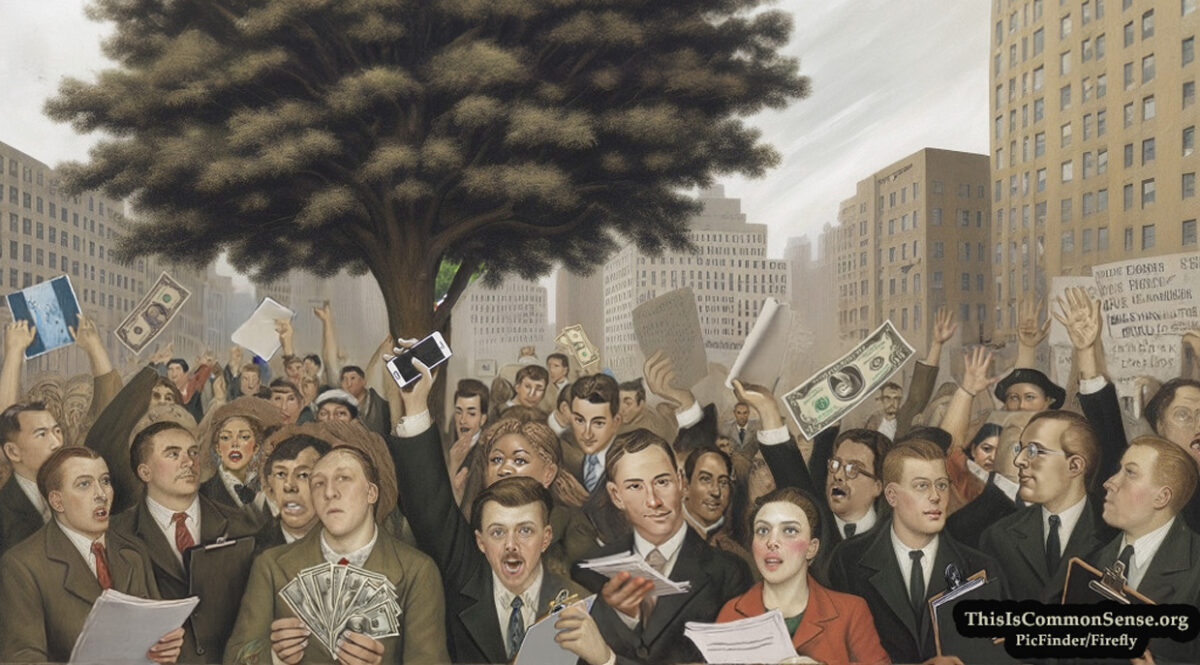
“Therefore,” the city — the Parks Department, the city, it’s all the same gang — is fining him $230,000.

Why? Well, they want money is why. If you can invest in NYC housing, this means you have money. 

If a little girl without money were to pluck a dandelion in her back yard, Parks would fine her only a quarter, maybe.

Trachtenberg is suing. The filing says: “Parks did not plant the tree, has never performed any work on, nor took care of the tree, nor has even registered it on its online resource called NYC Tree Map.”

The insanity is slightly complicated by a claim that two small trees on a nearby sidewalk were damaged by the work.

“The ownership of those two trees is not being contested, but the damage is,” says Mikhail Sheynker, Trachtenberg’s lawyer. Sheynker says he hasn’t observed the damage that the city describes.

But he has observed that in the 1990s, “the Parks Department didn’t really issue fines over trees. But they figured out this is a moneymaker.”

Trachtenberg should have developed a tract in some other burg.

This is Common Sense. I’m Paul Jacob.


PDF for printing

Illustration created with PicFinder and Firefly

See all recent commentary
(simplified and organized)
See recent popular posts

Categories
Fifth Amendment rights general freedom property rights

Government Greed Swept in Double-Header

Geraldine Tyler lived long enough to see the U.S. Supreme Court rule against those who robbed her. She is 94.

On May 25, 2023, the Court determined in a 9-0 ruling that Hennepin County, Minnesota, is not constitutionally entitled to pocket the entire sale-price value of a condo in massive excess of the property taxes that Geraldine Tyler owed on the property when the government seized it for unpaid taxes.

Including penalties and interest, Tyler had owed about $15,000. But after selling the condo for $40,000, the county government seemed to think that $25,000 was a reasonable brokerage fee.

Pacific Legal Foundation, which represented Tyler in the case, argued that the county violated the Takings Clause of the Constitution by taking private property for public use “without just compensation.”

The Court agreed, saying that exploiting the debt “to confiscate more property than was due” effected “a ‘classic taking in which the government directly appropriates private property for its own use.’ ”

The ruling also rejects the county’s argument that Tyler somehow forfeited her constitutional rights by failing to pay her property taxes.

The same day, PLF also won another huge victory in the U.S. Supreme Court when the Court ruled that the EPA does not have limitless authority to block property owners from building on their own land if the agency chooses to designate a soggy part of the land a protected “wetland.”

Two for two. Not a bad batting average.

This is Common Sense. I’m Paul Jacob.


PDF for printing

Illustration created with PicFinder.ai and DALL-E2

See all recent commentary
(simplified and organized)
See recent popular posts