Categories
crime and punishment media and media people

With Our Own Eyes

Police body-cam video cannot bring back the dead. Nor end racism or prevent tragedy. 

What point-of-policing video can capture is solid and critical evidence. After a deadly police encounter, body-cam footage gives the public confidence that the truth will soon come out. 

But only if police consistently and promptly release relevant video to the public.

Consider last week’s tragedy in Columbus, Ohio, where a policeman shot and killed 16-year-old Ma’Khia Bryant as she was preparing to stab another young women. Many politicians and those in the media were ready to herald it as “the latest in a string of deadly videos documenting the final moments of a person of color killed by law enforcement.” 

The cop-cam video, however, clearly showed a policeman firing his gun to prevent one person of color from stabbing another. Just what we want police of any color to do.

NBC Nightly News still managed to mangle its reporting, editing out the image of the knife. In the aftermath of George Zimmerman’s shooting and killing of Trayvon Martin, you may remember, NBC News broadcast Zimmerman’s 911 call but dishonestly edited part of the conversation to inject a racial element where none had been.*

And, sure, even staring at incontrovertible videotape evidence of good police behavior, some took to defending knife-fighting as a youthful rite of passage.

But everyone can see the footage for themselves.

In another fatal shooting last week, police attempted to serve an arrest warrant in Elizabeth City, North Carolina. But under state law police are not required, short of a court order, to release police body-cam video. 

Citizens are going to court.

This is Common Sense. I’m Paul Jacob.


* The local Jacksonville, Florida, NBC affiliate fired three employees over the incident.

PDF for printing

Photo by Lance

See all recent commentary
(simplified and organized)
See recent popular posts
Categories
crime and punishment Regulating Protest

Mostly Peaceful Protest?

Crimes committed yesterday at the capitol should be prosecuted. 

Let’s make that the rule from now on, not the exception.

I’m not suggesting long prison terms for trespassing, smashing windows, small-scale vandalism. But we have a right (and almost a duty) to insist that people respect the lives and property of others, no exceptions.  

That’s Civilization 101.

Last summer, I think the cavalier attitude displayed by many public officials (Portland Mayor Ted Wheeler comes to mind) — and media outlets — toward looting and riots, as well as intimidation and violence directed at innocent individuals sent the wrong signal to . . . bad people on all sides.

Mostly peaceful protest isn’t good enough.

As the dust settles, we will learn more and discuss further. Note that as I put this and myself to bed last night, Congress was back at work but not yet finished certifying the Electoral College results.

Speaking of doing one’s job, in yesterday’s chaos, I witnessed one policemen apply some finesse to protecting the capitol — by de-escalating the tense situation. The mob he confronted refused to heed his instruction to leave the capitol. As the officer retreated up the stairs, they were on his heels. To delay their advance and stop them from overtaking him, he would turn upon reaching each floor’s threshold and threaten them with his baton. 

But he didn’t hit them. If would have been disastrous for him to do so, because even with a baton he was badly outmanned: mob against one.

Soon, however, he was able to get to reinforcements, who together appeared to block the insurgents.

A few moments of wise restraint. Too rare these days.

Not to mention some fancy footwork. 

This is Common Sense. I’m Paul Jacob.


PDF for printing

See all recent commentary
(simplified and organized)
See recent popular posts
Categories
crime and punishment ideological culture

The Portland Chaos

“As a lifelong Portlander,” Alan Grinnell writes to the editor of The Oregonian, “I am shocked at what our city has become.”

Responding to a Steve Duin column about Portland, the “broken city,” Grinnell asks, rhetorically, “Who would have thought that our downtown would become a wasteland, that there would be homeless camps everywhere in the city, and that gangs of armed thugs on all sides of the political spectrum would run out our police?”

Duin defined the problem as one of “mob rule,” lamenting that “just about everyone I spoke to was terrified they might be the next random target of the mob.”

After months of riots and property destruction following the killing of George Floyd by police in distant Minneapolis, Minnesota, the focus of recent police and community attention turned to a house on Mississippi Street from which so-called “sovereign citizens” — the Kinney family (who are black and indigenous) — were evicted for not paying their mortgage (since 2017). Now the house is being occupied by “activists,” who have turned the area into a sort of autonomous zone — as was done for weeks this summer, dangerously, in the Capitol Hill area of Seattle.

“[I]f you live or tend shop on North Mississippi, and fear for your own safety around the local ‘security’ forces,” inquired the columnist, “what do you make of the cops’ retreat from the neighborhood?” 

While many appear sympathetic with the Kinneys’ plight, the takeover by the terrorists, er, activists, is another matter entirely. One black man on reddit calls it “one big scam,” suggesting folks “ignore these loons.”

But ignoring willful lawbreakers appears to be the problem, not the solution.

This is Common Sense. I’m Paul Jacob.


PDF for printing

See all recent commentary
(simplified and organized)
See recent popular posts
Categories
Accountability crime and punishment

Who is Responsible?

Breonna Taylor is dead. She was shot five times by Louisville police, who were returning fire after forcibly entering her apartment.

“[T]he department had received court approval for a ‘no-knock’ entry,” reports The New York Times, but “the orders were changed before the raid to ‘knock and announce,’ meaning that the police had to identify themselves.” There is disagreement as to whether police did so.

It appears that shortly after midnight on March 13, police knocked down Ms. Taylor’s front door and her boyfriend fired his gun at what he thought was an old boyfriend of Breonna’s.

That old boyfriend, Jamarcus Glover, who has a “2015 drug trafficking conviction” and “several pending drug and weapons cases against him,” Louisville’s WAVE-3 TV informs, “was named on the March 13 warrant that sent officers to Taylor’s apartment.”

But three lawmen came through the door instead. One was hit in the leg and they opened fire.

Another of them, already terminated by the Louisville Metropolitan Police Department, was charged yesterday with “wanton endangerment” for firing his weapon indiscriminately. But no charges for Breonna Taylor’s death.

While the apparent police misconduct must not be excused, it is too easy to blame police. Breaking down doors — whether after “no-knock” or a brief wee-hours rap on the door and yodeled announcement (when the target is likely asleep) — leads to gun battles and lost lives . . . of innocent citizens as well as police officers.* 

And the drug laws that ultimately brought Louisville’s battering-ram-wielding cops to Breonna’s door were not written by those policemen.

They were written by politicians, and it is they who must change the laws and the policies that led to Breonna Taylor’s death.

But they will never do it unless we make them.

This is Common Sense. I’m Paul Jacob.


* I remember Cory Maye in Mississippi, who was on death row for years after killing a policeman in a late-night no-knock raid on his home. No drugs found. Wrong house. Thankfully, Cory was finally released. But the policeman is still dead; his wife and kids lost a husband and father.

Note: As we put this commentary to bed, two Louisville policemen have been shot and a suspect arrested. Both officers are receiving treatment at a local hospital.

PDF for printing

See all recent commentary
(simplified and organized)
See recent popular posts
Categories
crime and punishment judiciary

Nor Excessive Fines Imposed

“Excessive bail shall not be required, nor excessive fines imposed, nor cruel and unusual punishments inflicted.”

Although less controversial than other constitutional amendments, the much-neglected Eighth Amendment provides important protection from the government. Yet this amendment has been violated, sometimes grotesquely, and not only in the context of criminal sanctions.

The question before the Ninth Circuit Court of Appeals, decided July 22, was whether local governments must comply with the prohibition against “excessive fines” when issuing parking tickets.

“This right to be free from excessive governmental fines is not a relic,” the court ruled. “The government cannot overstep its authority and impose fines on its citizens without paying heed to the limits posed by the Eighth Amendment.” Providing the basis for the present decision was a 2019 Supreme Court decision affirming that the Excessive Fines Clause does indeed apply to state and local governments.

The driver who is the focus of the class-action suit did not win his specific case. With respect to whether the fine he contested was in fact “excessive,” the court said no, it was not. But it sent the question of whether the late penalties were excessive to a lower court for further review.

The principle is crucial here, and the court clearly affirmed the rule that local governments may not impose “excessive fines.”

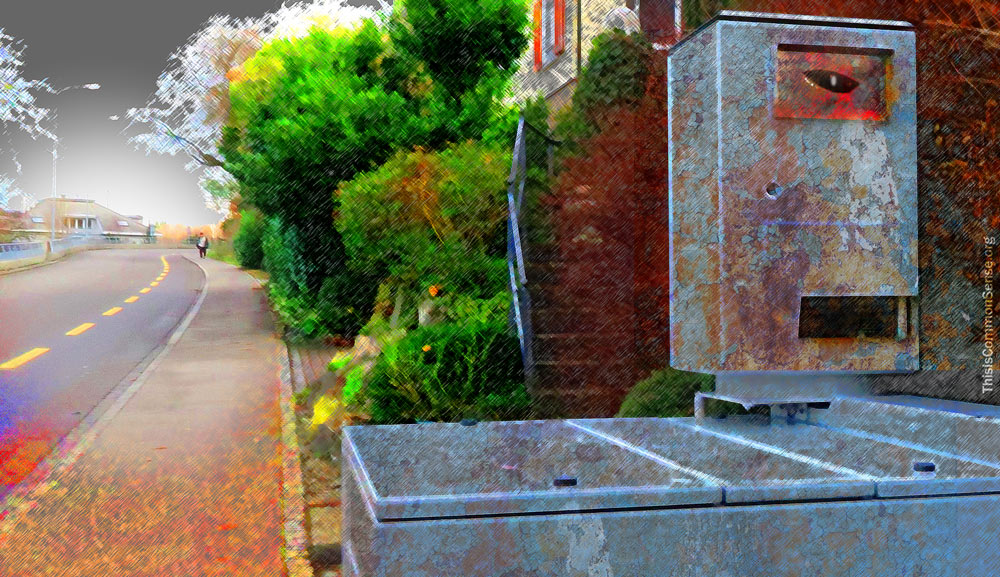
The many drivers in many municipalities who have been victimized by ridiculous use of red-light cameras to fill government coffers are among those who should take heart.

This is Common Sense. I’m Paul Jacob.


PDF for printing

Original photo by Kecko

See all recent commentary
(simplified and organized)
See recent popular posts
Categories
crime and punishment national politics & policies property rights

Dereliction of Duty

Must governments act to protect you when you or your property are attacked — for example, by rioters who vandalize and burn your store? 

Is the government liable if it willfully lets it happen?

Protection of life and property is the moral obligation of governments constituted for this purpose. But whether officials who ignore the obligation can be held to account is another question.

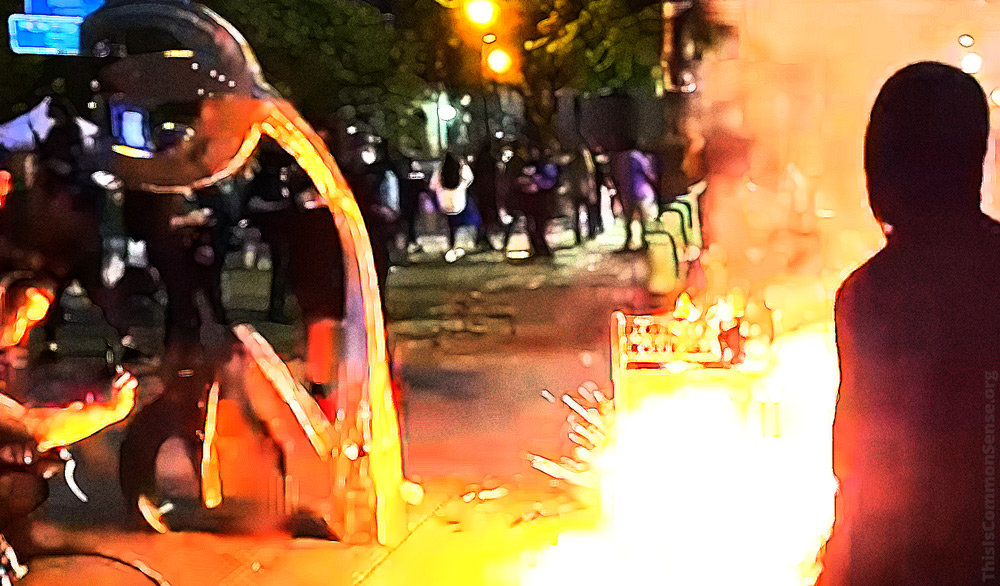
A Madison Avenue shop, Domus Design Center, is suing the mayor of New York City and the governor of New York State. In late May and early June, hundreds of businesses were damaged by rioters while Mayor de Blasio and Governor Cuomo refused to act to oppose them.

“Where are our tax dollars going?” asks the Center’s attorney, Sal Strazzullo. “Not protecting commercial properties is negligence of duty. Paying taxes that help pay the salary of the NYPD, we expect protection in return. Government is responsible to protect its citizens and businesses against criminals who want to do bad.”

Yes. 

But Strazzullo’s client faces the precedents of rulings in cases like Warren v. District of Columbia, Castle Rock v. Gonzales, and a lawsuit by Parkland, Florida students against the local sheriff’s office. In these cases, plaintiffs argued that law enforcers had a positive duty to protect the plaintiffs when they were being clearly threatened. 

The courts disagreed.

We must hope that there are limits to the willingness and ability of judges to avert their gaze. Otherwise, we are paying everyone in the system to look the other way when trouble comes.

This is Common Sense. I’m Paul Jacob.


PDF for printing

Photo by Georgia National Guard

See all recent commentary
(simplified and organized)
See recent popular posts
Categories
crime and punishment national politics & policies

Police Incentives Matter

“For every bullet the German police fired on duty in 2016, American police killed 10 people,” writes Jason Brennan for MarketWatch. “Even overwhelmingly white states like Wyoming and Montana imprison citizens at higher rates than authoritarian Cuba.”

What is going on here?

And by here I mean “these United States of America.”

Well, Brennan, who is the Robert J and Elizabeth Flanagan Family Professor of Strategy, Economics, Ethics, and Public Policy at Georgetown University’s McDonough School of Business, has an answer.

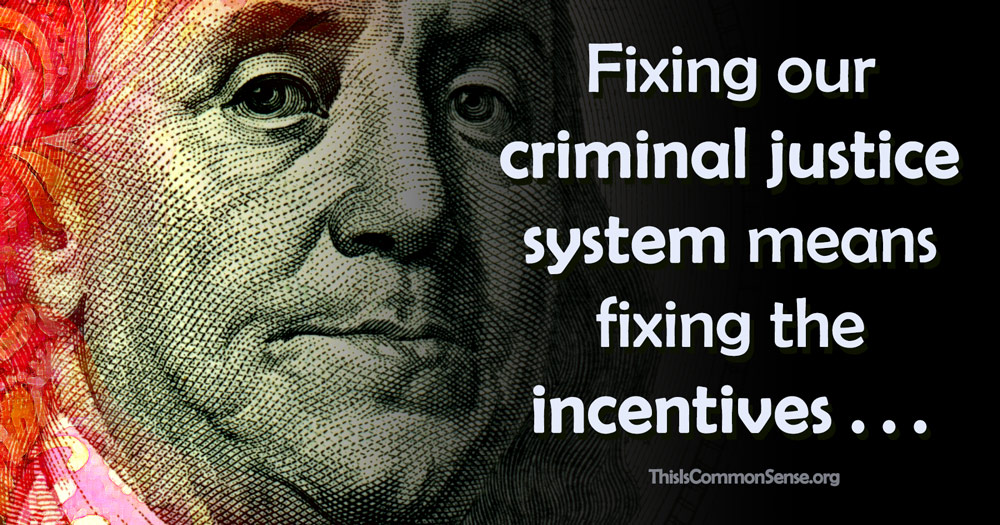
“What matters even more than black and white is green,” he writes, referencing the current protests and riots sparked by coverage of the George Floyd killing by Minneapolis police. “Fixing our criminal justice system means fixing the incentives.”

Professor Brennan points the finger at a number of federal programs:

  • The 1981 Military Cooperation with Law Enforcement Act “authorized and incentivized the U.S. armed forces to train police in military tactics” while the 1990 National Defense Authorization Act established a pipeline from the military industrial complex to local police forces.
  • The drug war set up police theft of private property via civil asset forfeiture, and encouraged federal drug warriors to share the loot with local police departments.
  • In many localities, direct election of prosecutors leads to campaign boasts about prosecution stats and long sentences, even when these policies make us less safe.

There’s a lot here to mull over, and you may not agree with everything Brennan argues, but the basic point is quite clear: “Even if we magically erased all racism overnight, the U.S. would still be harsh and violent” — and that because our politics has skewed incentives all wrong.

Getting rid of programs and laws that disincentivize good policing is a must.

This is Common Sense. I’m Paul Jacob.


PDF for printing

See all recent commentary
(simplified and organized)
See recent popular posts
Categories
crime and punishment folly

Qualified Backlash

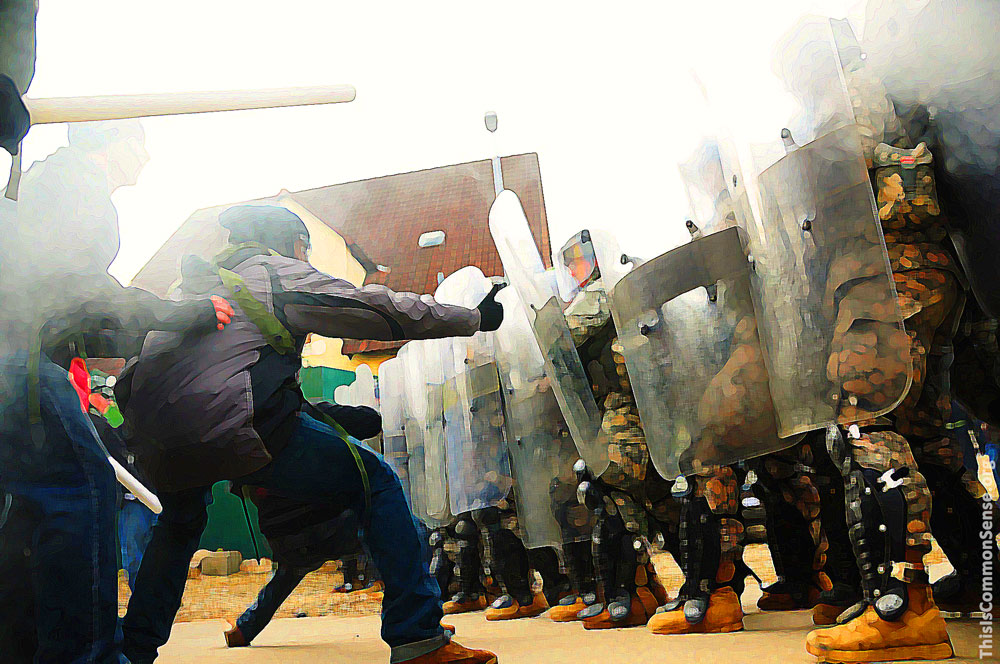
Extreme forms of protest — that is, rioting, looting, and street violence, as well as chanting about killing people, carrying torches, and the like — don’t help the cause of those who engage in it.

You know it; I know it — but is it common knowledge?

So, as a contribution to the common wisdom of Homo (hopefully) sapiens politicus, let us stress the truth, which we can now back up with a study published in the Journal of Personality and Social Psychology. 

Eric W. Dolan, writing on PsyPost, explains that six experiments involving 3, 399 participants “assessed how different types of protest behaviors influenced support for a variety of progressive and conservative social causes, including the Black Lives Matter movement and the anti-abortion movement. They found that more extreme behaviors — such as the use of inflammatory rhetoric, blocking traffic, and vandalism — consistently resulted in reduced support for social movements.”

While “extreme protest behaviors” garner media attention, they turn away more people than they bring in.

“We found extreme anti-Trump protest actions actually led people to not only dislike the movement and support the cause less, but to be willing to support Trump more,” the researcher who talked to Dolan, said. “It was almost like a backlash.”

Almost?

Protest organizers have to understand that their enemies also know this backlash effect, and have incentives to corrupt peaceful protests by sparking extremism. Infiltrators from governments as well as opposing groups have been known to incite riots or cause destruction simply to discredit protests. 

While destruction and mayhem by some do not negate the crying, dying need for criminal justice reform,* the tragedy remains: violence does spoil good will.

And calling in federal troops, as the president threatens, discredits almost everything. What a mess.

This is Common Sense. I’m Paul Jacob.


* Much better than the turn to violence? Protest morphing into specific legislative and administrative reform. Ending “qualified immunity” for public officials, mentioned here Friday, and proposed by Representative Justin Amash (L-Mich.), would be a great start.

PDF for printing

See all recent commentary
(simplified and organized)
See recent popular posts
Categories
general freedom

Freedom’s Front Lines

Last weekend, riot police broke up a candlelight vigil for Chow Tsz-lok, the Hong Kong University of Science and Technology student, who died back in November. He had fallen a story from a parking garage as Hong Kong police were “clearing a group of anti-government protesters.”

“Police said they seized petrol bombs, bricks and other protest items from the car park where the memorial was held,” reports the South China Morning Post. “Officers then stopped rally-goers from leaving and checked their identity cards and bags, arresting more than 40 people for unlawful assembly.”

If the police can be believed. 

They can’t. 

As Tom Grundy, editor-in-chief of Hong Kong Free Press, puts it: “[P]eople just don’t trust the Government.”

While people were violently arrested, it wasn’t for violence or weapons. It was for daring to use what we call “freedom of assembly.”

Now with the spread of the COVID-19 virus, protesters have been reluctant to call for mass gatherings. Nicholas Bequelin, a Hong Kong-based regional director of Amnesty International, told the Australian Broadcasting Corporation, “The authorities may be counting on the coronavirus epidemic to extinguish the unrest.”*

On Friday, authorities used the lull to charge three prominent pro-democracy leaders — Jimmy Lai, owner of media highly critical of China; Yeung Sum, the former Democratic Party chairman; and the Labour Party vice-chairman, Lee Cheuk-yan — for taking part in a protest march last year.

They join more than 7,000 demonstrators arrested since the protest movement began last June. 

Young people — and some not-so-young — are risking their very lives for freedom, for the right to choose their leaders . . . knowing that without such basic mechanisms, they have no defense against the Butchers of Beijing.

This is Common Sense. I’m Paul Jacob.


* Amnesty International has called for an “independent investigation into police violence.”

PDF for printing

coronavirus, Covid, China, police, protest,

See all recent commentary
(simplified and organized)
See recent popular posts

Categories
general freedom ideological culture

The Fundamental Complaint

“Something is going on,” writes The Washington Post’s Adam Taylor. “From Baghdad to Hong Kong, Santiago to Barcelona, sites around the world have seen major protests over recent weeks.”

What is that something? 

“Global protests share themes of economic anger and political hopelessness,” reads the headline to Taylor’s article.  

He’s way off. 

Hope, not hopelessness, drives people to demand change. 

“Income inequality seems to have added an economic insecurity that helped lead to anger and protests,” Taylor informs . . . in keeping with a consistent Post narrative.

The millions who have marched in Hong Kong didn’t take to the streets over income equality. Their five clear and reasonable demands are about justice and basic democratic citizen control of government. 

The protests and violence in Catalonia stem from the central Spanish government denying self-determination and trying to bully the people by imposing long prison terms on Catalonian officials who committed the crime of holding an “illegal” referendum for independence.

Even where economic concerns are far more prominent (or the main driver of demonstrations, such as in Chile) the frustration is much less about inequality than a lack of opportunity in a stagnant and corrupt system. 

“They promise changes every time we protest, but it’s not a new law or a concession that we want,” Iraqi student Ali Saleh explains. “It’s our rights. It’s a fundamental change in how we’re governed.”

The current global explosion of political unrest isn’t about income inequality or even economic insecurity alone. It is about the desire for more fundamental freedoms — economic as well as political — in an unfree world. 

This is Common Sense. I’m Paul Jacob.


PDF for printing

revolution, protest, police, authoritarianism,

See all recent commentary
(simplified and organized)
See recent popular posts