Categories
Accountability government transparency national politics & policies

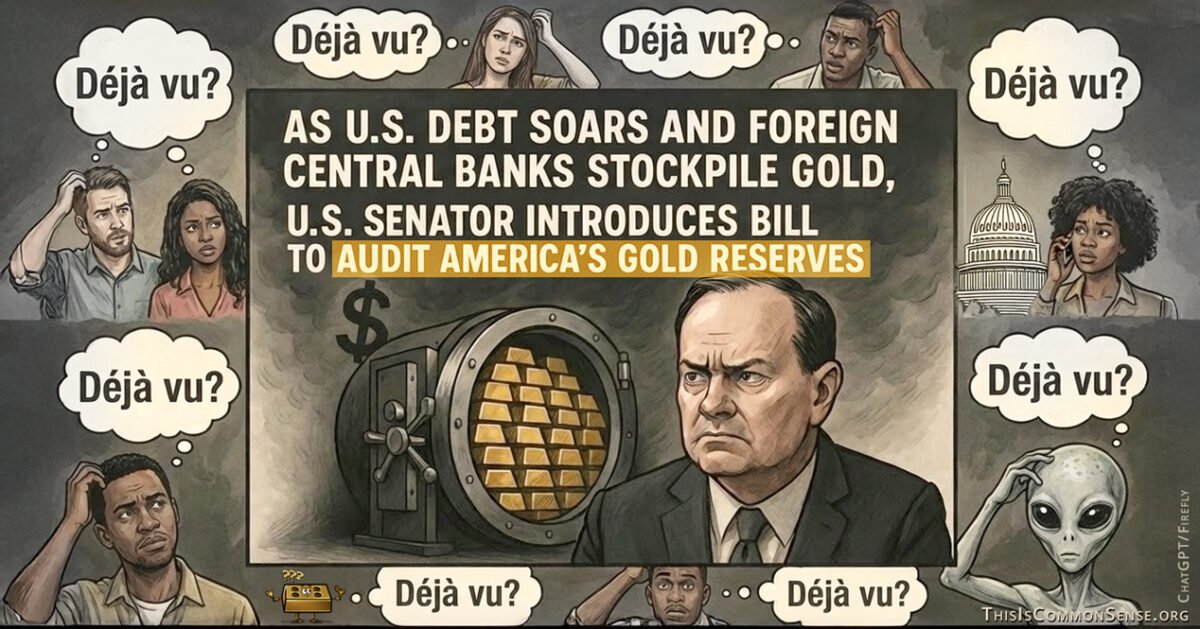
One Day an Audit?

“As U.S. debt soars and foreign central banks stockpile gold,” asserts a new article, “a U.S. senator today introduced a bill to require the first comprehensive audit of America’s gold reserves in decades.”

Reading the Mises Institute piece, I got a sense of déjà vu.

“Sponsored by Sen. Mike Lee (R‑UT), the Gold Reserve Transparency Act would require a full assay, inventory, and audit of all United States gold holdings,” the author, Jp Cortez, explains, “along with an upgrade in the purity of the gold so that it meets global market standards.”

The “haven’t I read this before?” thought hit me hard. Talk of auditing the gold reserves is not new. Earlier this year, in the heady days of Elon Musk and DOGE, a lot of folks dared wonder: does the federal government even have any gold at all? 

I asked the question in February, in the context (I kid you not) of UFOs!

A “Gold Reserve Transparency Act” has been introduced four times in the House since 2011, always by Republican sponsors aligned with sound-​money advocates. But it has also never passed the House, let alone advanced to the Senate or become law. 

The House Committee on Financial Services received these bills but only the 2011 version got so much as a hearing. 

No Senate version existed until Sen. Mike Lee’s introduction (S. _​_​, 119th Congress) weeks ago, which mirrors the House bill and remains unnumbered and in committee as of yesterday.

A gold audit would be very interesting. But I get the feeling this will be treated like UFOs: full disclosure forever forthcoming.

This is Common Sense. I’m Paul Jacob.


PDF for printing

Illustration created with ChatGPT/​NanoBanana/​Firefly

See all recent commentary
(simplified and organized)
See recent popular posts
Categories
deficits and debt international affairs

Billions and Billions

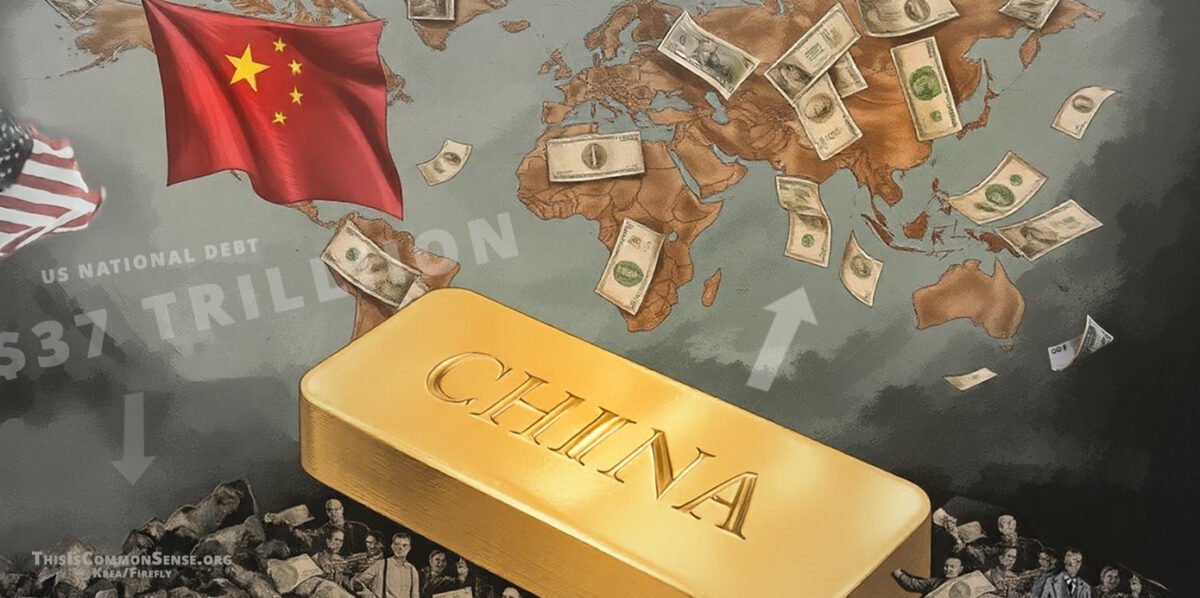
While we were going about our business, and maybe even soaking in some summer sunshine, the “US National Debt,” as the federal government’s explicit financial obligation is called, passed the $37 trillion mark. 

As if to mark the occasion, the Chinese government unloaded a whopping eight billion, two hundred million dollars worth of U.S. Treasuries onto the market.

It’s a lot of money.

It’s a lot of debt.

And now China no longer holds it. 

Thus they are not quite as invested in our future.

Is that scary?

Well, everything about our federal debt load should scare us. If we are placid and unperturbed now, how many extra billions and trillions would it take to shake us?

If you are especially concerned about world stability, it might make sense to comfort you with this … interesting … piece of information: China still holds over $750 billion in United States debt.

A more important piece of information might be what the Chinese central bank has been replacing the U.S. debt with: gold.

Lots of gold.

About 200,000 kilograms of gold!

Nicholas Nassim Taleb, author of The Black Swan, insists that “a single asset has overtaken the US dollar’s position as the world’s de facto reserve currency.” That asset is gold.

We aren’t on the gold standard, but it looks like we may be falling backwards into something like one.

It makes me wonder if there is still gold in Fort Knox … and just how much. 

Mr. Trump

Congress? 

This is Common Sense. I’m Paul Jacob.


PDF for printing

Illustration created with Krea and Firefly

See all recent commentary
(simplified and organized)
See recent popular posts

Categories
free trade & free markets national politics & policies too much government

Banker Away

Republican candidate for the U.S. Presidency Mitt Romney has received some flak for keeping some of his vast hoard of wealth in foreign accounts. Though I have a few problems with Mr. Romney, this isn’t one of them. Folks with savings and investments should diversify. Anyone with large amounts of money should consider diversifying beyond our borderlines.

And not just for “tax avoidance” reasons, either.

For one thing, as nice and generous as our politicians are, the U.S. isn’t exactly stable and business-​friendly. That used to be the U.S. It may not be, any longer.

Take Peter Schiff’s new endeavor. The redoubtable Schiff, an investment expert perhaps best known for having predicted the 2008 mortgage crisis and the severity of the current recession, has started a gold bank, Euro Pacific Bank Ltd., which will back deposits with gold. The actual yellow stuff.

Its most interesting innovation will be its offer of a “gold debit card,” for use worldwide. Peter Wenzel calls this idea “awesome,” but then notes the downside:

U.S. security laws have become so intrusive, burdensome, and expensive to comply with, that it made it difficult for Schiff to offer the services in the U.S. So, Schiff opened his bank offshore, in St. Vincent and the Grenadines. It operates outside the jurisdiction of U.S. security regulations, and does not accept accounts from American citizens or residents. 

America’s place in the world is changing. And not for the better.

This is Common Sense. I’m Paul Jacob.

Categories
free trade & free markets national politics & policies too much government

Going After the Gold

What does gold have to do with medical care? Ingested, it’s a poison. It’s not often used in treatment.

So why did the Obama administration place a provision further regulating the buying and selling of gold into the Democrats’ medical reform legislation? 

Economist Thomas Sowell explains, in a recent column, why politicians are obsessed with the yellow metal. Before FDR, gold provided a check against politicians’ desire to spend the money government could “just print.” Because, in those long-​ago days, paper dollars were backed by gold, Americans would cash the paper in for gold when it looked like the Treasury had gone on a printing spree. So inflation (the increase of the supply of money, and the consequent diminishing of its value, leading to increasing prices) was checked.

In 1933, FDR confiscated most of America’s circulating (and hoarded) gold, and Nixon took us off the gold standard completely in the ’70s, morphing our monetary system into a pure fiat (inflationary) standard. 

Also in Nixon’s time, it became legal, again, for Americans to own gold.

So why make it harder, now, to trade in gold — when gold is not money?

Because investors, in times of inflation and crisis, turn to gold as a hedge. Against politicians, basically. And, says Sowell, “the Obama administration sees people’s freedom to buy and sell gold as something that can limit what the government can do.” 

Gold, like freedom, “cramps the government’s style.”

That speaks volumes about gold … and “Obamacare.”

This is Common Sense. I’m Paul Jacob.