Categories
general freedom moral hazard nannyism responsibility too much government

The $659,000 Non-Question

The so-​called “Motor Voter” law of 1993 created a national mandate: when people obtain their drivers’ licenses at the Department of Motor Vehicles, ask them if they’d also like to register to vote. 

The federal mandate is perhaps heavy-​handed, but the underlying idea has merit.

Now a new idea is gaining ground, taking the notion (nudge, nudge) a step further. Let’s not bother asking people if they want to sign up to vote, the proposal runs. Government should simply register them. Without asking.

It is a form of paternalism.

“It flips the presumption, where right now they ask you if want to be registered,” argues D.C. Council member Charles Allen. “Instead of that, we’re just going to go ahead and get you registered, and that absolutely helps enfranchise voters.”

“Lawmakers in 32 states have introduced measures in the last year to automatically register drivers to vote,” reports the Washington Post.

Some folks contend there isn’t much difference between asking if someone wants to register and registering them without asking. Well, if there isn’t much difference, why spend the $659,000 that Washington, D.C. officials estimate it will cost over the next four years for their new “don’t‑ask” program. 

Of course, there is a difference in the two policies: sort of like between offering people something to eat and force-​feeding them. 

Some Americans have no desire to vote or be registered. It is surely no business of any state or local government to act as if their preferences don’t count.

And what good are a bunch of names on a voter list if they aren’t interested? Is someone going to vote for them?

This is Common Sense. I’m Paul Jacob.


Printable PDF


Categories
Accountability free trade & free markets general freedom national politics & policies property rights responsibility

Juicer Choosers

We all have our complaints about this company or that, this product or that.* And it is popular to rag on “consumerism” and the emptiness of “capitalism.” But put it into perspective: me “wasting money” on, say, an expensive juicer is nowhere near as offensive — that is, worth a rant, an excoriation, a philippic — than the government wasting money on … anything else. 

Or, for that matter, on juicers.

At this point, you may be wondering, “what’s with this juicer business?” 

Well, it is all about the hullabaloo regarding, er, a juicer business!

Juicero, to be precise.

The well-​funded-​at-​startup Silicon Valley biz makes the expensive Juicero Press. And news. Newsweek and Washington Post were just two major media outlets to lay into the company. They characterized Juicero and its product as a symbol of all that’s wrong with Silicon Valley.

Wow. What weight for one niche-​market company to bear.

While journalists in print and online fret over how Silicon Valley offers up empty gewgaws and gadgets for the “temporarily rich” — a few decades ago members of this class were excoriated as Yuppies — over at Star Slate Codex Scott Alexander reminds us that Silicon Valley does all sorts of things. 

One juicer cannot stand for everything else.

Besides, when “Capitol Hill screws up, tens of thousands of innocent Iraqis get killed,” Alexander writes. When “Silicon Valley screws up, people who want a pointless Wi-​Fi enabled juicer get a pointless Wi-​Fi enabled juicer.”**

Forcing many people to pay for dubious-​at-​best products, or enticing a few people to pay for harmless luxuries? You see why I prefer the latter. 

This is Common Sense. I’m Paul Jacob.


* You should listen to me curse my computers! Or, on second thought, no. You shouldn’t.

** “Which by all accounts,” Alexander concludes, “makes pretty good juice.” Even if squeezing the company’s frozen packets yourself works just as well.


Printable PDF


Categories
Accountability folly general freedom ideological culture media and media people moral hazard nannyism political challengers responsibility too much government

French Beacon

“Since the French Revolution,” the New York Times pontificated online, “the nation has often been viewed as a beacon of democratic ideals.”

Really? Can a nation of constitutional turnovers — kings and republics and revolutions and foreign occupation — be a beacon? Most often we in America compare our Revolution to France’s, focusing on The Terror: mob rule and proto-totalitarianism.

On Friday, “the staff of the centrist candidate Emmanuel Macron said… that the campaign had been targeted by a ‘massive and coordinated’ hacking operation, one with the potential to destabilize the nation’s democracy before voters go to the polls on Sunday.” A few minutes later, the campaigns fell under the country’s election gag rule, unable to debate immediately prior to the voting. The government told the media not to look at what was dug up in the “hack” (which everybody said was by Russians). Though Macron’s putative Islamization plan is worth looking at, surely.

Much talk (at the Times and elsewhere) of how the hack destabilized democracy. No talk, for some reason, about how the election regulation gag rule did. 

The idea that information might destabilize democracy? Awkward. 

Still, we can see how an info-dump’s timing might destabilize an election.

But since Macron won by a large margin, the Late Exposure Strategy may have backfired, Russians or no.

The most obvious oddity in reportage? The continued reference to former Socialist Party hack Macron as “centrist” while Le Pen is called “far right” ad nauseam. Macron is pro-​EU; Le Pen is nationalist. Neither are reliably for freedom. The fact that Macron packaged his En Marche ! Party as centrist doesn’t make it so.

This is Common Sense. I’m Paul Jacob.


Printable PDF


Categories
free trade & free markets general freedom media and media people moral hazard nannyism property rights too much government

Of Salt and Socialism

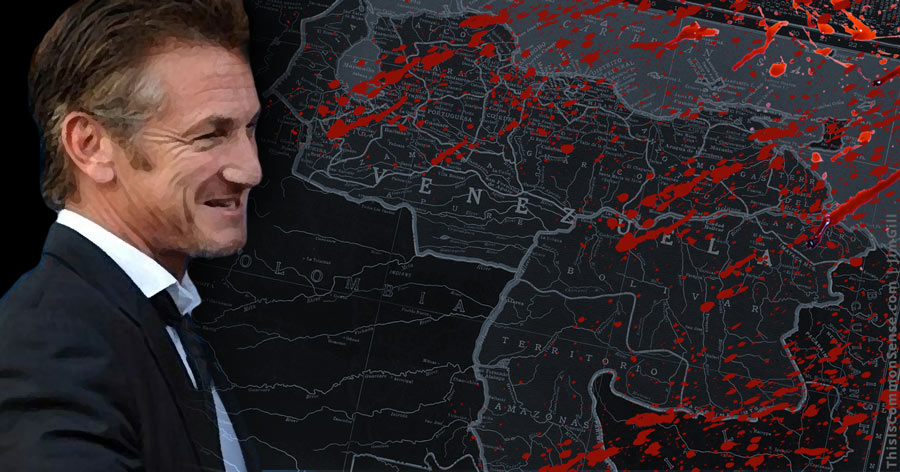
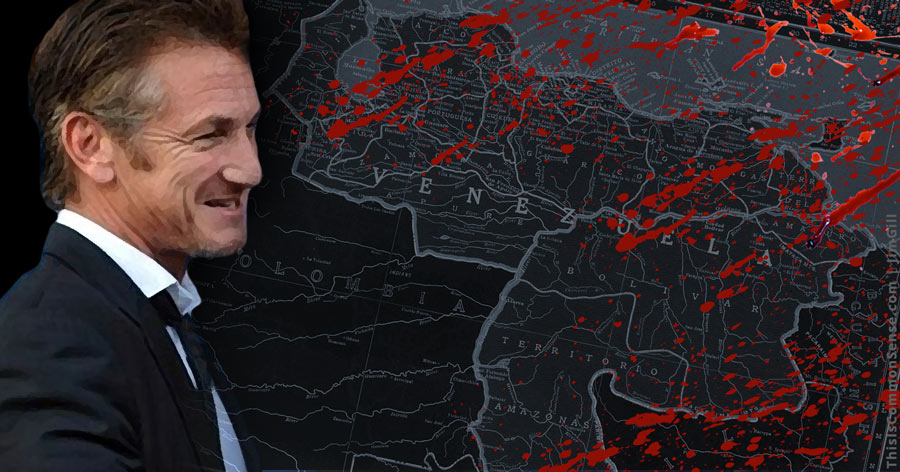
Nearly 75 percent of Venezuelans have lost 19 pounds or more in 2016. “People have become so desperate,” the Miami Herald reported recently, “that they are butchering and eating flamingos.”

While acknowledging the problem, TeleSUR, a television network based in Venezuela and funded by governments including Cuba, Ecuador, Nicaragua, and Venezuela, called the Herald’s story “kooky” and suggested taking reports “like alleged flamingo eating with a grain of salt.”

If, in socialist Venezuela, one could find a grain of salt.

In America, salt is necessary, too, when listening to our socialist Hollywood celebs blather about their kooky diets, for which some are blaming President Trump.*

Socialism kills. The deprivations in Venezuela are no joke, for along with economic chaos, Venezuelans are experiencing political repression on a grand scale. A new report from Luis Almagro, secretary general of the Organization of American States (OAS), documents the thousands arrested for protesting or “having posted something against the national government or a public official on Twitter.” The report details the “curtailment of civil, political and electoral freedoms” and “torture” and “censorship.”

Almagro calls for the suspension of Venezuela’s membership in the OAS, which is long overdue. The Human Rights Foundation demanded that nine years ago.

The Obama administration opposed such a move, as the Washington Post editorialized, in order to pursue “a legacy-​making détente” with “the Castro regime in Cuba.”

At Townhall,** I urged Trump to support the effort to boot Venezuela out of the OAS, which might provide some assistance toward political change there … and Venezuelans eating more.

And perhaps to socialists in Hollywood and elsewhere eating crow … but not flamingo.

This is Common Sense. I’m Paul Jacob.


* I covered this last week, when I compared their Trump Diet nonsense to the “Maduro Diet,” named for Venezuelan President Nicolás Maduro, the socialist dictator presiding over the complete economic collapse of what, prior to socialism, had been South America’s richest country.

** From which this Common Sense is adapted.


Printable PDF


Categories
folly general freedom moral hazard national politics & policies responsibility U.S. Constitution

Deplorable Distrust?

The United States is no longer a “full-​fledged democracy.”

According to a New York Post story, our union is, instead, a “flawed democracy.”

Hmmm. Where to begin?

Despite the article’s featured photo of President Trump, the downgrading of America’s democratic status occurred prior to the billionaire’s swearing-in.

Technically, of course, the United States is not now nor has ever been a full-​fledged (much less a flawed) democracy. We live in a republic … if we can keep it.

As is often the case, folks use the term “democracy” not to indicate it as a form of government — a pure democracy — but as a shorthand for a country with democratic elections, where “basic political freedoms and civil liberties are respected,” and with “an independent judiciary.”

An organization associated with The Economist, the Economist Intelligence Unit (EIU), has for a decade been rating the world’s countries based on numerous political factors. For the first time, this year, the United States has dropped out of the top tier and into the second, joining the likes of Botswana, Ghana and India.

“The U.S. is the second-​highest ranking flawed democracy,” the Post noted, “coming in right behind Japan and tying with Italy.” Norway garnered first place among the 19 “full-​fledged democracies,” including most Western European countries.

Why was the U.S. downgraded? The EIU report explained the lower score “was caused by the same factors that led Mr. Trump to the White House: a continued erosion of trust in government and elected officials.”

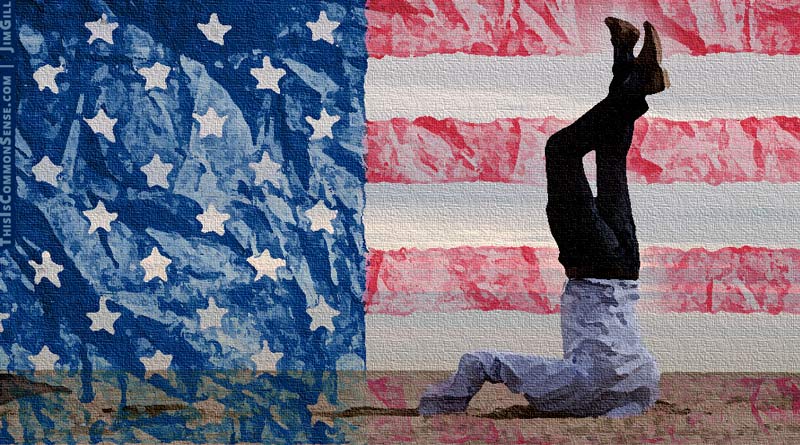
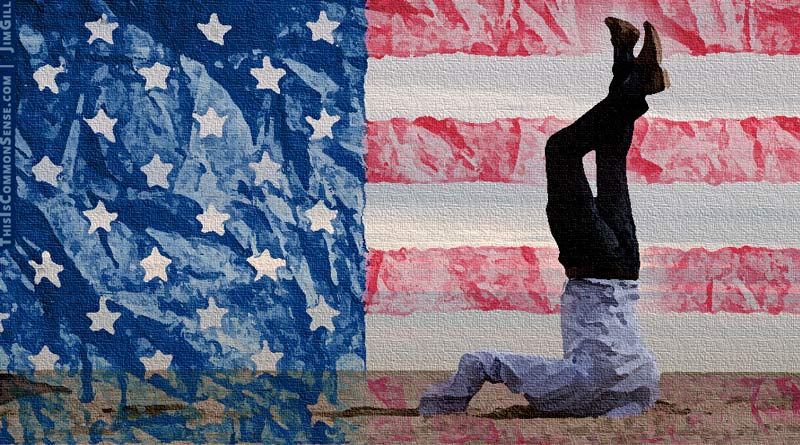
So, if the American people simply placed their heads in the sand, blindly trusting politicians, we’d be “full-​fledged,” eh?

Full-​fledged fools fiddling away our freedom, that is.

This is Common Sense. I’m Paul Jacob.


Printable PDF


Categories
general freedom ideological culture meme nannyism national politics & policies

A Childlike Faith…

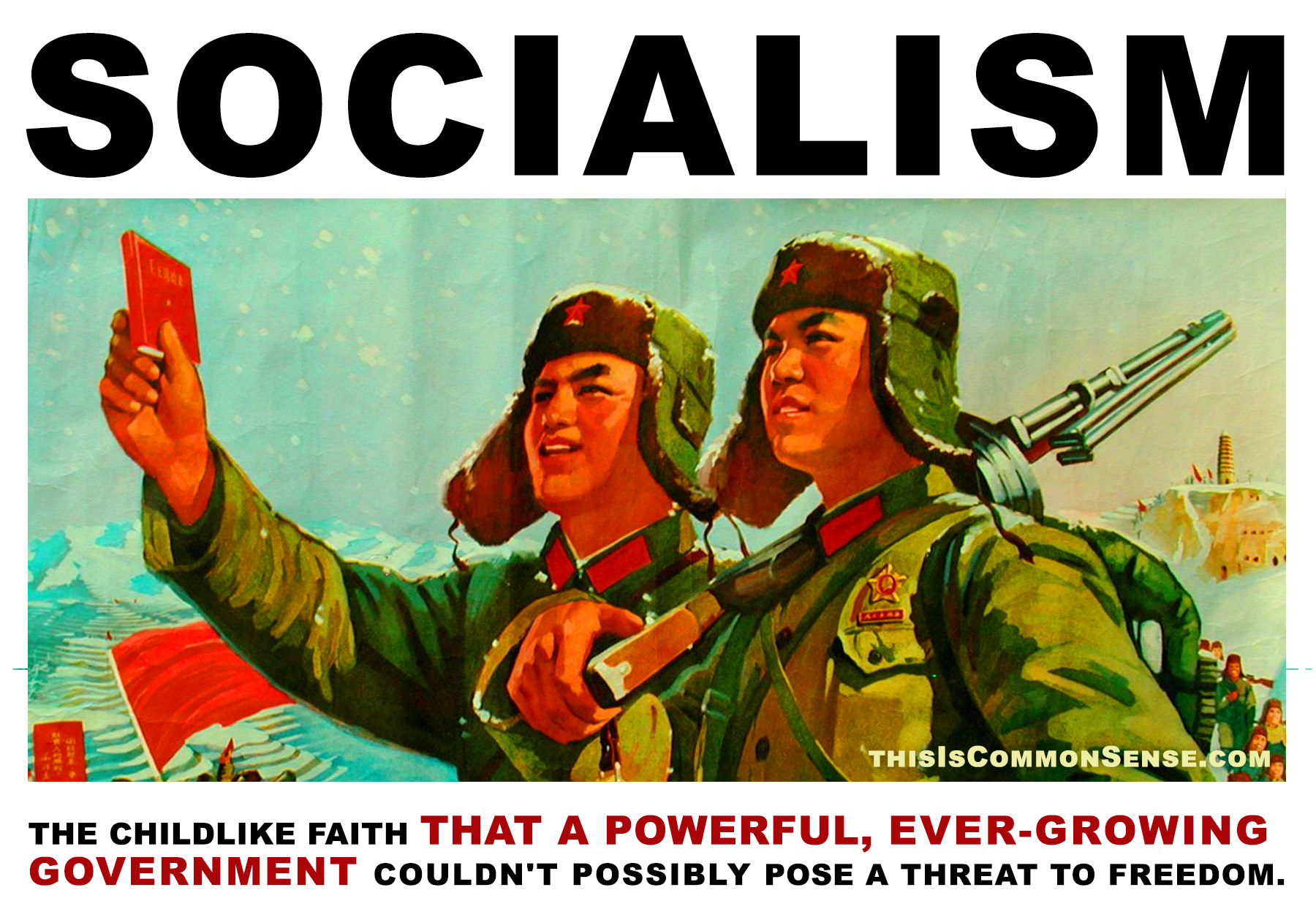
SOCIALISM…

The childlike faith that a powerful, ever-growingGovernment couldn’t possibly pose a threat to freedom.


Click here for a high resolution version of the image:

socialism, childlike faith, government, power, progressivism, Paul Jacob, Jim Gill, Common Sense, meme, illustration


Categories
Accountability education and schooling general freedom ideological culture national politics & policies

Parents in Context

Consider the intersection of freedom and decontextualized fragments.

The specific “decontextualized fragments” in question appear in great and not-​so-​great works of literature, assigned in public schools for young adults to read: a graphic rape scene in Toni Morrison’s Beloved; racial slurs in Huckleberry Finn; sex, violence.

“Virginia regulators are drafting rules that would require school districts to red-​flag objectionable teaching material and make it easier for parents to control what books their children see in the classroom,” reports the Washington Post.

Those regulations won’t be finalized for a year or more (because government bureaucracies are painfully slow). Yet an “earlier version of the language released on a state website drew hundreds of comments from the public,” the Post informs.

“Most parents were supportive of the change.…”

Teachers? Against.

Stafford County Public Schools literacy coordinator Sarah Crain worries about literature being wrongly labeled “sexually explicit.” To “reduce a book or a work down to something that is a mere decontextualized fragment of the work,” she argues, “actually impedes the ability for teachers and parents to have informed conversations.”

What about freedom?

Well, public schools aren’t primarily about freedom.

Teachers have a job to do; students follow instruction.

And it is pretty easy to see one reason for the opposition by “the professionals”: the new rules would entail more work.

Nonetheless, parents and their kids deserve as much choice as can be provided. And in every context.

Here, freedom means acknowledging the right of parents to decide. Not experts. Parents.

This is Common Sense. I’m Paul Jacob.


Printable PDF

education, parents, children, Virginia, freedom


Original photo credit: wealhtheow on Flickr


Categories
crime and punishment general freedom ideological culture media and media people Second Amendment rights

The Truth About Gun Control

Confucius said that our first task is to “rectify the language.”

That amounts to word control, but we probably should not take that too literally. We cannot “control the language.” Instead, we should take caution: error often rests upon improper word choice.

Take as an example not word control, but …

Gun control.

Which, Thomas Sowell reminds us, isn’t what it seems to be. “The fatal fallacy of gun-​control laws in general is the assumption that such laws actually control guns,” Sowell wrote on the first day of winter. “What such laws actually do is increase the number of disarmed and defenseless victims.”

A new wisdom? No. Sowell, in 2016, is disabusing The New York Times for its inanities regarding the bearing of arms. In 1925, H. L. Mencken took on The Nation.

Gun control, Mencken wrote, “would not take pistols out of the hands of rogues and fools; it would simply take them out of the hands of honest men.”

Sowell argues that, no matter how irrational spree and mass murderers may seem, they “are usually rational enough to attack schools, churches, and other places where there is far less likelihood of someone being on the scene who is armed.”

Mencken noted that the gunman of his day “has great advantages everywhere. He has artillery in his pocket, and he may assume that, in the large cities, at least two-​thirds of his prospective victims are unarmed. But if the Nation’s proposed law (or amendment) were passed and enforced, he could assume safely that all of them were unarmed.”

Maybe, following Confucius*, we should call laws against concealed carry not “gun control” but “citizen disarmament.”

This is Common Sense. I’m Paul Jacob.

* “Confucius” is the Western name for Kong Qui (551 – 479 B.C.E.), the great Chinese sage. He was often referred to by the honorific Kong Fuzi, meaning “Grand Master Kong,” which Jesuit missionaries to China in the 16th-​century Latinized to “Confucius.”


Printable PDF

gun, control, gun control, freedom, Confucius, disarm, defense, Mencken, illustration
Categories
Accountability general freedom ideological culture media and media people nannyism Regulating Protest responsibility too much government

Tyranny’s Days Are Numbered

Fidel Castro, the Cuban dictator for half a century, died Friday night.

“Although Castro was beloved by a legion of followers,” The Washington Post acknowledged, “detractors saw him as a repressive leader who turned Cuba into a de facto gulag.”

Many on the American left — especially in Hollywood — have been surprisingly enamored of Castro, and the supposed “accomplishments” of better education and healthcare delivery in his socialist paradise.

I guess we must all weigh whatever policy advances were made against Mr. Castro’s faults.

As the New York Times detailed: “Foreign-​born priests were exiled, and local clergy were harassed so much that many closed their churches.… a sinister system of local Committees for the Defense of the Revolution that set neighbors to informing on neighbors. Thousands of dissidents and homosexuals were rounded up and sentenced to either prison or forced labor.… jailing anyone who dared to call for free elections.… imprisoning or harassing Cuban reporters and editors.”

Fidel Castro’s death reminds me of Irving Berlin’s jazz tune about Adolf Hitler, When That Man is Dead and Gone:

What a day to wake up on

What a way to greet the dawn

Some fine day the news’ll flash

Satan with a small mustache 

Is asleep beneath the lawn

When that man is dead and gone

Saturday morning, that news finally flashed for Cuban Americans in south Florida. Followed by jubilation. Horns honking. Smiles, cheers and songs. Jigs were danced.

Fidel Alejandro Castro Ruz — that dictator, the person who imprisoned and murdered many seeking freedom — is dead and gone.

For now, sadly, his brand of tyranny continues through brother, Raúl Castro. But its days, too, are numbered.

This is Common Sense. I’m Paul Jacob.


Printable PDF

Castro, death, Cuba, Communism, freedom, illustration


Categories
general freedom individual achievement

Crybaby

I’m not a crybaby. “Believe me” … as one fellow running for president is fond of saying.

Yesterday, however, at the San Francisco Freedom Forum, I was admittedly glad that the ballroom was dimly lit. Listening to speakers from across the globe tell their stories of struggling for freedom, I became … well, verklempt.

The event, organized by the Human Rights Foundation, is an expansion of the long-​running Oslo Freedom Forum. It featured speakers such as:

  • Hyeonseo Lee, who not only escaped from North Korea, the world’s most totalitarian regime, but later returned to help her family get out as well.
  • Yulia Marushevska, the Ukrainian anti-​corruption crusader, whose powerful YouTube video, entitled “I Am a Ukrainian,” helped the world see the Euromaidan protests.
  • Anjan Sundaram, the journalist with chilling tales of the totalitarian regime of Rwanda’s President Kagame, who recently overcame term limits through a referendum wherein 98 percent of the country supposedly voted to allow him to stay in power until 2034. Embarrassingly, Kagame spoke at Harvard and Yale on democracy and human rights. Sundaram recalled a Rwandan who explained, “We don’t know where the state ends and we begin.”
  • Zineb El Rhazoui, who co-​authored the comic book The Life of Mohamed with slain Charlie Hebdo editor Stéphane Charbonnier, and now lives facing an ISIS death sentence.

And many more.

For me, Rosa María Payá, with the Cuba Decides campaign, was the biggest tear-​jerker. She spoke about the murder of her activist father, Oswaldo Payá, at the bloody hands of the Castro regime.

As a father, it made me … (give me a moment) … think about how important freedom is.

This is Common Sense. I’m Paul Jacob.


Printable PDF

San Francisco Freedom Forum, Paul Jacob, Common Sense, Illustration