Categories
ideological culture international affairs

Triumph & Failure

“Shen Yun Performing Arts completed its 18th global tour earlier this month,” a May 24th press release informs, “a historic run of 799 shows in 199 cities in 26 countries in front of over a million people.

This notice, entitled “Triumphant 2025 Shen Yun Season Concludes,” may look like the usual glowing corporate self-​congratulatory exercise in unwarranted hype. But it isn’t. “Shen Yun’s eight touring groups and hundreds of performers overcame tornadoes and fires as well as sabotage attempts from the Chinese Communist Party (CCP) and its allies. And yet, not a single performance was missed.”

That is an accomplishment, indeed, for the theater troupe did face back-​room political pressure from that great foe of freedom, the CCP.

I had seen several news reports of their troubles. It took a court order, for example, to enforce a venue contract with South Korea’s Kangwon National University. University officials had “greenlit the New York classical Chinese dance company’s application to perform at its Baekryeong Art Center on April 1,” explains The Epoch Times, “only to walk back on the agreement after the Chinese embassy voiced a complaint.” 

The university “stated that its decision to cancel the show had to do with the public interests of the school,” of course. But while“escalating the matter into a ‘diplomatic issue’” obviously loomed large, the center also mentioned the danger from “the roughly 500 Chinese-​national students studying at the center who it claimed could stage protests, potentially leading to clashes, should the performance go on as scheduled.”

The Shen Yun Performing Arts organization is made up of many artists who have fled communist China. The communists in China do not like defectors, and their reach is alarming.

Thankfully, in this case, the CCP failed.

This is Common Sense. I’m Paul Jacob.


PDF for printing

See all recent commentary
(simplified and organized)
See recent popular posts

Categories
international affairs political economy

Out of Poverty

“So, who brought who out of poverty?” asks Frank Dikötter about China’s economic rise.

The Dutch historian and author of four excellent books on Chinese history — Mao’s Great Famine; The Tragedy of Liberation; The Cultural Revolution; and China After Mao — Dikötter recently spoke at length with Peter Robinson, host of the Hoover Institution’s “Uncommon Knowledge” podcast.

Calling it “conventional wisdom,” Robinson offers that “the number that I found over and over again was eight to 900 million people lifted out of poverty since Deng Xiaoping announce[d] his reforms in ’78.”

“That’s all propaganda,” declares Dr. Dikötter. “The people in the countryside have lifted themselves out of poverty.”

Even before Mao’s death in 1976, the Cultural Revolution ended and the “army, which was deployed in every farm, every factory, every office from 1968 onwards, that army goes back to the barracks and is purged in turn,” he explains. “People in the countryside realize there’s nobody there to supervise them. There’s nobody there to tell them, go and work in the collective fields.”

Mr. Robinson chimes in: “The boot is off their neck.”

“So,” Dikötter expounds “they start operating underground factories; they open black markets; they trade among themselves.”

Deng “merely [put] the stamp of approval on something that escapes them altogether, namely the drive of ordinary villagers to claim back the freedoms they had before 1949.

“Allow ordinary people to get on with it,” he says, “they will!

“But this is not a party,” concludes Dikötter, “that will allow ordinary people to get on with it.”

This is Common Sense. I’m Paul Jacob. 


PDF for printing

Illustration created with Krea and Firefly

See all recent commentary
(simplified and organized)
See recent popular posts

Categories
general freedom ideological culture national politics & policies

Excellence in Success

The NASA Jet Propulsion Lab has “parted ways with” — I’m guessing fired, despite the glowing words that attended the parting — DEI officer Neela Rajendra.

The Free Beacon reports that NASA seems to have been nudged in this direction by a Beacon report that despite the anti-​DEI policies of the new U.S. administration, the Jet Propulsion lab had tried to retain Rajendra by changing her title. She still had many of the same responsibilities, including managing “affinity groups” like the Black Excellence Strategic Team.

The propulsion lab is now replacing its DEI department with a new one called “Office of Team Excellence and Employee Success.” 

Even assuming that race and gender consciousness are now no more — probably not a safe assumption — we may wonder why such a department, solely devoted to “excellence and success,” is necessary.

If it is, how did the NASA of the 1960s, including Apollo 11 astronauts Neil Armstrong, Michael Collins, and Buzz Aldrin, ever manage to reach and land on the moon? Surely this kind of accomplishment must have required pervasive excellence. Maybe, back then, commitment to excellence was one of the requirements for getting and keeping NASA jobs to begin with?

Among Rajendra’s own excellences: hostility to deadlines and criticism of SpaceX for being “fast-​paced” and failing to promote DEI, as she complained in 2022. 

A few years later, it was a SpaceX capsule that enabled the rescue of NASA astronauts stranded on the International Space Station. 

Now that’s “team excellence”!

This is Common Sense. I’m Paul Jacob.


PDF for printing

Illustration created with Krea and Firefly

See all recent commentary
(simplified and organized)
See recent popular posts

Categories
general freedom international affairs media and media people

Europe, Land of the Free?

The Economist has declared Europe the Land of the Free.

One proof is that in Europe, no tech oligarchs are “spending their weekends feeding bits of the state ‘into the wood chipper.’”

This is an ill-​considered allusion to the efforts of Elon Musk and the Department of Government Efficiency to reduce the bloat and fraud in U.S. government spending. And the trillions in U.S. federal debt. Which are unsustainable. Because magic doesn’t work.

“Europeans can say almost anything they want, both in theory and in practice.” 

In Britain you can be arrested or jailed for praying, tweeting a wrong-​thinking tweet, reading from the Bible, holding up street signs.

Nor is freedom of speech safe in Germany. To prove the continent’s theoretical and practical freedom of speech, The Economist piles up carefully unelucidated half-​truths but declines to cite, for example, the conviction of German journalist David Bendels.

In February, Bendels, the editor in chief of Deutschland-​Kurier, published a satirical post slamming a German minister, Nancy Faeser, for opposing freedom of speech. An obviously doctored photo showed Faeser with a sign saying “I hate freedom of speech.” Faeser, who loves freedom of speech, filed a criminal complaint after being alerted by German police, who also love freedom of speech.

Bendels has been fined 1,500 pounds, given a suspended prison sentence of seven months, and ordered to apologize. 

He is appealing the verdict, and others are fighting the law under which he was prosecuted.

This is Common Sense. I’m Paul Jacob.


PDF for printing

Illustration created with Krea and Firefly

See all recent commentary
(simplified and organized)
See recent popular posts

Categories
ideological culture

The Libertarian Path?

Donald Trump is launching so many initiatives to curtail government power and its abuse that even students of policy find it hard to keep up. I don’t always agree with what he’s doing, but I often do. Sometimes, a hundred percent.

In his second term, President Trump is following what Glenn Reynolds calls a libertarian path. 

Say, what?

There has long been a libertarian streak in the Republican Party — from even before Goldwater’s 1964 presidential run — but once in power, Republican politicians rarely did any streaking.

Trump was different at the start, more immune to many of the left’s vicious tactics. But Trump 2 (2025- ) is still different from Trump 1 (2017 – 2021).

One difference between 2017 and now is that in the intervening years, Trump’s ideological enemies have slugged him with impeachments, every possible kind of bogus investigation and lawsuit, rigged various parts of the 2020 election, robbed him of many millions of dollars, and threatened him with imprisonment.

“Trump saw firsthand, to a degree greater than probably any American citizen ever, just how far the resources and lack of principles or moral fiber of the federal government go,” writes Reynolds. “It would be very difficult to remain a believer in Big Government … after that.” 

Reynolds echoes Trump’s declaration at the Libertarian Party convention last May about the consequence of his persecution: “If I wasn’t a libertarian before, I sure as hell am a libertarian now.”

One Trump foe complains that his second term “is all about curtailing government’s power and reach.”

Yes. We know. Feature, not a bug.

This is Common Sense. I’m Paul Jacob.


PDF for printing

Illustration created with Krea-​Realtime and Firefly

See all recent commentary
(simplified and organized)
See recent popular posts

Categories
general freedom ideological culture

Greatest Man in the World

Today, while we prepare our family’s feast or exchange our fastidiously purchased Presidents’ Day gifts or even find ourselves kissing under the cherry tree, let us take just a moment to consider the history of this momentous day.

When I was a kid, we celebrated Washington’s Birthday on February 22nd, each year. That officially recognized day honored George Washington, first president and the ‘father of our country,’ began in the 1880s (even before I was born). Then in 1968, someone discovered that Abraham Lincoln also had a February birthday and was apparently feeling slighted. 

So, what could we do but get the two big guys together for a mega national holiday? Lincoln was a pretty consequential president, after all.

But the holiday came to be known as Presidents’ Day … and as the Encyclopedia Brittanica notes, “is sometimes understood as a celebration of the birthdays and lives of all U.S. presidents.”

Is this some sort of “everyone gets a trophy” thing?

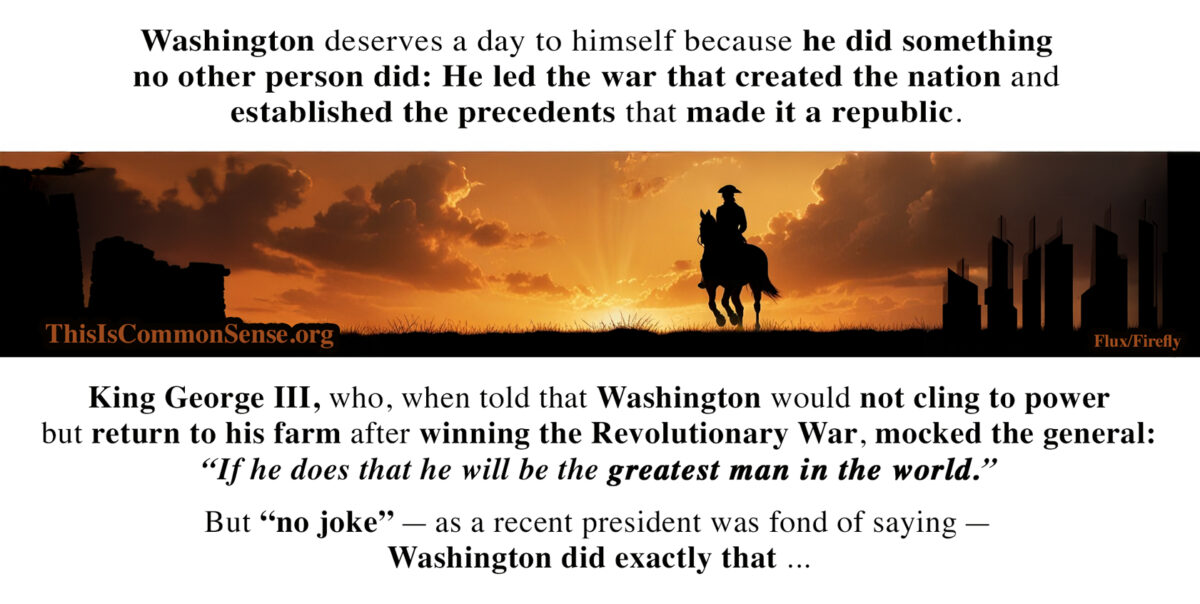
No. “Washington deserves a day to himself,” wrote David Boaz years ago, “because he did something no other person did: He led the war that created the nation and established the precedents that made it a republic.”

Boaz also wrote of King George III, who, when told that Washington would not cling to power but return to his farm after winning the Revolutionary War, mocked the general. “If he does that he will be the greatest man in the world.”

But “no joke” — as a recent president was fond of saying — Washington did exactly that, handing back his commission as commander of the army. 

Just as years later he stepped down after two terms as president, setting the tradition that ultimately led to the Constitution’s 22nd Amendment: presidential term limits.

So, Happy Washington’s Birthday!

This is Common Sense. I’m Paul Jacob. 


PDF for printing

Illustration created with Flux and Firefly

See all recent commentary
(simplified and organized)
See recent popular posts

Categories
insider corruption regulation too much government

Killing a Bureau

First, Trump fires the holdover director of the Consumer Financial Protection Bureau, a radically anti-​business agency. He appoints the new treasury secretary, Scott Bessent, as acting director.

Bessent orders the agency to stop everything — “rulemaking, communications, litigation,” Bloomberg Law reported. “A source inside the bureau who asked to remain anonymous said the order appeared to shut down the CFPB altogether, for the time being.”

So far, so good.

Trump replaces acting director Bessent with Russ Vought, a former and also the new director of the Office of Management and Budget.

The CFPB’s website goes dark and the Department of Government Efficiency (DOGE) begins to audit the books.

Musk and his team will find bad things. But “efficiency” isn’t quite the issue. Suppose the Bureau proves to be extremely efficient and noncorrupt at the task of making businesses extremely inefficient?

The mission itself is bad.

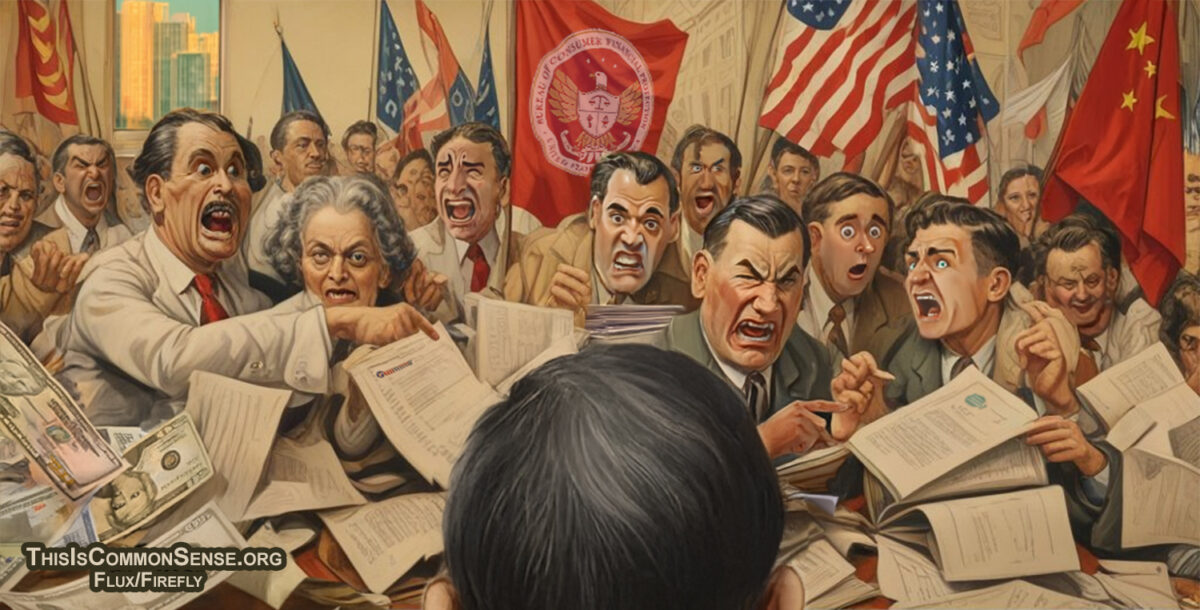
This agency sets its own budget, is perversely cut off from congressional oversight, has been able to run wild. One of its strokes of genius: treating video games as bank accounts.

Now we have oversight. Internal. “The calls are coming from inside the house”; it’s being gutted from within.

RedState hopes the CFPB’s “hyperaggressive regulation-​writing and legal thuggery will be markedly reduced” and that the agency may even be closed.

Yes, end it: as critics have long argued. Why does this agency exist except to harass and murder businesses and free enterprise? One of many federal agencies that should expire. 

This is Common Sense. I’m Paul Jacob.


Previously on the CFPB:

Give Them Credit — February 2, 2014
Invulnerable Government — November 28, 2017
Peel Back the Onion — November 30, 2017
Protector Protection — January 6, 2020

PDF for printing

Illustration created with Flux and Firefly

See all recent commentary
(simplified and organized)
See recent popular posts

Categories
Common Sense regulation

Cooking with Gas

If you’ve been wanting to buy a gas stove but have been worried about the federal government’s determination under Biden to outlaw selling them and other nice things, relax. You’re now going to be cooking with gas.

I’m looking at a paragraph of one of the many executive orders issued by President Trump to get the government off our necks.

I refer, of course, to provision (f) of Section 2 of “Unleashing American Energy.”

To wit: “It is the policy of the United States … to safeguard the American people’s freedom to choose from a variety of goods and appliances, including but not limited to lightbulbs, dishwashers, washing machines, gas stoves, water heaters, toilets, and shower heads, and to promote market competition and innovation within the manufacturing and appliance industries.…”

Water heaters … toilets and shower heads … and gas stoves?

It shouldn’t be such a big deal to be able to keep buying this or that modern convenience. We’ve already invented and can mass-​produce, mass-​distribute these things. We have a functioning market economy. And most of us don’t want to be Amish.

But if you’ve got successive administrations hell-​bent on returning us all to the Stone Age in order to control global weather and spare Mother Earth further inconvenience — well, adamant interruption of this trend is indeed a very big deal.

It seems that certain insanities will be stopped cold at least for the next four years. Maybe even beyond.

Industrial civilization: a good thing. Let’s keep it.

This is Common Sense. I’m Paul Jacob.


PDF for printing

Illustration created with Flux and Firefly

See all recent commentary
(simplified and organized)
See recent popular posts

Categories
meme Thought

Voltairine de Cleyre

“Did the seed of tyranny ever bear good fruit? And can you expect liberty to undo in a moment what oppression has been doing for ages?” (From anarchistquotes​.com)

Voltairine de Cleyre

Categories
Internet controversy regulation

Net Neutrality: Dead Again

Net neutrality, a scheme to centrally plan the provision of broadband Internet access by private companies, is dead.

At least for now. 

No harebrained scheme is ever definitely dead for sure and forever in politics. Not on this planet.

Net neutrality had been killed before. But last year, Democrats on the FCC in favor of micromanaging how broadband Internet access is priced and how broadband companies may invest their resources revived the misnamed doctrine, a confection of the Obama era.

Fortunately, the Sixth Circuit Court of Appeals has put the kibosh on this recrudescence of out-​of-​control power-​grabbing. The court explicitly noted a recent Supreme Court ruling that deference need no longer be accorded to regulators who make the law say whatever they want it to say.

The Sixth Circuit ruled 3 – 0 that the FCC had overstepped its authority under the law. 

And it cited the Supreme Court’s 6 – 3 decision last year in Loper Bright Enterprises v. Raimondo. This was the decision that overturned the Chevron doctrine (according to which judges must defer to bureaucratic misinterpretation and hijacking of law if such hijacking can be somehow construed as “reasonable”).

The Wall Street Journal points out that “ending Chevron will make it harder for regulators to exceed their authority.… This is a victory for self-​government and the private economy over the willful administrative state.”

That, and the more basic truth that net neutrality is itself an incoherent, unworkable policy, is more than enough reason to celebrate this revenant notion’s reiterated demise.

This is Common Sense. I’m Paul Jacob.


PDF for printing

Illustration created with Flux and Firefly

See all recent commentary
(simplified and organized)
See recent popular posts