Categories
general freedom

Thank You, Anonymous Leaper

I hope that the still-anonymous North Korean refugee who jumped a three-meter high, barbed-wire fence a few weeks ago — details are just now emerging — has paused to thank himself for his daring and initiative.

Now is a good time to do it. Thanksgiving is an American holiday, but we’re happy to let others around the world borrow it for their own thanks-giving purposes.

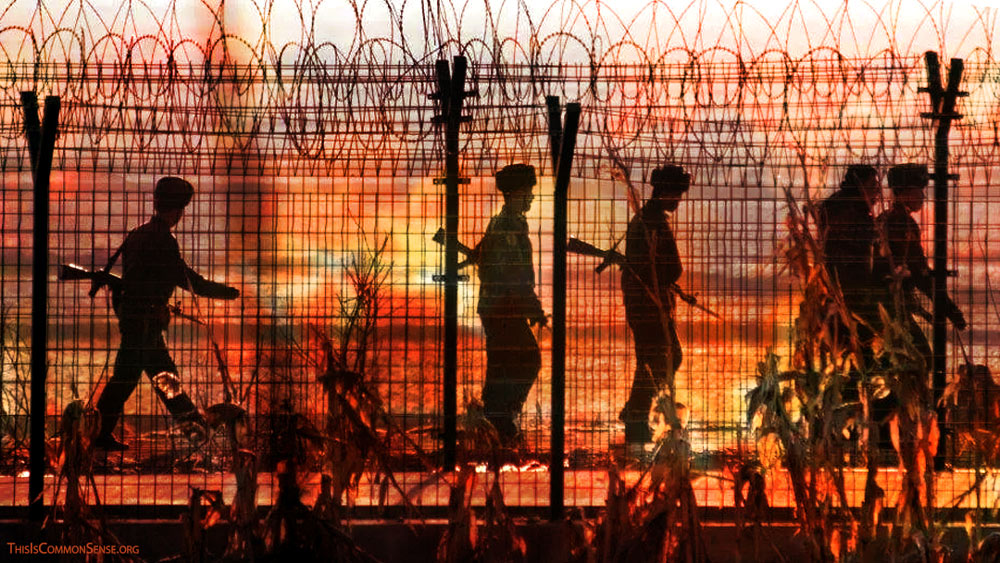
On November 3, a former 110-pound, North Korean gymnast leapt over a ten-foot fence in the demilitarized zone to reach South Korea.

The man has confirmed his story to the extent of proving his ability to leap tall barriers in a single bound in front of South Korean officials. He says he wants to defect.

I wish we knew more about him. But until I hear different, I’m going to assume that he is not a double agent. Just a guy who dislikes being oppressed and who wants a better life.

Every time a person leaps from totalitarianism to freedom, we should all be thankful. Here is someone who made it! This, despite pandemic-incited lockdowns that have made it even harder to escape North Korea. His feat shows others stuck behind country-wide prison walls that escape is still possible, even if few can do it the same way.

It also inspires those of us already on this side of the fence to keep working to preserve and expand the freedom, so often jeopardized, that we still enjoy.

Thank you, sir.

This is Common Sense. I’m Paul Jacob.


PDF for printing

See all recent commentary
(simplified and organized)
See recent popular posts

Categories
Thought

Something to Hate

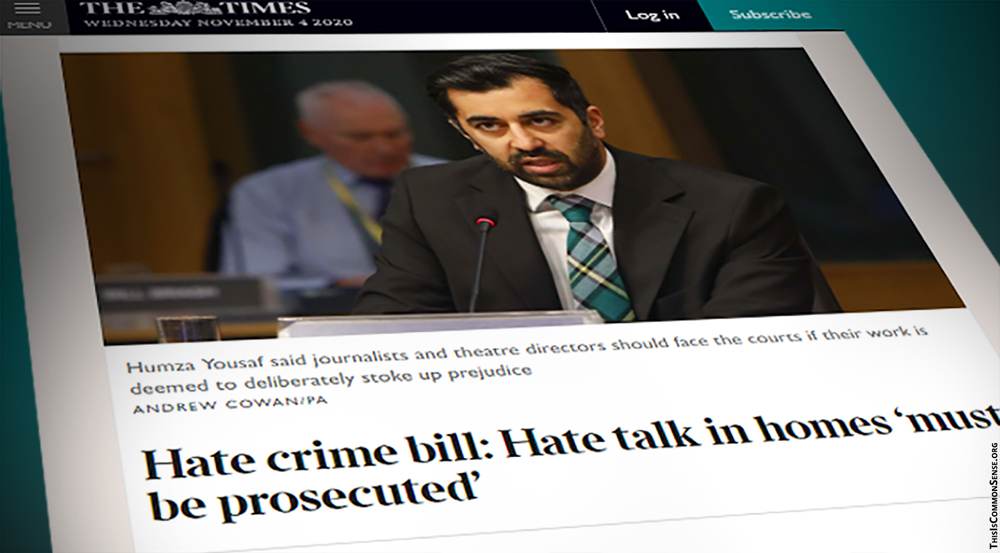
Headline: “Hate talk in homes ‘must be prosecuted.’”

Must”?

The proposed legislation targets speech alleged to promote prejudice. It is backed by Scotland’s secretary for justice, Humza Yousaf.

Might the law be deployed to squelch debate regarding, say, radical Islam?

“Are we comfortable giving a defence to somebody whose behaviour is threatening or abusive, which is intentionally stirring up hatred against, for example, Muslims?” Yousaf asks. “Are we saying that that is justified because that is in the home?”

I suspect that here we have someone who has never attended a sizable family gathering. Many attendees might report “hate talk” but oppose fining or imprisoning the so-called hate-talkers.

Could the law be directed against journalists and others who publicly express loves and hatreds?

“We wouldn’t want to give the likes of Tommy Robinson a defence by saying that he’s ‘a blogger who writes for The Patriot Times,’” says Yousaf.

“Stirring up hatred” is, of course, not identical to threatening or instigating violence. Presumably it is already illegal in Scotland to plan murder and mayhem over the dinner table.

There’s an awful lot of speech out there with which we might vehemently disagree. Plenty of dumb, hateful, prejudice-laden speech that violates the rights of no one does get uttered in homes and Internets. We must preserve the distinction between “things that are wrong to say or do” and “actions that should be illegal.”

Scots should resist these hateful assaults on their right to speak freely.

This is Common Sense. I’m Paul Jacob.


PDF for printing

See all recent commentary
(simplified and organized)
See recent popular posts
Categories
ideological culture

Papitalism

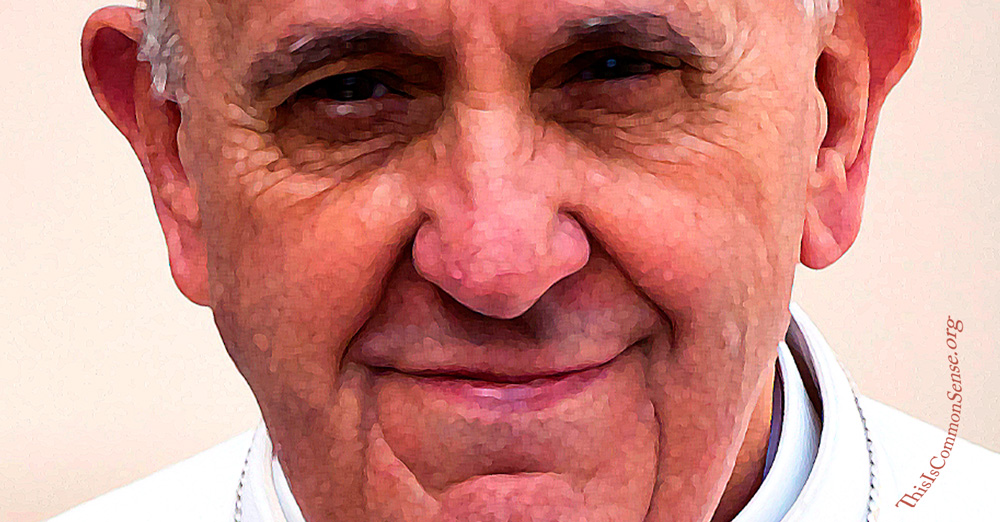
In his new encyclical, “Fratelli Tutti,” Pope Francis continues his attacks upon capitalism.

“The marketplace, by itself, cannot resolve every problem, however much we are asked to believe this dogma of neoliberal faith.” Capitalism “does not resolve the inequality that gives rise to new forms of violence. . . . The fragility of world systems in the face of the pandemic has demonstrated that not everything can be resolved by market freedom.”

What caused the inequality? Nature? Predation? Production? Inequality caused by theft and serfdom is a problem; inequality caused by production and freedom is not.

The pain of lockdowns (whether justified or not) is inflicted by massive restrictions on capitalism. And it turns out these government programs — pandemic “mitigation efforts” — will likely hit poor countries the hardest, causing (as the UN fears) mass starvation.

The pope cannot blame capitalism for that inequality!

Also, which champions of capitalism contend that capitalism resolves (instantly?) “every” problem? 

Capitalism is the socio-economic system characterized by freedom of production and exchange and by respect for property rights. It enables us to earn a living and make plans without worrying that we will be continuously robbed and our plans continuously derailed by governments. A free society shouldn’t pretend it can fix every problem, but it provides many incentives and opportunities to solve, or at least cope with, the problems of life. When free, we can speak and act as we judge best. 

And learn from our mistakes.

It would be a grave mistake to think that capitalism must be blamed for natural inequality, or for government actions to shut down production and commerce in order (we are told) to fight a virus. 

This is Common Sense. I’m Paul Jacob.


PDF for printing

Photo of Pope Francis by Catholic Church England

See all recent commentary
(simplified and organized)
See recent popular posts
Categories
too much government

Sweet Grape Victory of 2020

Raise a long-stemmed glass to the wineries of Minnesota. And to the Institute for Justice, which fought for their rights in court.

Minnesota wine makers may now make wine with whatever grapes they like! They may make wines that were illegal for them to make before.

Early in September, a federal judge struck down a 1980 Minnesota law which prevented Minnesota wineries from crushing grapes into wine unless most of the grapes being used had been grown in Minnesota. Winemakers were thus thwarted from producing popular varietals requiring grapes that can’t be grown in the state. Temporary exemptions from the law were possible but could not be counted on.

Judge Wilhelmina Wright’s ruling may well inspire challenges to similar prohibitions in other states. You know you’re a fifth of the way into the twenty-first century when dramatic modernistic advancements like letting wineries buy whatever grapes they wish have become possible.

You may be thinking: “Huh? I had no idea that wine makers in Minnesota were not allowed to buy grapes from other states. That’s painfully stupid!”

Of course, that is probably not the opinion of the proponents of the law. At least some Minnesota grape growers no doubt believe that persuading lawmakers to block out-of-state grapes was a smart move. 

But is it really so very wise to hobble business competitors for the sake of short-term advantages regardless of the long-term costs to the freedom — not to mention the palates — of all?

This is Common Sense. I’m Paul Jacob.


PDF for printing

See all recent commentary
(simplified and organized)
See recent popular posts
Categories
international affairs

All Together Now

Chinese Communist Party-controlled Hong Kong — under the National Security Law — has issued arrest warrants for six democracy activists.

I was not honored with inclusion.

“But Paul,” you sputter, “you do not live in China!”

Well, neither do those activists — all six now live outside the territory. 

Passed in secret in Beijing and imposed on Hong Kong, the new law basically criminalizes opposition to the CCP. 

ALL opposition. Anywhere. Anytime. Ex post facto

“The law criminalizes secession, subversion, terrorism and foreign interference,” CNN explains, “and it applies to offenses committed ‘outside the region’ by foreigners who are not residents of Hong Kong or China.”

One fugitive from injustice is Nathan Law, a former Hong Kong lawmaker and a leader of 2014’s Umbrella Movement. “I was prepared when I left Hong Kong to be in exile,” Mr. Law said on social media, explaining his departure when the draconian new law took effect, “but . . . who can enjoy freedom from fear in the face of China’s powerful political machine?”

Hong Kong officials maintain that there is “no retrospective effect” to the law, but that seems obviously untrue in Law’s case, and others’.* 

Samuel Chu with the Washington-based Hong Kong Democracy Council, a U.S. citizen for two decades, also graces the list. “I might be the 1st non-Chinese citizen to be targeted, but I will not be the last,” tweeted Chu. “If I am targeted, any American/any citizen of any nation who speaks out for HK can-and will be-too.”

Last year, when the protests first began, I wrote “I Am Hong Kong.” A year later? Even the CCP ominously agrees with Mr. Chu’s conclusion: “We are all Hong Kongers now.”

This is Common Sense. I’m Paul Jacob.


* “Other activists targeted include Simon Cheng, a former employee of the British consulate in Hong Kong who was granted asylum in the United Kingdom after alleging that he was tortured in China and interrogated by secret police about the city’s pro-democracy protests,” according to CNN, “and Hong Kong pro-independence activists Ray Wong, Honcques Laus and Wayne Chan.”


Note: Before these indictments, Hong Kong authorities tossed a dozen pro-democracy candidates off the ballot for September’s election. And then suspended the election for a year citing the pandemic — obviously wanting to avoid another massive election defeat for the CCP-puppet government. 

PDF for printing

Photo by Warren R.M. Stuart

See all recent commentary
(simplified and organized)
See recent popular posts
Categories
general freedom media and media people

The Four Froms

Liberty was a straightforward concept.

Once. 

Then The New York Times got ahold of it back in April with a featured editorial: “The America We Need.” 

“Our society was especially vulnerable to this pandemic,” the paper alleges, “because so many Americans lack the essential liberty to protect their own lives and the lives of their families.”

The fight against the Wuhan virus has been deficient due to a deficit of . . . “essential liberty”? 

This isn’t the Merriam-Webster definition of “liberty,” i.e. the “quality or state of being free” or “freedom from physical restraint.” Dump that retro “narrow and negative definition,” advises the editorial; it represents an “impoverished view of freedom” that “has perpetuated the nation’s defining racial inequalities and kept the poor trapped in poverty.”

Freedom of speech, religion, the press, etc., are all negative. Trade them in for a “broad and muscular conception of liberty: that government should provide all Americans with the freedom that comes from a stable and prosperous life.”

Prosperity for all! For free! Come on down!

Noting the “extraordinary nature of the crisis,” the editorial calls for “permanent changes in the social contract” to take the nation “beyond the threadbare nature of the American safety net.”

Free stuff from the government, housing, healthcare — all very positive ideas of liberty. 

But what about these positives’ negatives?

“A government big enough to give you everything you want,” former President Gerald Ford once explained to Congress, “is a government big enough to take from you everything you have.”

The cost of “positive freedom” is our freedom from dependence, from interference, from coercive control, from . . . oppression.

Positively negative, if you ask me.

This is Common Sense. I’m Paul Jacob.


PDF for printing

Illustration adapted from Liberty Leading the People (La liberté guidant le people) by Eugène Delacroix (1830)

See all recent commentary
(simplified and organized)
See recent popular posts
Categories
Common Sense general freedom

I pledge allegiance to my refrigerator warranty . . .

. . . and to the refrigerator for which it stands, one cooling unit, under electric power, indivisible from the side by side freezer, with cold drinks and frozen TV dinners for all.

Silly to pledge allegiance to a refrigerator or its warranty? Perhaps no more so than to pledge allegiance to our nation’s flag or our beloved Republic, for which that flag stands.

Wait a second: Doesn’t our Republic deserve our allegiance?

Well, what is meant by “allegiance”? The first dictionary definition reads: “the obligation of a feudal vassal to his liege lord.” 

The word “allegiance” does indeed derive from feudal times. Even further variations of the definition — “the fidelity owed by a subject or citizen to a sovereign or government” or “the obligation of an alien to the government under which the alien resides” — are tied to a relationship whereby “We, the People” are inferior to our nation-state.

But not in America. We are not “subjects” nor “aliens.” We are the sovereigns.

That wonderful frost-free icebox is ours; it works for us. This Republic is also ours and it was designed to work for us. In clear and deliberate language. In fact, language not dissimilar from an appliance warranty — though written more accessibly for the common person.

We are the government. So, do we really need to pledge our allegiance to ourselves?

As Judge Andrew Napolitano asked on his Freedom Watch show several years ago — before Fox mysteriously cancelled the show — “Does the government work for us or do we work for the government? Are true patriots guided by symbolism such as flag waving and pledges or by their commitment to personal freedoms?”

Perhaps it doesn’t matter. Most folks reciting the Pledge surely do not view themselves as feudal serfs.

Still, words matter. And actions and rituals matter as well. Tomorrow we celebrate Independence Day — not simply as a method to get out of work, but as a way to remind ourselves and our children that this country was conceived in liberty, in the hope we can continue to expand on and live in freedom. (That’s why I say “Independence Day” rather than the “Fourth of July,” since what happened is much more important than the date it happened.)

The Founders who signed the Declaration of Independence — pledging their lives, fortunes and sacred honor — didn’t see fit to establish a pledge for citizens to recite. Their pledge was to each other and to the country.

The Pledge of Allegiance, on the other hand, was written by an admitted socialist, Francis Bellamy, in 1892. In addition to the Pledge, Mr. Bellamy also came up with a salute for school children and others to make toward the flag. To prove that truth is stranger than fiction, what came to be known as the Bellamy Salute was very similar to the salute adopted by Mussolini and the Italian fascists . . . as well as the Nazis, for use in tandem with their exclamation of “Heil Hitler!”

In 1942, after U.S. entry into World War II, Congress amended the Flag Code to advise folks to place their hand over their heart, instead of giving the Nazi — er, Bellamy Salute.

Don’t go off the deep-end here: I’m not suggesting that reciting the Pledge of Allegiance makes one a Nazi, or even a far milder brand of socialist. When Americans recite the Pledge, they do so for love of country and to affirm the freedoms our Republic is designed to protect and defend.

What I am declaring is that we Americans must understand our history, our government, and our exceptional place in the world well enough to stop defining patriotism as the repetition of someone else’s words about an alien concept of allegiance. Instead, let’s celebrate the words that are quintessentially ours: the Declaration of Independence, the Constitution and the Bill of Rights.

As we celebrate our Independence Day, our break from the monarchy of the Old World, we ought to appreciate that this break threw out any allegiance to rulers as if they wielded divine power over us and substituted for that corrupt rule a constitutional republic, where the citizens had protection against government encroachment on their freedoms, written down in black and white and fully enforceable.

The Constitution is a warranty of sorts. And the more we think of government in practical terms, like a refrigerator or an agreement for services, rather than some mystical force that tells us what to do, the better for actually maintaining our freedom and keeping our Republic.

As Tom Paine wrote: “It is the duty of the patriot to protect his country from his government.”

We cannot protect our freedom by repeatedly declaring allegiance to the Republic, much less its three-color stand-in. 

Instead, saving our Republic requires citizens to stand up and demand that our government adhere to the contract.

This is Common Sense. I’m Paul Jacob.


PDF for printing

See all recent commentary
(simplified and organized)
See recent popular posts
Categories
general freedom international affairs

Last Bit of Freedom

Yesterday, on the 23rd anniversary of Britain’s 1997 handover of Hong Kong to China, the Chinese Communist Party (CCP) imposed a draconian national security measure on the previously semi-autonomous territory.

“The law effectively ends the long-cherished freedom of speech that Hong Kong residents have had,” reported The Washington Post, “putting them under the same threat of life imprisonment if they criticize Beijing’s government, as other Chinese nationals face.”  

Supersizing police powers to “intercept communications and covertly surveil people” are also part of the CCP clampdown.

“In the past,” a pro-Beijing council member explained, “Hong Kong has been too free.”

In keeping with that sentiment, protests planned for yesterday were banned. 

“They still came out,” however, noted a reporter with UK’s Sky News, “even though the cost of protest had been raised significantly on the first full day of the new law.” 

“We are on street,” tweeted Joshua Wong, the young pro-democracy activist, “against national security law. We shall never surrender. Now is not the time to give up.”

“China is Hong Kong, Hong Kong is China, as of today, the first of July. It’s a sad day, but that’s what it is,” offered a woman protester. “I’ll still take to the streets. I’ll still say what I think. Because it is my right as a human being.”

More than 300 protesters were arrested yesterday. 

Wong called on the “international community” to “continue to speak up for Hong Kong” and help protect its “last bit of freedom.”

This is Common Sense. I’m Paul Jacob.


PDF for printing

See all recent commentary
(simplified and organized)
See recent popular posts
Categories
general freedom

Happy Juneteenth!

Slavery has been called America’s “original sin.”

Folks do not generally like to dwell on their sins. That is why we all think forgiveness is so swell.

But the first and most important step in redemption? To stop committing the wickedness, in this case to immediately emancipate those held in bondage. That “struggle,” as the escaped slave and abolitionist Frederick Douglass would so eloquently refer to it, was anything but quick.   

Emancipation came only after Union forces won the Civil War, America’s bloodiest conflict by far.  

But it did come. Slavery was abolished.

And this wonderful news reached Galveston, Texas, on June 19, 1865 — a date that has lived on as the holiday “Juneteenth.” (Some call it “Emancipation Day” or “Freedom Day.”) And enslaved people were freed.

“This year, Juneteenth, a holiday that celebrates the arrival of the news of emancipation from slavery,” Veronica Chambers writes in the New York Times, “seems to be a bigger deal across the nation.”

By executive order, New York Gov. Andrew Cuomo has declared today a paid holiday for state employees. Virginia Gov. Ralph Northam, of blackface infamy, gave all state executive branch employees the day off and promised to push through legislation next year naming Juneteenth a state holiday to be “acknowledged and celebrated by all of us.”

U.S. Rep. Sheila Jackson Lee says she will introduce a bill to make Juneteenth a national holiday. 

I like it. Is there anything more worthy of commemoration than freeing people from slavery? It cannot hurt to remind people there was once slavery in America, or that we fought and died to bring that awful institution to an end.

This is Common Sense. I’m Paul Jacob.


PDF for printing

See all recent commentary
(simplified and organized)
See recent popular posts
Categories
international affairs

Trumping China?

“You may not like Donald Trump,” argues Dr34mLucid in his latest video on YouTube and Facebook, “but he is the most vocal and has taken the most action in containing China. That is a fact.” 

Dr34mLucid is Christopher Raymond Hall, who claims to be “made in Britain, schooled in the U.S., assembled in Taiwan, hardened by China, currently broadcasting from London.” His video, “Trump or China, unite or fall,” created with Dr. Lai from the Sci-tadel channel, is full of worries . . . about “attitudes to China in the West.” 

The two YouTubers are troubled that “the West has done its best to ignore” the library of crimes against humanity committed by the Chinese Communist Party. Recognizing that “China has very real ambitions to become THE world superpower,” they ask, “What kind of world would that look like?”

“China invading Taiwan is a very real risk,” insists Dr34mLucid. “The weaker the West becomes the higher the chance of Xi Jinping making a move on Taiwan. . . . with the riots in the US . . . now is an excellent time for Xi to invade.”

“If you think Hong Kong looks bad,” he offers, “wait until they get to Taiwan.” 

“We shouldn’t be waiting until they get to Taiwan,” replies Dr. Lai. 

Dr34mLucid and Dr. Lai applaud President Trump for standing up to China and for Taiwan. But they fret about his unpopularity. 

“I doubt many people would support Trump if he decided to defend Taiwan,” notes Dr34mLucid. “I doubt they would miss the chance to call him interfering or an imperialist.”

Opposition to totalitarian China and support for free and democratic Taiwan should unite the free world. 

This is Common Sense. I’m Paul Jacob. 


Note: In the video, Dr. Lai recounts that President Trump called Taiwanese President Tsai Ing-wen after his 2016 victory. It was actually Pres. Tsai who phoned to congratulate Mr. Trump.

PDF for printing

See all recent commentary
(simplified and organized)
See recent popular posts