Categories
First Amendment rights ideological culture Internet controversy

The Random Malefactor

I’m pretty sure I’d never heard the term “stochastic terrorism” until last week; now it’s everywhere.

What does it mean?

It sounds redundant, as if the first word didn’t modify the second so much as define it, but I could be wrong, so I . . . freespoke . . . it.

Freespoke is the new search engine I’m trying out, now that all the old ones seem compromised in weird ways.

Matt Walsh, of his Daily Wire podcast and his documentary film What Is a Woman?, appears to be one of the term’s current honorees. He is said to commit “stochastic terrorism” by calling attention (in one case) to the child abuse going on in hospitals in the form of “gender affirmation” treatments and surgeries. Merely by identifying something that is actually happening and judging it as bad qualifies because it has some unmeasurable likelihood of eliciting violence against those who are thus fingered — not ineluctably or directly or certainly or anything like that. 

Just randomly. 

Stochastic means random.

Of course, the charge against Walsh (or say, Trump, or anyone else) is that by identifying specific people in specific institutions he’s inviting random followers to engage in violence. But what Walsh is doing specifically is inviting his followers to protest and take political action against the malefactors he identifies.  

In familiar terminology, Walsh’s naming of names is similar to doxxing, and can be judged on that basis.

Yet, that hardly justifies calling non-violent speech “violence.”

Furthermore, back to my opening concern, isn’t all terrorism random? Terroristic acts differ from insurrection and assassination in their randomness, the better to elicit a culture of fear in the populace. The randomness in “stochastic terrorism” is not in the targets but the terrorists.

In a heavily polarized political climate, all specific charges by one side against specific people on the other side could be seen as “stochastic terrorism.”

Better to tread carefully. And drop the term.

This is Common Sense. I’m Paul Jacob.


PDF for printing

See all recent commentary
(simplified and organized)
See recent popular posts
Categories
education and schooling First Amendment rights

A Lesson for the Board

Shawn McBreairty has the right to speak at public school board meetings in Maine.

That may not sound like the most controversial of contentions, but many school boards and even the Justice Department have been treating parents as criminals for publicly objecting when schools 

  1. teach kids to feel racially guilty, 
  2. unlearn the biologically obvious about sex, and in general 
  3. engage in radical indoctrination at the expense of education.

The parents’ sin in such cases is that of nettling board members and others who want a free hand to inflict such policies.

Mr. McBreairty has gotten in hot water with more than one school board in Maine. The recent court ruling that he has the right to speak at board meetings was occasioned by the actions of the RSU 22 school district, which barred McBreairty from its own board meetings.

When he tried to attend one in June, the board used local police to stop him.

The judge in the case, Nancy Torreson, has no sympathy for the board’s antics, characterizing its rationale for trying to muzzle McBreairty as “evolving, ad hoc, and unsupported.”

Judge Torreson concludes that McBreairty’s expression of “school-related concerns at the podium during the public comment period of School Board meetings constitutes speech that is protected under the First Amendment.” Her ruling grants the motion for an order temporarily restraining the school board from stopping McBreairty from attending and speaking at its meetings.

Even if board members disagree with him.

McBreairty and the school board are in America, after all.

This is Common Sense. I’m Paul Jacob.


PDF for printing

Photo credit

See all recent commentary
(simplified and organized)
See recent popular posts
Categories
education and schooling First Amendment rights general freedom

Squelched in Quebec

It’s a Université Laval thing; a Quebec thing: a Canada thing.

These are no places to be if you want to debate questions about pandemics and vaccines now “settled” by government-mandated consensus. Professors Patrick Provost and Nicolas Derome, who both teach at Laval, recently got the message in spades.

Provost, professor of microbiology and immunology, has been suspended for two months without pay for doubting the wisdom of giving COVID-19 vaccines to children. Kids face only a very low risk of serious consequences from the disease and a nonzero risk of being hurt by vaccination.

A newspaper that quoted his thoughts on the data and on free speech has cravenly deleted the offending article, stressing that “we can’t subscribe to” Provost’s views.

Laval also suspended Derome, professor of molecular biology, for expressing doubts about the value of vaccinating kids.

Canada’s authoritarians enjoy no monopoly on smothering academic and other speech. Many governments strive to more diligently repress their citizens. But Canadian officials fancy themselves pioneers in this area, and perhaps they are.

The hazards of squelching discourse about life-and-death matters should be obvious. It’s in our interest that scientists and everybody be able to freely investigate and discuss facts and interpretations without worrying whether an unauthorized assertion will cost the speaker two months of salary.

Or worse.

But some care nothing about logic and evidence — or, apparently, how useful these are to both individuals and to society at large.

It’s not an attitude consistent with . . . Common Sense.

I’m Paul Jacob.


PDF for printing

See all recent commentary
(simplified and organized)
See recent popular posts
Categories
First Amendment rights general freedom

FIRE the ACLU

The American Civil Liberties Union used to be about civil liberties — a staunch defender of freedom of speech for all, including speech that it regarded as detestable. 

Now the ACLU is a changeling monster, with many at the organization arguing to ignore threats to what they regard as the wrong kind of speech. The erstwhile bastion of civil rights has even come out against restoring due process for the accused on our nation’s campuses.

Among longtime ACLU supporters discouraged by the retreat is David Goldberger. This lawyer believes that it has become “more important for ACLU staff to identify with clients and progressive causes than to stand on principle. Liberals are leaving the First Amendment behind.”

Or: progressives are no longer even a little bit “liberal.”

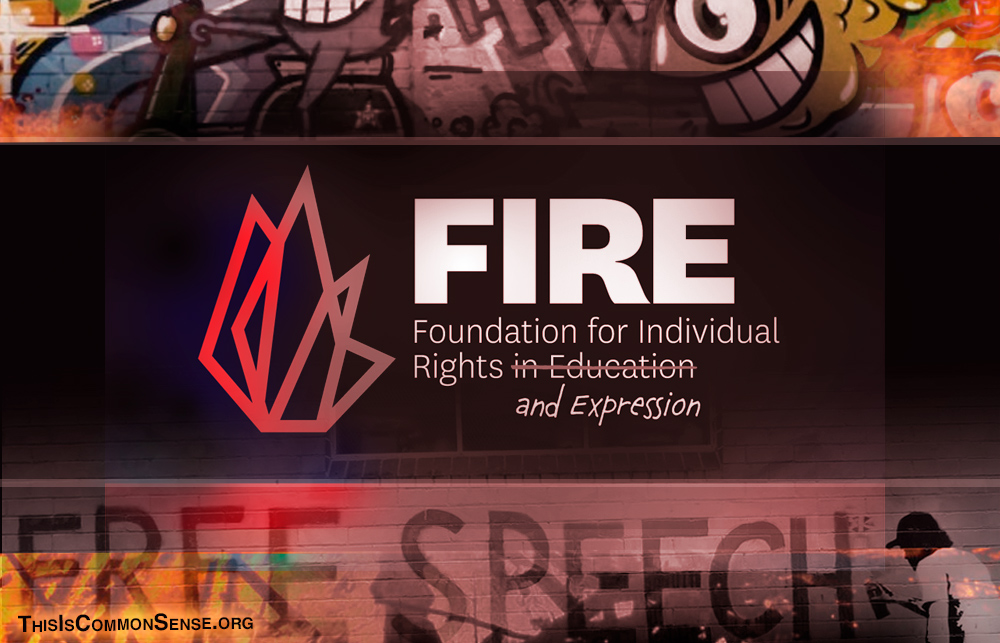
Fortunately, taking up the discarded banner is the Foundation for Individual Rights and Expression, until recently called the Foundation for Individual Rights in Education. The new name signifies an expanded mission. 

FIRE will — we are assured — still combat threats to freedom of speech at colleges and universities, where it has been doing excellent work for years.

“To say the least, we have not solved the campus free-speech problem,” says FIRE president Greg Lukianoff. “But we started to realize if we wanted to save free speech on campus we have to start earlier and we have to do things not on campus.”

Freedom of speech is for everybody. In its heyday, the ACLU defended people of all walks of life, and offended tyrants everywhere. Now that progressives generally and Democrats specifically have gone pro-censorship, FIRE is taking up the cause of civil libertarianism.

Someone needed to.

This is Common Sense. I’m Paul Jacob.


PDF for printing

See all recent commentary
(simplified and organized)
See recent popular posts
Categories
First Amendment rights general freedom ideological culture Internet controversy

Two Thumbs Up for Netflix

Although a new “Artistic Expression” section in Netflix’s culture memo could be improved, I’m giving it two thumbs up instead of the customary one and a half accorded to promising but imperfect credos.

In these censorious times, why not applaud any sincere testament upholding freedom of speech?

Even if called “diversity,” in Netflix-speak.

According to the revised memo, the company supports “a diversity of stories, even if we find some titles counter to our own personal values. . . . If you’d find it hard to support our content breadth, Netflix may not be the best place for you.”

This is probably not about Netflix’s willingness to rent The Wizard of Oz no matter who objects to the spectacle of weepy tin men or broom-riding green-faced women in pointy hats.

Recently, Netflix has been roiled by employee protests against videos they find annoying, especially Dave Chapelle’s comedy special “The Closer.” Chapelle, who appears to lean more left than right, turns out not to be the type to run his riffs by a lefty censorship board.

Now let’s see how Netflix follows up on its delicate suggestion that working for Netflix “may not be the best place” for employees demanding censorship. Will Netflix show the door to all sullen saboteurs of speech-diversity?

Also, will it more fundamentally diversify its own original content?

In any case, good for Netflix for resisting the mob, for now. Until further notice, it’s two full thumbs up.

This is Common Sense. I’m Paul Jacob.


PDF for printing

See all recent commentary
(simplified and organized)
See recent popular posts
Categories
First Amendment rights individual achievement social media

A Failure of Trust

Why is the Federal Trade Communication threatening to investigate Elon Musk’s acquisition of Twitter?

The FTC is reportedly reviewing the Tesla CEO’s takeover of the forum and will soon decide whether to conduct an anti-trust probe of the transaction.

Musk hasn’t been entirely clear about his plans for Twitter now that he is on the verge of acquiring it. But we can expect that this avowed free speech absolutist will do his best to ensure that tweet-speech is much more open than it has been. He won’t label every statement he dislikes as “hate speech” or “misinformation” and forthwith expunge it.

And this, I’m pretty sure, is the problem.

Certainly, no new “monopoly” is in the offing. It’s not as if we lack social-media alternatives to Twitter — or that Musk already owns the alternatives. His other gigs pertain to electric cars, tunnels, and space flight.

The problem must be that government officials, too, expect that Musk will be a much better friend of unfettered speech than the previous Twitter insiders.

Officials expect — but also fear — that his Twitter won’t routinely terminate the speech of persons who dispute “official” doctrines about COVID-19, elections, or what have you.

To fear the prospect of a Musk-run Twitter is to fear open debate — debates that are unavoidable and should be welcome if we value citizen control of government.

But of course, those who seek to control us worry: if the people do not agree with them about what is and is not a fact, what is and is not the highest moral and political value, they might not stay in power.

This is Common Sense. I’m Paul Jacob.


PDF for printing

See all recent commentary
(simplified and organized)
See recent popular posts
Categories
First Amendment rights national politics & policies

Just Sue Already

Two state attorneys general, Eric Schmitt and Jeff Landry (of Missouri and Louisiana, respectively), are suing the federal government for colluding with Big Tech to suppress speech in violation of First Amendment rights.

Their recent filing quotes a ruling which argues that it“violates the First Amendment ‘if the government coerces or induces [a private entity] to take action the government itself would not be permitted to do, such as censor expression of a lawful viewpoint.’”

The plaintiffs observe that this has been happening for years, “culminating in . . . open and explicit censorship programs,” and they ask the court to permanently enjoin such unlawful conduct.

Separately, twenty attorneys general (including Schmitt and Landry) have sent a letter to Homeland Security Secretary Alejandro Mayorkas about the agency’s new board instituted to counter unapproved speech.

The AGs threaten to “consider judicial action” if Mayorkas doesn’t “disband this Orwellian Disinformation Governance Board immediately.”

According to the letter, the board “will inevitably have a chilling effect on free speech.”

It is, I suppose, conceivable that if a suit were filed the Biden administration would recognize that it can’t win and would dissolve the board immediately. So far, though, the administration has just been barreling ahead with bad policies unless and until legally thwarted.

So why are the AGs even bothering with a letter that must have even less effect than a filing?

Now the letter has been submitted. Fine. Give Mayorkas ten minutes to shut down the board. Has he shut it down? No.

Sue!

This is Common Sense. I’m Paul Jacob.


PDF for printing

See all recent commentary
(simplified and organized)
See recent popular posts
Categories
First Amendment rights free trade & free markets

Elon Musk Is Serious

Billionaire Tesla and SpaceX entrepreneur Elon Musk is showing the world how capitalism reforms wayward companies — like Twitter. 

It is done from within the system.

By stock ownership.

Becoming Twitter’s top stockholder — right after Musk told the Babylon Bee he just might have to buy Twitter to reform it — surely demonstrates serious intent.

But Twitter honchos have stressed that the mere advent of Elon Musk portends no major changes, a hint of things not to come. 

Moreover, a restriction on how many shares board members may purchase meant that had Musk joined Twitter’s board, he’d have been unable to ramp up the pressure for reform by becoming an even bigger stockholder.

So Musk chucked his original plan to join the board and decided, what the heck: If I do need to buy Twitter to fix its anti-speech policies, I better outright buy it. He has reportedly offered $43 billion.

He says: “I invested in Twitter as I believe in its potential to be the platform for free speech around the globe.” But he now realizes that the company in its current form will never be that platform. 

“Twitter needs to be transformed as a private company.”

A week ago we asked, “Will Elon Liberate Tweeting?

We’re still asking. Maybe the current owners love banning disagreement with themselves too much to give it up. 

Someone should tell them that are worse things to sell out for than open discourse and freedom of speech.

This is Common Sense. I’m Paul Jacob.


PDF for printing

See all recent commentary
(simplified and organized)
See recent popular posts
Categories
First Amendment rights ideological culture

Our Uncivil War

The New York Times admits it: “America Has a Free Speech Problem.” But the March 18 editorial, while trying carefully to distinguish one kind of speech issue from another, fails to acknowledge the full extent of the problem. 

The trouble, you guessed it, is partly a left versus right issue: “Many on the left refuse to acknowledge that cancel culture exists at all, believing that those who complain about it are offering cover for bigots to peddle hate speech,” which strikes me as a fairly accurate account. But the Times cannot help itself — the right must be made to seem worse. “Many on the right,” the editorial goes on, “for all their braying about cancel culture, have embraced an even more extreme version of censoriousness as a bulwark against a rapidly changing society, with laws that would ban books, stifle teachers and discourage open discussion in classrooms.”

Sans persuasive examples — the Times provides none — I reject this claim as a grave misunderstanding of current trends. What has been happening is not the banning of books, but the mere removal of them from public school libraries and/or curricula. 

“Stifling teachers” is not a thing, really. Taxpayer-funded teachers have no more right to teach anything they want than taxpayer-funded police have the right to enforce whatever laws they want.

The multi-racial backlash against the left, most recently in Virginia, was a movement of parents upset over cultural Marxist indoctrination on racial issues . . . taking the place of quality education. 

Something else the Times missed: the extent to which cancel culture has worked hand-in-hand with social media companies under the influence of partisans in Congress and the Deep State.

That being said, the Times does get something right: “When speech is stifled or when dissenters are shut out of public discourse, a society also loses its ability to resolve conflict, and it faces the risk of political violence.”

Yes, it’s a problem.

This is Common Sense. I’m Paul Jacob.


PDF for printing

See all recent commentary
(simplified and organized)
See recent popular posts
Categories
First Amendment rights general freedom media and media people moral hazard nannyism social media

Tom Paine Sues Facebook

The ghost of Thomas Paine is suing Instagram and Facebook.

Mr. Paine, the eloquent champion of the American Revolution who penned such zeitgeist-capturing volumes as Common Sense, The American Crisis, and The Rights of Man, is going to court to protest the indignity that these social-media forums recently inflicted upon his spirit by censoring his statement that “He who dares not offend cannot be honest.”

The statement comes from an op-ed Paine published in the April 24, 1776 issue of the Pennsylvania Journal: “Cato’s partizans may call me furious; I regard it not. There are men too, who, have not virtue enough to be angry, and that crime perhaps is Cato’s. He who dares not offend cannot be honest.”

Mr. Paine seems to be saying that persons of craven mettle often eschew the challenge of being standard-bearers of truth, especially when controversial matters are involved. Articulating such views forthrightly tends to offend — somebody.

The particular mentalities of censorious Facebook flunkies and algorithms are new to Mr. Paine, of course. But he is ready to fight.

“Tyranny, like hell, is not easily conquered,” he declares when asked to assess his prospects, “yet we have this consolation with us, that the harder the conflict, the more glorious the triumph. What we obtain too cheap, we esteem too lightly. . . . [I]t would be strange indeed if so celestial an article as FREEDOM should not be highly rated.”

If that be hate speech, Mr. Paine seems to suggest, make the most of it.

This is Common Sense. Happy New Year! I’m Paul Jacob.


PDF for printing

See all recent commentary
(simplified and organized)
See recent popular posts