Categories
education and schooling First Amendment rights

Signs of the Times

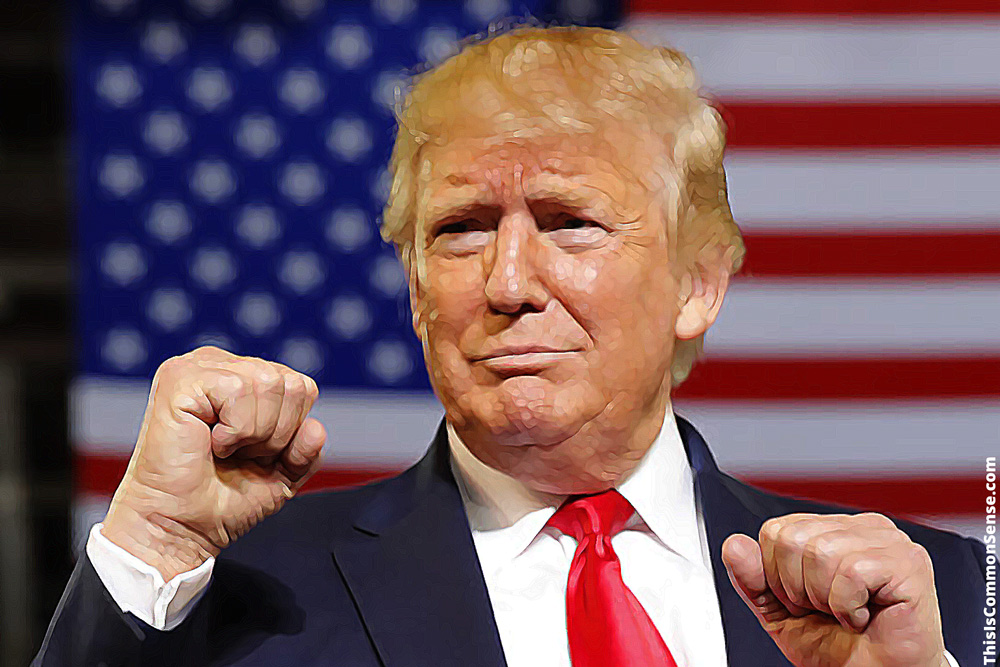
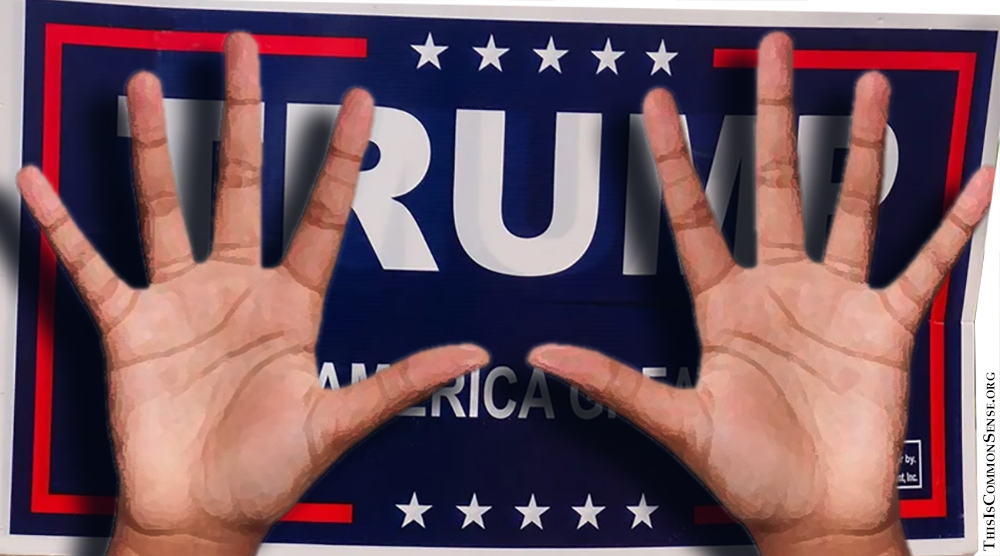
Texas A&M University’s Student Code of Conduct office is harassing a student for posting pro-Biden signs on campus last November.

Don’t believe it? 

Well, ya got me. The signs were pro-Trump, not pro-Biden.

I committed this small and fleeting deception to make a point. The fact that posting of signs, announcements, etc., on a university campus, including the Texas A&M campus, is nothing unusual. The kids these days (along with those of the last umpteen centuries) have always engaged in political debate on campus, trying to promulgate their views.

Doing so doesn’t typically cause big problems with officials of U.S. universities. Unless — and, alas, increasingly — the message being promulgated contradicts approved establishmentarian political themes.

According to a CampusReform.org report, Dion Okeke, president of Students for Trump, received a letter from the school’s Student Conduct Office saying he’d better meet with the Student Conduct office about posting the signs. Otherwise, he could face charges of improper student conduct, and his registration could be placed on “administrative hold.”

Universities doubtless have rules about sign placement. Okeke’s sign-posting sounds like a minor infraction at worst.

If it even was an infraction at all.

Are the veiled and not-so-veiled threats in the letter signed by Jessica Welsch, assistant coordinator of the Student Conduct Office, a proportionate response to any alleged sin by Dion Okeke? No.

Meanwhile, a Texas A&M student who perpetrated a hoax about alleged racism last summer is not in any trouble with the school.

This is Common Sense. I’m Paul Jacob.


PDF for printing

See all recent commentary
(simplified and organized)
See recent popular posts

Categories
initiative, referendum, and recall national politics & policies term limits

The Next Election

“If Tuesday’s vote sparks unrest,” a weekend Washington Post feature informed, “customers at Fortitude Ranch will be secure behind walls patrolled by armed guards.”

The Post highlighted a pricey survivalist “get away” in West Virginia and hyped for the rest of us “that violence could erupt, especially if the vote count drags on for days without a clear winner.”

Just as an aside, doesn’t it seem like we are getting less information about what happened yesterday and a lot more “news” about what is going to happen tomorrow? 

Anyway, I think we can trust each other. We’ve got to. Not on TV, but in real life. 

Part of that trust is believing that one election loss won’t alter all previous societal norms [cough: court-packing]. Yes, elections have consequences, but in a free country, losing an election should not be a scary event. Look at me, I have only voted for one winning candidate in my entire life!!!*

Whatever happens tomorrow . . . or days or weeks later . . . don’t worry. You have rights and there shall be another election before too long. Right? 

Rights?

“Eternal vigilance” being the rule about defending basic things like rights, the next election will always be the most important.

Ballot measures in Arkansas, Florida and North Dakota are about the next election. 

Sadly, dangerously, they seek to make it much harder and more expensive for citizens to petition issues onto the state ballot and gain an up or down decision from the voters. That’s why Citizens in Charge is fighting to defeat all three.

Proponents shriek that wealthy out-of-state interests must be stopped from changing the state constitution, but not a single word in any of the three amendments even touches on out-of-state funding. Instead, each makes the process more cumbersome and expensive, undercutting grassroots groups while having little effect on moneyed interests.

In North Dakota, voters passed a reform measure in 2018 creating a state ethics commission. The ballot issue was funded by an out-of-state group, and thoroughly despised by state legislators . . . who referred Measure 2 to the ballot.

Measure 2 allows the legislature to veto a vote of the people for a constitutional amendment and require the vote to be held a second time. Beyond the ugly optics of politicians vetoing the people, it will make passing an initiative amendment much more costly — again empowering wealthier interests at the expense of the less well-heeled.

In Florida, a constitutional amendment already requires a 60-percent supermajority vote. Amendment 4 would require the measure win a second time by that supermajority. In the nation’s third largest state, the expense of a second campaign weighs in favor of long-term established political interests and against grassroots reform.

In Arkansas, Issue 2 seeks to further weaken the already weakened term limits and Issue 3 endeavors to wreck the petition process to block a future term limits initiative. Previously, I’ve explained the duo of amendments as the “Lifetime Politicians Ruin Christmas Amendments.” Today, a “Trojan” Horse travels Arkansas telling the tale

Which is critical because Arkansas legislators refused to clue-in voters. The ballot titles that legislators placed on both measures tell voters precisely zero about the actual constitutional changes being voted upon. 

That our own representatives are attempting to knock out an important democratic check on themselves is not “the small stuff.”

We had better sweat it. 

And you can help Citizens in Charge fight back. It’s too late to do more toward tomorrow’s votes in Arkansas, Florida and North Dakota. With earned (free) media work and a shoestring budget of Facebook ads, we got our message out in all three states and have a shot to defeat each one.

Help us fight the new bills we know are coming as legislative sessions begin in January. Support our work with activists in Arkansas and North Dakota fighting Issue 3 and Measure 2, respectively, as they go on offense to demand change — perhaps by initiative.

Good luck to America tomorrow, but the campaign to prevent critical grassroots democratic checks from being hobbled and chopped and blocked continues. Because there is another election in 2022.

This is Common Sense. I’m Paul Jacob.


* And I still regret it. Who was it? Well, ours are secret ballots, but I will fully disclose the sordid details in the first three minutes of my podcast this weekend.

PDF for printing

See all recent commentary
(simplified and organized)
See recent popular posts

Categories
media and media people national politics & policies

Train or Dumpster?

If you sent Trump into a meeting with Xi Jinping, you’d worry that Trump might say something that maybe he shouldn’t. But you wouldn’t have to worry that China’s warlord would go “Wo-ho-ho! Would you sign this? And drink this?!?!” 

With Biden, well, you would worry, no?

That’s my prime takeaway of Tuesday’s terrible debate, which is near-universally described as a “train wreck” or “dumpster fire.” 

My “meta” take is that the debate format itself was doomed to derail or blow up in flames (depending on metaphor).

It started out with a reasonable “two minutes for you; two minutes for you” method, and then lurched into a free-for-all, with far too many interruptions and back-and-forth. 

You can tell when a moderator lacks control: he talks all the time. 

Chris Wallace talked too much. 

Did you notice that both debaters attempted to answer questions before they had been fully formulated? Once, twice, thrice . . . at first you wonder, “Hey guys, can you calm down a bit?” 

Of course,

  • it is hard to calm down in those situations, and
  • at a certain point you realize the problem lies with the person asking the questions.

Why, pray tell, is there a 62-part interrogative barrage?

To allow the questioner to sneak in something tangential but of a “gotcha” nature, of course — an element of some media-spun controversy. 

Must we select the moderator by sortition?

More structure seems a good idea. And gain the ability to turn off microphones.

Or do the opposite: Put both men in a studio all alone* with live mics and let’s see if they could negotiate the 90 minutes like adults. They might learn something.

And so might we.

This is Common Sense. I’m Paul Jacob.


* Maybe a couple security guards, too, just in case.

PDF for printing

See all recent commentary
(simplified and organized)
See recent popular posts
Categories
media and media people national politics & policies

Q & A & Q & A

Trevor Noah, interviewing presidential candidate Joe Biden a while back, had a juicy question near the end of his “Daily Social Distancing Show” with the Democrat pol. “Have you ever considered what would happen if the election result came out as you being the winner and Trump refused to leave?”

“Yes I have,” Biden confidently stated.

Then there is an obvious cut, and the video switches from side-by-side video-chat panels to the comedian in a Picture-in-Picture box with a full-screen Biden saying all the sudden:

And I was so damned proud. Here you have four chiefs of staff coming out and ripping the skin off of Trump. You have so many rank-and-file military personnel saying ‘whoa, we’re not a military state, this is not who we are.’ I promise you — I am absolutely convinced — that they will escort him from the White House with great dispatch.

This is hacky. Not stand-up comedian hacky — political hacky.  

Its function is transparent, being primarily a self-programing technique, which — in recent times — partisans use to convince themselves that their enemies, in this case the Evil Republicans, will stoop to anything

Allowing them to stoop to anything.

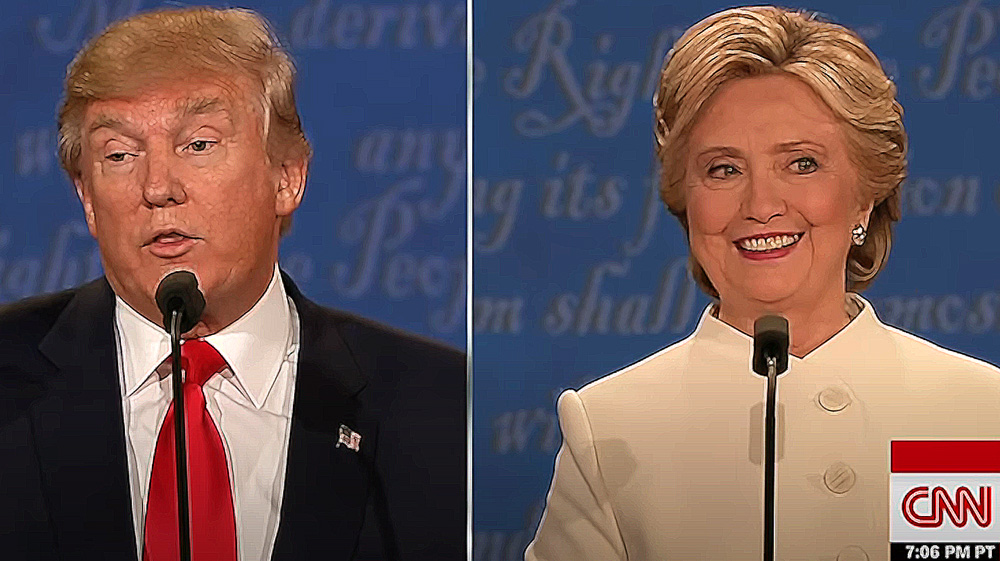
The crowning case of this idiocy came in 2016, when Democrats worked themselves into a frenzy over Trump’s flip answer to the debate question whether he would ‘absolutely accept the results of this election.’ 

Hillary Clinton grinned triumphantly when Trump gave his non-canned, iffily defiant response. Very Trumpian. 

But after Election Day, Clinton’s followers spent months and then years not accepting the results of the election. 

Clinton’s lingering Cheshire Cat smile rebukes her party.

And persistent questions like Trevor Noah’s.

This is Common Sense. I’m Paul Jacob.


PDF for printing

See all recent commentary
(simplified and organized)
See recent popular posts

Categories
crime and punishment national politics & policies

Frisky Friends

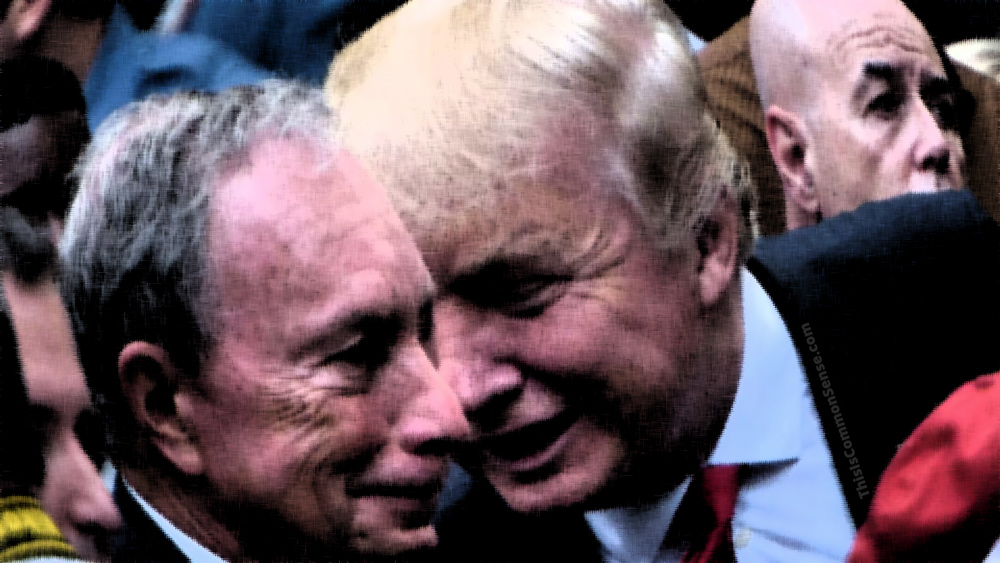
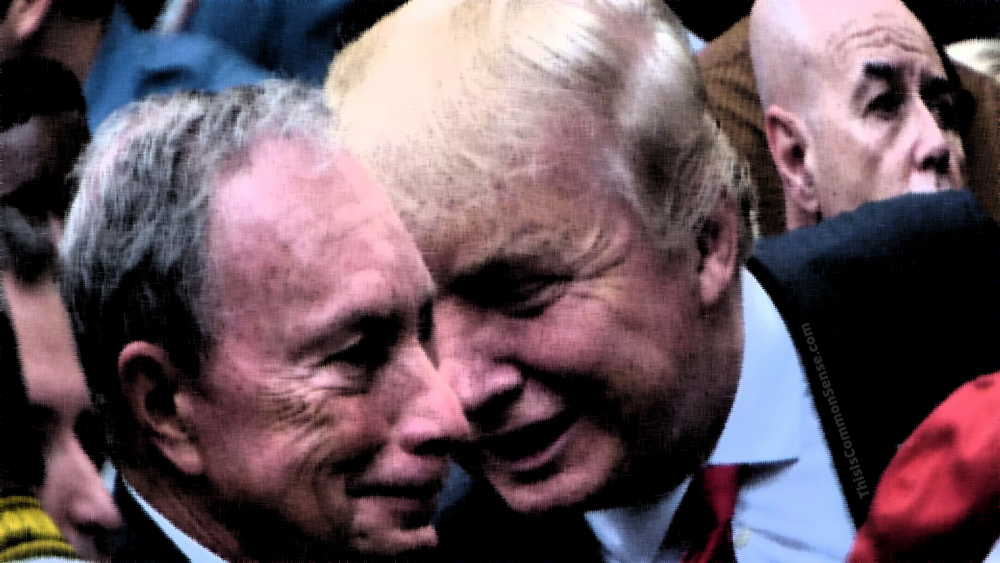
“WOW, BLOOMBERG IS A TOTAL RACIST!” tweeted President Donald J. Trump.

He was reacting to a recording, recently unearthed, of Democratic presidential aspirant Michael Bloomberg speaking to the Aspen Institute in 2015 about his controversial “stop-and-frisk” police policy while mayor of New York City.

“Ninety-five percent of your murders, murderers and murder victims fit one M.O.,” Bloomberg told his audience. “You can just take the description, Xerox it and pass it out to all the cops. They are male, minorities, 16 to 25. . . . that’s where the real crime is.”

“And the way you get the guns out of the kids’ hands,” explained Mayor Mike, “is to throw them up against the wall and frisk them.”

Bloomberg has since apologized for targeting young male minorities to be regularly detained, searched, harassed and thrown into walls by police on the basis of nothing more than being young male minorities. Ultimately, a federal court struck down Bloomberg’s program as an unconstitutional mass violation of Fourth Amendment rights. 

“We did it in New York, it worked incredibly well and you have to be proactive and, you know, you really help people sort of change their mind automatically,” Trump argued in 2016, floating a national roll-out and defending Bloomberg as “a very good mayor.” 

Back in 2009, Mr. Bloomberg and Mr. Trump were together on something else: Bloomberg disregarding a campaign promise and defying two clear citywide referendums to run for a third mayor term.

“Well, I’m not a believer in term limits,” Trump said then, adding, “Michael is a friend of mine.”

Funny, asked about then-Sen. Hillary Clinton, Trump offered, “I think she’s a wonderful women,” but “she’s a little bit misunderstood.”

Not long after posting the racist-baiting tweet noted above, the president deleted it.

We understand.

This is Common Sense. I’m Paul Jacob.


PDF for printing

Michael Bloomberg, Donald Trump, stop and frisk,

See all recent commentary
(simplified and organized)
See recent popular posts

Categories
national politics & policies

Much Ado in D.C.

The impeachment trial of President Donald J. Trump began yesterday, after much stalling by House Speaker Nancy Pelosi, who had postponed sending the House impeachment documents to the Senate after the finalization of the impeachment vote a month ago. Supreme Court Chief Justice Roberts swore in the assembled senators — 99 of 100 signed their oaths — and a schedule was announced.

The question of new documents and testimony remains a bit up in the air. “House Speaker Nancy Pelosi says a federal watchdog’s report on President Donald Trump’s freeze of aid to Ukraine makes it more important for Congress to get new testimony and documents,” according to the Associated Press. Seems odd that a trial would require more information than was present in the original indictment, er, impeachment, but I’m no scholar of the legality of this issue.

I do remember the last presidential impeachment.

And it was a real partisan — indeed, all-around — let-down. 

Interestingly, that trial was held around the time Bill Clinton was to give 1999’s State of the Union address. And he gave it, indeed, in the midst of the whole brouhaha. 

Defiantly.

What will President Trump do? What should he do?

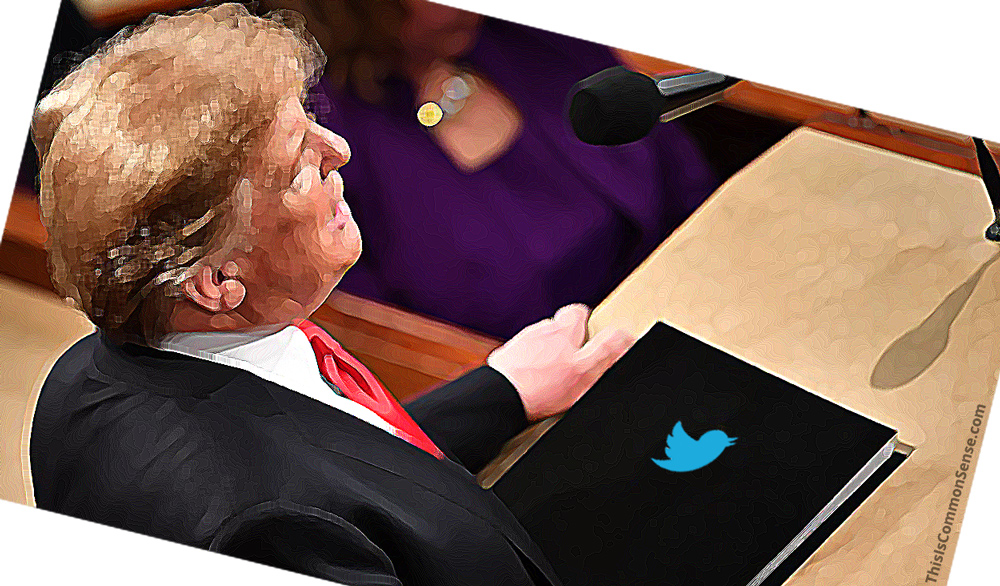
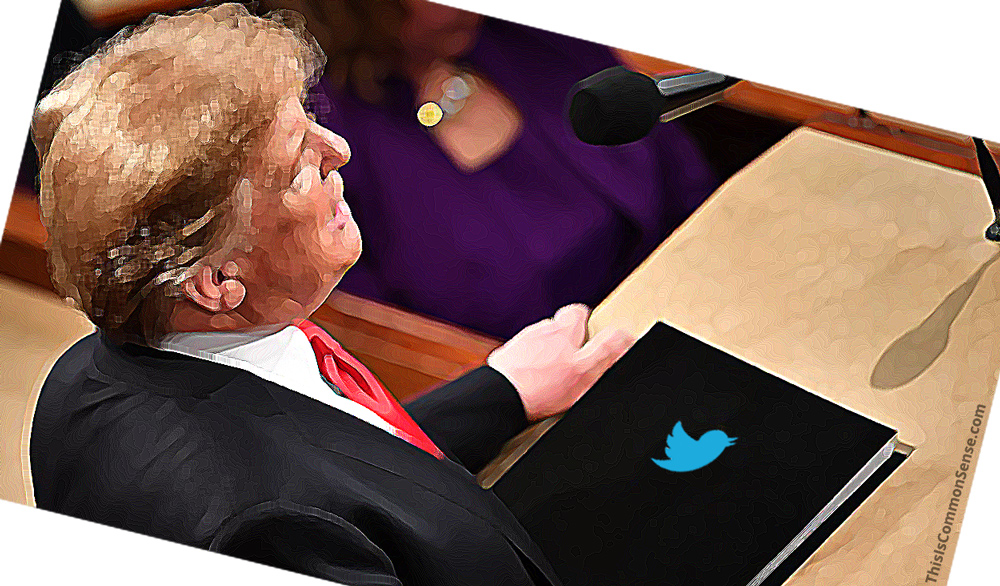
I don’t know. But I know what would be fun: deliver it via Twitter.

The Constitution, as I’ve noted before, does not specify a format of the annual presentation before Congress. Thomas Jefferson wrote it out and had it delivered. No speech at all.

But the idea of the Twitterer-in-Chief tweeting it and even not correcting the spelling errors? Priceless.

He could end with “Covfefe.”

This is Common Sense. I’m Paul Jacob.


PDF for printing

Donald Trump, State of the Union, Twitter, impeachment,

See all recent commentary
(simplified and organized)
See recent popular posts
Categories
national politics & policies

Impeachment Day, 2020

“The difference between this and parody?” asked Loserthink author Scott Adams, referring to Adam Schiff’s latest rationale for impeaching the president. His answer: no difference

“It’s completely merged.”

House Intelligence Committee Chairman Adam Schiff (D-Cal.), repeating a theme he had been pushing all week on talk shows, had tweeted to explain why the Democrats “had to move forward with articles of impeachment:

The threat persists. 

The plot goes on.

And Trump’s efforts to cheat in the next election will never stop.

The President — and his lawyer — continue to make the case for his own removal.

Scott Adams found it impossible not to see this as an appeal to ‘pre-crime’ to distract us from the paucity of evidence the two impeachment committees had collated. 

After yesterday’s deed had been done, Schiff castigated Republicans for failing to vote for the “historic” impeachment. “They have made their choice and I believe they will rue the day that they did.” 

Adams thinks it will be Schiff to rue Impeachment Day, 2020. By genius or luck, President Trump has egged Democrats to do the one thing that will help him most: play Bad Boy and survive impeachment, making Democrats look ridiculous in the process.

He knows it: “It doesn’t really feel like we’re being impeached,” Mr. Trump said as the impeachment votes were tallied in the House, using the Majestic Plural. 

Only if the Senate convicts Trump will this scenario not help the president. 

“We” for Trump refers (obviously) to himself and the people . . . who voted for him.

But he had made a more telling remark earlier: “I’m the only politician in history that have [sic] kept more promises than I made.” 

Impossible? Sure. 

But funny.

The president’s Yogi Berra-ism was deliberately hyperbolic.

The Democrats’ form of comedy seems . . . less advertent.

This is Common Sense. I’m Paul Jacob.


PDF for printing

Adam Schiff, impeachment, Donald Trump,

See all recent commentary
(simplified and organized)
See recent popular posts
Categories
national politics & policies partisanship Popular

Between the Devil and the Deep State, See?

“If it turns out that impeachment has no sting, has no bite,” exasperated Princeton University professor Eddie Glaude, Jr., speculated on Meet the Press, “and we are in the aftermath, what it will mean is that there will be an unlimited, an imperial, executive branch that can do whatever it wants to do.”*

Per the “imperial presidency, actually, that ship sailed a while ago,” the American Enterprise Institute’s Danielle Pletka quickly responded. 

“I mean, it was a problem under George W. Bush. It was a growing problem under Obama. And it has come to its apotheosis under Donald Trump.”

There appears a left-right consensus among TV chatterers that, a Constitution of enumerated federal powers notwithstanding, the president can “do whatever [he] wants to do.” 

But considering what we are learning about “the interagency” machinations to take down the current imperator, the imperial guard may be as big a problem. 

Last week, Justice Department Inspector General Michael Horowitz released his report on the FBI’s investigation of the Trump campaign, code-named “Crossfire Hurricane.” Though the IG did not find conclusive evidence that political bias inspired the launch of the investigation, he did detail “many basic and fundamental errors” that “raised significant questions” . . . adding portentously, “we also did not receive satisfactory explanations for the errors or problems we identified.”

“[A]s as the probe went on,” reported The Washington Post, “FBI officials repeatedly decided to emphasize damaging information they heard about Trump associates, and play down exculpatory evidence they found.”

The evidence piles up: Washington is dangerously out of control, and our career-politician Congress can only muster to provide a constitutional check on the flimsiest grounds and partisan manner.

This is Common Sense. I’m Paul Jacob.


* Somehow Professor Glaude seems to have forgotten President Bill Clinton, who reached his highest ever public approval rating — 73 percent — in the aftermath of his 1998 impeachment by the then-Republican-controlled House. Been there, done that.

PDF for printing

Donald Trump, Imperial Presidency, President, crown,

See all recent commentary
(simplified and organized)
See recent popular posts

Categories
insider corruption

Another Impeachable Offense?

“Do me a favor: start buying agriculture.” 

That’s what President Donald J. Trump says he said to the Chinese in agreeing to Phase One of a U.S.-China trade deal.

Now, if China starts buying more American agricultural products, Trump might be aided in defeating his Democratic opponents next November.

“The biggest winners in the China trade deal announced Friday appear to be a key part of President Trump’s voter base: U.S. farmers,” Jon Healey wrote in the Los Angeles Times. “There’s nothing wrong with that, because Trump’s political interests coincide with U.S. national interests.”

But when President Trump asked Ukrainian President Volodymyr Zelensky for a favor, back during the now-infamous July phone call, a whole lot of people concluded that Trump’s desire to “get to the bottom” of the Bidens’ pungent possible corruption in Ukraine was not a harmony of interests between Trump and Americans.

Last week, his biggest critics on the House Judiciary Committee passed two articles of impeachment against him, alleging (1) that he abused his power in delaying the aid Congress had appropriated for Ukraine in order to push the Ukrainians to open up an investigation of Hunter Biden and Burisma, the Ukrainian energy company that hired him, and (2) obstruction of Congress, for refusing to adequately respond to congressional subpoenas.

An investigation launched by Ukraine into former Vice-President Joe Biden’s son would certainly be news — bad for Biden, currently the leading Democratic rival to the president; good for Trump.

But is such an investigation warranted

Surely Americans who voted for Trump to “drain the Swamp” would think corruption is always worth investigating. 

The Swamp — along with many good Americans — disagrees.

This is Common Sense. I’m Paul Jacob.


PDF for printing

Donald Trump, impeachment, swamp,

See all recent commentary
(simplified and organized)
See recent popular posts

Categories
media and media people

Zucker’s Scold

It was in bad taste.

The “meme” — an altered video — depicted extreme, murderous violence. But it was not “weaponized” as  incitement to real violence; it was, instead, “memeticized” contempt against the meme’s “victims,” the full panoply of media outlets along with a few iconic politicians.

The video was very popular over the weekend on social media. It took the church massacre scene from the first Kingsman movie, but with President Trump’s head placed over Colin Firth’s visage, crudely in “meme” fashion, and a few other heads put over other actors’, and the logos of major news outlets superimposed over most of the movie’s victims’ heads.

Cartoonish, yes, but done with élan.

Brooke Baldwin, however, is a paid agent of billionaire president of CNN, Jeff Zucker, and she has her marching orders, as revealed this week by a Project Veritas scoop. So she lit into the president in high moral dudgeon: “Mr. President, why is it taking you so long to condemn this video? You tweet all the time. I don’t want to hear from your press secretary . . . who says you strongly condemn the video . . . I want to hear from YOU.”

What Ms. Baldwin and her boss don’t get is that a growing swath of the American populace does not want to hear from a news reporter scolding demands that the president “condemn” things he had nothing to do with.

Trump didn’t make the meme, after all, nor had it made for him. 

Brooke Baldwin’s effrontery shows why someone might make a meme like the one in question. 

Not because you deserve to be killed, Ms. Baldwin, but because you deserve derision.

This is Common Sense. I’m Paul Jacob.


PDF for printing

Donald Trump, Kingsman meme

See all recent commentary
(simplified and organized)
See recent popular posts