Categories
First Amendment rights national politics & policies too much government

Free Jimmy

Last Friday (and Saturday), we supported the right of ABC’s corporate leaders to ignore bullying comments by Federal Communications Commission (FCC) Chairman Brendan Carr and produce the late-night show, “Jimmy Kimmel Love!” to their heart’s content.  

I’m happy to hear that ABC will bring Kimmel back tonight.

Not glad because I like him or will watch his show. I don’t. I won’t. I’d cancel him were it up to me. But freedom’s tops, so I get especially jazzed when people stand up to demand it. 

And concerned when those in power attempt to take it away.

The very potent public backlash against the idea that ABC was muscled by the Trump administration into suspending Kimmel’s show is why it has returned. That’s a healthy sign of our political culture. Plus, take note that this pushback against the FCC chairman and President Trump hasn’t come just from the Left but also, as The Wrap reports, from many prominent conservatives including “Tucker Carlson, Ben Shapiro and Ted Cruz.”

What Kimmel alleged — that the murderer of Charlie Kirk was somehow MAGA — was not only “without evidence” but clearly contradicted by the evidence. As well as being asinine on its face. And more than a bit callous.

Still, freedom of speech means the freedom to say what you think, no matter how boneheaded, whether those in power like it or not. 

Sinclair Broadcast Group, owner of the largest chain of ABC affiliates, has already announced that its stations will not be airing Kimmel’s program. As is their right.

Stick with freedom of speech, Mr. President. For all.

This is Common Sense. I’m Paul Jacob. 


PDF for printing

Illustration created with Krea and Firefly

See all recent commentary
(simplified and organized)
See recent popular posts

Categories
free trade & free markets regulation tax policy

The New Old Coke

The President of these United States famously drinks Diet Coke.

Despite his preference, however, it’s regular Coca-Cola he’s making waves about.

“I have been speaking to Coca-Cola about using REAL Cane Sugar in Coke in the United States, and they have agreed to do so,” Donald Trump wrote on Truth Social last week. 

The Atlanta-based company has confirmed the story, but it will not be removing High Fructose Corn Syrup (HFCS) Coke from the market. 

What will change? 

“Mexican Coke” (made from refined cane sugar) is available in glass bottles right now, for a premium, in many venues. In effect, Trump is merely helping promote this currently U.S.-made product, allowing it to sit next to regular Coke just as aspartame-sweetened Diet Coke competes on the shelf with Coke Zero, which is made with a blend of artificial sweeteners, including aspartame and acesulfame potassium (Ace-K).

Maybe all Coca-Cola will really do is re-brand Mexican Coke.

To “Trump Coke”?

“I’d like to thank all of those in authority at Coca-Cola,” added the president. “This will be a very good move by them — You’ll see. It’s just better!”

Matters of taste aside, cane sugar may be marginally healthier for you than HFCS. Invented in the Fifties and Sixties in labs, it has been pushed by the USDA, which regulates its prices (as Matt Damon’s 2009 comedy The Informant! makes clear). But both are sugar, if slightly different, chemically.

Behind the proposal to switch to HFCS lies a broader reality: domestic refined cane sugar production from states like Hawaii, Florida, and Louisiana falls short of U.S. consumption needs, while protectionist policies keep its price significantly above global market levels.

For some reason, Donald Trump hasn’t been talking about reducing the sugar tariff!

This is Common Sense. I’m Paul Jacob.


PDF for printing

Illustration created with Krea and Firefly

See all recent commentary
(simplified and organized)
See recent popular posts

Categories
deficits and debt partisanship too much government

Upstart?

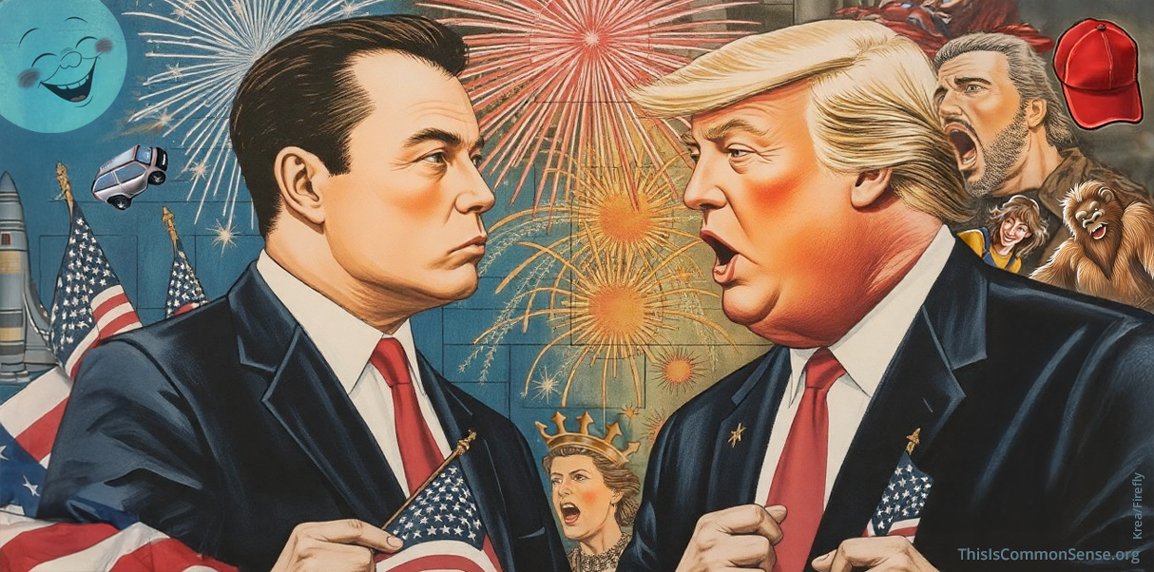
The spectacular fallout between Donald Trump and Elon Musk over the Big Beautiful Bill in particular (but deficit spending and debt accumulation in general) promises political watchers a big, ugly brawl.*

Now, billionaire Musk appears to be serious about his proposed “third party,” the “America Party.” A name perfectly designed to ruffle Trumpian feathers. It might steal some of the thunder of “America First” and “Make America Great Again.”

The president mocks the notion, saying that third parties “have never succeeded in the United States.”

Well, that is not exactly true. For a long time, it was second parties that had problems. 

The first party, the Federalists, basically lost for a generation, finally withering away against the onslaught of that most American party of all, the Democratic-Republican. 

When the victorious party reformed under the leadership of Andrew Jackson and Martin Van Buren to become the Democratic Party, the Whig Party emerged to counter-act Jackson’s imperial presidency. The Whigs had some success — if with a string of presidents almost no one remembers — only to lose ground to Democrats and then a whiggish replacement, the Republican Party.

Yes, Trump’s own party was a “third” party once.

And it achieved power largely because the Democrats split into two for the 1860 election, leaving a sectional plurality candidate (Abraham Lincoln) to win the Electoral College as a Republican.

In modern times, Republicans and Democrats have ably squelched challenger parties

So Trump’s right — in spirit.

Now enter Andrew Yang, enthusiastic for the upstart. But how can his Universal Basic Income agenda fit with Elon’s fight against over-spending? 

This is Common Sense. I’m Paul Jacob.


* Though, some wonder if the Trump-Musk feud isn’t all an act.

PDF for printing

Ilustration created with Krea and Firefly

See all recent commentary
(simplified and organized)
See recent popular posts

Categories
insider corruption scandal

The Devil and the Deep Blue Dress

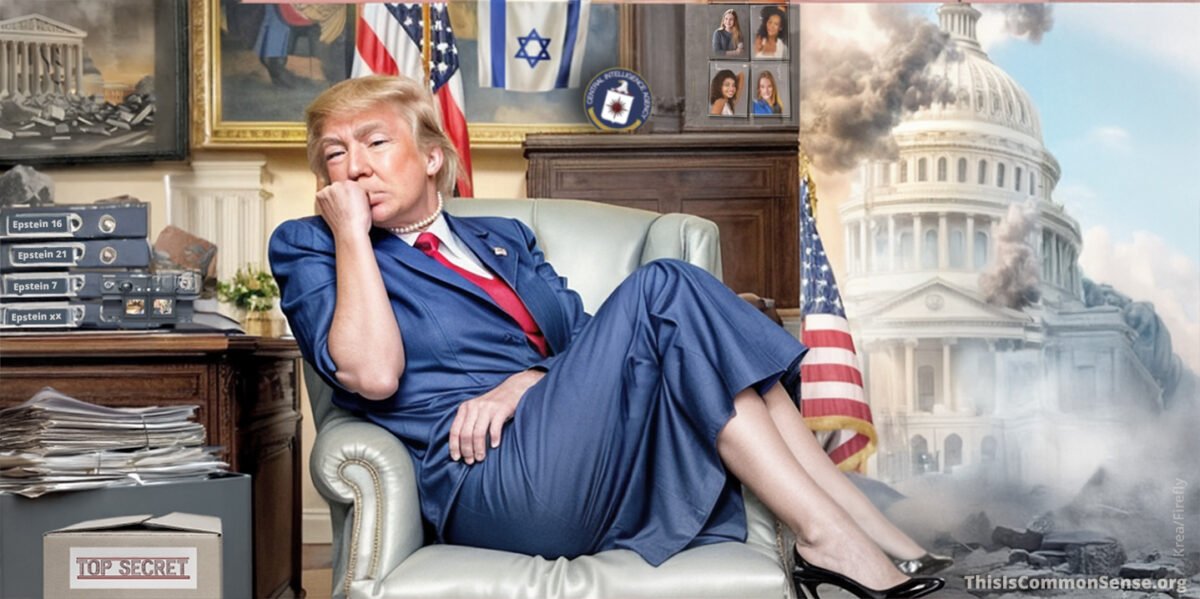
There is a slim possibility that Jeffrey Epstein did actually kill himself, but what possibility is there that he wasn’t running an elaborate blackmail/spy endeavor — a “honey pot” scam — for major Deep State outfits, foreign or domestic?

Or both.

So when Axios scooped everybody, Monday, with the story that the FBI had closed the Epstein case, most rolled their eyes. Not that they didn’t believe Axios. They didn’t believe the aptness of judgment in closing the case.

Even if Epstein did actually commit suicide, it was still a huge criminal justice failure for that act to not have been prevented. And for the notorious Epstein files (remember that the Attorney General had said she had them on her desk) to suddenly go poof! . . . does not inspire confidence. 

Frankly, there’s no reason to trust the government. Especially on this.

Why? We all pretty much believe the initial reports. We remember the image of Bill Clinton — it is surely seared into many a brain, alas for those brains — posing in a blue dress, portrait hung up prominently in Epstein’s trap, I mean, townhouse.

The ties to Israeli intelligence and politics and U.S. spymasters has been fairly well established — at least Whitney Webb’s readers seem certain — and that brings us to the bottom line:

Donald Trump is not shining light upon the Stygian Deep State here, nor “draining the swamp.”

“I can’t believe you’re asking a question on Epstein,” the president said, interposing himself between a reporter and Attorney General Pam Bondi. Trump eagerly added context: all the “successes” and “tragedies” of the current day. Videos? Computer files? Victims? Lolita Island? Brushed aside.

As if unimportant.

Thus America’s unexpected encounter with the dark, Deep State. They insist we blithely accept that there is nothing to see here.

This is Common Sense. I’m Paul Jacob.


PDF for printing

Illustration created with Krea and Firefly

See all recent commentary
(simplified and organized)
See recent popular posts
Categories
free trade & free markets international affairs tax policy

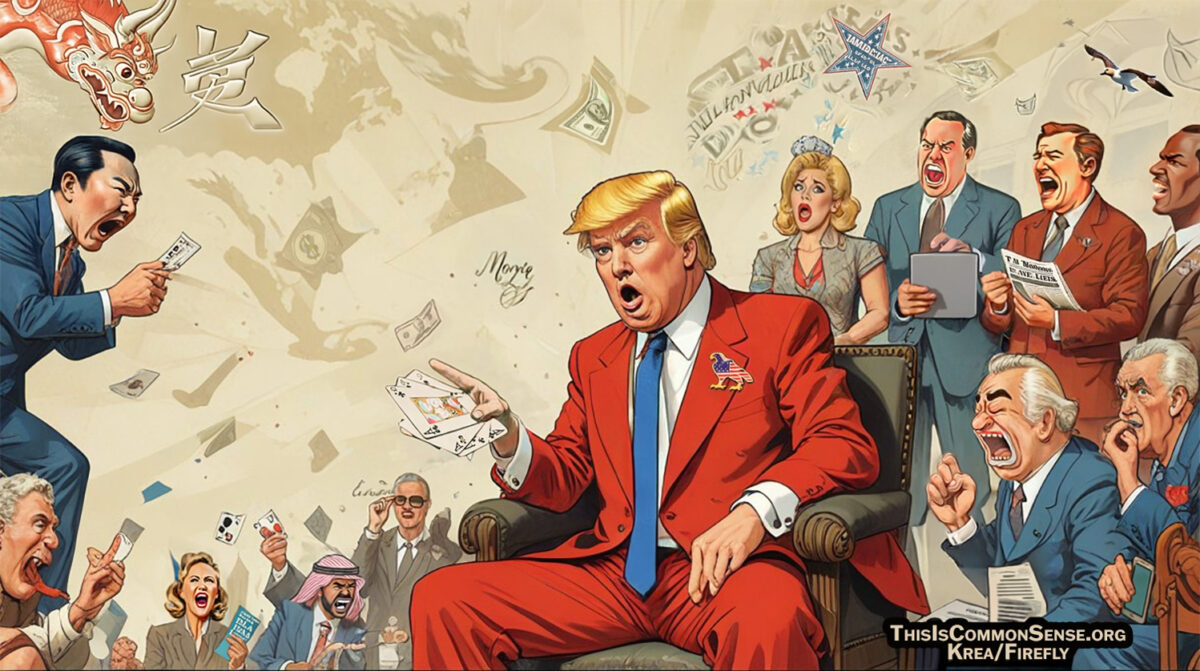
The Tariff King

The fight over the president’s tariffs is taking place in Congress. 

Or is it?

“House Republicans blocked on April 9 an effort by Democrats to force a vote on halting the reciprocal tariffs imposed by President Donald Trump,” explains The Epoch Times, “which are currently paused for three months.”

Let’s make that clearer. These now-infamous/much-debated “reciprocal tariffs” went “into effect” immediately after midnight yesterday. As Republicans “sneakily” worked to change the rules to disallow any congressional move to dissolve the president’s declared emergency — which, by Congress’s own legislation, gives the executive a great deal of latitude to change tariff rates — and Democrats moved to do just that, get rid of the “state of emergency,” President Trump put most of his tariff hikes on hold for three months.

Except for those on China — now in effect, at a rate of 125 percent.

It sure looks like Trump’s main concern is trade relations with China, not Lesotho or Israel or anywhere else. And much can be said about China’s trade policies (try selling American consumer goods in China) or respect for intellectual property. But it is the matter of constitutionality that interests me most.

Whatever the alleged merits of high tariffs, unilateral free trade, or any of these issues, these policies should not be decided by the president; the Constitution gives Congress the responsibility “to lay Taxes, Duties, Imposts and Excises” and “regulate Commerce with foreign Nations.”

By handing the president “emergency” powers to change tariff policy in the first place, Congress has abdicated its role in setting tax policy. Republicans in the House seem gung-ho about Trump’s prerogatives. And Democrats haven’t sought to repeal the International Emergency Economic Powers Act, which gives the president legislative taxing authority.

Apparently, Congress wants the president to be king.

This is Common Sense. I’m Paul Jacob.


PDF for printing

Illustration created with Krea and Firefly

See all recent commentary
(simplified and organized)
See recent popular posts
Categories
media and media people national politics & policies

Praying to the Deep State

The Deep State does not exist.

How do we know?

If it did exist, it would have stopped Trump’s tariffs!

Welcome to modern political theology and ideological theodicy — by way of late-night “comedic entertainment.”

Because of Trump’s tariffs, “we’ve had the worst day for our economy since Covid,” quipped Stephen Colbert on Thursday’s Late Show. “Just a reminder: this time he’s the disease.”

I found his setup somewhat funny, goofy looks and all, and I don’t usually find Colbert funny. But as the bit progressed . . .

“It’s all pretty solid proof that there is no Deep State.”

I’ve already given away his punchline, because it was not so much funny as eye-roll-worthy.

“Because if there was, they would have stopped this s**t.”

The assumption here is that, by definition, the Deep State must be omnipotent. While we can point to existing institutions working under the new rubric of “Deep State,” it’s never been all-powerful. It’s just very powerful, working in mysterious (secret) ways.

“But if they do exist,” Colbert continued, “I just want to say to the cabal of financial and governmental elites who pull all the strings behind the scenes, ‘maybe put a pause on your 5G chip/JFKjr/adrenochrome/chemtrail orgy and jump in here cuz we’re f**king dying!’”

Here’s the deal: Trump was hounded with unprecedented state surveillance, impeachments, lawfare, and speech suppression . . . and dodged bullets from assassins. While we know nothing, if we catch a whiff of anything it’s that “non-existent” Deep State.

So begging it to take out Trump is . . . late-in-the-game.

The cabal has already tried. Many times. And failed. Proving itself perhaps more desperate than competent.

This is Common Sense. I’m Paul Jacob.


PDF for printing

Illustration created with Krea and Firefly

See all recent commentary
(simplified and organized)
See recent popular posts

Categories
free trade & free markets international affairs tax policy U.S. Constitution

Legal Trade War

Donald Trump’s imposition and changing of tariffs, all by his lonesome — without Congress — vexes more than a few critics.

His authority to do this, however, derives directly from laws passed by Congress.

The U.S. Constitution gives Congress the power to “lay and collect Taxes, Duties, Imposts and Excises” under Article I, Section 8, which includes tariffs, since they are taxes on imported goods. But Congress has legislated hand-offs to presidents, allowing significant flexibility on tariffs.

The idea seems to be that, as Commander-in-Chief, the president should handle trade because . . . like war, it has to do with foreign countries.

Laws allowing presidential discretion include Section 232 of the Trade Expansion Act, Section 301 of the Trade Act of 1974, and the International Emergency Economic Powers Act of 1977. 

The first says that the president has broad discretion to define as threats to national security all sorts of things and then impose tariffs and other trade restrictions in response.

The 1974 legislation authorizes further along Trump’s favored line, the power to retaliate against “unfair” foreign trade practices.

The IEEPA grants sweeping powers in a declared national emergency.

So if free traders and others are alarmed at Trump’s seemingly dictatorial powers regarding tariffs, it isn’t new. It has been built into the Imperial Presidency. While Congress could take its constitutional authority back, there is certainly no groundswell to do so.

Also not new?

What setting up high tariffs have historically done: elicit similar tariffs in retaliation. 

Yikes: the kind of trade war that made the Great Depression “great.”

This is Common Sense. I’m Paul Jacob.


PDF for printing

Illustration created with Krea and Firefly

See all recent commentary
(simplified and organized)
See recent popular posts
Categories
education and schooling national politics & policies Tenth Amendment federalism

Nixon & Trans Athletes

The President of the United States clashed with the governor of Maine over transgender participation in government-organized athletics. Quite a hoot.

Behind this fracas looms the legacy of . . . Richard M. Nixon.

First, the fracas: “In a tense exchange with Maine Democratic Gov. Janet Mills, President Donald Trump threatened to strip Maine of its federal funding,” explains CNN, “if the state refuses to comply with his executive order banning transgender women from competing in women’s sports.”

The brief volley of promises (threats) between the governor and the president made other governors “uncomfortable.” Yes, that’s a news story.

“Is Maine here?” he wondered aloud. “The governor of Maine?”

“Yeah,” Gov. Janet Mills answered from across the room. “I’m here.”

And then came a testy political exchange, the kind you don’t often see, culminating in this from Trump: “You better comply, you better comply, because, otherwise, you’re not getting any federal funding.” 

“See you in court,” she promised.

“Good; I’ll see you in court. I look forward to that. That should be a real easy one. And enjoy your life after governor, because I don’t think you’ll be in elected politics.”

Trump may not be wrong. He may have the better legal case.

But doesn’t it seem weird that the president of the United States can extort compliance from the states on matters that are not enumerated in the Constitution?

Well, back in his first term Trump signed an executive order to direct a new devolution process of turning back education to the states. But the transgender issue is a big deal, and most Americans (around 80 percent) are against “biological” “men” competing with girls and women in sports, and since much of sports in America takes place in state-directed/taxpayer-funded contexts, Trump is leveraging federal bloc grants against states that balk at his agenda.

Thank Nixon and his “New Federalism.” While an attempt to give power back to the states, it also tied federal money to the devolution, which has effectively turned states into welfare queens begging big bucks off Washington, severely compromising the states’ . . . basic competence.

It’s this policy that Trump should be fighting.

But that would make governors even more uncomfortable.

This is Common Sense. I’m Paul Jacob.


PDF for printing

Illustration created with Krea and Firefly

See all recent commentary
(simplified and organized)
See recent popular posts
Categories
ideological culture

The Libertarian Path?

Donald Trump is launching so many initiatives to curtail government power and its abuse that even students of policy find it hard to keep up. I don’t always agree with what he’s doing, but I often do. Sometimes, a hundred percent.

In his second term, President Trump is following what Glenn Reynolds calls a libertarian path. 

Say, what?

There has long been a libertarian streak in the Republican Party — from even before Goldwater’s 1964 presidential run — but once in power, Republican politicians rarely did any streaking.

Trump was different at the start, more immune to many of the left’s vicious tactics. But Trump 2 (2025- ) is still different from Trump 1 (2017-2021).

One difference between 2017 and now is that in the intervening years, Trump’s ideological enemies have slugged him with impeachments, every possible kind of bogus investigation and lawsuit, rigged various parts of the 2020 election, robbed him of many millions of dollars, and threatened him with imprisonment.

“Trump saw firsthand, to a degree greater than probably any American citizen ever, just how far the resources and lack of principles or moral fiber of the federal government go,” writes Reynolds. “It would be very difficult to remain a believer in Big Government . . . after that.” 

Reynolds echoes Trump’s declaration at the Libertarian Party convention last May about the consequence of his persecution: “If I wasn’t a libertarian before, I sure as hell am a libertarian now.”

One Trump foe complains that his second term “is all about curtailing government’s power and reach.”

Yes. We know. Feature, not a bug.

This is Common Sense. I’m Paul Jacob.


PDF for printing

Illustration created with Krea-Realtime and Firefly

See all recent commentary
(simplified and organized)
See recent popular posts
Categories
First Amendment rights national politics & policies

A Free Speech Order

“Will President Trump be a free speech president?”

On January 21, David Keating, president of Institute for Free Speech, asked this question. And he refers the reader to his Wall Street Journal op-ed published last month in which he offered suggestions about how to stop the federal government from censoring people via social media or in other ways.

The new president sure seemed to get off to a good start restoring the First Amendment. One of his thirty or so executive orders signed on the 20th, his first work day, is entitled “Restoring Freedom of Speech and Ending Federal Censorship.”

Section 2 says that it is U.S. policy to “secure the right of the American people to engage in constitutionally protected speech,” ensure that no federal employee or agent “engages in or facilitates” unconstitutional abridgement of speech, and “identify and take appropriate action to correct past misconduct by the Federal Government related to censorship of protected speech.”

Section 3 says no federal employee or department may act in a manner inconsistent with Section 2.

Maybe this broad order needs to be supplemented with many more specific orders that say: Really. Don’t engage in censorship here or there or anywhere.

This is where specific suggestions like Mr. Keating’s come in handy, such as preventing the IRS from penalizing taxpayers for criticizing political candidates, repealing SEC limits on political donations, and instituting specific regulations to “force disclosure of most government contacts with social-media organizations asking to take down third-party posts,” thereby scuttling most future such contacts.

It’s a start. Let’s keep going.

This is Common Sense. I’m Paul Jacob.


PDF for printing

Illustration created with Flux and Firefly

See all recent commentary
(simplified and organized)
See recent popular posts