Categories
ideological culture national politics & policies political challengers

Double Bubble America

The “unexpected” Donald Trump presidential victory has put the folks at The Gray Lady a bit out of sorts.

Heather Wilhelm at the National Review pokes and prods at the absurdities of the New York Times’s cultural cluelessness. And ably enough. So I’ll stick to The Times’s recent “six views” of America’s ideological divide:

Julie Turkewitz recognizes two well-insulated informational bubbles at play. Nothing too controversial — or very deep.

Campbell Robertson muses upon the dominance of the “elites” against which Trump’s insurgents rebel, noting that “the elites are the still the ones who get to decide who gets to be elite.”

Laurie Goodstein takes on religious culture, making much of divergent spiritual outlooks, left and right.

Julia Preston peers at immigration and the prospect of sending a message by building a “wall.”

In the manner of the other five, Sheryl Gay Stolberg digs up real-world people — as does our speechifier-in-chief, Barack Obama — to lightly probe questions of assimilation versus multiculturalism.

Manny Fernandez concludes with a (yawn) discussion of giving and taking offense.

They all miss the underlying structural basis for the divide.

On one side: folks working in the private sector — or local governments and charities, or at home — who have seen the world pass them by in terms of income and security.

On the other: government workers and consultants (and other college grads) who make more, on average, than their “real world” counterparts.

The latter has advanced as a class; the former remain in stasis . . . at best.

A mystery?

No — it’s the predictable result of what Thomas Jefferson called “the parasite institutions now consuming us.”

This is Common Sense. I’m Paul Jacob.


Printable PDF

bubble, Trump, election, reasons, explanations, illustration


Original (cc) photo by diana MĂRGĂRIT at Flickr


Categories
Accountability ballot access general freedom incumbents initiative, referendum, and recall national politics & policies political challengers responsibility too much government U.S. Constitution

Votes Without Poison

Strange election. So . . . round up the usual suspects!

Immediately after Hillary dried her tears and conceded, out came the Tweets, then the analyses: the “third parties” are to blame!

Over the weekend, I focused* on one such election post-mortem. The basic idea is not altogether wrong: minor party efforts together may have cost the Democrat her Electoral College advantage this time around, just as Nader’s Green Party run spoiled Al Gore’s bid in 2000 and several past congressional races have been spoiled for the GOP by Libertarians.

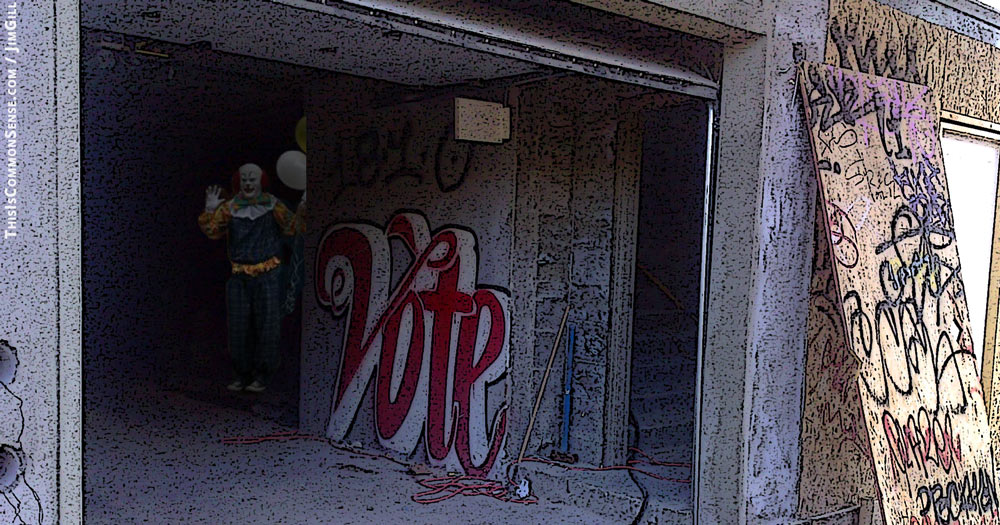
Is there a problem here? Yes. But do not blame the minor party voters. It’s the way we count their votes that is “problematic.” The current ballot-and-count system turn voters most loyal to particular policy ideas into enemies of those very same ideas.

When we minor party voters turn away from a major party — usually because said party tends to corrupt or betray our ideas, or make only small steps toward our goals — our votes aren’t so much wasted as made poisonous.

Because the candidate least preferred may prevail.

But there’s a way out: On election day, voters in Maine showed how to cut through the Gordian Knot. Voting in approval for Question 5, Maine now establishes “ranked choice voting.”

Under this system, you don’t “waste” your vote when expressing a preference for a minor party candidate. You rank your choices and, if your first choice proves unpopular, your second choice (or maybe your third) gets counted. So you don’t “poison” your cause.

Republicans and Democrats have more than enough reason, now, to adopt ranked choice voting across the country.

This is Common Sense. I’m Paul Jacob.
 

* See yesterday’s links page to my weekend Townhall column for the basic references. But there were many, many articles on the Minor Party Effect, including a skeptical one by Sasha Volokh’s.


Ask the next question.

Questions Answered:

What is the effect of minor parties on major party outcomes?

What causes those effects, voter intent or something else?

Is there a way to prevent this, short of further sewing up the ballot access system to minor parties?

The Next Question:

What might our elections look like if people spent more time discussing issues and ideas … and less about class, culture wars, and sex crimes?


Printable PDF

ranked choice, vote, voting, democracy, clown, illustration


Categories
Accountability general freedom ideological culture moral hazard national politics & policies political challengers responsibility too much government U.S. Constitution

The Wisdom of the Founders

“At a certain point, you have to let go for the democracy to work,” President Barack Obama told HBO’s Bill Maher last week, praising “the wisdom of the founders.”

“There has to be fresh legs,” he continued. “There have to be new people. And you have to have the humility to recognize that you’re a citizen and you go back to being a citizen after this office is over.”

Maher failed to ask Mr. Obama how this “fresh” viewpoint squared with his support for Mrs. Clinton. Nevertheless, let’s applaud the president’s endorsement of term limits.

Speaking of the founders, and limits on power, and this being Election Day, I’m reminded of a commentary in Forbes, back on Election Day four years ago, written by Ed Crane, the man who built the Cato Institute into one of the nation’s preeminent think tanks. Bemoaning the “interminable presidential race,” Crane wished for “a nation in which it really didn’t matter who was elected President, senator or congressman.”

“Don’t get me wrong, because I’m not saying it doesn’t,” explained Crane, “only that it shouldn’t.” He added, “I believe the Founders had a similar view.”

His point is simple: Getting to vote for your next president and senator and congressman is swell, but it’s important to have a Constitution that restrains those elected, so they “don’t have a heck of a lot of power over you or your neighbors.”

“We are a republic of limited governmental ­powers,” or should be, argued Crane. “Such a nation allows for sleep on election night.”

Instead of gnashing of teeth.

This is Common Sense. I’m Paul Jacob.


Printable PDF

Constitution, voting, democracy, Ed Crane, fear


Categories
Accountability ballot access incumbents moral hazard national politics & policies political challengers responsibility

Vote Early & Often?

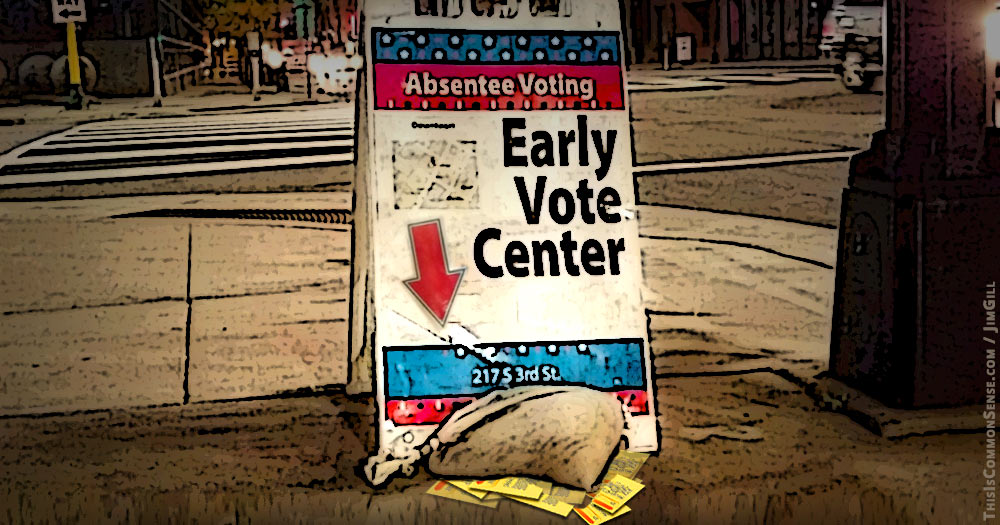
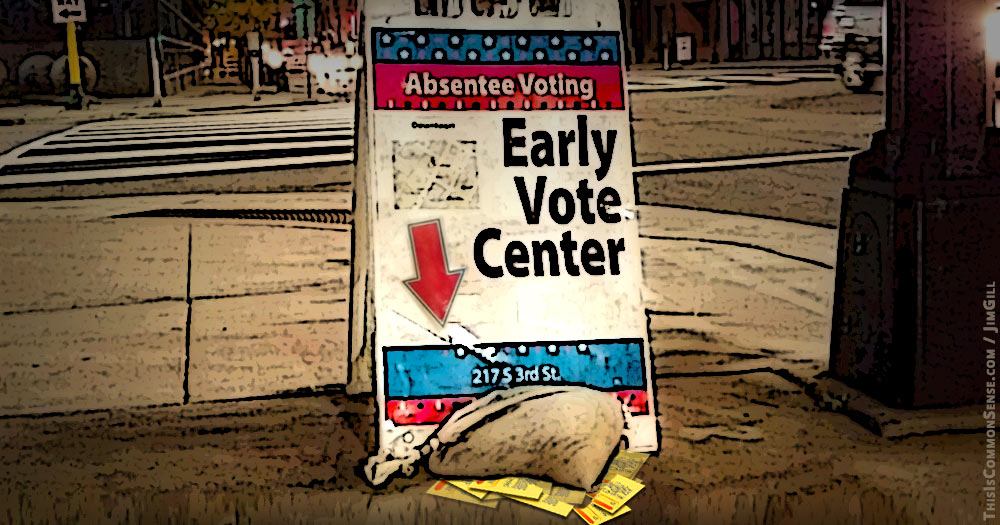
Voted yet? The Pew Research Center thinks about 50 million Americans have, representing 38.5 percent of the voter turnout forecast.

I’m for making it as easy as possible for people to cast a ballot. Who isn’t? Well, I mean who among normal people isn’t? I’m not counting politicians and their hacks.

But even I am opposed to extended “early voting.”

Here’s why:

First, the longer the voting period goes, the greater the cost — as more paid advertisements, phone calls and mailings are needed to keep reaching voters over many weeks. No problem here with more money in politics — money is essential, and my candidates and ballot issues could certainly always use more promotion. But let’s not artificially advantage big money by running the meter.

Several states now allow more than six weeks of voting prior to so-called Election Day. Even a three-week voting period is far more expensive than building toward a single day — or, say, a weekend through Tuesday voting period (four days).

Second, we ought to vote together, close to the same time, all of us privy to the latest public knowledge. This year’s drip of near daily “October”* surprises, thanks to WikiLeaks and the FBI, shows the potential problem should a major scandal or incident impact the race after so many folks have already voted.

Third, early voting tends to advantage incumbents. Challengers often don’t catch up to the better known and organized incumbent until the final days of the race.

As for voting often, as in more than once, that’s a crime. Plus, with these candidates, once is more than enough.

This is Common Sense. I’m Paul Jacob.

 

*Well into November, some of these surprises, eh? I mean, it is as if they saved the blood rituals for last.


Printable PDF

vote, early, often, democracy, early voting, illustration, joke, meme


Categories
meme

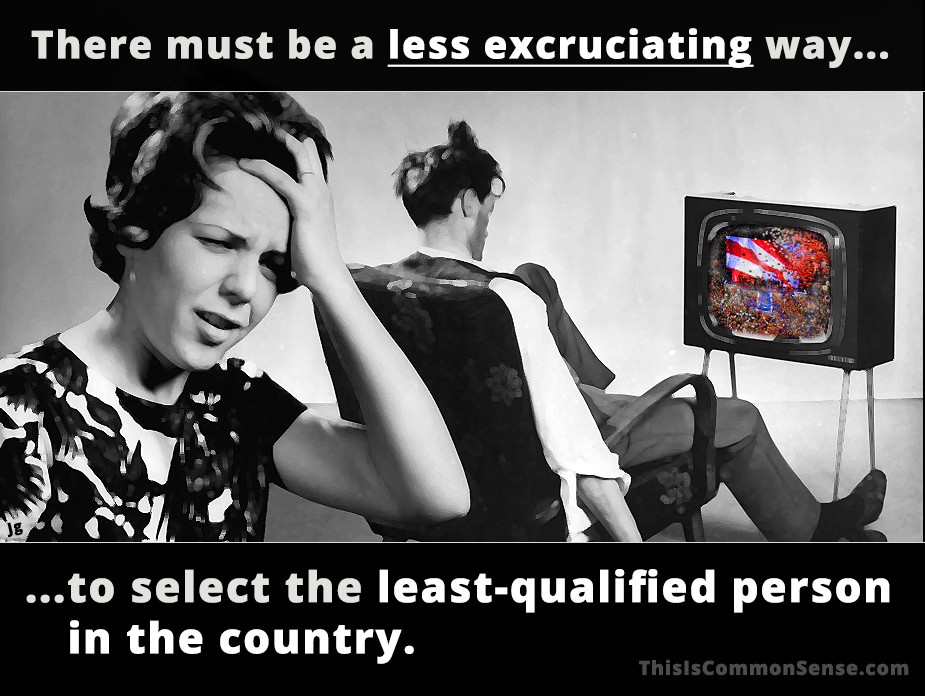
There must be. . .

There must be a less excruciating way to find the least qualified person in the country.

Categories
ballot access national politics & policies political challengers

Question 5 Fixes Flaw

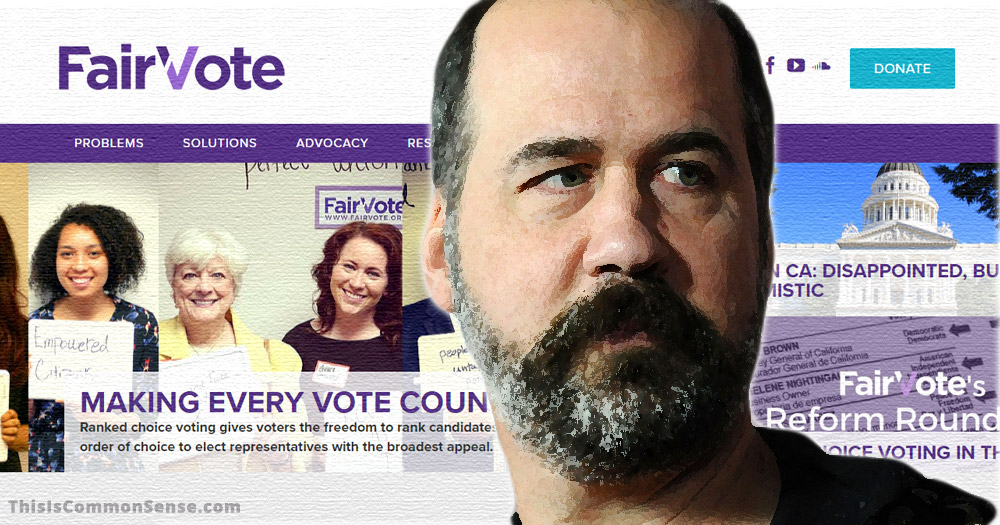
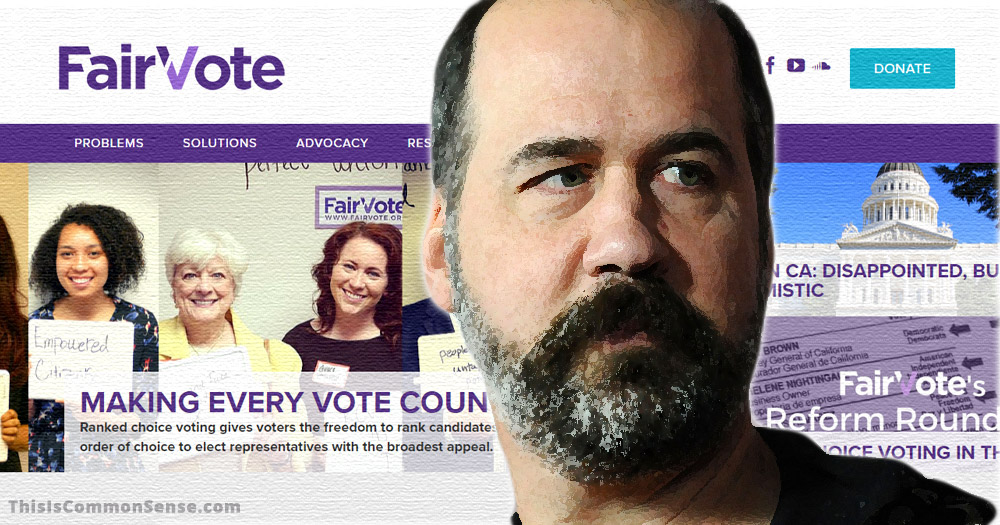
This week, Krist Novoselic, rock-n-roll bassist of Nirvana fame and fellow board member of FairVote.org, appeared on Fox Business’s Kennedy to explain ranked choice voting.

Krist compared a single ranked ballot under the proposed system to two ballots under the current method. Often, a voter will mark the ballot for one candidate in the primary, and, if the candidate doesn’t make the cut, for another in the general election.

Ranked choice voting sort of collapses multi-candidate primaries and the shorter list of the general election into one, allowing voters to rank their choices so that when their first choice doesn’t make it, their less valued candidates get counted.

So if you prefer a candidate unlikely to win you aren’t “wasting” your vote by marking that candidate first, as today in most American elections, because your vote goes to your second choice.

The current system encourages “strategic voting,” where we deny our preferences to work around the defects of the electoral system. We end up voting for candidates we do not like, to avoid even worse, promoting mediocre and downright bad elected officials.

In Maine, Question 5 on the November ballot, sets up a ranked-choice ballot system for “the offices of United States Senator, United States Representative to Congress, Governor, State Senator and State Representative for elections held on or after January 1, 2018.” It has a not insignificant amount of support, from Mainers across the political spectrum.

But not from the state’s governor (and voicemail-performance-artist) Paul Le Page. He dubs it a way for “loser” candidates to get a “second chance.”

Just like a politician! He focuses on politicians’ chances not voters’ options.

This is Common Sense. I’m Paul Jacob.


Printable PDF

fairvote, Krist Novoselic, Nirvana, voting, democracy, illustration


Categories
Accountability general freedom initiative, referendum, and recall national politics & policies

What Me Vote?

The people, without permission, The New York Times recently explained, in

  • Colombia, rejected a peace deal deemed too soft on the communist FARC guerrillas; in
  • Britain, decided to leave the European Union; in
  • Thailand, ratified a new constitution; and in
  • Hungary, rejected the European Union refugee resettlement plan.

I’ve not perused the Colombian accord. I’m actually not permitted to vote there — though I once stayed at a Holiday Inn Express in Bogotá. In lieu of moi, who better to decide than the Colombian people?

Brexit, too, was a decision for the inhabitants of the United Kingdom, not me.

Thailand is under military rule. Passage of the referendum was promoted as a pre-condition for moving toward democracy; campaigning against the constitution was outlawed. When a gun is held to your head, there is no democracy.

An unbelievable 92 percent of Hungarians rejected the EU plan to set migration policies for Hungary. But turnout below 50 percent invalidated the result.

“Though such votes are portrayed as popular governance in its purest form, studies have found that they often subvert democracy rather than serve it,” claims the Times report, “Why Referendums Aren’t as Democratic as They Seem.”

Without offering any studies.

The problems with these four ballot questions, to the degree there were any, weren’t caused by democracy, but a lack thereof.

Nonetheless, asensible academics pontificated that people are too stupid to be permitted to vote. A London School of Economics professor said referendums are “risky.” They “range from pointless to dangerous” claimed an Irish political scientist. A hyperbolic Harvard professor posited that referendums are “Russian roulette for republics.”

But which is worse: clueless academics, tyrannical pols, or . . . democracy?

This is Common Sense. I’m Paul Jacob.


Printable PDF

initiative, referendum, democracy, voting, legislature, illustration


Categories
Accountability general freedom ideological culture media and media people moral hazard nannyism national politics & policies too much government U.S. Constitution

Blame the Kids?

Why is it when some politicians or pundits get a brilliant idea about how to make the country better, involving (of course) making people do as the government dictates, it only applies to other people?

Sunday, on NBC’s “Meet the Press,” New York Times columnist and Times-styled conservative David Brooks bemoaned the electorate’s disunity due to the unprecedented unpopularity of Mr. Trump and Mrs. Clinton: “We could have a winner at 42 percent. Look at those poll numbers. . . . And so, that’s almost like a minority government. I think we’ve just got to do something about it.”

Do something? What?

Brooks explained, “Mayor Rahm Emanuel of Chicago has an idea that every kid who graduates from high school spends the next three months in some sort of national service. So a kid from Martha’s Vineyard or Marin County is with a kid from Mobile, Alabama, and just three months, it would make a difference.”

Chicagoans will warn against emulating Mayor Emanuel.*

“I thought national service was going to be a given,” host Chuck Todd then offered. “I mean, my God, we’ve been talking about national service my whole adult life and I can’t believe we’re not there.”

News Flash: The problem with our politics is not the fault of teenagers. Nor would forcing young people to put their dreams on hold the better to toil in some social engineering scheme solve anything.

Want national service? Begin with politicians and TV talking heads.

This is Common Sense. I’m Paul Jacob.
 

* A whopping 62 percent of Chicagoans disapprove of their mayor and fully 40 percent want ole Rahm Never-Let-a-Crisis-Go-to-Waste Emanuel to immediately resign. The mayor’s delay in releasing an incriminating police video, until after his re-election, has been the most incendiary issue. But also consider some ugly facts about systemic breakdown in city governance: the number of murders this year is already higher than last year, four out of ten freshman in Chicago high schools fail to graduate and 91 percent of graduates going on to college require remedial courses.


Printable PDF

National Service, David Brooks , Mayor Rahm Emanuel , illustration, children, brick wall, illustration


Categories
Accountability initiative, referendum, and recall nannyism national politics & policies responsibility too much government

Governments Against the People

Is it odd to see government employees and politicians — public servants — hold onto particular laws with a death grip?

Maybe not. In Texas, municipal government employees have been working mightily to prevent citizens from repealing local ordinances. According to a report by WOAI News Radio, the Texas “State Senate Intergovernmental Relations Committee on Monday heard horror story after horror story from citizen groups which have tried to circulate petitions calling for repeal of local ordinances.”

It’s not shocking, I suppose, since those laws may give politicians and bureaucrats more power. And perhaps there’s pride of authorship.

But, despite any merit (or demerit) these laws may possess, public servants are still public servants, which means: serve the public.

Which means: uphold democratic processes.

Government is all about processes, really. This shouldn’t be too hard.

Which is why there’s no excuse for what has been going on:

  • “municipal governments . . . employ ‘tricks’ and intimidation in an attempt to halt citizen petition drives”;
  • they cite “bogus city ‘statutes’ which invalidate signatures”; and
  • “will claim that more signatures are required than the citizens group has managed to collect.”

Basically, these government bodies are setting unreasonably high and arbitrary hurdles for petitions to get on the ballot — such as requiring “birth dates and Social Security numbers” of signers.

That often does the trick. One would have to be very careless to put one’s Social Security number onto a public document — one that anyone could see. And photograph.

For later nefarious use.

The fact that these government tactics are all illegal justifies the Senate committee probe into the malfeasance — and demands action.

This is Common Sense. I’m Paul Jacob.

PDF for printing

deathgrip, death grip, democracy, bureaucracy, change, politics, illustration


Categories
Accountability folly free trade & free markets general freedom government transparency initiative, referendum, and recall moral hazard nannyism national politics & policies property rights

The Return of the Philosopher King

On Sunday, at Townhall, I addressed the whining attacks on referendums and “democracy” that followed the Brexit referendum.

The most outrageous? A broadside from Jason Brennan.

“To have even a rudimentary sense of the pros and cons of Brexit,” argues this Robert J. and Elizabeth Flanagan Family Associate Professor of Strategy, Economics, Ethics, and Public Policy at the McDonough School of Business at Georgetown University, “a person would need to possess tremendous social scientific knowledge. One would need to know about the economics and sociology of trade and immigration, the politics of centralized regulation, and the history of nationalist movements.”

In other words, most Brits needn’t worry their pretty little heads about deciding their future; experts have everything under control.

Brennan has a new book coming out, Against Democracy, wherein he posits that we need “a new system of government — epistocracy, the rule of the knowledgeable.”

Sound familiar? ’Tis the old Platonic whine in new wineskins.

This Philosopher King is necessary, you see, because citizens don’t posses the advanced degrees to judge whether Brennan is right or wrong. We can’t even find a Holiday Inn Express in the phonebook. Or a phonebook.

Nonetheless, why not consult other known knowers?

The late William F. Buckley, Jr., well-educated and well-spoken on political matters, once declared that he would “rather entrust the government of the United States to the first 400 people listed in the Boston telephone directory, than to the faculty of Harvard University.”

“Incestuous, homogeneous fiefdoms of self-proclaimed expertise are always rank-closing and mutually self-defending, above all else,” warned journalist Glenn Greenwald, an expert on such hooey.

“I know no safe depositary of the ultimate powers of the society but the people themselves,” wrote Thomas Jefferson, “and if we think them not enlightened enough to exercise their control with a wholesome discretion, the remedy is not to take it from them, but to inform their discretion by education.”

Most decisions in a free society are thankfully made by individuals (not voters, bureaucrats, or academics) about their own lives.

But when legitimate decisions of governance must be made, I’ll take democracy over rule by experts.

This is Common Sense. I’m Paul Jacob.

Printable PDF

technocracy, expert, epistocracy Brexit, illustration