Categories
media and media people

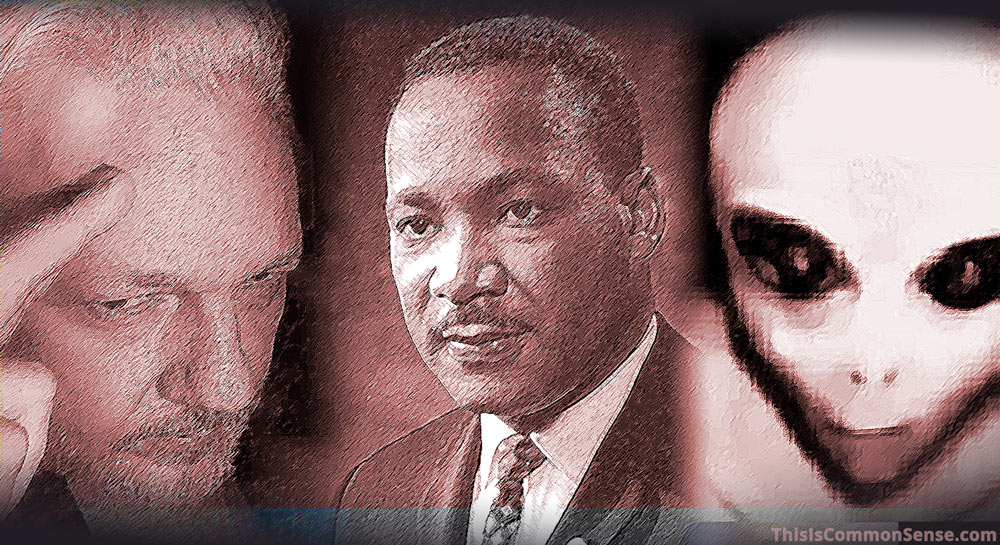
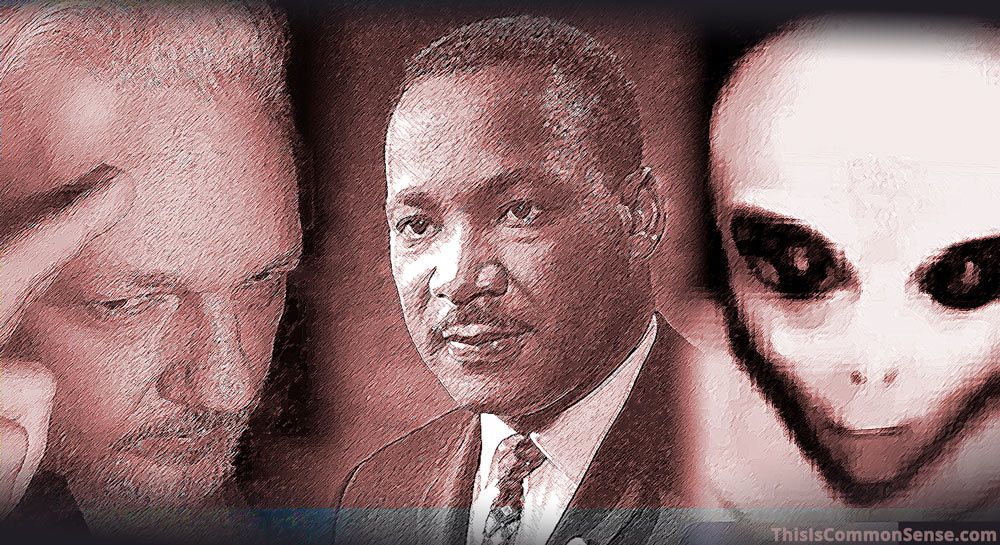
It’s Aliens!

Why does corporate media report what it reports? 

And neglect what it neglects? 

From an article, yesterday, by Caitlin Johnstone, “Julian Assange is Reportedly Gravely Ill, and Hardly Anyone’s Talking About It,” we learn that Mr. Assange is too ill to speak. Since the U.S. Government has indicted him for espionage, you might think that this would be big news in America. 

From major sources: crickets.

A few days earlier, friends noted that the Martin Luther King story, brewing in Great Britain, has received little notice on this side of the pond. New revelations about FBI spying on the much-honored civil rights leader, and also about the information gleaned from that spying, that is Reverend King’s alleged profligate sexual misconduct, sure seem like big stories. 

But you know what is being seriously covered? 

UFOs.

Yes, the subject that was pooh-poohed and pilloried by major media sources for decades has recently been getting major coverage from the likes of the New York Times and the Washington Post and CNN and Fox News.

In the Post we are instructed that a “UFO is not necessarily an alien from another planet,” but by the end of that same Tuesday think piece, we read that we might have to consider that very bizarre possibility.

So, why is mainstream media mum about Assange and MLK but now so enthusiastic about UFOs? 

Could it be because the Assange and King stories do not make our government look good, while the UFO story is part of a major plan* of “controlled disclosure”?

Of course, it might be just another round of disinformation.

This is Common Sense. I’m Paul Jacob.


* Dr. Hal Puthoff, in a lecture available on Vimeo, explains the plan in the course of discussing his work for the Department of Defense’s Advanced Aerospace Threat Identification Program, as well as the more recent work of the To the Stars Academy, which has apparently organized the current media blitz.
PDF for printing

Assange, King, alien, media, news,

See all recent commentary
(simplified and organized)
See recent popular posts


Categories
Thought

Rose Wilder Lane

The need for Government is the need for force; where force is unnecessary, there is no need for Government.

Categories
Today

Goddess?

On May 30, 1989, student demonstrators unveiled a 33-foot high “Goddess of Democracy and Freedom” statue in Tiananmen Square.

Categories
crime and punishment

Prisoners All

The logic for drug prohibition is direct: to keep people from hurting themselves with recreational drugs, we must prevent them from accessing those drugs.

Voilà!

There are a number of things wrong with that, though, and one is this: governments cannot even keep illegal drugs out of prisons. 

In California, nearly 1,000 men and women overdosed last year in “an alarming spike in opioid use by those behind bars,” reports the San Francisco Chronicle. 

Steven Greenhut, writing in Reason, notes that confinement centers are “among the most tightly controlled environments on Earth, yet correction officials can’t figure out how to deal with dramatic spikes in the number of inmates who are dying from drug overdoses and alcohol poisoning.”

Doesn’t this make the prohibitionist “solution” absurd?

“If they can’t keep heroin off of death row,” Greenhut concludes, “then maybe they should rethink their ability to control the rest of us.”

There is a problem, here, though — it is easier to control “the rest of us.”

As with gun control laws, it is the law-abiding folks who fall in line. It is the edgier, less civic-minded people who tend to rebel. 

But the two issues remain distinct: generally lawful and level-headed citizens still need to defend themselves from criminals, but do not feel a need to take drugs that can be deadly even in innocent hands. Thus the War on Drugs seems a bit less obviously tragic than gun control.  

Which is why conceiving of the War on Drugs as unworkable prison policy writ large remains important.

Why would we want to make our society more like drug-ridden prisons?

This is Common Sense. I’m Paul Jacob.


drug war, prison, jail, prohibition, ban, freedom,

Photo credit: Thomas Quine

See all recent commentary
(simplified and organized)
See recent popular posts


Categories
Thought

Epicurus

Those animals which are incapable of making binding agreements with one another not to inflict nor suffer harm are without either justice or injustice; and likewise for those peoples who either could not or would not form binding agreements not to inflict or suffer harm.

Epicurus, Principle Doctrine XXXII
Categories
Today

Historian

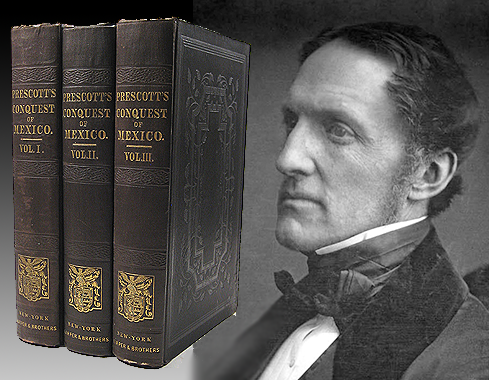
On May 4, 1796, American historian William H. Prescott was born. Prescott’s History of the Conquest of Mexico and his Conquest of Peru remain classic works of well-researched, ”scientific history.” Prescott, Arizona, was named in his honor.

Categories
national politics & policies too much government

Wand Wavers Aren’t Us

Why do some Washington wizards refuse to wave their magic wands? Why, they could make our world . . . wonderful!

On CNN’s State of the Union program over the weekend, guest host Dana Bash spoke with Sen. Joni Ernst (R-Iowa) about her legislation to “give parents paid leave to be with their child in exchange for delaying retirement up to six months.”

“So, the question is,” Bash queried the senator, “if paid leave is so important, why would it require somebody to . . . lengthen their time working, to give up six months of retirement, in order to pay to have a child and work?”

In other words, why should employees not be awarded paid leave from their jobs whenever they want it? Without having to make any trade-off with their employer. Is Sen. Ernst some kind of cheapskate?

“[T]he plan that I have put forward . . . is a voluntary program,” she noted. “It is not a mandatory program.” 

Not mandatory? She must be relatively new to Washington.

“And that way, a parent can decide what is right for them,” explained Ernst. 

Time off taken now would be traded for equal time working later; it would not be simply forced upon employers to provide a freebie for employees. 

“But what we don’t want to do is impose an additional tax,” the rookie senator continued. “And I have heard from small business owners all across Iowa that say, if there was an additional tax, I wouldn’t be able to have as many workers or so forth.”

Voluntary federal programs . . . next thing we know freedom may break out.

This is Common Sense. I’m Paul Jacob.


PDF for printing

Photo credit: New America

See all recent commentary
(simplified and organized)
See recent popular posts


Categories
Thought

Benedetto Croce

We must be severe, not only with ourselves, but with others also; exigent, not only with ourselves, but with others also; and so, on the contrary, benevolent not only towards others, but also toward ourselves; compassionate, not only toward others, but also towards this instrument of labour that we carry about with us and of which we sometimes demand too much; that is, our empirical individuality. Reality is neither democratic nor aristocratic, but both together; it abhors the privilege of some over others as much as that equality, according to which each one must have the same value as the other at every moment.

Benedetto Croce, The Philosophy of the Practical: Economic and Ethic, trans. Douglas Ainslie (1913, 1967), p. 429.
Categories
Today

Greek voters

On May 28, 1952, the women of Greece gained the right to vote.

Categories
Common Sense The Draft

Of Honor and Horror

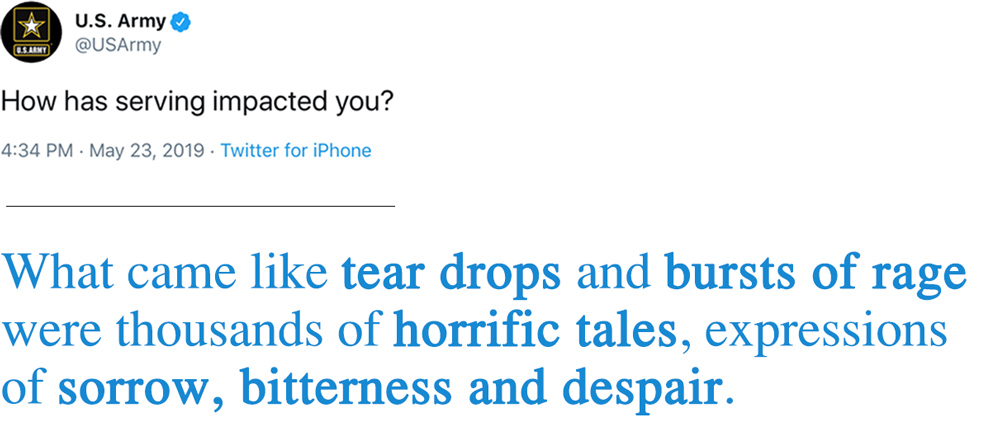
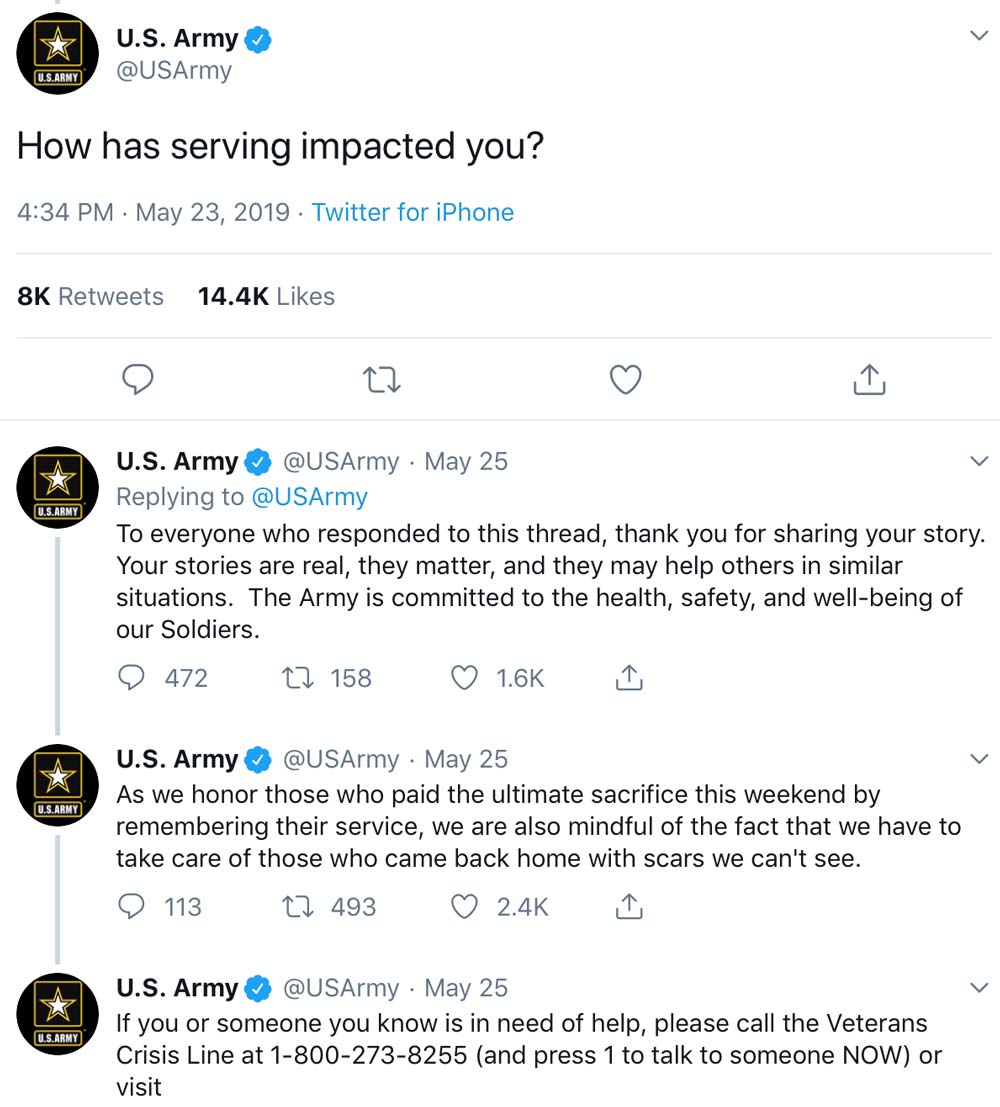
Last week, when the public relations wing of the U.S. Army asked, on Twitter, “how has serving impacted you?” the bulk of the responses were not what was hoped for. What came like tear drops and bursts of rage were thousands of horrific tales, expressions of sorrow, bitterness and despair.

No doubt the intention was to elicit, if not patriotic uplift, at least stories of learning, moral growth, centeredness, and personal victory out of sacrifice and suffering. Almost certainly the Army wanted what the promoters of “national service” now want.

The outcome was far messier.

Now, the Army handled the Twitterflak very well, with a tweet thanking people for their expressions. But a response by Mike Schmidt (@MikeSchmidt69) was probably as upbeat as could be expected, given the ‘writing on the wall’— er, Twitterfeed: “Some say this thread back-fired but this is just the thread that is needed each [M]emorial [D]ay so we remember the sacrifices military members and their families make and how we as a country need to understand the true cost of service and improve our support.”

Most of the tweets I read were decidedly not upbeat. The anger and pain over battle deaths, wounds, PTSD, mental illness, suicides, and so much indifference to it — it was deep and wide . . . and heartbreaking.

‘War is hell.’ In self-defense — defense of These United States — the brave soldier and general is honorable. But that honor is informed by the reticence that comes from actual knowledge of its true costs.

Maybe this Memorial Day President Trump and all policy makers will finally get what service truly is . . . and stop pitching more of the same unjustifiable-because-unwinnable or -unendable interventions around the world. 

Of course, demanding peace and sanity and accountability is up to all of us holding the hot dogs.

This is Common Sense. I’m Paul Jacob.


PDF for printing

See all recent commentary
(simplified and organized)
See recent popular posts