Categories
deficits and debt national politics & policies

Of Stopgaps and Ladders

“By law, we have one job,” Rep. Tim Burchett (R-Tenn.) asserted the last time he opposed the “continuing resolution” (CR) on the federal budget. 

What is that “one job”? It is “to pass twelve appropriations bills and a budget. We aren’t doing that, which is why we are $33 trillion in debt.”

Katherine Mangu-Ward, at Reason, fleshed this out: “In theory, the president proposes a budget, Congress passes a budget resolution, and then various committees put together a dozen separate spending bills. They’re debated and voted on, and then the president signs them into law by October 1.”

The practice, however, is a bit different: “What happens instead is that the members of the House careen into each fall full tilt, screaming at each other until they throw together some kind of stopgap measure to fund the federal government for a little while longer until they can get their act together to generate a big, messy omnibus bill that no one will have time to read.”

But it’s worse: “When they can’t manage even that, we get a shutdown.”

To prevent a shutdown, but also not fall back into the usual iterations of the continuing resolutions, the new House Speaker, Rep. Mike Johnson (R.-La.) has floated the idea of a “laddered” CR. According to The Epoch Times, this plan “would spread the due dates over a period of time rather than having all the bills come due at once.” Think of it as an ultra-weak echo of the responsible budgeting process.

Will it work? Will Congress manage this merest hint of responsibility?

In ten days, it’s go time — or, no-go time — again.

This is Common Sense. I’m Paul Jacob. 


PDF for printing

Illustration created with PicFinder and Firefly

See all recent commentary
(simplified and organized)
See recent popular posts

Categories
Thought

Will Rogers

There’s no trick to being a humorist when you have the whole government working for you.

Categories
Today

Gandhi Arrested

On November 6, 1913, Mohandes K. Gandhi was arrested for participating in a march of Indian miners in South Africa.

Categories
Thought

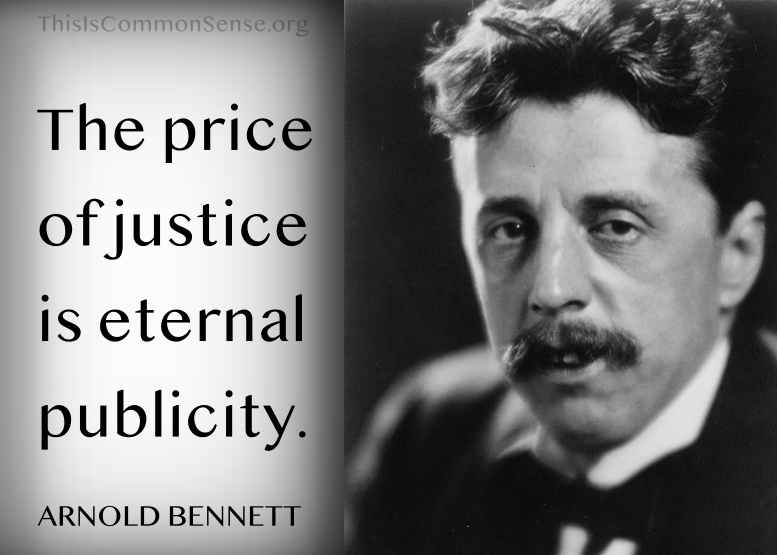
Arnold Bennett

The price of justice is eternal publicity.

Arnold Bennett, Things That Have Interested Me, 2nd series (1923), “Secret Trials.”
Categories
Today

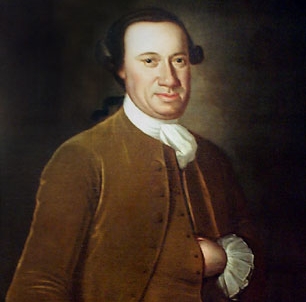
President John Hanson

On November 5, 1781, the second session of the United States in Congress Assembled began, in Philadelphia, Pennsylvania. This “Second Confederation Congress,” as it is popularly known, ended on November 2, 1782.

And on that Fifth of November, 1781, John Hanson of Maryland (pictured above) was elected to serve as president of the United States in Congress Assembled. He would become the first president of Congress to serve a full one-year term as specified under the Articles of Confederation, for the second session of the Confederation Congress. Of course, this presidency was nothing like the presidencies under the Constitution. Hanson merely presided over Congress.


On November 5, 1872, Susan B. Anthony defied the law to vote, and was later fined $100.

Categories
Today

Will Rogers

On November 4, 1879, American humorist Will Rogers was born. Aside from his cowboy act, and his work as an actor in Hollywood, he gained much fame for being a topical comedian “just reporting what’s in the papers.”

Categories
international affairs

This Week @ StoptheChinazis.org

Keeping track of the threat from the Chinese Communist Party and its hegemony over the Chinese (and other) peoples:

A Two-day Trip, A Four-year Trap

A two-day business trip to became a four-year trap for
Taiwanese businessman. . . . [Monkton, Nov. 3]

Pro-democracy Parties “Failed to Field” Candidates in Rubble of Hong Kong’s Democracy

Failed to field. That’s one way of putting it. . . . [Scribbler, Nov. 1]

Spy for Us!

If you’re a former or current member of the
U.S. military, the CCP wants you to spy on
your country! [Scribbler, Nov. 1]

To Victims, the Premier Was No Good Guy

Many of Li Keqiang’s mourners are doubtless sincere
and are not, like some. . . . [Scribbler, Nov. 1]

COVID 2050

Why did the world go so crazy in its reactions
to COVID? [Anders Chydenius, Nov. 1]

The Staycation Is Mandatory

International travel is being more strictly limited for
Chinese government bureaucrats, public school
teachers, and even . . . [Monkton, Oct. 31]

China’s “Planned Capitalism” Kills Wealth

Sometimes, prosperity is an illusion. The massive
building boom in the People’s Republic of China
is creating outer signs of affluence, but there
isn’t enough demand. . . . [Sandy Ikeda, Oct. 29]

Categories
Common Sense

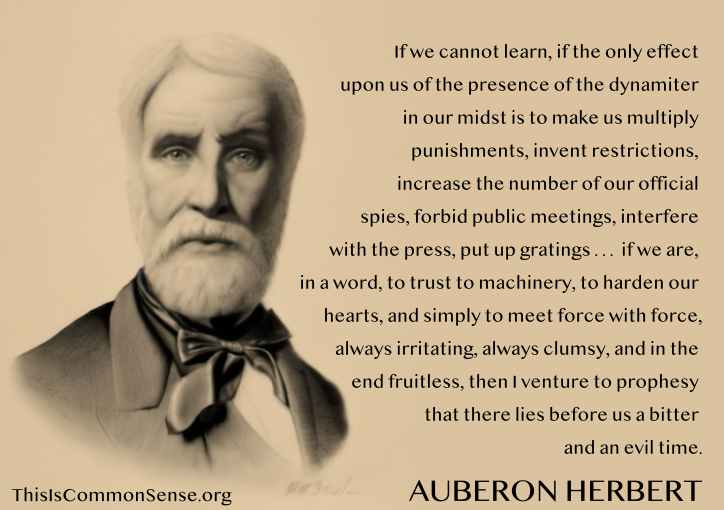
Auberon Herbert

If we cannot learn, if the only effect upon us of the presence of the dynamiter in our midst is to make us multiply punishments, invent restrictions, increase the number of our official spies, forbid public meetings, interfere with the press, put up gratings — as in one country they propose to do — in our House of Commons, scrutinize visitors under official microscopes, request them, as at Vienna, and I think now at Paris also, to be good enough to leave their greatcoats in the vestibules — if we are, in a word, to trust to machinery, to harden our hearts, and simply to meet force with force, always irritating, always clumsy, and in the end fruitless, then I venture to prophesy that there lies before us a bitter and an evil time.

Auberon Herbert, The Ethics of Dynamite (1894).

Categories
education and schooling general freedom

The Homeschooling Surge

Although homeschooling had once been common in the United States, by the 1970s few families taught their kids at home.

This began to change in the 1980s and 1990s. Researcher Brian Day estimates that by 2019, some 2,300,000 children were being homeschooled.

During the recent pandemic, even more parents gave homeschooling a try. But the trend had already been intensifying for decades. Not coincidentally, of course, because public schools continued to get lousy report cards, with the quality of government-provided education demonstrably in steep decline.

In a recent article on the growth of homeschooling, The Washington Post concludes that it has become “America’s fastest-growing form of education” as families “embrace a largely unregulated practice once confined to the ideological fringe.”

Apparently, now even normal people are rescuing their kids from the educrats (unlike back in the day, when only fringe parents like my wife and I did so).

Looking at data from some 7,000 school districts, the Post concludes:

  • The number of homeschooled kids has increased by 373 percent in Anderson, South Carolina. It increased by 358 percent in one Bronx district.
  • In 390 districts, for every ten children being taught in public schools in the 2020–2021 academic year, one child was homeschooled.
  • The Post estimates that between 1.9 million and 2.7 million kids are currently being homeschooled in this country.

Post-lockdowns, the practice is still going strong. In most districts for which data is available on the 2022–2023 school year, homeschooling “dropped from its pandemic peak. . . . Yet even in those places it remains elevated well above pre-pandemic levels, and in 697 districts it kept increasing.”

That’s good. For the children.

This is Common Sense. I’m Paul Jacob.


PDF for printing

Illustration created with PicFinder

See all recent commentary
(simplified and organized)
See recent popular posts

Categories
Thought

Will Rogers

Always drink upstream from the herd.

Will Rogers, in ‪The Friars Club Bible of Jokes, Pokes, Roasts, and Toasts‬ (2001), by Nina Colman, p. 316