Categories
general freedom property rights too much government

Plymouth’s Great Reform

Times too tough for much thanksgiving? Some of my readers, surely, are feeling the bracing effects (to put it mildly) of a severe economic slump — a so-called “recession” that I’ve been calling, more simply (and I think more honestly) a “depression” — and all I can say is I have some glimmering of such troubles. Things could definitely be better.

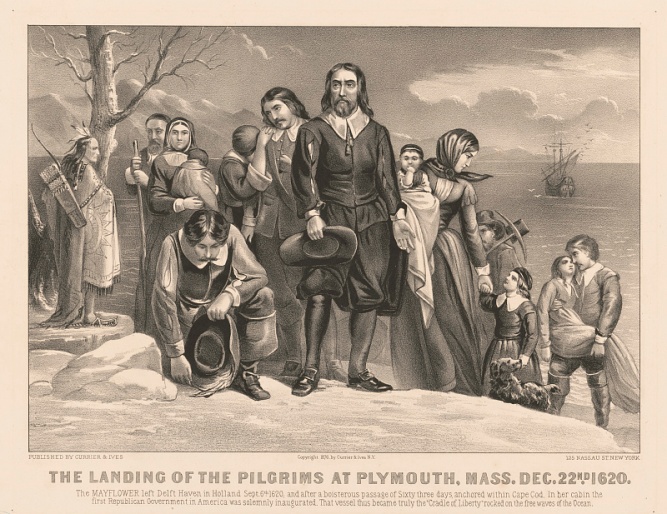
But at Thanksgiving, it might do us good to consult William Bradford’s account of the History of “Plimoth Plantation,” a document that recounts how his fellow Pilgrim settlers established, endured, barely survived, recovered, and eventually thrived in Massachusetts.

By the spring of 1623 — a little over three years after first settlement in Plymouth — things were going badly. Bradford writes of the tragic situation:

[M]any sould away their cloathes and bed coverings; others (so base were they) became servants to [the] Indeans, and would cutt them woode & fetch them water, for a cap full of corne; others fell to plaine stealing, both night & day, from [the] Indeans, of which they greevosly complained. In [the] end, they came to that misery, that some starved & dyed with could & hunger.

The problem? The colony had been engaging in something very like communism.

The experience that was had in this comone course and condition, tried sundrie years, and that amongst godly and sober men, may well evince the vanitie of that conceite of Platos & other ancients, applauded by some of later times; — that [the] taking away of propertie, and bringing in comunitie into a comone wealth, would make them happy and florishing; as if they were wiser then God.

Bradford relates the consequences of common property:

For this comunitie (so farr as it was) was found to breed much confusion & discontent, and retard much imploymet that would have been to their benefite and comforte. For [the] yong-men that were most able and fitte for labour & service did repine that they should spend their time & streingth to worke for other mens wives and children, with out any recompence. The strong, or man of parts, had no more in devission of victails & cloaths, then he that was weake and not able to doe a quarter [the] other could; this was thought injuestice. The aged and graver men to be ranked and equalised in labours, and victails, cloaths, &c., with [the] meaner & yonger sorte, thought it some indignite & disrespect unto them. And for mens wives to be commanded to doe servise for other men, as dresing their meate, washing their cloaths, &c., they deemd it a kind of slaverie, neither could many husbands well brooke it.

Yes, the s-word: Slavery. Common property was mutual slavery.

The solution? The plan for society that Bradford attributed to God. He brooked no pleading that common property didn’t work because of corruption, sin. As he put it, “seeing all men have this corruption in them, God in his wisdome saw another course fiter for them.” The course? I’ll use a word of coined by Robert Poole, one of the founders of Reason magazine: Privatization.

Basically, what the Pilgrims privatized was land, and the fruits thereof, assigning to

every family a parcell of land, according to the proportion of their number for that end, only for present use (but made no devission for inheritance), and ranged all boys & youth under some familie. This had very good success; for it made all hands very industrious, so as much more corne was planted then other waise would have bene by any means [the] Govror any other could use, and saved him a great deall of trouble, and gave farr better contente. The women now wente willingly into [the] feild, and tooke their litle-ons with them to set corne, which before would aledg weaknes, and inabilitie; whom to have compelled would have bene thought great tiranie and oppression.

Thus began the years of bounty in Massachusetts. There’s much more in Bradford’s account worth reading, including the increasingly tragic relations with the native Americans. And, indeed, one learns from reading such first-hand accounts how imperfect a creature is man.

But it is obvious that some systems of property and governance work better than others, and, on the day that our government has set forth as a day of Thanksgiving, it is worth being thankful for living in a land that has upheld — to at least some degree — the system of private property that America’s Pilgrim’s learned to see as God’s “fitter course” for corruptible man.

Times may be tough today. On the bright side, they’ve been tougher. One reason for the progress we have seen — even as we endure a major setback, and perhaps a bigger one to come, as the international financial system implodes — is the system of private property that underlies our personal and economic liberties.

Let’s hope we can recover the best in this tradition.

This is Common Sense. I’m Paul Jacob.

Categories
Thought

Pastor Martin Niemöller – Dachau, 1944

“In Germany, they first came for the Communists, and I didn’t speak up because I wasn’t a Communist. Then they came for the Jews, and I didn’t speak up because I wasn’t a Jew. Then they came for the trade unionists, and I didn’t speak up because I wasn’t a trade unionist. Then they came for the Catholics, and I didn’t speak up because I was a Protestant. Then they came for me – and by that time no one was left to speak up.”

Categories
Today

The Hollywood 10

On Nov. 24, 1947, the U.S. House of Representatives voted 346 to 17 to approve citations of contempt against the “Hollywood 10” for refusing to answer questions before the House Un-American Activities Committee about their alleged Communist Party ties. These ten writers, directors, and movie producers were sentenced to a year in jail. In a joint statement, the Hollywood 10 argued, “The United States can keep its constitutional liberties or it can keep the Thomas committee. It can’t keep both.”

Categories
tax policy too much government

Many Thanks to Grover

Since the Super Committee failed to come up with the promised $1.2 trillion in pretend deficit reduction over the next decade, many in the nation’s capital blame Americans for Tax Reform President Grover Norquist.

Our taxes — and even the taxes of people with the nerve to be wealthy — are not being increased. This, you must understand, is all Grover’s doing, the fault of the Taxpayer Protection Pledge he “pushed” on more than 275 members of Congress.

His pledge articulates a simple, straightforward idea: Taxes are too high and politicians should stop increasing them. Incumbent politicians appear fearful of breaking this pledge. If they go back on their word, they risk being defeated come the next election.

Last Sunday, 60 Minutes’ correspondent Steve Kroft blurted out to Norquist, “You’ve got them by the short hairs!”

Norquist responded, “The voters do, yeah.”

Are we really supposed to be sad about the system of accountability known as elections?

Former Wyoming Senator Alan Simpson whined that Norquist “may well be the most powerful man in America today.”

“The tax issue is the most powerful issue in American politics going back to the Tea Party,” Norquist explained.

If you think the federal government is too small and does too little, a pledge not to raise taxes makes scant sense. But if you think, like Norquist, that government is a whole lot bigger than it should be, pledging not to make it bigger still is a no-brainer.

This is Common Sense. I’m Paul Jacob.

Categories
Today

Boss Tweed

On Nov. 23, 1876, “Boss” Tweed, the leader of New York City’s corrupt Tammany Hall political organization during the 1860s and early 1870s, was delivered to New York City authorities after his capture in Spain. Tweed had escaped from prison in 1875, where he was serving time for forgery, larceny and other charges. He died in prison in 1878.

Categories
Thought

C.S. Lewis

Of all tyrannies, a tyranny sincerely exercised for the good of its victims may be the most oppressive. It may be better to live under robber barons than under omnipotent moral busybodies. The robber baron’s cruelty may sometimes sleep, his cupidity may at some point be satiated; but those who torment us for our own good will torment us without end for they do so with the approval of their own conscience.

Categories
free trade & free markets national politics & policies too much government U.S. Constitution

The Post Office’s Future?

At some point approaching catastrophe, one has to stop offering googly sounds of uplift and hope, and just speak the truth.

Postmaster General Patrick Donahoe may understand that. The U.S. Post Office, he recently told the National Press Club, is “in a deep financial crisis because we have a business model that is tied to the past.” Deep ties to the past, indeed. Setting up a postal system was written into the Constitution.

Early in the system’s history, postal positions served as rewards to friends of successful politicians. This put a lot of bad apples into the cider; the business soured. Postage skyrocketed.

This sorry situation brought entrepreneurs into the market, delivering letters at a fraction of the government system’s prices. The politicians fought back, took the competitors to court, and won — on dubious Constitutional grounds.

But they did overhaul the system, reducing prices.

That was a long time ago. Today’s situation may be worse. As Donahoe put it, “We are expected to operate like a business but we do not have the flexibility to do so. Our business model is fundamentally inflexible.”

No surprise, Congress is inflexible. But there are competing bills rumbling around to allegedly fix the financial woes of the institution Donahoe calls “a national treasure.”

Well, if it’s a treasure, sell it off: The federal government could use the money. (Though likely not well.)

And the people could use a good privatized mail service. Or two. Or more.

This is Common Sense. I’m Paul Jacob.

Categories
Thought

Thomas Jefferson

“Timid men prefer the calm of despotism to the tempestuous sea of Liberty.”

Categories
Today

Orange Revolution

On Nov. 22, 2004, in what became known as the Orange Revolution, massive protests erupted across the Ukraine after charges that the Nov. 21 presidential run-off election between candidates Viktor Yushchenko and Viktor Yanukovych was rigged by the authorities in favor of the latter. Ultimately, Ukraine’s highest court annulled the election and a new vote reversed the result.

Categories
national politics & policies too much government

The Un-Super Committee

Surprise, surprise — the so-called Super Committee isn’t very super.

It appears that the august micro-body of solons will fail to come to an agreement to reduce the federal deficit by $1.2 trillion over the next ten years, not in any combination of new revenue or spending “cuts” by today’s effective deadline.

On the bright side, given the nature of the likeliest possible agreement this committee would conceive, its failure sounds like the best possible result.

We’re now over $15 trillion in debt, running a deficit of $1.5 trillion this year alone. Still, the Super Committee couldn’t sop up even 80 percent of the red ink they’re spilling just this year. Not even spread out over the decade.

It gets worse. “I think we need to be honest about it,” Kentucky Senator Rand Paul pointed out yesterday on CNN. “Spending is still rising under any of these plans. We’re only cutting proposed increases in spending.”

“The curve of spending in our country is going up at about 7.5 percent a year,” Sen. Paul went on to explain. “If you were to freeze spending for ten years, no cuts . . . they would call that a $9 trillion cut.”

So, as we face a debt crisis, the Super Committee couldn’t even manage to lessen their planned massive increases in spending.

Or talk straight with the American people.

Why? Perhaps because official Washington knows that spending is the real source of their power.

This is Common Sense. I’m Paul Jacob.