I believe that freedom and justice cannot be parceled out in pieces to suit political convenience.
Categories
Coretta Scott King

I believe that freedom and justice cannot be parceled out in pieces to suit political convenience.

On March 28, 1936, Peruvian author Mario Vargas Llosa was born. This recipient of the 2010 Nobel Prize in Literature ran, in 1990, for the presidency of Peru, but lost to Alberto Fujimori. His novels include La casa verde (The Green House), La guerra del fin del mundo (The War of the End of the World), La fiesta del chivo (The Feast of the Goat), and Aunt Julia and the Scriptwriter, which was filmed as Tune in Tomorrow.
On the same date in 1970, Vince Vaughn, American actor, producer, and screenwriter, was born. Vaughn is one of a small minority of non-left-leaning Hollywood stars; his ideas on politics and economic policy were greatly influenced by Ron Paul.

Trump and America, the plot thickens! Click on over to Townhall. Then come back here for more clues.
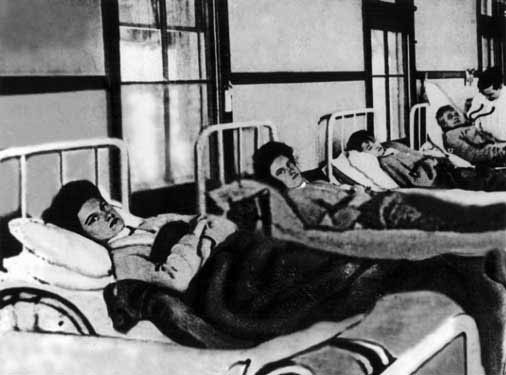
On March 27, 1915, Mary Mallon, popularly and scandalously known as “Typhoid Mary,” was put in quarantine, where she would remain for the rest of her life, over 23 years incarcerated.
Ms. Mallon was the first healthy carrier of disease ever identified in the United States. As an asymptomatic carrier of typhoid, she was a puzzle to science, and, once discovered, an apparent threat to those around her, with at least three deaths attributable to her presence. She did not co-operate with officials, and preferred to work as a cook, which paid higher wages than less dangerous-to-the-public occupations. She had been quarantined once before her final permanent quarantine in a hospital.
The civil liberties aspect to her incarceration loom large, and it is obvious that health officials of her time were not exactly any more co-operative regarding her rights as she was with those of her clients and neighbors. The case was an obvious turning point in American legal practice, and can be categorized along with eugenics and “social hygiene” — along with prohibition regarding alcohol and recreational drugs — in the increasing illiberality of legal practice in America in the early part of the 20th century.
Men quickly learn to look upon what is done for them by the state as a right and grumble that what is given is not given in fuller measure. It is a common cry: “We do not want charity, but state employment.” State employment is charity, only with all the healing grace left out of it.
Auberon Herbert, as reprinted in the first edition of The Right and Wrong of Compulsion by the State, 1885.

What the U.S. government does (and what this has to do with hummus—you’ll have to watch the video, because we are not going to describe it):
The report almost no one has read: The Senate Intelligence Committee Report on Torture: Committee Study of the Central Intelligence Agency’s Detention and Interrogation Program.

On March 26, 1991, local self-government in South Korea was restored after three decades of centralized control.
Freedom is never really won. You earn it and win it in every generation. That is what we have not taught young people, or older ones for that matter. You do not finally win a state of freedom that is protected forever. It doesn’t work that way.
The next president will take office as this year’s $544 billion deficit pushes up the U. S. national debt to nearly $20 trillion . . . which is chicken feed compared to nearly $127 trillion in unfunded liabilities racked up by our entitlement state.
And, on top of that, add our outrageous world policeman fees.
The Washington Post reports that, “thanks to various treaties and deals set up since 1945, the U.S. government might be legally obligated to defend countries containing 25 percent of the world’s population.”
And boy, has America, World Policeman, been active! The U. S. military is well into a second decade of wars in Iraq and Afghanistan, engaged in ongoing armed conflict in Libya, Pakistan, Somalia, Syria and Yemen, and with ISIS and its terror, not seemingly degraded at all but growing.
No wonder, then, that the iconoclastic Donald J. Trump questioned — at a Washington Post editorial board meeting, just before the Brussels terrorist attacks — the wisdom of U.S. commitments to NATO, South Korea and Japan.
“NATO was set up when we were a richer country,” Trump explained. “We’re not a rich country. We’re borrowing, we’re borrowing all of this money. We’re borrowing money from China. . . .”
So why subsidize wealthy countries? “Well, if you look at Germany . . . Saudi Arabia . . . Japan . . . South Korea — I mean we spend billions of dollars on Saudi Arabia, and they have nothing but money.”
Lest I get my hopes up too high, it seems unlikely that Trump would change actual policy, but simply make “a much different deal with them, and it would be a much better deal.”
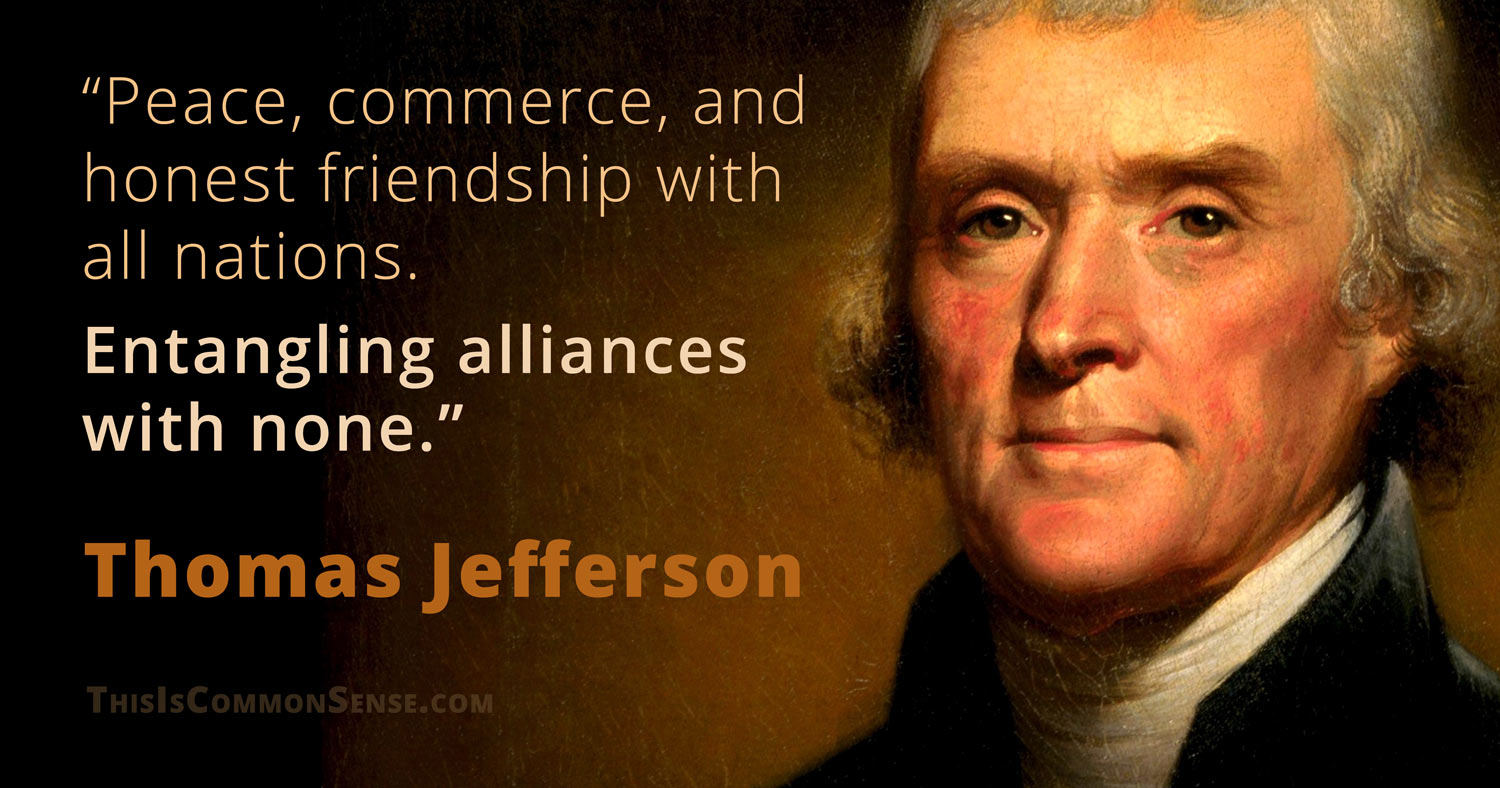
Here’s an even better deal, as our third president, Thomas Jefferson, articulated: “Peace, commerce, and honest friendship with all nations. Entangling alliances with none.”
It’s quite affordable.
This is Common Sense, I’m Paul Jacob.
Also, please consider showing your appreciation by dropping something in our tip jar (this link will take you to the Citizens in Charge donation page… and your contribution will go to the support of the Common Sense website). Maintaining this site takes time and money. Your help in spreading the message of common sense and liberty is very much appreciated!
We must all begin to question the experts. They have not really been right. No abundance of material goods can compensate for the death of individuality and personal creativity.
Correta Scott King, Harvard class day address (1968); published in the July 1, 1968, issue of Harvard Alumni Bulletin.