I tell you there is no such thing as creative hate!
Willa Cather, The Song of the Lark (1915).
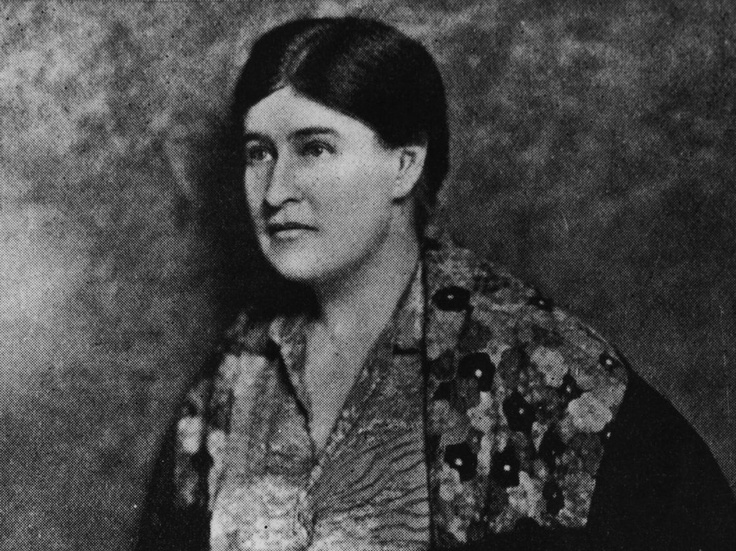
I tell you there is no such thing as creative hate!
Willa Cather, The Song of the Lark (1915).

The replacement for ObamaCare that Rand Paul is pushing looks a lot better than his previous statements had led some of us* … to fear:
It is mainly a freeing up of the system. Mainly. It is government getting out of the way. Of course, it is packaged so to sound like a “plan” — politics is still politics.
The good part is that, yes, we consumers of medical care are going to be more in charge of spending our own dollars. And thus controlling more of our own care.
* Well, “suggested” to some of us on the skeptical side of the political debate.
February 25, 1805, saw the birth of Angelina Emily Grimké Weld, American abolitionist and feminist. She was the younger sister of the equally famed Sarah Moore Grimké.
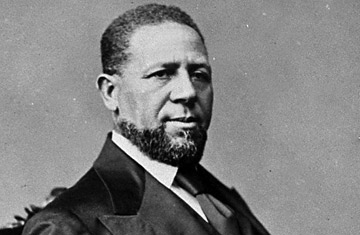
On February 25, 1870, the first African-American entered Congress to serve in the U. S. Senate. Hiram Rhodes Revels (Sep 27, 1827 – Jan 16, 1901) was a minister in the African Methodist Episcopal Church, a Republican politician, and college administrator. Born free in North Carolina, he later lived and worked in Ohio, where he voted before the Civil War. He was elected as the first African American to serve in the United States Senate, and was the first African American to serve in the U.S. Congress. He represented Mississippi in the Senate in 1870 and 1871 during the Reconstruction era.
In Law #46 of February 25, 1947, the Allied Control Council formally proclaimed the dissolution of Prussia.
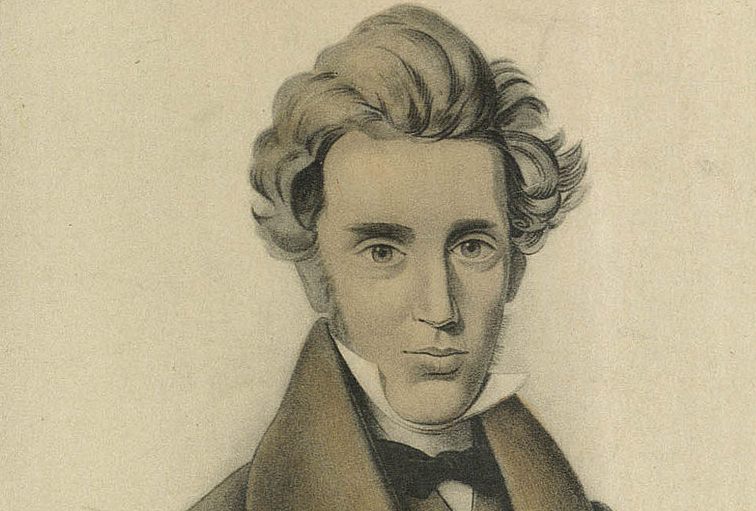
Aristotle’s view that philosophy begins with wonder, not as in our day with doubt, is a positive point of departure for philosophy. Indeed, the world will no doubt learn that it does not do to begin with the negative, and the reason for success up to the present is that philosophers have never quite surrendered to the negative and thus have never earnestly done what they have said. They merely flirt with doubt.
Soren Kierkegaard, Journals and Papers III 3284 (1841).

Californians account for more than one of every ten Americans.
For now.
Three years ago, an initiative sought to split the mega-state up. Had that measure succeeded, the U.S. Congress would have decided whether to permit the Golden State to become six separate states — with ten more U.S. Senators.
Now, a group called “Yes California” is petitioning for a 2018 ballot measure on leaving these United States altogether: Secession. “California could do more good as an independent country than it is able to do as just a U.S. state,” says its website.
Supporters argued in a recent Washington Post feature that California “subsidizes other states at a loss.” Indeed, it’s one of 14 states that get less money back from the federal government than paid in taxes.
And there’s Trump. Opposition to the president is palpable. California provided Hillary Clinton with a 4.3 million popular vote margin over Republican Donald Trump, 1.5 million more than her national margin.
“It’s understandable why the election of an evil white supremacist swindler as president,” wrote Zócalo Public Square’s Joe Mathews in the Fresno Bee, “has given the idea of California independence such currency.” Nonetheless, he opposes #CalExit as divisive and “not very Californian.”
Nationally, for partisan reasons, Republicans may cheer it, while Democrats shudder.
Me? I’m for self-determination.
But, remember: Northern Californians have been agitating to secede from the state since 1941. Those desires are picking up steam — especially with trepidation over whether the Oroville dam will hold. Folks feel unrepresented in the state capitol.*
And they are. Already 21 of the 23 northernmost counties have made declarations to form the State of Jefferson.
Let Californians decide . . . county by county.
This is Common Sense. I’m Paul Jacob.
* Note that Trump won by a landslide in the counties that would comprise Jefferson, our would-be 51st state.

The history of every country begins in the heart of a man or a woman.
Willa Cather, O Pioneers! (1913).
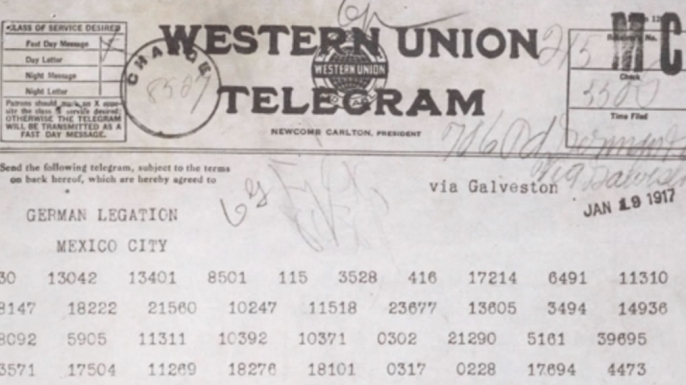
A century ago today, on February 24, 1917, United States ambassador to the United Kingdom, Walter Hines Page, was shown the intercepted Zimmermann Telegram, in which Germany offered to give the American Southwest back to Mexico if Mexico were to declare war on the United States.
On February 24 1803, the Supreme Court, in Marbury v. Madison, established the principle of judicial review.
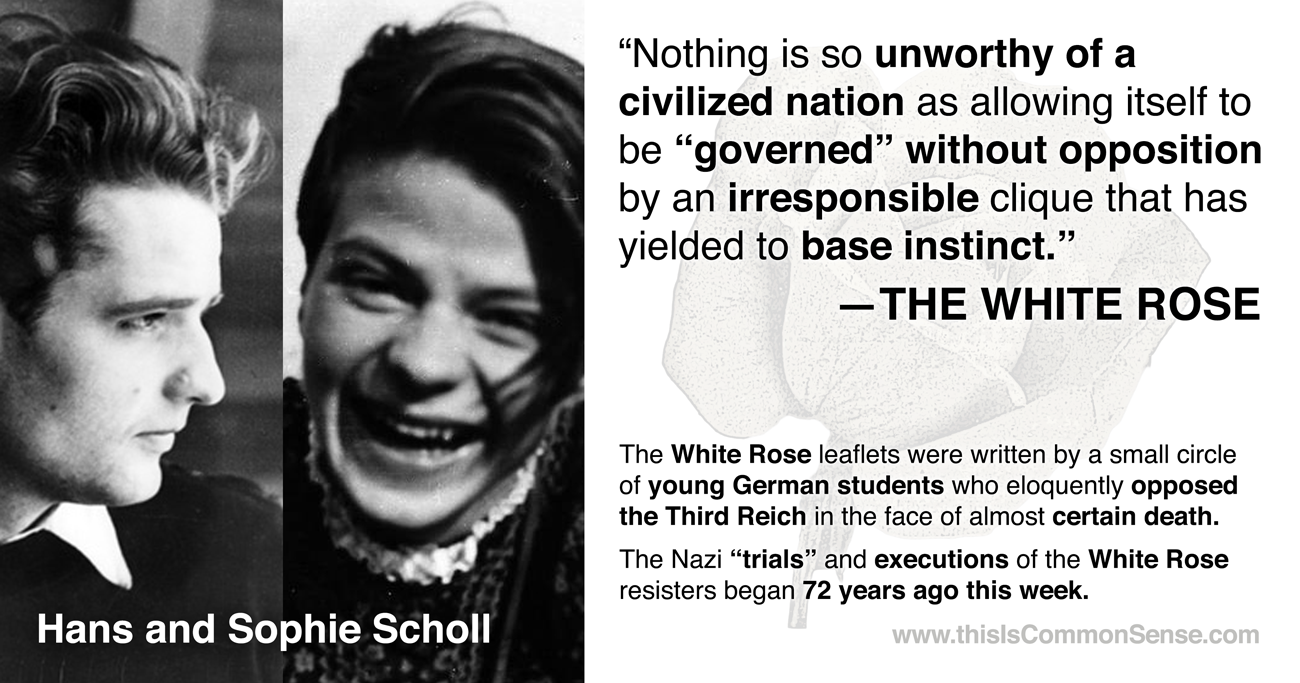
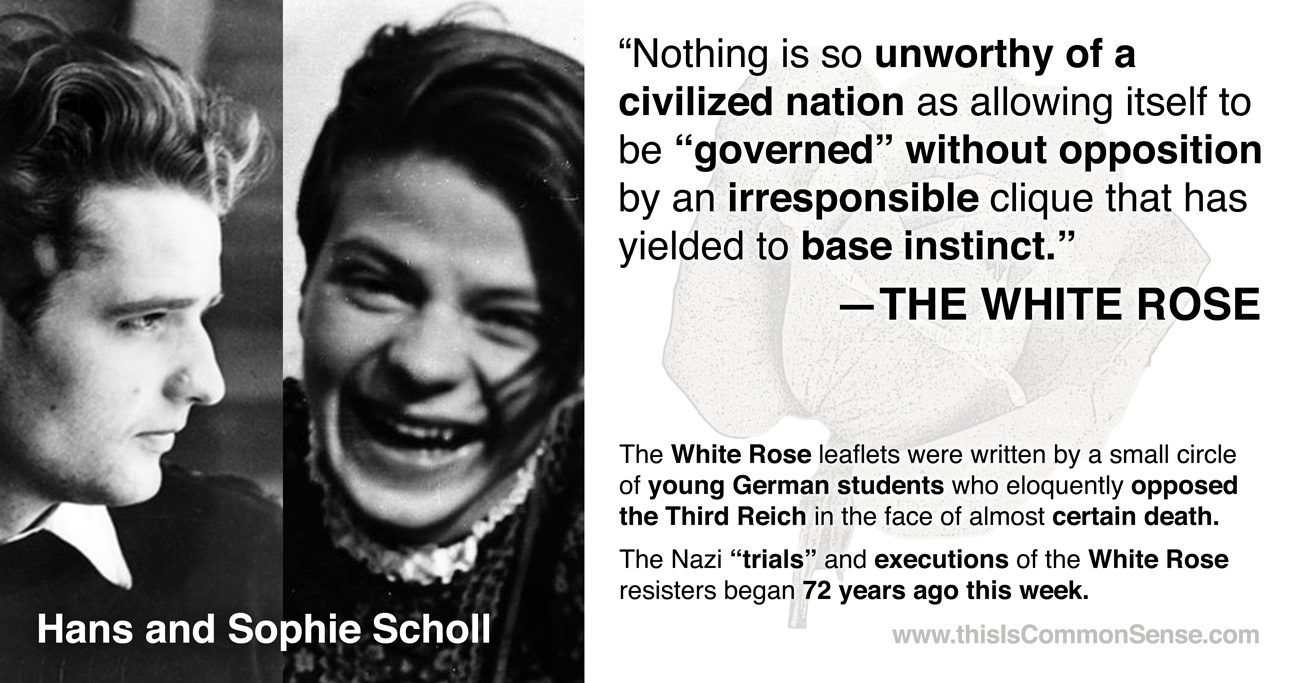
Yesterday marked a solemn anniversary. Seventy-four years ago — on Feb. 22, 1943 — three German students at the University of Munich were tried for treason by the Nazis, convicted and then executed via the guillotine, all in one day.
Days earlier, Hans Scholl and his sister Sophie had been caught distributing a leaflet at the university, which read: “In the name of German youth, we demand restitution by Adolf Hitler’s state of our personal freedom, the most precious treasure we have, out of which he has swindled us in the most miserable way.”
Hans had in his pocket a draft of another leaflet, in Christoph Probst’s handwriting. That seventh leaflet, never distributed, led to Christoph’s arrest and execution, along with Hans and Sophie.
The three were part of a small group of students who wrote and distributed leaflets under the name The White Rose — a symbol of purity standing against the monstrous evil of the Third Reich. The leaflets decried the crimes of National Socialism, including the mass murder of Jews, and urged Germans to rise up.
Three more members were later executed: Willi Graf, Alex Schmorell and Professor Kurt Huber. Another eleven were imprisoned.
Their resistance was ultimately futile, unsuccessful . . . but not pointless. They would not remain cogs in the killing machine that had taken the most advanced society in the world to the depths of depravity. They took a stand against what George Orwell later characterized as “a boot stamping on a human face, forever.”
Let’s remember, and say, “Never again.” And have the courage to make those words true.
This is Common Sense. I’m Paul Jacob.
N.B. For an excellent account of The White Rose, consult the aptly titled A Noble Treason, by Richard Hanser. See also Jacob Hornberger’s The White Rose — A Lesson in Dissent. The Orwell quotation is from the dystopian novel 1984.
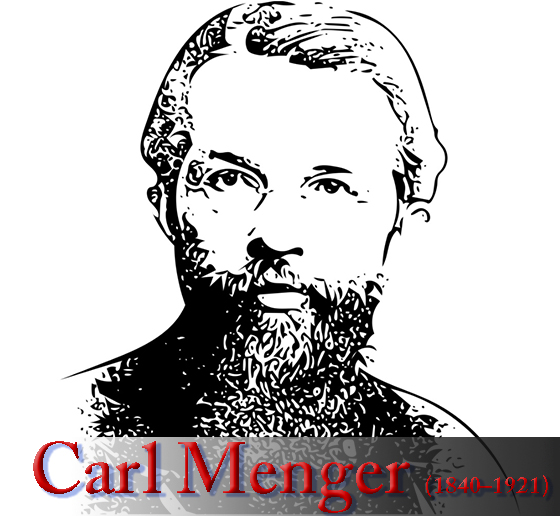
On February 23, 1898, Émile Zola was imprisoned in France after writing J’accuse, a letter accusing the French government of anti-Semitism and wrongfully imprisoning Captain Alfred Dreyfus.
Zola is perhaps most famous for his leadership in extending realistic naturalism to the novel, in such works as Germinal (1885).
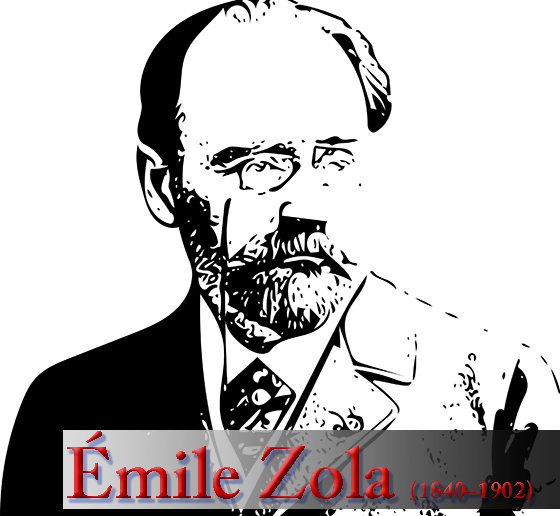
Fifty-eight years earlier, Austrian economist Carl Menger was born.
Menger would go on to contribute to the development of the theory of marginal utility, which supplanted cost-of-production theories of value in economics, in his first book, translated into English as Principles of Economics. Though expert in mathematics (he served as tutor in economics and statistics to Archduke Rudolf von Habsburg, the Crown Prince of Austria not long after the publication of the Principles), his approach to marginal theory was the least mathematical of his famous “co-discovers” of the principle, William Stanley Jevons and Leon Walras. Rooted in a subjective theory of value, it was the most realistic and least mathematical of the marginalist revolutionary works. For example, Menger was more interested in price formation, not “price determination,” which focused almost exclusively on equilibrium conditions. He developed an evolutionary theory of money, and his second book expanded upon evolutionary processes, especially the invisible hand aspect of social order.
Zola died in 1902; Menger died in 1921.
Someone can conquer kingdoms and countries without being a hero; someone else can prove himself a hero by controlling his temper. Someone can display courage by doing the out-of-the-ordinary, another by doing the ordinary. The question is always — how does he do it?
Soren Kierkegaard, Either/Or (1843).