Categories
Today

March First Firsts

March 1st Firsts (and a 17th and a 37th):

| The first United States census was authorized, in 1790.

| Ohio was admitted as the 17th U.S. state, in 1803.

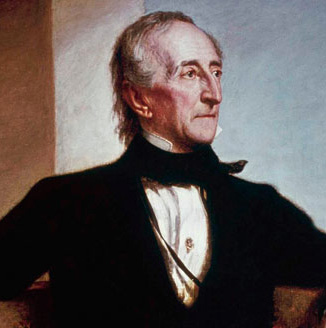
| President John Tyler [pictured above] signed a bill authorizing the United States to annex the Republic of Texas, in 1845.

| The state of Michigan formally abolished capital punishment, 1847.

| Nebraska became the 37th of the United States, in 1867.

| Yellowstone National Park was established as the world’s first national park, 1872.

On March 1, 1781, the Continental Congress of the United States adopted the Articles of Confederation. With this, the governing body became known, officially, as United States of America in Congress Assembled, less officially as the Congress of the Confederation. The first session of this newly styled Confederation Congress took over without a break from the Second Continental Congress, adjourning on November 3. Samuel Huntington and Thomas McKean served as presidents during this first session.

Categories
Thought

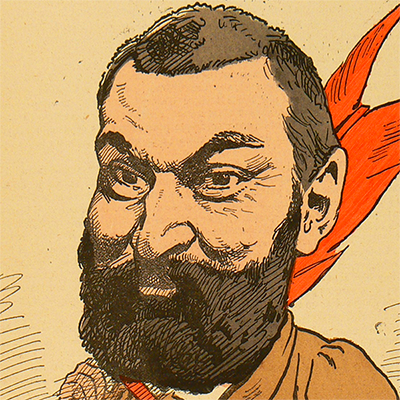
Yves Guyot

[O]ver two-thirds of the railways of the world belong to private companies. Moreover, of the 24,500 miles of railway belonging to the state of British India, 18,000 miles are operated by private companies. In Holland all the lines are operated by companies. In Belgium the tramway lines are longer than the state railways, and they are operated by private companies. Lines in Great Britain, which have three, four, or even more tracks, are included in these figures on the line and not the track basis. The total length of line is 23,287 miles. The length of main track, however, is 39,851 miles, and of main track and sidings, 54,311 miles.

The greatest system in the world, that of the United States, is owned by private companies. Mr. Bryan, on returning from Europe in 1903, introduced nationalization of railways into his platform, without informing any of the members of the Democratic party of his intention. This brilliant inspiration helped to destroy his chances for the presidency.

The operating ratios suffice to show that superior administrative capacity is not to be found on the side of the several states which exercise it in this direction.


Yves Guyot, Where and Why Public Ownership Has Failed, Book II: Financial Results of Government and Municipal Ownership; Chapter IX, Public vs. Private Operation” (American edition, 1913).

Categories
Accountability folly ideological culture media and media people national politics & policies political challengers

Bigly Truthiness

“Journalists should be tough when powerful people say untrue things,” writes the Books and Arts columnist for The Economist.

I’m with “Johnson,” that pseudonymous author, except for one thing. In calling President Trump a Big League liar, he himself seems to miss the whole truth, nothing but the truth.

At the very least, The Economist scrivener proves himself rather obtuse . . . especially for a column de plume tipping the hat to the great Samuel Johnson. Many of the Trumpian falsehoods he mentions are indeed whoppers. No doubt. But a few cry out for a more subtle reading.

After distinguishing between falsity, lying, and fantasizing, “Johnson” speculates that Trump may actually believe “his own guff.”

But then, about Trump’s murder rate statements, Johnson quickly runs off the rails: “Mr. Trump said something wildly wrong about something easily checkable, leaving an adviser, Kellyanne Conway, flailing to cover for him. . . .” But Conway did suggest that Trump may have been speaking about certain cities wherein the murder rate has gone up.

Trump often speaks as hyperbolist: murder has gone up in a few major cities; he relates the fact as if murder had gone up generally. This annoys sticklers. Me, included. But Trump’s been using the rhetoric of exaggeration.

You could call it the rhetoric of inexactitude.

It’s how he trolls.

Trump could also be charged with “truthiness,” comedian Stephen Colbert’s signature 2005 coinage about confidence in factoids for intuitive reasons, sans evidence.

But so might this “Johnson.” When subtle men miss homespun subtleties, one has to wonder whether they might miss it for . . . intuitive reasons.

This is Common Sense. I’m Paul Jacob.


Printable PDF


Categories
Today

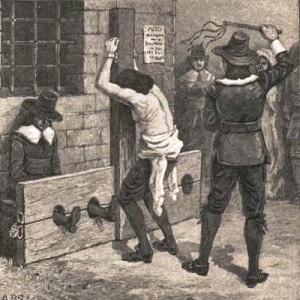
Whipped for sleeping in church

On February 28, 1646, Roger Scott, of Lynn, Massachusetts, was tried for sleeping in church. Awakened in church by a tithingman’s long, knobbed staff hitting him on the head, he struck back at the man, and garnered a whipping as punishment, as well as the dark designation as “a common sleeper at the publick exercise.”

Categories
Thought

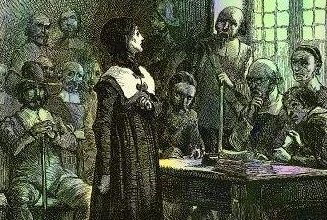
Anne Hutchinson

Do you think it not lawful for me to teach women and why do you call me to teach the court?


Anne Hutchinson, testimony in her trial for teaching women in the Massachusetts Bay Colony church (1637)

Categories
folly ideological culture media and media people

Deep Dark Truthful Mirror

At my advancing age, I couldn’t stay up late enough to watch Hollywood’s winners grab their Oscars and punctuate their rambling, teary-eyed acceptance speeches by hurling brickbats at President Trump.

The Donald will have to defend himself for perverse statements such as heard on the Access Hollywood tape: “[W]hen you’re a star . . . You can do anything.” Live by the stars, die by the stars.

Still, consider: how much more effective would those Hollywood (snoozed-through) scoldings be had these cultural “icons” voiced similar disfavor against President Bill Clinton’s similar actions.

Regardless of the precise Clintonian “is”-ness of “is,” clearly “hypocrisy” is up in lights in Tinseltown.

Another seeming Hollywood double-standard strolls down the red carpet unimpeded: the gender pay gap. “Compared to men, in most professions, women make 80 cents to the dollar,” actress Natalie Portman said last month. “In Hollywood, we are making 30 cents to the dollar.”

Much ballyhooed and largely erroneous, the national gender wage gap compares the median male income against the median female income out of hundreds of millions of workers, without regard to jobs done, hours worked, or levels of experience. Conversely, leading roles in a movie can more fairly be compared.

The North Korean hack of Sony Pictures revealed numerous cases where female stars were paid far less than their male counterparts. For instance, in the film No Strings Attached, Ashton Kutcher, Portman’s male co-star, received compensation three times greater.

Yesterday, at Townhall, I asked a simple question: Wouldn’t it better serve the interests of fairness and equality were actors to muster whatever truth to be had directly at the Hollywood power structure . . . sitting before them in the ballroom?

This is Common Sense. I’m Paul Jacob.


Printable PDF


Categories
Thought

Yves Guyot

Neither government nor municipal monopolies are novelties; they are antiques. To represent them in the light of consequences of modern economic changes is to commit a solecism. They are not indicative of evolution, but of retrogression.


Yves Guyot, Where and Why Public Ownership Has Failed, Book IV: Political and Social Consequences of Public Operation, Chapter I, Socialist Programs and the Facts” (American edition, 1913).

Categories
Today

Arthur Latham Perry

On February 27, 1830, American economist and free trade advocate Arthur Latham Perry was born.


The Twenty-second Amendment (Amendment XXII) of the United States Constitution, which sets a term limit for election and overall time of service to the office of President of the United States, was ratified by the requisite 36 of the then-48 states on February 27, 1951.

Congress had passed the amendment on March 21, 1947.

Categories
links

Townhall: The Stars of Sexist and Racist Hollywood Shine Bright Tonight

On behalf of the Academy of Motions Pictures Arts and Sciences, we’d like to extend a little advice to Hollywood’s best and brightest. Click to Townhall; come back for more abuse.

Categories
Today

Dominican Independence

February 26 marks the Dominican Republic’s Independence Day.