On November 17, 1777, the Articles of Confederation were submitted to the states for ratification.
On that date in 1800, the United States Congress held its first session in Washington, D.C.
On November 17, 1777, the Articles of Confederation were submitted to the states for ratification.
On that date in 1800, the United States Congress held its first session in Washington, D.C.
Here is something I don’t quite understand about us moderns — we, oh-so-sophisticated citizens of the world; we who say that government is instituted to help us . . . but often we expect almost no real help when it comes to even the basics.
Take this very “virtual” venue: the Internet; “the Web.”
This wasn’t a thing in the first decade of my adult life. I never expected to spend so much time “on” something that did not, then, exist in any meaningful way.
Well, computers opened up brave new worlds for us, but, did you notice? Bad guys were right there from the beginning, making “viruses” and “spyware” and “malware” of all kinds. Destroying billions of dollars of data and equipment, robbing us of the most important thing of all: time.
And what did the United States government do?
Nothing, or next to it.
Belatedly, and haphazardly, it scraped together a digital defense for its own infrastructure, and began to cook up ways to surveil us all.
But did it offer to help? What programs did it provide the public, or the states, to assist us with bad guys trying to steal our savings, credit, and virtual identities?
I haven’t seen anything. And our local governments have stood around useless, too.
Yet I haven’t heard anyone complain.
Our security has been up to us. Long ago, John McAfee invented the first anti-virus software, and an industry grew up from his kernel — and that industry is where we turn to for help.
Government has mostly just stood by — in the sole area of the computer industry that it could plausibly have warrant to “interfere.”
This is Common Sense. I’m Paul Jacob.
Questions Answered:
Does government fulfill its main function consistently?
Who do Americans turn to for effective security?
If government doesn’t even bother doing its main job, why give it more jobs?
“…the bogeyman government is like the bogeyman under the bed. It’s not real. It doesn’t exist.”
Citation:
On November 16, 1532, Francisco Pizarro and his men captured Inca Emperor Atahualpa at the Battle of Cajamarca.
In 1811 on this date, John Bright (pictured above), English academic and politician, Chancellor of the Duchy of Lancaster, was born. Bright (d. 1889), famously worked with Richard Cobden against the Corn Laws (repealed in 1846) as well as for the Cobden–Chevalier Treaty of 1860, which ushered in freer trade and closer interdependence between Britain and France.
Those who seek education in the paths of duty are always deceived by the illusion that power in the hands of friends is an advantage to them. As far as Adams could teach experience, he was bound to warn them that he had found it an invariable disaster. Power is poison. Its effect on Presidents had been always tragic, chiefly as an almost insane excitement at first, and a worse reaction afterwards.
Henry Adams, The Education of Henry Adams (1907).
“If Libertarian Gary Johnson doesn’t win the presidency,” I posted to Facebook last Monday, “I’m leaving the country.”
Well, Johnson didn’t win. And I wasn’t kidding. I’m writing this from a Parisian café.
Of course, I was also tongue-in-cheek, since — spoiler alert! — I am coming home next week.
This week, I’m speaking at the Global Forum on Modern Direct Democracy in San Sebastián, Spain — a gathering of pro-initiative folks from all over the world. We want people’s votes to count, even if we disagree with their candidate or issue.
Which brings us back to Donald J. Trump’s surprise victory. Protests have broken out in several cities — some violent. And some folks say they’re scared of what Trump may do as president. Sure, one can snicker at these fearful responses as liberal whining. And to the extent they’re talking about university professors canceling tests and coddling “traumatized” students . . . well, no argument here.
Still, I don’t just sympathize when I hear people fear a politician with power, I empathize.
For a long time, I’ve been worried by out-of-control presidential power — from unconstitutionally making laws through executive orders to making war without any real check on that power. Scary. Whether that president is George W or Obama or Hillary or Trump.
Government is a monopoly on force. Therefore, by definition, government is frightening.
Democracy is often an antidote to tyranny, a check on power, but not always. That’s why folks who truly appreciate democracy believe in individual rights that transcend any vote-getting public decision mechanism.
Scared by President-Elect Donald Trump? Protect yourself: enact greater limits on government.
This is Common Sense. I’m Paul Jacob.
Questions Answered:
Is fear a natural byproduct of government?
Which presidential powers lack sufficient checks and balances?
What is more important: individual freedom or democratic decision-making?
Is democracy a check on power or an enhancement?
The Next Question:
How do we go about creating greater limits on political power?
On November 15, 1777, the Continental Congress approved the Articles of Confederation — after 16 months of deliberation.
No man chooses evil because it is evil; he only mistakes it for happiness, the good he seeks.
Mary Wollstonecraft, A Vindication of the Rights of Men (1790).
Strange election. So . . . round up the usual suspects!
Immediately after Hillary dried her tears and conceded, out came the Tweets, then the analyses: the “third parties” are to blame!
Over the weekend, I focused* on one such election post-mortem. The basic idea is not altogether wrong: minor party efforts together may have cost the Democrat her Electoral College advantage this time around, just as Nader’s Green Party run spoiled Al Gore’s bid in 2000 and several past congressional races have been spoiled for the GOP by Libertarians.
Is there a problem here? Yes. But do not blame the minor party voters. It’s the way we count their votes that is “problematic.” The current ballot-and-count system turn voters most loyal to particular policy ideas into enemies of those very same ideas.
When we minor party voters turn away from a major party — usually because said party tends to corrupt or betray our ideas, or make only small steps toward our goals — our votes aren’t so much wasted as made poisonous.
Because the candidate least preferred may prevail.
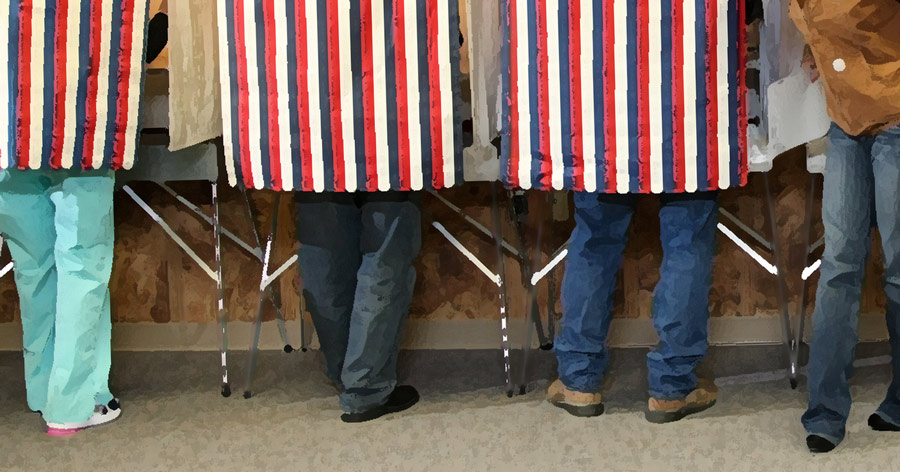
But there’s a way out: On election day, voters in Maine showed how to cut through the Gordian Knot. Voting in approval for Question 5, Maine now establishes “ranked choice voting.”
Under this system, you don’t “waste” your vote when expressing a preference for a minor party candidate. You rank your choices and, if your first choice proves unpopular, your second choice (or maybe your third) gets counted. So you don’t “poison” your cause.
Republicans and Democrats have more than enough reason, now, to adopt ranked choice voting across the country.
This is Common Sense. I’m Paul Jacob.
* See yesterday’s links page to my weekend Townhall column for the basic references. But there were many, many articles on the Minor Party Effect, including a skeptical one by Sasha Volokh’s.
Questions Answered:
What is the effect of minor parties on major party outcomes?
What causes those effects, voter intent or something else?
Is there a way to prevent this, short of further sewing up the ballot access system to minor parties?
The Next Question:
What might our elections look like if people spent more time discussing issues and ideas … and less about class, culture wars, and sex crimes?
English is an outrageous tangle of those derivations and other multifarious linguistic influences, from Yiddish to Shoshone, which has grown up around a gnarly core of chewy, clangorous yawps derived from ancestors who painted themselves blue to frighten their enemies.
Roy Blount, Jr., Alphabet Juice (2008), p. 93.