Categories
links

Townhall: An American Abroad

Paul Jacob was in Europe last week, at a conference. Which was not without its ideological conflicts — on the streets. Click on over to Townhall, then come back here for street-ready ideas.

Categories
Thought

P. J. O’Rourke

There is worldwide pigheadedness about money. There is a willful and even belligerent ignorance concerning ways and means. . . . Not all this ignorance is irrational. Economists, for instance. John Maynard Keynes couldn’t have become a big shot, guiding government intervention in business and finance, if it hadn’t been for the Great Depression. And Alan Greenspan is a success because we all lost our wallets when inflation scared our pants off.


P. J. O’Rourke, Eat the Rich: A Treatise on Economics (1998), p. 235.

Categories
by Paul Jacob video

The Media Helped Elect Trump

From an interview on Swiss public television, Paul Jacob explains the Trump victory for concerned Europeans:

http://youtu.be/96WgWGxFWZQ

An article featuring Paul can be found here: “Election upset to boost direct democracy in US.”

Paul is scheduled to return to his home soil next week.

Categories
Thought

Roy Blount, Jr.

A good heavy book holds you down. It’s an anchor that keeps you from getting up and having another gin and tonic.


Roy Blount, Jr., “Reading and Nothingness, Of Proust in the Summer Sun,” New York Times (June 2, 1985).

Categories
Today

Of/By/For

On November 19, 1863, President Abraham Lincoln delivered the Gettysburg Address at the ceremonial dedication of the military cemetery in Gettysburg, Pennsylvania, appropriating an old phraseology for republican government — “of the people, by the people, for the people” — and giving it its most memorable usage.

On the same date in 1955, National Review published its first issue.

Categories
general freedom ideological culture nannyism national politics & policies Popular too much government U.S. Constitution

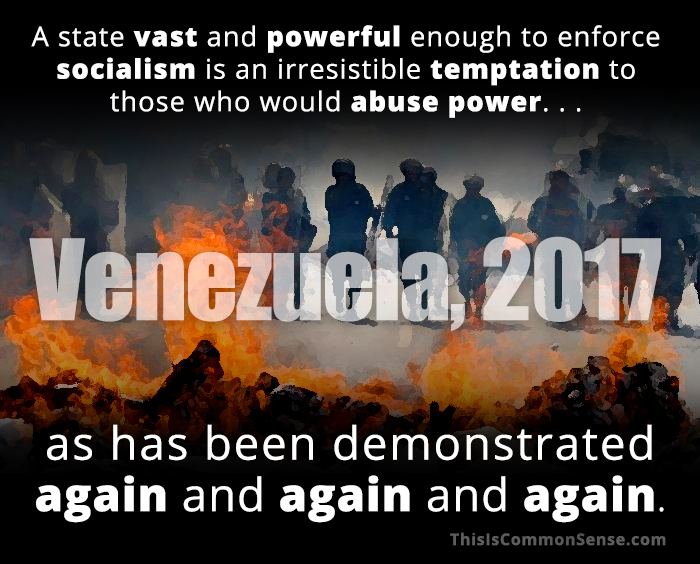
The Venezuela Chaos

I have friends who call themselves anarchists. Their theory? Government is always merely an open conspiracy of some to live at the expense of others.

Republicanism, on the other hand, proposes that if we limit government, we can hone it down to the level where there is no conspiracy, and everything the government does can plausibly help everybody.

Not just a few insiders.

Socialism is the opposite notion. Socialists seek to grow government so far that it “naturally” serves everybody, not only the few. It’s all about “equality,” you see.

Here’s what we know for sure: socialism, when really tried, is so awful that it makes anarchy-as-chaos sound good.

The latest socialist horror is Venezuela, which is getting worse every day. Now hospitals place newborns in cardboard boxes. There are no other supplies.

But that’s not all. The special program for feeding everybody? It’s now mainly for feeding just those close to the government — precisely as my anarchist friends say all government is:

Six months after the creation of the Local Committees of Supply and Production (Clap) that is designed to “distribute food directly to the people,” the government has decided to change its approach by threatening those using the program.

The Venezuelan government announced that it will suspend delivery of food packages to those who criticize its policies.

Are socialist out to prove anarchists right?

I bet most of my readers still put some hope in limiting government to serve all. Venezuelan socialism demonstrates how badly the opposite idea is, showing us that serving everybody by total government just decays into the folks allied closely with government warring against everybody else . . . who starve in plain sight.

This is Common Sense. I’m Paul Jacob.


Ask the next question.

Questions Answered:

What is the difference between a republic and a socialist state?

What do anarchists think of government?

What happens when government tries to do everything for everybody?

The Next Question:

How do we convince well-meaning socialists that total government cannot work for the benefit of everybody? (Since the examples of the USSR, Communist China, and Venezuela haven’t worked so far.)


Printable PDF

government, bathtub, Venezuela, illustration


Categories
Thought

George Santayana

Egotism is a bastard word meant to designate something spurious and artificial, not to be confused with the natural egoism or self-assertion proper to every living creature. To condemn the latter would be to condemn life, which could not go on without it; but like every normal faculty, self-assertion has degrees, and passes insensibly from the happy mean to the opposite vices of excess and defect. Egotism, on the contrary, though more or less pronounced, is always a vice because it is founded on a mistake.


George Santayana, postscript to Egotism in German Philosophy (1916).

Categories
Today

Tell and Shaw

On November 18, 1307, legend has it, William Tell shot a crossbow bolt to pierce an apple, toppling it off his son’s head. He was forced to do this by the local Austrian authority, whose hat hung on a pole in the Altdorf town square Tell had refused to bow to when entering the village. Tell endures as a Swiss folk hero, and provides the subject of a famous opera by Rossini — the music of which is associated with, in many ears, Bugs Bunny and the Lone Ranger.

In 1926, on this date, George Bernard Shaw formally refused to accept the money for his Nobel Prize for Literature, saying, “I can forgive Alfred Nobel for inventing dynamite, but only a fiend in human form could have invented the Nobel Prize.”

Categories
ideological culture national politics & policies political challengers

Double Bubble America

The “unexpected” Donald Trump presidential victory has put the folks at The Gray Lady a bit out of sorts.

Heather Wilhelm at the National Review pokes and prods at the absurdities of the New York Times’s cultural cluelessness. And ably enough. So I’ll stick to The Times’s recent “six views” of America’s ideological divide:

Julie Turkewitz recognizes two well-insulated informational bubbles at play. Nothing too controversial — or very deep.

Campbell Robertson muses upon the dominance of the “elites” against which Trump’s insurgents rebel, noting that “the elites are the still the ones who get to decide who gets to be elite.”

Laurie Goodstein takes on religious culture, making much of divergent spiritual outlooks, left and right.

Julia Preston peers at immigration and the prospect of sending a message by building a “wall.”

In the manner of the other five, Sheryl Gay Stolberg digs up real-world people — as does our speechifier-in-chief, Barack Obama — to lightly probe questions of assimilation versus multiculturalism.

Manny Fernandez concludes with a (yawn) discussion of giving and taking offense.

They all miss the underlying structural basis for the divide.

On one side: folks working in the private sector — or local governments and charities, or at home — who have seen the world pass them by in terms of income and security.

On the other: government workers and consultants (and other college grads) who make more, on average, than their “real world” counterparts.

The latter has advanced as a class; the former remain in stasis . . . at best.

A mystery?

No — it’s the predictable result of what Thomas Jefferson called “the parasite institutions now consuming us.”

This is Common Sense. I’m Paul Jacob.


Printable PDF

bubble, Trump, election, reasons, explanations, illustration


Original (cc) photo by diana MĂRGĂRIT at Flickr


Categories
Thought

P. J. O’Rourke

Marijuana never kicks down your door in the middle of the night. Marijuana never locks up sick and dying people, does not suppress medical research, does not peek in bedroom windows. Even if one takes every reefer madness allegation of the prohibitionists at face value, marijuana prohibition has done far more harm to far more people than marijuana ever could.


P. J. O’Rourke, as quoted in Busted : Stone Cowboys, Narco-lords, and Washington’s War on Drugs (2002), edited by Mike Gray.