Categories
tax policy too much government

A Tale of Two States

Tuesday is Election Day for Wisconsin’s gubernatorial recall, pitting Republican Gov. Scott Walker against Democratic Milwaukee Mayor Tom Barrett in a rematch of their 2010 contest, won by Walker. Polls show Walker leading, and likely to become the first “recalled” governor to ultimately defeat his recall and retain his office.

In fact, after all the massive protests and the recall campaign, Walker’s popularity has increased.Governors Walker and Quinn
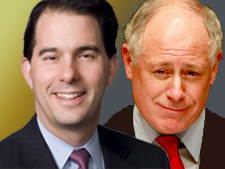
Why?

Mr. Walker has done what he said he would. He hasn’t raised taxes. He staked out his position on ending collective bargaining for most public employees as well as requiring them to pay something toward healthcare and pension benefits, and, against a flurry of opposition, stuck to his guns.

Now the Badger State’s unemployment rate is down below the national average and economic prospects are up.

For a very different story, look south, to Illinois.

Gov. Patrick Quinn supports initiative, referendum and recall, but gets demerits for his response to the current economic difficulties. In 2010, Illinois raised the state income tax by 66 percent. But the $7 billion in extra revenue has done little to solve the state’s chief budget woe — Illinois was $8 billion in the hole when the income tax was hiked, and somehow faces that same $8 billion shortfall today.

So, just a week ago, lawmakers slapped a $1-per-pack tax on cigarettes.

If a state could tax itself out of trouble, Illinois would be a near paradise today.

Walker took on the government employee unions; Quinn took on the taxpayers. That’s why Wisconsin — including their embattled governor — is on the upswing and Illinois is not.

This is Common Sense. I’m Paul Jacob.

Categories
tax policy

Regressive Europe

Some folks love to compare the U.S. to Europe unfavorably.

Not me.

Though I’m fine with learning from European states and cultures (hey: I like Switzerland!), I shudder when I hear someone suggest that America should be “more like Europe.”

Obviously, I’m not with our current president on this. He says we should tax the rich more, make them pay “their fair share.” And his left-leaning admirers append the phrase, almost under their breath, “like in Europe.”

Ugh.

But reserve some of that “ugh” not at the proposal, but at the assumption that European states tax the rich with higher “progressivity.” Veronique de Rugy, reporting on a new book by Bruce Bartlett, says that view is off base. European states tend to rely on the VAT, which is heavily regressive. Additionally, Europe’s high income tax rates kick in at lower incomes, so that Europeans lower down on the middle class ladder feel the bite of high taxes.

De Rugy concludes that America is a lot like Europe, on the whole, but that America’s “tax framework may be worse. . . . It disproportionately relies on the top earners to raise revenue, it exempts a large class of taxpayers from paying any income taxes, and it conceals spending in the form of tax breaks.”

This is all very interesting. But my take-away is not to emulate Europe, but — instead — the distinctively American policies we’ve let slip away. Our limited government principles don’t require us to endlessly chase new revenue streams.

This is Common Sense. I’m Paul Jacob.

Categories
free trade & free markets ideological culture tax policy

Unfuzzying Up the Past

We hear a lot of talk about the disappearing middle class. Sometimes this jabber goes so far as to posit that normal folks — say, the “99 percent” — haven’t really experienced any progress since the ’60 or ’70s.

So blame the rich. And their government.

It’s not an implausible case. Wealthy interests do rent politicians at extravagant rates, changing policy in their favor.

But as economist Russ Roberts and Cornell University’s Richard Burkhauser discussed recently, sloppy statistics feed the hand-wringing over middle-class decline. Considering government transfer payments from rich to poor and plotting income by household rather than individually, the basic “stagnation” thesis doesn’t pass the “smell test.”

For the real stink, however, consult the Internet memes, particularly this goofy contention:

In the 1950s and 1960s when the top tax rate was 70-92%, we laid the interstate system, built the Internet, put a man on the moon, defeated Communism, our education system was the envy of the world, our middle class thriving, our economy unparalleled. You want that back? Raise taxes on the rich.

Forget the obvious nonsense (ARPANET was the Internet only in ovo; Communism collapsed in the ’80s), and concentrate on the main points, as Tom Woods has done: tax evasion was rampant back in the alleged “good ol’ days”; public schools have doubled in per capita spending since then, and not improved; and the stagflationary ’70s followed the booming ’60s, almost certainly as a consequence of the policies being touted, here.

Selective memories help in constructing just-so policy “proofs.” The middle class has received some big hits, I grant you. Still, we’ve seen progress, too.

This is Common Sense. I’m Paul Jacob.


Categories
tax policy

Expiration Date

Lots of talk and worry has been expended over an unfortunate aspect of the ancient Mayan calendar: it was calculated to run through 2012 but no further.

Some folks, placing inordinate weight on pre-Aztec American time-keeping, think that spells the end of the world.

As preposterous as the movie about this was, there are a few things to be expected at the end of this year that have a touch of the hand of Doom.

Bush-era tax rates expire, for instance.

Isn’t it strange how a lowered tax rate must expire, but higher rates don’t get a similar sunset treatment?

Anyway, on December 31, 2012, tax rates go up. The Washington Post relates that some folks are calling this “Taxmageddon,” and it could be a disaster for our faltering recovery:

Overnight, the marriage penalty for joint filers will spring back to life, the value of the child credit will drop from $1,000 to $500, and the rate everyone pays on the first $8,700 of wages will jump from 10 percent to 15 percent.

The just-agreed-to payroll tax reprieve also has a built-in expiration date, so FICA withholding will go up 2 percent as well.

Though folks are running scared about this, politicians are girding their loins for a big fight. Or “negotiation.” Or something.

Meanwhile, no real cuts in spending can be expected, especially if President Obama wins in November, as seems increasingly likely.

And the U.S. government continues to borrow an additional six billion dollars every business day. I fear more than one thing is set to expire.

This is Common Sense. I’m Paul Jacob.

Categories
tax policy

Two Forms of Subsidy

Ronald Bailey, online at Reason.com, quotes a press release from a group of renewable energy outfits whining and moaning to keep their huge tax breaks. It’s all for the good of the country, they say.

But Bailey notes that when such tax credits go to businesses not favored by environmental activists and the New York Times, they get branded subsidies.

What is the difference?

A. Barton Hinkle, also working in the vineyards of Reason, clarified one such kerfuffle last year, showing that most of the allegedly shocking subsidies accruing to Big Oil were, in actual fact, general tax rules applicable to all sorts of companies. Hinkle readily concedes that maybe

these are dumb rules. Maybe they need changing. But in no sense can they be called subsidies—i.e., money taken from Smith and given to Jones. The failure to tax Exxon more does not increase your payment to the IRS by one red cent.

Hinkle concludes that if partisans, left or right, are going to treat tax breaks as subsidies, then they should do so across the board, without ideological cherry-picking.

And yes, there is an argument for calling all tax breaks “subsidies.” The lobbying for them looks about the same. They favor some businesses (or, more often, industries) over others. Politicians get the benefits from the special interests in the exact same way.

Perhaps we should define two broad categories of subsidy: Direct benefits and negated detriments. A tax sure is a detriment to the taxpayer. A tax credit or other break is a “negated detriment.” That is, an indirect benefit.

And those negative detriments sure can affect the bottom line.

This is Common Sense. I’m Paul Jacob.

Categories
tax policy too much government

Many Thanks to Grover

Since the Super Committee failed to come up with the promised $1.2 trillion in pretend deficit reduction over the next decade, many in the nation’s capital blame Americans for Tax Reform President Grover Norquist.

Our taxes — and even the taxes of people with the nerve to be wealthy — are not being increased. This, you must understand, is all Grover’s doing, the fault of the Taxpayer Protection Pledge he “pushed” on more than 275 members of Congress.

His pledge articulates a simple, straightforward idea: Taxes are too high and politicians should stop increasing them. Incumbent politicians appear fearful of breaking this pledge. If they go back on their word, they risk being defeated come the next election.

Last Sunday, 60 Minutes’ correspondent Steve Kroft blurted out to Norquist, “You’ve got them by the short hairs!”

Norquist responded, “The voters do, yeah.”

Are we really supposed to be sad about the system of accountability known as elections?

Former Wyoming Senator Alan Simpson whined that Norquist “may well be the most powerful man in America today.”

“The tax issue is the most powerful issue in American politics going back to the Tea Party,” Norquist explained.

If you think the federal government is too small and does too little, a pledge not to raise taxes makes scant sense. But if you think, like Norquist, that government is a whole lot bigger than it should be, pledging not to make it bigger still is a no-brainer.

This is Common Sense. I’m Paul Jacob.

Categories
initiative, referendum, and recall tax policy

Time Waits for the Tax-Fighter

More than two decades ago, I got involved in my very first initiative campaign.

In 1990, tax-fighter Jim Tobin, then the head of Taxpayers United of Illinois, filed the Tax Accountability Amendment. I organized the petition drive, which gathered more than half-a-million voter signatures to earn a place on the ballot. Polling showed more than 70 percent support for the issue, but a lawsuit by the Chicago Bar Association struck our initiative from the ballot.

The amendment would have mandated a three-fifths vote of both legislative chambers to increase taxes. By requiring public notice and hearings before a tax hike could be enacted, the amendment also promoted transparency in the legislative process — long before the “transparency” buzzword became cool.

Illinois’s very limited initiative process has allowed for only one issue to appear on the state ballot — a successful 1980 measure, cutting back the number of state legislators and electing them in single member districts.

But even without a vote, Tobin wrested a pledge from both candidates for governor to abide by the provisions of the amendment, which the victorious governor stuck to for several years.

Tobin’s group has grown, finding considerable success battling big taxing politicians. It hasn’t forgotten about transparency, either. The group has launched a national campaign to provide the public with information on lavish and unsustainable pensions being collected by public employees.

Tonight, I’ll be with Jim Tobin at a big event in Chicago celebrating the 35th anniversary of his now national anti-tax organization, Taxpayers United of America.

Congratulations, Jim! Thanks for letting me be a part of it.

This is Common Sense. I’m Paul Jacob.

Categories
free trade & free markets tax policy

An Embarrassment of Riches

Have you heard the terrible, awful news?

Over roughly the last three decades, specifically from 1979 to 2007, Americans across all segments of the economy — from the poorest to the richest — have seen their incomes rise.

It just doesn’t get any worse, eh?

If you haven’t committed hara-kiri, here are the cold, hard facts from the Congressional Budget Office report:

  • The poorest fifth of the population, on average, saw their inflation-adjusted incomes increase 18 percent.
  • The 60 percent of Americans in the middle earned nearly 40 percent more, after taxes.
  • Those of us from the 80th percentile to the 99th had income gains of 65 percent.
  • Incomes for the top one percent of earners were up a whopping 275 percent.

One might think that universally higher incomes are a good thing, but that depends on how you look at it.

“If you think of America’s total income as one giant pie,” an ABC World News Tonight report explained, “the richest one percent have seen the size of their piece double over the last 30 years. And everyone else has seen their piece get smaller.”

Well, I’m really hoping that we won’t start thinking of all our incomes as “one giant pie.”

What about this 99 percent versus 1 percent warfare?

That’s media slant. Most Americans don’t begrudge someone good fortune, and affirmatively admire those who grow wealthy in return for smarts and hard work.

But they do oppose bailouts.

This is Common Sense. I’m Paul Jacob.

Categories
tax policy

Fair Share Laid Bare

President Barack Obama says “it’s only right that we ask everyone to pay their fair share in taxes.”

Rich folks must be wondering when their refund checks will start arriving in their mailboxes.

The current income tax is progressive, requiring those making more to pay a higher rate. Thus, those earning a million dollars pay, on average, 29 percent of their income to Uncle Sam, while those taking home $50,000 to $75,000 a year pay an average of 15 percent. This progressivity can be seen in wide angle, too: Figuring credits and exemptions, 47 percent of Americans pay no federal income tax at all. Meanwhile, the top ten percent in income pay 73 percent of all income taxes collected.

And Obama’s idea of taxing “the rich” would only make it more unfair.

But, wait, what about billionaire Warren Buffett? Doesn’t he pay a lower percentage of his income in taxes than does his secretary?

Most of Buffett’s income comes off his investments, not in salary. That’s capital gains, taxed at 15 percent. Obama decries it, but doesn’t propose any specific increase in capital gains taxes. Why? He doesn’t want the stock market to crater. As he put it two years ago, “The last thing you want to do is raise taxes in the middle of a recession.”

So, when President Obama says the rich should pay their fare share, what does he mean? Simple: “If you’re not rich, vote for me.”

This is Common Sense. I’m Paul Jacob.

Categories
ideological culture tax policy

A Social Contract You Can’t Refuse

Massachusetts U.S. Senate candidate Elizabeth Warren really worked up “progressives” with a rant about “fair taxation.”

“There is nobody in this country who got rich on his own — nobody.”

As A. Barton Hinkle points out, no one suggests otherwise. But the real meat of her argument is worth studying . . . for a peculiar pathology in logic:

You built a factory out there? . . . You moved your goods to market on the roads the rest of us paid for. You hired workers the rest of us paid to educate. You were safe in your factory because of police-forces and fire-forces that the rest of us paid for. You didn’t have to worry that marauding bands would come and seize everything at your factory — and hire someone to protect against this — because of the work the rest of us did.

Upon this rests her case for ramped-up progressive tax rates.

Apparently, according to Ms. Warren, successful businessfolk are takers only. But all along the way, businesses pay for the services they hire. Indeed, they pay for roads, too. Truckers, for instance, pay special weight-rate taxes and licenses for carrying heavy loads across roadways.

Her “argument” no more justifies government taxing truckers or factories more than a similar argument, mutatis mutandis, would allow the kid who mows your lawn to reach into your wallet when you aren’t looking.

The social contract doesn’t originate the way Warren specifies. Her logic establishes only that she’s not thinking clearly about obligations and lacks an appreciation for making a business succeed.

This is Common Sense. I’m Paul Jacob.