
Categories
First Amendment rights Fourth Amendment rights media and media people national politics & policies political challengers

The Citizen Threat

“The Republicans,” said Tucker Carlson — speaking of elected Republicans — “who really do hate their own voters in a way that’s pathological, are just re-upping the spy laws to allow the Biden Administration to spy on their voters.”

Mr. Carlson is not wrong, at least about Republican leaders aiding Democrats in spying on conservatives and others who sometimes vote GOP.

Yes, the federal government’s surveillance and criminal “justice” apparatus has been directed by Democrats — the Biden Administration specifically, and whoever runs that — to target, as The Enemy, conservatives and others associated with (or merely adjacent to) the Republican Party.

This cannot be dismissed as a conspiracy theory. Democratic thought leaders pushed this new anti-terrorism paradigm from the first moments of the Biden Administration, in public

Or at least on MSNBC, where John Brennan clearly reconceived opposition to his Democratic Party as a movement looking “very similar to insurgency movements that we’ve seen overseas.” 

“Even libertarians,” he said, constituted “an insidious threat” to, not the Democratic Party, but “our Democracy.”

This perspectival shift, of seeing policy and political opposition as “insurgency,” is key to the new anti-democratic mindset.

And very real. It could end our small-r republican experiment.

Which brings us back to Republican politicians and their willingness to let Democrats institute a permanent pogrom against all who oppose Democrats’ big government programs.

Why do this? Out of hatred? Disdain? Fear?

Let’s not ignore the age-old impulse of politicians to squelch the speech of opponents. The longer in office, the more these careerists tend to view their own constituents as threats. After all, anyone might freely offer a complaint that emboldens or comforts the opposition. This is a bipartisan principle.

Better an enforced silence about the dictates of Washington, sadly, if you are a Washingtonian delivering dictates.

This is Common Sense. I’m Paul Jacob.


PDF for printing

Illustration created with PicFinder and Firefly

See all recent commentary
(simplified and organized)
See recent popular posts

Categories
national politics & policies political challengers

Twelve-Point Play

How popular is President Joe Biden? 

Better to ask how unpopular; a substitute Democrat to be named later is more popular. 

Twelve points more popular.

“An unnamed ‘Democratic candidate’ shifts the race by 12 points on the margins,” Aaron Blake reports in The Washington Post, “turning a four-point Democratic deficit against Trump into an eight-point lead, 48 percent to 40 percent.”

Democrats are mulling all this over because their unpopular president, according to a recent New York Times-Siena College poll, trails former President Donald Trump “in five of the six most competitive battleground states”: Arizona, Georgia, Michigan, Nevada, and Pennsylvania. 

“I am concerned,” offered U.S. Sen. Richard Blumenthal (D-Conn.), “by the inexplicable credibility that Donald Trump seems to have despite all of the indictments, the lies, the incredible wrongdoing.”

Or is it, instead, the lack of credibility enjoyed by establishment politicians and media?

“What many missed about the poll is that a generic Democrat isn’t the only one significantly overperforming the actual candidate likely to lead the ticket,” Blake further explains.

“The poll also tested a race without Trump,” discovering that the “GOP’s lead goes from an average of four points with Trump to an average of 16 points without him, 52–36.”

Former South Carolina Gov. Nikki Haley polls best against Biden. 

Democrats, however, lack an “available alternative.” Vice-President Kamala Harris polls only a single point better than Biden, which is damning news for Biden. Would another Californian, Gov. Gavin Newsom, fare better? 

Or is the only good Democrat a mythical Democrat?

This is Common Sense. I’m Paul Jacob.


PDF for printing

Illustration created with PicFinder and Firefly

See all recent commentary
(simplified and organized)
See recent popular posts
Categories
political challengers

The Ultimate Outsider

“We do not make a pact with communists.”

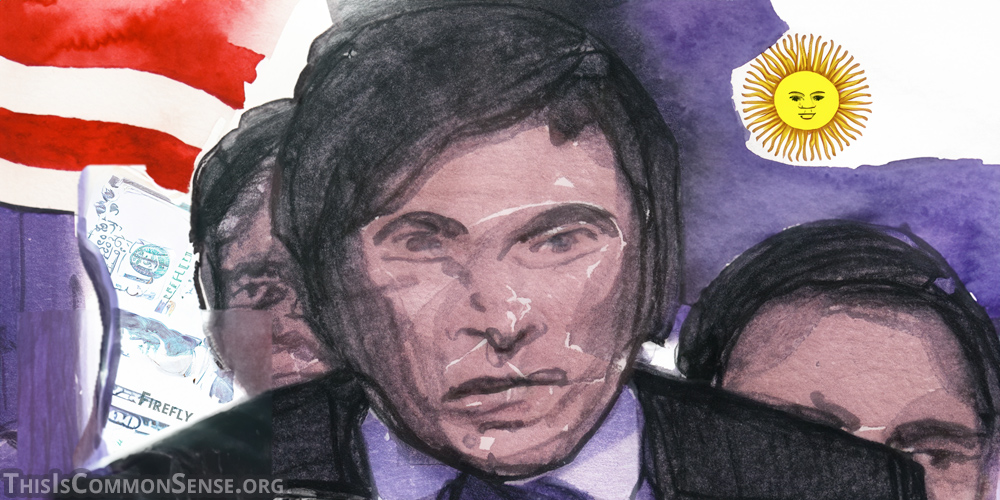
That’s how Argentine presidential candidate Javier Milei characterized his China policy. Now that he’s achieved second place in the recent election, and will face the nation’s current economic minister in a runoff on November 19, it’s time to take a second look at the Milei phenomenon. Three things:

  1. Dollarization.

Argentina is going through economic chaos right now. And it’s no surprise, considering how the country — once rich and admired — adopted fascistic economic and political models, flirting with hyperinflation . . . and worse. Peronism in Argentina is not unlike Progressivism in America: de-stabilizing, prone to leadership cults, waffling on term limits: deeply corrupt and corrupting. Milei’s establishment competition has presided over a 123 percent inflation rate, while Milei proposes to abolish its central bank.

And adopt the U.S. dollar as the backing for the Argentine monetary system.

When you resort to the debt-ridden dollar as the anchor to your economy, you know you are desperate!

  1. Spectrum characterization?

One thing that policy says about Milei, who calls himself a liberal, or — in American terms — a “libertarian,” is that he is not quite so radical as establishments might fear. He’s not talking about gold, or Bitcoin! (Except, he is — just not as the basis of legal tender.)

Note that characterization. In the recent Epoch Times article on Milei’s challenge to Peronism, the independent paper called him a “right-wing libertarian” while dubbing “[f]ormer president and current Vice President Cristina Kirchner” a “hard-left politician.”

Yet it is traditional to call the Peronism she practices a form of “fascism,” which is considered “right wing.”

  1. Lashing out.

Argentine insiders are not taking this lying down; prosecutors have launched a legal case against Milei for upsetting the economy. A bizarre case, on its face, but not so unfamiliar, though, is it?

This is Common Sense. I’m Paul Jacob.


PDF for printing

Illustration created with Firefly

See all recent commentary
(simplified and organized)
See recent popular posts
Categories
national politics & policies partisanship political challengers

No Protection, No Duh

Major candidates for the presidency are usually granted security details. The Biden Administration has so far balked at providing anything like that for Democrat-turned-independent candidate Robert F. Kennedy, Jr. 

Why?

In an October 16th letter, Senator Ted Cruz (R.-Tex.) challenged Department of Homeland Security Secretary Alejandro Mayorkas for 88 days of “failing to respond” to the candidate’s formal request, as well as for ignoring “follow-ups by his campaign.” 

The senator writes that this “represents a stark departure from the standard fourteen-day turnaround for this type of request.”

Cruz also cites an apparent attempt on Kennedy’s life, a man dressed up as a U.S. Marshal caught at one of his Los Angeles campaign events. 

“On Sept. 29, two weeks after the Los Angeles incident,” explains The Epoch Times, “government accountability organization Judicial Watch received 11 pages of Secret Service records that detailed its denial of Mr. Kennedy’s protection request.” The Secret Service acknowledges “that Mr. Kennedy received several threats from ‘known subjects’ and that he is at a higher ‘risk for adverse attention.’”

The report was no doubt placed in the “No Duh” file.

The history of the Kennedys being what it is, one is almost tempted to hazard a guess as to why The Biden has so little interest in protecting the political competition. 

Hasn’t it crossed every American’s mind that this son and nephew of two assassinated political figures might be targeted . . . maybe by the same group of assassins? Which many have wondered might have hailed from within the government.

Wait — is The Biden trying to say . . . no protection necessary . . . don’t worry . . . they have no such plans?

This is Common Sense. I’m Paul Jacob.


PDF for printing

Illustration created with PicFinder

See all recent commentary
(simplified and organized)
See recent popular posts
Categories
general freedom ideological culture political challengers

Two Libertarians, North and South

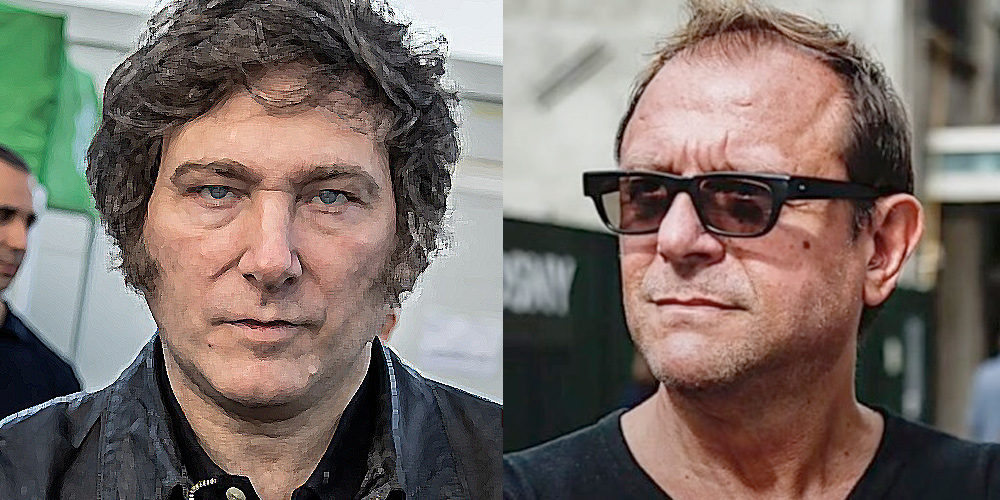
Two scholars have entered politics: Javier Milei in Argentina and Michael Rectenwald in the U.S. The latter’s work has been discussed before in these pages, but the former’s has not. 

Michael Rectenwald, an erstwhile Marxist who began criticizing woke leftism and found his way to libertarianism, spurred by his cruel rejection by the leftist academy and also by reading the work of Ludwig von Mises, is now running for the U.S. presidential nomination of the Libertarian Party.

Javier Milei was a footballer and rock-n-roll musician before becoming an economist and a politician. The Argentine with the wild hair spoke clearly and rationally to Tucker Carlson days ago in Buenos Aires, defending what he called “liberalism” (and opposing socialism in all its forms). Mr. Carlson identified Milei as a libertarian, claiming that the popular economist may become, next month, the next president of his country. At the ten-minute mark Milei explains that “liberalism” means something different in Argentina than in the U.S. He makes it clear he means freedom under a rule of law.

Michael Rectenwald formally introduced his campaign on comedian Dave Smith’s podcast Part of the Problem on Saturday. Rectenwald explains that his main goal is to speak the Truth. “The conclusion I’ve come to is effectively that the means that these elites use are actually the ends that they seek.” In short, those in power didn’t cook up lockdowns and mask mandates and jabs to fight a pandemic, but to extend their power.

Milei, in one popular video, takes a similarly dark view: “You can’t negotiate with leftards. You don’t negotiate with trash because they will end you!”

This politics stuff isn’t so easy.

This is Common Sense. I’m Paul Jacob.


PDF for printing

See all recent commentary
(simplified and organized)
See recent popular posts

Categories
media and media people national politics & policies political challengers

Bashing Climate Change

“[T]he climate change agenda and the policies are killing more people than climate change,” Republican presidential candidate Vivek Ramaswamy informed CNN’s Dana Bash yesterday. “That’s the reality.”

He explained: “The climate-related death rate — tornadoes, hurricanes, heat waves — it is down by 98 percent over the last century. For every 100 people who died of a climate-related disaster in 1920, two die today. And the reason why is more abundant and plentiful access and use of fossil fuels.”

Attacking the “anti-fossil fuel agenda,” Ramaswamy added, “Eight times as many people today are dying of cold temperatures, rather than warm ones. And the right answer to all temperature-related deaths is more plentiful access to fossil fuels.”

Her head having exploded, Bash responded by actually telling Vivek: “As you know, it’s not about people dying today. It’s about what is going to happen in the short term and long term.”

“Oh,” replied Mr. Ramaswamy, “I think it’s all about people dying today.”

Today does certainly come before both short term and long term.

“If you don’t want to cut fossil fuels,” Bash inquired, “what would your policies be to slow things like droughts, like flooding and other damage to our planet?”

“I think we should focus on adaptation and mastery of any change in the climate,” offered the candidate, “through technological advances powered by fossil fuels and other forms of energy.”

Celebrities, politicians and diplomats jetting off to international junkets where they jawbone over unenforceable agreements to cut carbon emissions may impress CNN talking heads. But will Vivek Ramaswamy’s more practical alternative convince voters?

This is Common Sense. I’m Paul Jacob. 


PDF for printing

Illustration created with Midjourney

See all recent commentary
(simplified and organized)
See recent popular posts

Categories
local leaders political challengers

Outlawed But Unmoved 

He plied his trade without shame. Through the years, he was again and again officially rebuked for his conduct. He went ahead full throttle anyway, laughing in the face of danger.

Once, enforcers even tossed him in jail for a night to deter him from his dastardly deeds, deeds that were so galling and offensive to . . . well, to competitors in the same business who had decades of regulatory tyranny on their side.

On the Liberty website, Bruce Ramsey recalls the story. Born Michael Patrick Shanks, Mike officially changed his name to Mike the Mover. 

Why? For the advertising value.

Maybe also the annoyance value.

His job was helping people move. Illegal, because the state of Washington doled out a strictly limited number of professional licenses. And for half a century it was virtually impossible to get one.

“Mike had started in 1981 with one truck,” says Ramsey. “When he painted his name on his trucks his competitors noticed him and complained. In 1987 the state cited him. In 1992 it hit him with a cease-and-desist order. In 1993 it slapped him with a court injunction. . . . He ignored them all. [State] enforcers wrote 89 tickets, each a gross misdemeanor, for operating without a license.”

Where Mike the Mover led, others followed. Finally, the regulators eased up and began licensing many more people to move for a living.

Not Mike the Mover. When he was finally offered a license, “I told them to shove it.”

Thanks, Mike.

This is Common Sense. I’m Paul Jacob.


PDF for printing

Illustration created with PicFinder.ai and DALL-E2

See all recent commentary
(simplified and organized)
See recent popular posts

Categories
Internet controversy national politics & policies political challengers

A Simulacrum of Solace

If you had thought about it at all, you may likely have hoped that artificial intelligence’s spread of popularity this last year would halt its “viral” spread short of politics. In a June 25 New York Times article, Tiffany Hsu and Steven Lee Myers dash your hopes.

Regular readers of this column are familiar with one use of AI: images constructed to arrest your attention and ease you into an old-fashioned presentation of news and opinion, written without benefit of AI. 

But our images are obviously fictional, fanciful — caricatures. 

One advantage of AI-made images is that they are not copyrighted. Using them reduces expenses, and they look pretty good — though sometimes they are a bit “off,” as in the case of a Toronto mayoral candidate’s use of “a synthetic portrait of a seated woman with two arms crossed and a third arm touching her chin.”

But don’t dismiss it because it’s Canada. Examples in the article include New Zealand and Chicago and . . . the Republican National Committee, the DeSantis campaign, and the Democratic Party. 

Indeed, the Democrats produced fund-raising efforts “drafted by artificial intelligence in the spring — and found that they were often more effective at encouraging engagement and donations than copy written entirely by humans.”

Yet, here we are not dealing with fakery except maybe in some philosophical sense. Think of it as the true miracle of artificial intelligence, where heuristics grab the “wisdom of crowds” and apply it almost instantaneously to specific rhetorical requirements. Astounding.

There’s a lot of talk about regulating and even prohibiting AI — in as well as out of politics. After all, science fictional scenarios featuring AI becoming sentient and attacking the human race precede The Terminator franchise by decades. 

I see no way of putting the genie back in the bottle. 

The AI will only get better, and if outlawed will go underground. It would be a lot like gun control, only outlaws would have AI.

We cannot leave deep fakery to the Deep State.

This is Common Sense. I’m Paul Jacob.


PDF for printing

Illustration created with PicFinder.ai

See all recent commentary
(simplified and organized)
See recent popular posts
Categories
election law partisanship political challengers

Democratic Money for Republicans

“After years of claiming that money in politics is bad and Trumpists will destroy America,” writes Joe Lancaster in Reason, “Democrats spent millions to boost the people they are most afraid of.”

In a strategy that might be designated Too Clever by Half, “Throughout the 2022 primary season, groups affiliated with the Democratic Party funded ads to boost immoderate Republican candidates,” Lancaster explains. “The goal was to boost the least moderate candidates in the hopes that they would be easier to beat in a general election.”

The Senate Majority PAC bought ads for New Hampshire’s Republican U.S. Senate primary, for instance, calling Chuck Morse a “sleazy politician,” allowing a retired brigadier general to advance on to the general election — only to lose to the incumbent. Another Democratic PAC pushed “nearly $100,000 on ads proclaiming Republican House primary candidate Robert Burns ‘the ultra-conservative candidate’ who ‘follows the Trump playbook.’” Burns went on to defeat his more moderate competitor and then be defeated in the general election.

That was the pattern around the country.

If this all sounds familiar, this is how we got Trump into the forefront in the first place. Hillary Clinton’s campaign infamously orchestrated the corporate news media’s fixation on Trump in 2015 and through to Trump’s winning the primary contest. And then, you will remember, the news media changed course and started the great anti-Trump freak-out.

This time, however, it may have paid off. Or at least not horribly backfired, for the much-prophesied Election Day 2022 “Red Wave” merely eroded the Democrats’ stranglehold on unified government. 

Washed away, instead, is the idea that Democrats truly fear these “mega-MAGA Republicans” or care about democracy.

This is Common Sense. I’m Paul Jacob.


PDF for printing

Illustration created with DALL-E

See all recent commentary
(simplified and organized)
See recent popular posts
Categories
ideological culture national politics & policies political challengers

Surfin’ U.S.A.

Back in the Spring, a pollster was detailing his findings to a group of us. The Democrats were none too popular, he informed. And informed. And further informed. But at one point, the pollster stopped to remind: “Don’t get me wrong, that’s not to suggest the public is fond of Republicans.”

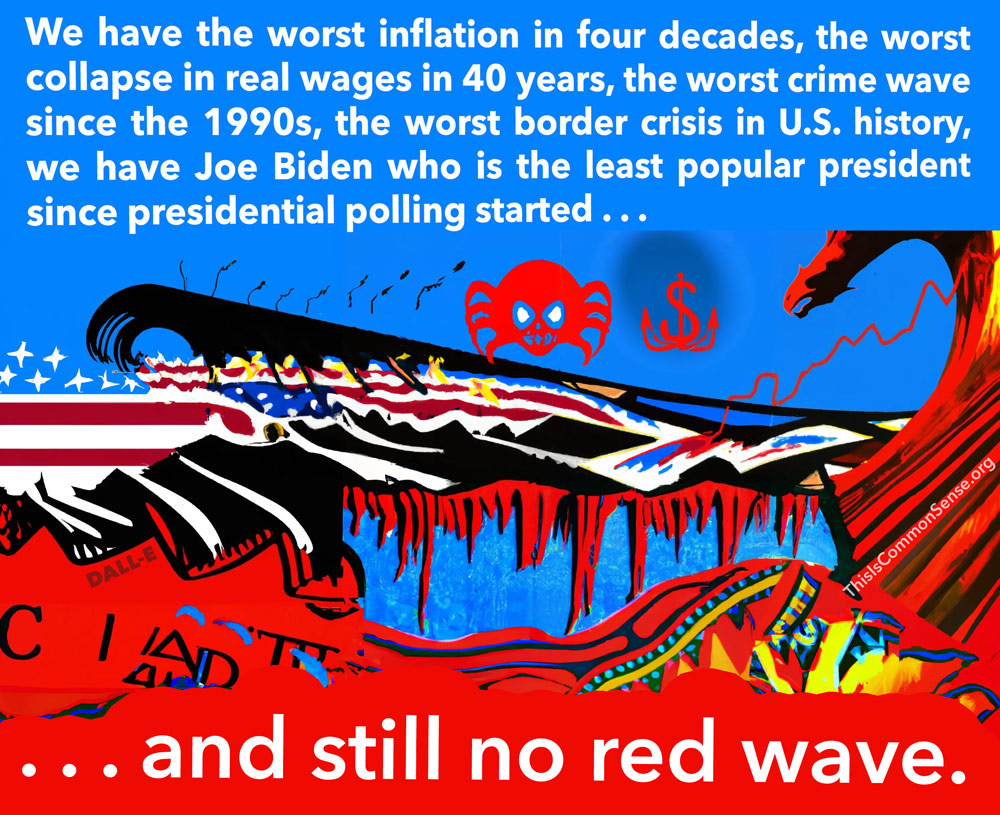
“We have the worst inflation in four decades, the worst collapse in real wages in 40 years, the worst crime wave since the 1990s, the worst border crisis in U.S. history, we have Joe Biden who is the least popular president . . . since presidential polling happened,” Washington Post columnist Marc Thiessen explained on Fox News, “and there wasn’t a red wave.”

Barely a ripple.

Voters, he continued. “looked at all of that and looked at the Republican alternative and said, ‘No, thanks!’”

Calling it “an absolute disaster,” Thiessen advised the GOP to do a “a really deep introspective look in the mirror right now.”

Watch for cracks.

More than the abortion issue or the mixed blessing of Mr. Trump’s omnipresence, I think the GOP’s problem was the lack of any serious, cohesive and positive agenda. We are indeed facing massive inflation, crime, cultural revolution . . . but what are you going do ’bout it?

Answers aren’t coming from the Republican Party.

In last year’s red wave across my home state of Virginia, it wasn’t now-Governor Glenn Younkin who made respecting the rights of the parents of public education students a cataclysmic issue. Parents did that.

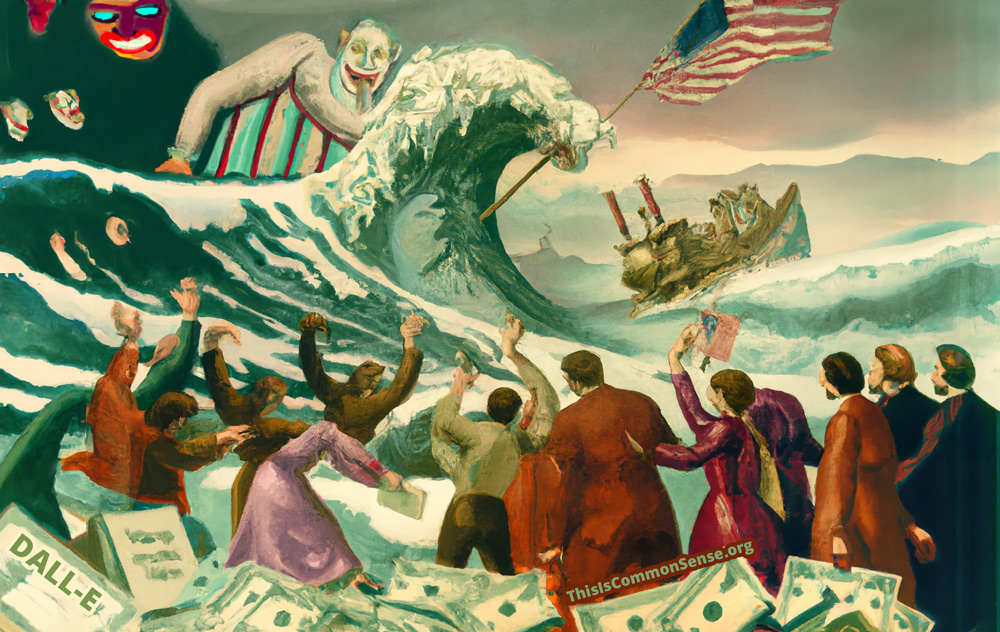
The Republican Revolution of 1994 rode a tsunami produced in no small part by the term limits movement. With term limits measures on the ballot throughout the country, the GOP gained 52 seats to secure a majority after 40 consecutive years in the minority — even defeating the Democratic House Speaker. 

Want candidates to ride a popular, pro-freedom wave? 

Better start splashing.

This is Common Sense. I’m Paul Jacob.


PDF for printing

Illustration created with DALL-E

See all recent commentary
(simplified and organized)
See recent popular posts