Categories
ballot access national politics & policies

The State of X and Y

“I was born without representation, but I swear,” Washington, D.C., Mayor Muriel Bowser vowed last week, “I will not die without representation.”

She has a point: 700,000 D.C. residents lack a voting representative in Congress. 

On Friday, the U.S. House passed legislation — 232 to 180 with 19 members hiding in the cloakroom and refusing to vote — to make the nation’s capital city the 51st state. Not merely garnering a U.S. Representative, but also a lifetime guarantee of two U.S. Senators. 

“D.C. will never be a state,” counters President Trump, explaining that Senate Republicans would be “very, very stupid” to allow two new U.S. Senators who are nearly certain to be Democrats. Senate Majority Leader Mitch McConnell quickly announced the Senate would not take up the bill.

But Republicans are not the only ones blocking representation. 

As Rep. Andy Harris (R-Md.) pointed out, Maryland had originally ceded some of the land to create the federal District of Columbia, and could now take back the residential areas. Those citizens would add their own House rep for Maryland and be represented by Maryland’s two U.S. Senators.

Democrats refuse. Why? Because it is not about representation. The city must be turned into a state so that two new Democratic U.S. Senators can be pulled out of a hat.

There is yet another path to representation. Make a bi-partisan deal to add two states. In addition to the State of Columbia (51), add the State of Jefferson (52) — comprised of 21 northern counties trying to secede from the rest of California. 

Better representation. No partisan advantage. Problem solved.

If anyone were interested in that.

This is Common Sense. I’m Paul Jacob.


PDF for printing

See all recent commentary
(simplified and organized)
See recent popular posts
Categories
media and media people national politics & policies

Q & A & Q & A

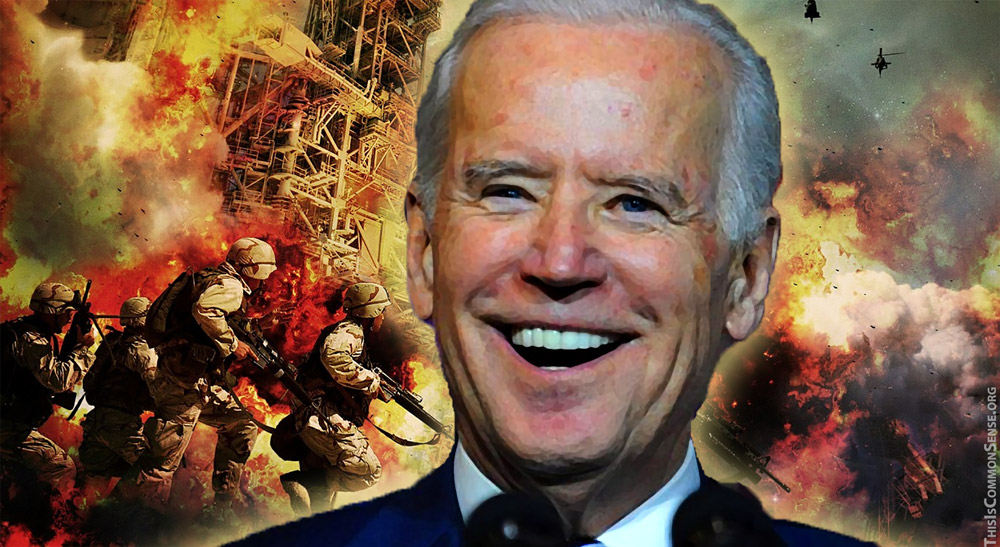
Trevor Noah, interviewing presidential candidate Joe Biden a while back, had a juicy question near the end of his “Daily Social Distancing Show” with the Democrat pol. “Have you ever considered what would happen if the election result came out as you being the winner and Trump refused to leave?”

“Yes I have,” Biden confidently stated.

Then there is an obvious cut, and the video switches from side-by-side video-chat panels to the comedian in a Picture-in-Picture box with a full-screen Biden saying all the sudden:

And I was so damned proud. Here you have four chiefs of staff coming out and ripping the skin off of Trump. You have so many rank-and-file military personnel saying ‘whoa, we’re not a military state, this is not who we are.’ I promise you — I am absolutely convinced — that they will escort him from the White House with great dispatch.

This is hacky. Not stand-up comedian hacky — political hacky.  

Its function is transparent, being primarily a self-programing technique, which — in recent times — partisans use to convince themselves that their enemies, in this case the Evil Republicans, will stoop to anything

Allowing them to stoop to anything.

The crowning case of this idiocy came in 2016, when Democrats worked themselves into a frenzy over Trump’s flip answer to the debate question whether he would ‘absolutely accept the results of this election.’ 

Hillary Clinton grinned triumphantly when Trump gave his non-canned, iffily defiant response. Very Trumpian. 

But after Election Day, Clinton’s followers spent months and then years not accepting the results of the election. 

Clinton’s lingering Cheshire Cat smile rebukes her party.

And persistent questions like Trevor Noah’s.

This is Common Sense. I’m Paul Jacob.


PDF for printing

See all recent commentary
(simplified and organized)
See recent popular posts

Categories
international affairs national politics & policies

Twelve Monkeys in Charge?

Dr. Anthony Fauci, current director of the National Institute of Allergy and Infectious Diseases, served as a leader on the “Global Vaccine Plan” through partnership with the Bill and Melinda Gates Foundation.

Bill Gates, late of Microsoft, Inc., is on record desiring to make a future coronavirus vaccine mandatory for travel . . . and to institute tracking of everyone’s interactions.

After the Obama Administration pressured National Institutes of Health to put a moratorium on “gain of function” research of coronavirus in America, according to Newsweek, Dr. Fauci devoted over $7 million to that very research . . . in Wuhan, China.

The idea? To see if the coronavirus in bats could migrate into humans, using ferrets and other animals to cajole the virus to “gain function,” i.e. transmissibility.

The goal being to prepare vaccines in advance of naturally occurring jumps over the barrier between humans and other animals.

But many scientists regard this kind of research to be morally questionable. 

And 12 Monkeys dangerous. 

In the midst of all this has been one Dr. Charles Lieber, a 61-year-old nanoscience researcher, who recently “has been indicted by a federal grand jury on two counts of making false statements and will be arraigned in federal court in Boston at a later date.  Lieber was arrested on Jan. 28, 2020, and charged by criminal complaint.” He allegedly lied about his relationship with China’s Thousand Talents Plan and his role as a “Strategic Scientist” at Wuhan University of Technology in China.

Where SARS-CoV-2 — the coronavirus of the current pandemic — apparently came from.

Nanoscience is the engineering of really, really small stuff. Like strands of RNA and DNA and . . . viruses.

Does this induce confidence about that vaccine allegedly in the offing?

This is Common Sense. I’m Paul Jacob.


PDF for printing

See all recent commentary
(simplified and organized)
See recent popular posts

Categories
First Amendment rights national politics & policies too much government

A Modest Extrapolation

The big news from yesterday’s Supreme Court decisions (in June, they typically come in chunks) regards discrimination law, in which the court decided, 6-3, with Neil Gorsuch writing the majority opinion, that discrimination “against an employee for being gay or transgender violates the Civil Rights Act of 1964.” As covered at Reason it makes for fascinating reading.

Still, there are many problems here. The whole employment discrimination issue assumes that people have a right to be judged suitable for employment based only on strict consideration of job performance.

This is intrusive into private decision-making, and opens up hiring and firing to huge legal costs.

But a bigger issue lurks here.

It is now commonplace for employees to be fired under public pressure for merely having political opinions that have little or nothing to do with their jobs.

Anti-discrimination civil rights law was designed to curb this sort of thing — public pressure for reasons of antipathy and social mania — but only on a limited number of criteria, racism and sexism against protected groups being the areas carved out.

Since we have a First Amendment right to speak, mightn’t that right be applied via discrimination law to prohibit mob deplatforming or resulting loss of employment?

Sure, 1964’s Civil Rights Act limited the scope of its intervention into employment contracts and the “public accommodations” realm of commerce to the above-mentioned isms, on grounds of a long history of bigotry and invidious private discrimination. But right now, that sort of discrimination is primarily an ideological matter, not racial or sexual. 

Extending the scope of the First Amendment via an anti-discrimination rationale would seem a natural.

At least for those who favor consistent government intervention over freedom. 

This is Common Sense. I’m Paul Jacob.


PDF for printing

See all recent commentary
(simplified and organized)
See recent popular posts
Categories
crime and punishment national politics & policies

Police Incentives Matter

“For every bullet the German police fired on duty in 2016, American police killed 10 people,” writes Jason Brennan for MarketWatch. “Even overwhelmingly white states like Wyoming and Montana imprison citizens at higher rates than authoritarian Cuba.”

What is going on here?

And by here I mean “these United States of America.”

Well, Brennan, who is the Robert J and Elizabeth Flanagan Family Professor of Strategy, Economics, Ethics, and Public Policy at Georgetown University’s McDonough School of Business, has an answer.

“What matters even more than black and white is green,” he writes, referencing the current protests and riots sparked by coverage of the George Floyd killing by Minneapolis police. “Fixing our criminal justice system means fixing the incentives.”

Professor Brennan points the finger at a number of federal programs:

  • The 1981 Military Cooperation with Law Enforcement Act “authorized and incentivized the U.S. armed forces to train police in military tactics” while the 1990 National Defense Authorization Act established a pipeline from the military industrial complex to local police forces.
  • The drug war set up police theft of private property via civil asset forfeiture, and encouraged federal drug warriors to share the loot with local police departments.
  • In many localities, direct election of prosecutors leads to campaign boasts about prosecution stats and long sentences, even when these policies make us less safe.

There’s a lot here to mull over, and you may not agree with everything Brennan argues, but the basic point is quite clear: “Even if we magically erased all racism overnight, the U.S. would still be harsh and violent” — and that because our politics has skewed incentives all wrong.

Getting rid of programs and laws that disincentivize good policing is a must.

This is Common Sense. I’m Paul Jacob.


PDF for printing

See all recent commentary
(simplified and organized)
See recent popular posts
Categories
free trade & free markets national politics & policies

President Goes Postal?

A bullying bull in a China shop?

“President Donald Trump is taking another swipe at China,” Jen Kirby wrote for Vox back in 2018, “by ripping up an international treaty that’s more than a century old.”

We’re talking about the Universal Postal Union — or UPU. “At 144 years old, the UPU is one of the oldest intergovernmental agencies,” she explained. 

“The organization made possible the international mail system,” offered Washington-based attorney and UPU expert Jim Campbell. 

Wellesley College Professor Craig Murphy, “an international organizations expert,” called Trump’s threat “absurd.”

“It makes the international postal system run smoothly,” explained Kirby, “it’s the reason why you can get a package from South Africa or a postcard from your aunt on vacation in Bali.”

So why gum up the efficient delivery of letters and packages?

“Trump does have a legitimate gripe,” Kirby abruptly changed tone, “and administrations going back to Ronald Reagan have voiced similar complaints about the UPU.” 

But did nothing about it.

“Countries like China that were developing nations in 1969 . . . still pay the U.S. Postal Service a pittance to deliver mail,” Foreign Policy’s Keith Johnson clarifies, which “means that Chinese firms had a tiny edge in shipping goods to the U.S. market — making the Postal Service pick up much of the tab for actually delivering the package, even while costing U.S. firms potential sales.”

“Tiny edge”

Bull.

“[I]t’s actually cheaper to ship some products from certain places overseas to the US,” Kirby acknowledged, “than it is to deliver something between New York and Kansas.”

The gripe? 

The “disproportionately dramatic response . . . reveals the White House’s obsession with what it sees as China’s unfair advantage in global trade.”

Yet, this is an unfair advantage. 

Er, well . . . was

This is Common Sense. I’m Paul Jacob.


PDF for printing

See all recent commentary
(simplified and organized)
See recent popular posts
Categories
Accountability national politics & policies

Up, Up and Away?

The new U.S. Space Force wants “flexibility.” It has requested from Congress the ability to purchase and use satellites and other developing technology with agility.

That is, it wants permission to follow an “alternative acquisition system” — as explained in a “23-page report to Congress from the U.S. Air Force, the current parent of the Space Force,” according to Ed Adamczyk for United Press International. Adamczyk says that “Congress mandated a retooling of the Space Force acquisition system when it created the new branch of the military in December.”

What the new Space Force yearns for certainly looks like off-budget funding of technological assets. 

The official wording speaks of a reduction in “space portfolio constraints via incremental funding,” which Adamczyk explains as an “expanded ability to pay for space systems without regular oversight or constant requests for congressional approval.” 

That, he writes, “is a constant in the report.”

The point? To “rapidly leverage industry innovation to outpace space threats.” 

While it is popular in ‘paranoid’ circles to warn of ‘one world government’ threats to form a ‘new world order,’ this is transparently a push to effect a breakaway above-world government that sure would change the balance of world power.

Scurrying further down a long and winding rabbit hole, it might also be a way to legitimize currently unconstitutional military-industrial complex programs, perhaps part of the black budget Pentagon/HUD double-digit unaccounted-for spending and income. 

Space Force is ambitious. Good. But it craves scant constraint from Congress.

Not to mention the citizens of these earthbound United States. 

Not good.

This is Common Sense. I’m Paul Jacob.


PDF for printing

See all recent commentary
(simplified and organized)
See recent popular posts

Categories
general freedom ideological culture national politics & policies

Masks Work

Early in this pandemic, experts — including CDC officials — told us that if you aren’t a medical worker dealing with infected patients, wearing a mask is ineffective in protecting yourself and others.

Many reversed themselves, though without honestly explaining why they had ever downplayed the value of masks to begin with. Masks are even now mandatory some places.

But we still hear naysayers who declare masks to be pointless.

One blithely declares: “The main transmission path is long-residence-time aerosol particles (< 2.5 μm), which are too fine to be blocked.” That’s less than 2.5 micrometers. A micrometer is one millionth of a meter. Yes, small.

But “too fine to be blocked”?

A properly worn mask need not be 100% effective to block tiny particles. Viruses do not fly unerringly through holes and gaps in the mask. They have no guidance system and no little legs enabling them to scamper to a hole if it hits fabric. 

Nor is the virus invariably unattached to larger particles. 

Obviously, the better the filtering, the more effective the mask.

Suppose you go to a supermarket and 

  1. wear a mask, 
  2. try to keep your distance from others, 
  3. go when fewer people tend to be shopping, and 
  4. leave fast. 

All pointless?

Short of wearing a hazmat suit or never leaving a one-resident home, no protective measure will be 100 percent effective all the time, infallibly. This doesn’t mean that partly effective measures should be dismissed as entirely ineffective. 

A part of something is, well, not zero.

This is Common Sense. I’m Paul Jacob.


PDF for printing

mask, filter, coronavirus, Covid, pandemic, epidemic,

See all recent commentary
(simplified and organized)
See recent popular posts
Categories
nannyism national politics & policies too much government

Regs to the Chopping Block

Donald J. Trump started his presidency with a flurry of activity. One of the things he did was sign an executive order to reduce Americans’ regulatory load.

This move may have been the most important initiative the new president advanced. It led to an economic boom that was not all just smoke and mirrors and “stimulus.” Real factors were involved in the resulting progress.

Now, however, the economy is in tatters. Massive unemployment, rising real poverty. 

But this is not a normal depression. It was the result of the reaction to the coronavirus — largely by the states, but at the recommendation of Trump himself, as advised by Dr. Anthony Fauci. Trump now wants what increasing numbers of Americans want: a return to business and normal life. But “re-opening the economy,” as it is called, is not going quickly or smoothly.

On Tuesday Trump signed an executive order to give his Cabinet secretaries broad permission to cut regulations, “instructing federal agencies to use any and all authority to waive, suspend and eliminate unnecessary regulations that impede economic recovery.”

“And we want to leave it that way.” 

Which is the most promising part of this. 

“Mr. Trump has made nixing regulations,” explains John T. Bennett in The Independent, “especially ones put in place by the Obama administration, a top priority during his over three years in office.”

We could call the nixing of the lockdown orders themselves a “freeing up” of the economy. To help ease over all the damage, also “freeing up” business from regulatory kludge could not hurt.

This is Common Sense. I’m Paul Jacob.


PDF for printing

chopping block, regulations,

See all recent commentary
(simplified and organized)
See recent popular posts

Categories
national politics & policies too much government

The Rationale Has Ended

Early on, we feared the worst. Based in no small part on the extravagant predictions of serial alarmist/lockdown scofflaw Neil Ferguson, a British epidemiologist, the worry quickly became: our hospitals will be swamped!

To prevent that, governments around the world 

  1. instituted lockdown orders, shutting down most commerce and peaceable assembly, to “flatten the curve,” thereby postponing many incidents of coronavirus and giving hospitals a steadier workload over time; and
  2. set up emergency clinics and hospitals, to take on overflow.

In the U.S., the Army Corps of Engineers contracted with private companies to set up field hospitals. Given the alarmist talk of “exponential growth,” that sure seemed like a prudent use of $660 million.

Now?

Well, most never saw a patient.

Many field hospitals are being dismantled.

And so is the case for the lockdowns: the hospitals are generally not being swamped, which means that as summer approaches we can open things up and let herd immunity build up.

Indeed, we may already have reached that condition, according to Nic Lewis writing on Judith Curry’s Climate Etc. blog. 

At issue is the “Herd Immunity Threshold” (HIT). The disgraced Ferguson’s original HIT was over 50 percent, while Lewis argues that the actual HIT level “probably lies somewhere between . . . 7% and 24%,” suggesting that “total fatalities should be well under 0.1% of the population by the time herd immunity is achieved.” 

Why the lower HIT? 

More realistic models take into account human diversity — a point also made by economist Daniel B. Klein, who adds important truths like “[f]or most people COVID-19 is scarcely a disease at all!”

It turns out that being reasonable about this pandemic requires neither complete gloom and doom nor risky response.

This is Common Sense. I’m Paul Jacob.


PDF for printing

hospital, bed, pandemic, corona virus, Covid, lockdown,

See all recent commentary
(simplified and organized)
See recent popular posts